The most common antibiotics for dogs side effects are diarrhea, vomiting, reduced appetite, and a disruption of the gut microbiome that outlasts the prescription itself. In one study of 22 dogs given a seven-day course of metronidazole, bacterial diversity stayed suppressed for up to three days after the final dose, and an altered gut community persisted for four to six weeks before returning to baseline. Antibiotics save lives when a real bacterial infection is present. The problem is how often they are given when one has not been confirmed.
Here is the line I want you to hold onto: an antibiotic is not a neutral decision, it is a trade, and you are allowed to ask what you are trading before you agree to it.
I learned that the hard way, and it took me years to connect the dots.
In this article
- What are the most common antibiotics for dogs side effects?
- Are antibiotics overprescribed in dogs?
- What does the research actually say about antibiotics for dog diarrhea?
- Is metronidazole safe for dogs?
- How long does it take for a dog's gut to recover after antibiotics?
- The two questions to ask before you accept an antibiotic
- What can you do to support your dog through a course of antibiotics?
- Keep a record, because you will forget
- Which support fits your dog right now?
- The honest bottom line
What are the most common antibiotics for dogs side effects?
They fall into two groups, and the second group is the one almost nobody warns you about.
During the course, or within days of it:
- Loose stool or diarrhea
- Vomiting or nausea
- Reduced appetite
- Lethargy
- Yeast overgrowth as bacteria are cleared out
Weeks to months after the course has finished:
- Loose or inconsistent stool that seems to come out of nowhere
- New food sensitivities
- Recurring ear or skin flare-ups
- A dog who seems generally off with no obvious trigger
That second list is the reason so many pet parents end up blaming a new food. The timeline has stretched far enough that the antibiotic is no longer a suspect.
Are antibiotics overprescribed in dogs?
Let's be real for a second. This is not about blaming your vet.
But the numbers are worth knowing. In a 2025 point-prevalence survey published in the Journal of the American Veterinary Medical Association, researchers looked at 478 dogs and cats prescribed an antibiotic to address an infection across US primary care and referral practices. Only 13.4% of those animals had bacterial culture and susceptibility testing done.
Read that again. Fewer than one in seven.
That means the overwhelming majority of antibiotic prescriptions in companion animal medicine are empirical, meaning based on clinical judgment and best guess rather than on a test that identifies which bacteria are actually present and which drug will work against them.
Sometimes a best guess is the right call. In an emergency, waiting 48 hours for a culture result is not an option. But "we did not have time to test" and "we did not think to test" are two very different situations, and only one of them is happening in most exam rooms.
What does the research actually say about antibiotics for dog diarrhea?
This is where the picture gets uncomfortable, because diarrhea is the number one reason dogs go home with antibiotics.
A 2020 placebo-controlled trial in the Journal of Veterinary Internal Medicine looked at dogs with uncomplicated acute diarrhea given amoxicillin-clavulanate versus placebo. The dogs on the antibiotic recovered no faster than the dogs on the placebo. What did change was resistance: the proportion of amoxicillin-resistant E. coli in their stool climbed sharply during the course and was still elevated three weeks after it ended. The authors noted these findings line up with international guidance that dogs with diarrhea should not receive antimicrobials in the absence of signs of sepsis.
Metronidazole, the drug most pet parents in our community ask us about, has two trials that disagree with each other, and I am going to show you both rather than the one that suits my argument.
- A 2020 randomized, double-blinded, placebo-controlled trial found dogs on metronidazole resolved in an average of 2.1 days versus 3.6 days on placebo. The authors were careful to add that most dogs recover within a few days regardless of what you give them.
- A 2019 trial in Frontiers in Veterinary Science ran three arms across 60 dogs: probiotic, metronidazole, and placebo. Resolution took 3.5 days with the probiotic, 4.6 days with metronidazole, and 4.8 days with placebo, with no statistically significant difference between any of the groups.
So the honest summary is this: for uncomplicated acute diarrhea, the evidence for antibiotics ranges from "no measurable benefit" to "maybe a day and a half sooner," in a condition most dogs resolve on their own anyway. That is a very different conversation than the one most of us have at the counter.
Is metronidazole safe for dogs?
Metronidazole has a place. It also has a label most pet parents never see, because the tablets usually come out of the blister pack and into a paper envelope.
The FDA-approved labeling for metronidazole in humans opens with a boxed warning stating the drug has been shown to be carcinogenic in mice and rats, and that unnecessary use of the drug should be avoided. I want to be precise about what that does and does not mean. That warning is on the human label, based on rodent studies at chronic dosing. It is not a finding about dogs, and I am not telling you metronidazole causes cancer in your dog. What it does tell you is that the regulator's own language on this drug is "avoid unnecessary use," which is a striking thing to read about a medication handed out this routinely.
Worth knowing: most metronidazole use in dogs is off-label. The only FDA-approved veterinary metronidazole product is Ayradia, approved in 2023 specifically for Giardia duodenalis in dogs.
The neurological side effects are the ones I want you to be able to recognize. Veterinary neurology reviews describe metronidazole toxicity as mainly related to cumulative dose and duration of therapy, presenting as ataxia (loss of coordination), a wobbling or drunken gait, head tilt, abnormal eye movements, and in some cases seizures. These signs are usually reversible when the drug is stopped promptly.
Years ago we shared a short video with veterinary oncologist, Dr. Kendra Pope about this drug, and a viewer left a comment I have never been able to forget. Her dog was on a long metronidazole course, lost the ability to walk, developed seizures, and was seen by two emergency vets who attributed it to a back injury and then to a brain problem. She lost him. Days later, her original vet called to say the dose and duration had been too long and the signs were a drug reaction.
I am not sharing that to frighten you or to make a villain out of anyone in that story. I am sharing it because if she had known the words "ataxia" and "cumulative dose" beforehand, the conversation in that emergency room might have gone differently. That is the entire reason this post exists.
How long does it take for a dog's gut to recover after antibiotics?
Somewhere between a few weeks and a couple of months for most dogs, depending on the drug, and longer if the gut was already struggling.
Here is what the research shows rather than the vague "three to six months" figure that gets repeated online without a source:
| Antibiotic | What the canine research found |
|---|---|
|
Metronidazole 7-day course, 22 dogs, 2024 |
Diversity suppressed up to 3 days past the last dose, altered community for 4 to 6 weeks, back to baseline by 6 months |
|
Amoxicillin-clavulanate 2020 |
Resistant E. coli still elevated 3 weeks after the course ended |
|
Tylosin 7-day course, healthy dogs |
Altered abundance of some species still present at 8 weeks, with at least 2 months suggested for full restoration |
Two things matter here. First, "back to baseline" is a population average, and your dog is not an average. A senior dog, a puppy whose microbiome is still assembling, or a dog on their fourth course this year does not recover on the same timeline as a healthy adult on their first. Second, the gut is where a huge share of immune activity lives, which is why the fallout so often shows up somewhere else entirely. I wrote about that connection in detail in our guide to dog gut health and why it drives whole-body wellness.
And when courses stack up over years, the concern moves from the microbiome to the barrier itself, which is the territory covered in our post on leaky gut in dogs and how to support the gut lining.
The two questions to ask before you accept an antibiotic
This is the part I want you to save to your phone. It came from a conversation years ago with Julie Anne Lee, DCH, the holistic animal homeopath behind Adored Beast, and it has changed how I walk into every appointment since. You can hear the full conversation in our podcast episode on antibiotics and how to advocate for your pet.
Before you agree to the prescription, ask:
- Is this a life-threatening situation?
- Is this an emergency situation?
If the answer to both is no, you have time. Not weeks, necessarily, but time. Time to ask for a culture and sensitivity test so the drug matches the actual organism. Time to get a second opinion. Time to start supporting your dog's body while you decide.
And if the answer to either is yes, then give the antibiotic. That is what it is there for. This framework is not an argument against the medication. It is a filter that separates the cases where the trade is obviously worth it from the cases where nobody stopped to check.
A third question is worth adding when the answer to the first two is no: can we do a culture and sensitivity test first? That is the test only 13.4% of animals in that JAVMA survey received. It identifies which bacteria are present and which drug they respond to. Pet parents often worry they are paying twice. You are not. You are paying once for the right answer instead of twice for the wrong one.
What can you do to support your dog through a course of antibiotics?
If your dog genuinely needs the medication, give it, finish it, and support the body alongside it. Here is where I want to be straight with you about how solid the evidence is for each piece, because most articles present all of this with equal confidence and it does not deserve equal confidence.
Tier one: good evidence.
Probiotics. Human trials consistently support giving probiotics alongside antibiotics to lower the risk of antibiotic-associated diarrhea, and the strongest canine signal we have is that 2019 three-arm trial where the probiotic group resolved fastest, even though the difference did not reach significance. A species-specific canine probiotic like Fido's Flora is our daily baseline, and when the gut is actively unsettled, Gut Soothe pairs probiotics with soothing herbs. Trials that showed benefit generally started the probiotic within a day or two of the antibiotic and continued for seven to fourteen days afterward.
What we use during a course
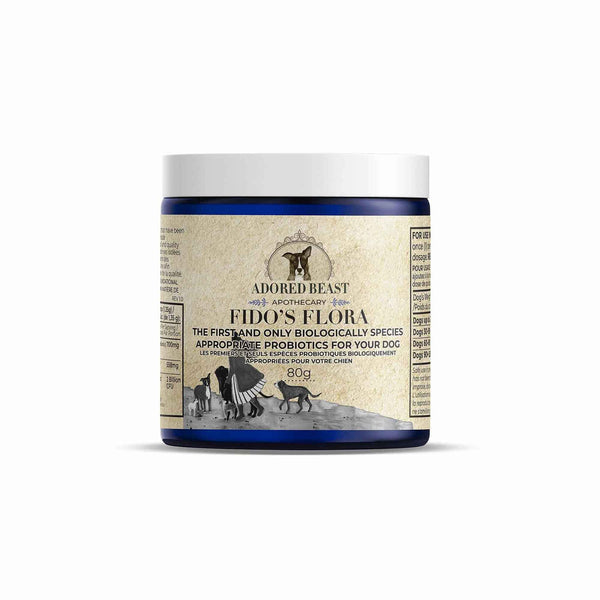 |
Fido's Flora, Canine Specific Pre & Probiotic4.9 out of 5 from 36 reviews A 16-strain blend built around two canine-specific strains, paired with a larch prebiotic and fulvic and humic acids. This is the one I reach for when a dog is on medication, because the strains were selected for dogs rather than borrowed from a human formula. Shop Fido's Flora |
On timing, here is something you will not read on competitor sites: the International Scientific Association for Probiotics and Prebiotics states plainly that no studies have compared different dosing schedules, so the optimal gap between an antibiotic and a probiotic is genuinely unknown. Most articles state "two hours" as settled fact. It is not. Julie's clinical preference is six hours. Both are reasonable practice, neither is proven, and the far more important variable is that you give the probiotic at all rather than waiting until the course is over.
Tier two: reasonable, with honest caveats.
Liver support. Every drug your dog takes passes through the liver. A 2021 study in BMC Veterinary Research found that silybin supplementation lowered ALT, AST, and GGT in dogs, including dogs with an existing liver disorder. The caveat: that study was not run during antibiotic courses, so we are reasoning from mechanism, not from direct evidence. Liver Tonic is what we keep in the cupboard for this.
One warning from our own experience, because I would rather you learn it from me than from a bloodwork panel. When Milka's ALT came back elevated around age eight, we did what a lot of well-meaning pet parents do and stacked several liver and detox products at once. Her next panel came back higher. We backed off to Liver Tonic alone, and her ALT normalized. Support and detox are not the same thing, and more is not better.
Food and hydration. Bone broth over meals adds moisture and gut-supportive amino acids, and it tempts a dog who has gone off their food. Our beef bone broth is the easy version of this.
Tier three: traditional practice, no canine evidence.
Julie also recommends the homeopathic remedy nux vomica alongside any drug. I am including it because she is one of the most experienced holistic veterinary professionals I know and I am not going to pretend she did not say it. I am also going to tell you honestly that I could not find canine research supporting it. That is her clinical experience, offered as clinical experience, and you can weigh it as such.
Keep a record, because you will forget
One more thing worth doing, and it costs nothing.
Keep a simple note of every antibiotic your dog has been given, when, for what, and how they responded. If your dog reacted badly to a drug, that belongs in writing, because at the next appointment you can say "not that class, please" instead of trying to remember the name of something from three years ago.
The reason this matters more than it sounds: side effects rarely announce themselves on schedule. A dog gets a course in March, and in June there is loose stool that nobody connects to March. The food gets blamed. The new chews get blamed. Meanwhile the microbiome is still finding its footing.
Which support fits your dog right now?
There are two different readers on this page, and they need different things. One of you has a prescription in your hand today. The other is months or years past the courses and still dealing with the aftermath. Here is how I would think about it.
| Fido's Flora | Leaky Gut Protocol | |
|---|---|---|
| Best for | A dog on a course now, or one healthy course behind them | A dog with repeated courses over years and lingering gut symptoms |
| What it does | Daily species-specific probiotic support | A staged 5-product system covering liver, enzymes, probiotics, and the gut lining |
| How long | Ongoing, daily | One kit, run to completion |
| Price | $55.99 (40g) or $99.99 (80g) | $109.99 (under 20 lbs) or $139.99 (over 20 lbs) |
| Shop Fido's Flora | Shop the Leaky Gut Protocol |
If the courses have stacked up
 |
Leaky Gut Protocol4.9 out of 5 from 21 reviews When the courses have stacked up over years, a daily probiotic on its own is doing a big job with one tool. This is the staged version: Rebalancer first, then Liver Tonic, Healthy Gut, Gut Soothe, and Gut Seal together, formulated by Julie Anne Lee, DCH. It covers the liver, the microbiome, and the gut lining in one sequence rather than leaving you to assemble it yourself. Shop the Leaky Gut Protocol |
The honest bottom line
Antibiotics are one of the great tools in medicine, and there will be a day when one saves your dog's life. Nothing here is an argument against that day.
What I want for you is the version of the exam room where you are a participant instead of a passenger. Where you know that fewer than one in seven prescriptions comes with a culture. Where you know that the research on antibiotics for uncomplicated diarrhea is thin at best. Where you can ask two questions without feeling rude, and support your dog's gut and liver alongside a course you have decided is genuinely necessary.
You are not being difficult. You are being your dog's advocate, and a good vet will meet you there.
Much love, Larry
Sources
- Measurement of antibiotic use in cats and dogs presenting to US primary care and referral practices provides insights for antimicrobial stewardship. Journal of the American Veterinary Medical Association, 2025. https://pubmed.ncbi.nlm.nih.gov/39879662/
- Werner M, et al. Effect of amoxicillin-clavulanic acid on clinical scores, intestinal microbiome, and amoxicillin-resistant Escherichia coli in dogs with uncomplicated acute diarrhea. Journal of Veterinary Internal Medicine, 2020. https://onlinelibrary.wiley.com/doi/10.1111/jvim.15775
- Langlois DK, et al. Metronidazole treatment of acute diarrhea in dogs: a randomized double blinded placebo-controlled clinical trial. Journal of Veterinary Internal Medicine, 2020. https://pubmed.ncbi.nlm.nih.gov/31742807/
- Shmalberg J, et al. A randomized double blinded placebo-controlled clinical trial of a probiotic or metronidazole for acute canine diarrhea. Frontiers in Veterinary Science, 2019. https://www.ncbi.nlm.nih.gov/pmc/articles/PMC6593266/
- Marshall-Jones ZV, et al. Conserved signatures of the canine faecal microbiome are associated with metronidazole treatment and recovery. Scientific Reports, 2024;14:5277. https://www.nature.com/articles/s41598-024-51338-7
- FDA-approved labeling for metronidazole tablets (boxed warning). US Food and Drug Administration. https://www.accessdata.fda.gov/drugsatfda_docs/label/2010/012623s061lbl.pdf
- FDA approves first treatment for Giardia duodenalis in any animal species (Ayradia). FDA Center for Veterinary Medicine, 2023. https://www.fda.gov/animal-veterinary/cvm-updates/fda-approves-first-treatment-giardia-duodenalis-any-animal-species
- Metronidazole: uses, toxicity and management of neurologic sequelae. dvm360, summarizing Evans et al., Journal of Veterinary Internal Medicine. https://www.dvm360.com/view/metronidazole-uses-toxicity-and-management-neurologic-sequllae
- Probiotic use alongside antibiotics: a guide to clinical FAQs. International Scientific Association for Probiotics and Prebiotics, 2024. https://isappscience.org/wp-content/uploads/2024/12/ISAPP-Clinician-resource-probiotic-use-alongside-antibiotics.pdf
- Kolodziejski PA, et al. Effects of silybin supplementation on nutrient digestibility, hematological parameters, liver function indices, and liver-specific mi-RNA concentration in dogs. BMC Veterinary Research, 2021. https://pubmed.ncbi.nlm.nih.gov/34174886/
- D'Angelo S, et al. Effect of Saccharomyces boulardii in dogs with chronic enteropathies: double-blinded, placebo-controlled study. Veterinary Record, 2018;182(9):258. https://pubmed.ncbi.nlm.nih.gov/29212912/
Disclaimer: This blog may contain affiliate links, and PAWDEGA may earn a small commission at no extra cost to you if you purchase through them. It may also link to products on our website, and this content is for educational purposes, not a replacement for veterinary advice.