If your dog is scared of fireworks and thunderstorms, the single most useful change you can make is timing. Support given ahead of a known event works very differently from anything handed to a dog who is already panicking, and the research on noise fears in dogs says the same thing the label on every calming product says: get in front of the fear rather than chase it. The weeks beforehand matter too, and most of what helps there costs nothing at all.
Noise fear in dogs is far easier to stay ahead of than to reverse mid panic, which is why the hours before fireworks start matter more than anything you do once they have begun.
In this article
- Why is my dog scared of fireworks and thunderstorms?
- Does noise phobia in dogs get worse every year?
- What are the signs most pet parents miss?
- Could pain be behind a sudden new fear?
- What actually works, according to the research?
- What should I be doing in the weeks before?
- What do I do on the night itself?
- Does hemp oil help a dog scared of fireworks?
- When should I ask my vet about medication?
- How long before I see a difference?
Why is my dog scared of fireworks and thunderstorms?
Because a firework is loud, sudden, unpredictable, and attached to nothing your dog can make sense of. There is no pattern to learn. No warning. No way to make it stop.
Noise fear is the most common behaviour problem in dogs, and between a quarter and half of the pet dog population is affected depending on which survey you read. Fireworks top the list of triggers, with thunder next, then gunshots. In one survey of 1,225 dog owners, 52 percent of dogs were at least partly frightened by fireworks.
Thunderstorms add layers that fireworks do not have. Falling pressure, static charge, the change in light, the smell of rain coming. Plenty of dogs are anxious long before the first rumble, which is why storm fear so often looks like a dog who decided to be strange that afternoon for no reason.
There is also a real genetic component. Breed and breed group both show up in the data, and heritability estimates for noise sensitivity sit above 0.2. So no, you did not cause this. And the number of positive social experiences a dog had as a puppy is one of the strongest factors linked to lower noise fear later, which tells you something useful about where the leverage actually sits.
Does noise phobia in dogs get worse every year?
Not necessarily, and this is the finding I wish more pet parents knew.
When owners were asked how their dog's firework fear had changed over recent years, 39 percent said it had improved, roughly a third said it had stayed the same, and around 26 percent said it had worsened. Fear of fireworks is not a one-way road. It moves in both directions, and owners who had done some training with their dog were more likely to be in the improving group.
Most of it starts young. Around 45 percent of affected dogs show signs before their first birthday, and a brand new fear appearing after six years of age is uncommon. Recovery after an event is usually quick, with about three-quarters of fearful dogs back to themselves by the next morning. But not all of them. In that same survey, 10 percent took up to a day, 12 percent took up to a week, and a small group took several weeks or months.
That last group is the reason I take one bad New Year seriously rather than writing it off.
What are the signs most pet parents miss?
Everyone recognizes the obvious ones. Shaking, hiding, pacing, barking, a dog trying to dig through the bathroom floor.
The quieter signals get missed constantly:
- Panting when the room is not warm
- Lip licking, yawning, or repeated nose licking
- Refusing food they would normally sell you out for
- Clinginess, or the opposite, going very still and flat
- Needing to go out at odd hours, or accidents indoors
- Restlessness that starts hours before the storm arrives
Here is what most pet parents are never told: refusing high-value food is a reliable marker of significant stress. If your dog will not take the thing they would normally do backflips for, their fear is not mild, whatever their face is doing.
And this is measurable, not a matter of opinion. When researchers played a five-minute storm recording to 19 storm-fearful dogs at home, salivary cortisol rose by 207 percent, and it had not returned to baseline 40 minutes later. Your dog is not being dramatic. Their body is in a full physiological stress response, and it takes a long time to come back down.
Could pain be behind a sudden new fear?
This is the question almost nobody asks, and it matters enormously for older dogs.
Researchers at the University of Lincoln compared two small groups of noise-sensitive dogs, one with identified musculoskeletal pain and one without. The dogs in pain had developed their noise sensitivity on average nearly four years later in life, at around six and a half years old, compared with under three years in the pain-free group. They also formed much wider associations, avoiding the place where the noise happened and, in some cases, other dogs too.
The thinking is straightforward. A sore body tenses hard at a sudden bang, that tensing hurts, and the dog learns that the noise and the place it happened are both bad news.
So if your seven-year-old has suddenly become frightened of storms after years of sleeping through them, a physical exam comes before anything else. Please do not let anyone tell you an older dog has turned nervous with age. That is a sample of 20 dogs, so it is a signal rather than proof, but it is a signal worth acting on, because if pain is part of the picture, nothing else you do will hold.
What actually works, according to the research?
The largest comparison we have asked more than a thousand owners to rate what they had actually used for their dog's firework fears. Here is how the approaches ranked.
Scroll sideways to see the full table.
| Approach | Owners reporting it helped | How to read that |
|---|---|---|
| Reward after every bang | Over 70% | Highest rated of everything studied |
| Relaxation training | 69% | Free, underused, works year-round |
| Vet-prescribed anxiety medication | 69% | Backed by placebo-controlled trials |
| Sound recordings, graded slowly | 55% | Helps many dogs, not all of them |
| Pressure vest | 44% | Best of the non-prescription options |
| Herbal products | 35% | Inside the placebo range |
| Homeopathic remedies | 31% | Inside the placebo range |
| Pheromone collars and diffusers | 29% | Inside the placebo range |
| Calming supplements, all pooled | 27% | One pooled figure, no product detail |
Why the placebo range matters: in placebo-controlled veterinary studies, 30 to 50 percent of owners given a dummy product report that their animal improved. In one firework trial specifically, 37 percent of the placebo group rated the effect as good or excellent. So anything landing in the high twenties or low thirties is telling you very little on its own.
Two things to take from that table, and I am going to be straight with you even though I run a store that sells calming supplements.
First, the two highest-rated approaches cost nothing. They are what you do, not what you buy, and I would rather you did those than bought anything from me.
Second, read the bottom row carefully. That 27 percent pools every calming supplement on the market into one number. The author of that survey says plainly that no conclusions can be drawn about individual products from it, and it records nothing about which product, what dose, or when it was given. As you will see further down, dose and timing turn out to be exactly what separates the studies that found an effect from the ones that did not. A pooled average cannot see that, which is a limitation of the survey rather than a verdict on every bottle in it.
What should I be doing in the weeks before?
This is the part most people skip, and it needs a runway. Here is the sequence I would follow.
Scroll sideways to see the full table.
| When | What to do |
|---|---|
| 6 weeks out | Vet check for pain, start daily gut support |
| 6 weeks out, same day | Build the den, feed every meal near it |
| From day one, ongoing | Every real-life bang gets a reward, every time |
| 4 weeks out | Start relaxation training, five minutes daily |
| 3 weeks out | Add sound recordings, volume barely audible |
| 2 weeks out | Speak to your vet if last year was severe |
| 1 week out | Do a dry run of whatever you plan to give |
| The day itself | Walk early, feed early, check ID and microchip |
Three notes on that sequence.
The den is not a locked crate. It is a covered, soft, dark place your dog can enter and leave whenever they want, in a room with no windows if you have one. It earns its reputation in the weeks before, through meals and chews and good things happening there, not on the night when it is suddenly produced like a solution.
Rewarding after a bang is the whole game. Car door slams, a dropped pan, a distant firework in October. Noise happens, something delicious appears. Over and over. Owners rated this the single most effective thing they did, and it is the one you can start this afternoon for free.
The gut piece is the quiet one. The gut-brain axis is one of the fastest-moving areas in canine research, and a calmer baseline makes every other thing on this list easier. In a blinded crossover study, Purina scientists reported that anxious Labradors supplemented with a specific strain of Bifidobacterium longum showed fewer anxious behaviors, lower salivary cortisol, and lower heart rates than on placebo. That work was presented at a veterinary behavior symposium rather than published in a peer-reviewed journal, and it was run by the company selling the product, so take it with a grain of salt. The mechanism is sound and the direction is consistent, and a dog whose gut is settled copes better with everything.

For the weeks before
The Wolf, Species Appropriate Pre & Probiotic
This is the baseline layer, not the event layer. Wolf-specific strains paired with triple-extracted turkey tail, one drop per 2 lbs of body weight daily, and a minimum of six weeks before you judge it. Which is exactly why it belongs at the start of the runway rather than the night of.
See The WolfIf your dog also has inconsistent stools or itchy skin alongside the anxiety, that combination points at deeper gut trouble rather than two separate problems, and our explainer on why gut health sits underneath almost everything is the better starting point.
What do I do on the night itself?
- Give any calming support early, before the first bang. Not when your dog starts shaking. More on dosing and timing in the next section, because this is the part most pet parents get wrong.
- Walk and feed before dark. Once it starts, you do not want to be outside, and a frightened dog on a lead near a bang is a bolting risk.
- Check the ID tag and microchip details. Dogs go missing on firework nights more than any other, often straight through a door or a window.
- Close curtains and blinds, and move to the quietest room. Blocking the flashes matters as much as muffling the noise.
- Mask the sound with something that resembles it. A loud fan or heavy repetitive drums work better than soft classical music, because masking depends on the covering sound being similar to the one you are covering.
- Feed and play if your dog still can. This was the only management strategy linked to fear actually improving over time. Bang, then chicken. Bang, then a game.
- Comfort them if they come to you. You cannot reinforce fear with kindness. Fear is an emotion, not a behavior you are rewarding, and in other stressful situations, being stroked and spoken to lowers dogs' stress markers. Let them choose the contact, and never hold them in place.
Does hemp oil help a dog scared of fireworks?
This is the question I get asked more than any other, and the honest answer is that the research looks contradictory until you look at how the studies were run. Then it stops being contradictory at all.
In 2020, researchers fed dogs chews containing cannabidiol at 1.4 mg per kg daily for a week, then played them a noise recording. No meaningful calming effect showed up, either in behavior or in heart rate.
In 2023, a team at the Waltham Petcare Science Institute gave dogs a single dose of around 4 mg per kg, two hours before a real stressor. Those dogs had a smaller rise in cortisol, were rated significantly less sad, whined less, and were scored as more relaxed than the placebo group.
Low dose, daily, versus a proper dose given a couple of hours ahead of the event. Same compound, opposite results. Both were research dogs rather than pets, and neither study used fireworks, so I am not going to tell you this is settled. What I will say is that the pattern matches what the rest of this article keeps pointing at. Timing is the variable almost nobody controls, and most pet parents reach for the bottle at the first bang, which is the one moment it has the least chance of helping.
Here is what we do, and I want to be clear that this is our experience rather than a clinical finding. Milka gets CALM hours before anything we know is coming. Before a house full of people arrives. Before fireworks nights. Before the drive to the airport. Not at the first bang, not when she has already started pacing, but well ahead, while she is still settled. It has been a genuine life saver in our house, and I cannot imagine a New Year without it.
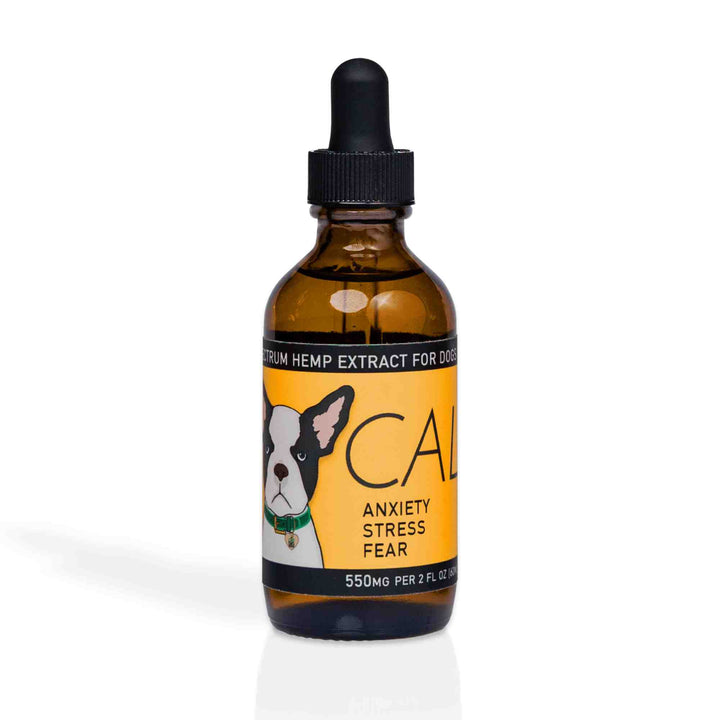
What I give Milka before fireworks
CALM Full-Spectrum Oil for Dogs
A full-spectrum hemp extract rather than an isolate or a distillate, formulated for pets by medicinal cannabis expert Angela Ardolino, from American hemp grown organically without pesticides and third-party lab-tested. We use it situationally, ahead of anything we can see coming, which is the way the label is written and the way the research that found an effect was designed.
- Label guidance for noise and thunder fear: 9 mg before the trigger, then reassess after 15 to 20 minutes
- Onto the gums, not into food, where absorption is faster and far less of it is wasted
- Two strengths, 9 mg or 18 mg per 1 ml dropper, roughly 60 servings per bottle
- Hemp extract with hemp seed oil, lavender and MCT oil, and nothing else
- Do a dry run on a quiet evening first, so the real night is not the first time
Dosing is individual, and bodyweight, metabolism and how anxious your dog gets all change what the right amount looks like. Start at the label guidance, keep a note of what you gave and when, and ask our team if you want help working it out for your dog. If your dog is on prescription medication, clear it with your vet first.
If the distress you are describing is about being left alone rather than the noise, that is a different problem with a different fix, and our piece on the timing most pet parents get wrong with separation anxiety covers it properly. For gentler herbal options, we have also written about chamomile for dogs.
When should I ask my vet about medication?
Sooner than most holistic pet parents are comfortable with, and I include myself in that.
If your dog panics, cannot eat, hurts themselves trying to escape, or takes days to come back to normal, that is a welfare problem happening in real time. Prescription options have the strongest trial evidence of anything in this article, with a success rate around 69 percent in the owner survey and placebo controlled trials behind several specific medications. There is even evidence that repeated use across different noise events helps some dogs learn to cope better, so the medication can be reduced later.
Two things worth knowing before that conversation. Anything prescribed should be trialled on a quiet night first, so you know how your dog responds. And acepromazine, an old standby that sedates without reducing fear, is considered inappropriate for noise fears and may heighten sound sensitivity. That is a question worth asking directly.
Supporting a dog naturally and using medication for the worst nights are not opposing positions. They sit alongside each other. The goal is a dog who is not terrified, and anyone who tells you the route matters more than the dog is selling you something.
If you would like the bigger picture on supporting your dog's whole system, not only the noise, I put it all in a free guide.
How long before I see a difference?
Honest answer: it depends which layer you mean.
Situational support given ahead of an event works on the timescale of that event, which is why the dry run matters more than the theory. Rewarding after bangs can start changing how your dog feels within weeks, though you will usually notice it at the next real event rather than day-to-day. Relaxation training needs daily repetition before the cue means anything, so give it a month of five-minute sessions. Gut support needs a minimum of six weeks before you judge it. A pain issue, if there is one, may improve quickly once addressed, but the learned fear attached to it will still need its own work.
What you are aiming for is not a dog who sleeps through fireworks this year. It is a dog whose fear moves in the right direction, who recovers by morning instead of by Thursday, and who has somewhere safe to be while it passes.
You are not failing your dog by finding this hard. Fireworks season is genuinely awful for a frightened dog and for the person watching them, and the fact that you are reading this now rather than panicking on the night means you are already doing the thing that works.
Much love, Larry
Please keep in mind that I'm not a veterinarian, and this isn't medical advice. Every pet is unique, so I always recommend working alongside your vet, ideally a holistic or integrative vet, especially for anything ongoing or serious.
Sources
- Riemer, S. Therapy and Prevention of Noise Fears in Dogs: A Review of the Current Evidence for Practitioners. Animals, 2023. mdpi.com
- Riemer, S. Not a One Way Road: Severity, Progression and Prevention of Firework Fears in Dogs. PLOS ONE, 2019. journals.plos.org
- Riemer, S. Effectiveness of Treatments for Firework Fears in Dogs. Journal of Veterinary Behavior, 2020, volume 37, pages 61 to 70.
- Lopes Fagundes, A.L., Hewison, L., McPeake, K.J., Zulch, H., Mills, D.S. Noise Sensitivities in Dogs: An Exploration of Signs in Dogs with and without Musculoskeletal Pain Using Qualitative Content Analysis. Frontiers in Veterinary Science, 2018. frontiersin.org
- Dreschel, N.A., Granger, D.A. Physiological and Behavioral Reactivity to Stress in Thunderstorm Phobic Dogs and Their Caregivers. Applied Animal Behaviour Science, 2005.
- Morris, E.M., Kitts-Morgan, S.E., Spangler, D.M., McLeod, K.R., Costa, J.H.C., Harmon, D.L. The Impact of Feeding Cannabidiol (CBD) Containing Treats on Canine Response to a Noise-Induced Fear Response Test. Frontiers in Veterinary Science, 2020. frontiersin.org
- Hunt, A.B.G., Flint, H.E., Logan, D.W., King, T. A Single Dose of Cannabidiol (CBD) Positively Influences Measures of Stress in Dogs During Separation and Car Travel. Frontiers in Veterinary Science, 2023. frontiersin.org
- McGowan, R.T.S., Barnett, H.R., Czarnecki-Maulden, G.L., Si, X., Perez-Camargo, G., Martin, F. Tapping into those Gut Feelings: Impact of BL999 (Bifidobacterium longum) on Anxiety in Dogs. ACVB Veterinary Behavior Symposium Proceedings, 2018. Conference proceedings, manufacturer funded, not peer reviewed.
- Korpivaara, M. et al. Dexmedetomidine Oromucosal Gel for Noise Associated Acute Anxiety and Fear in Dogs: A Randomised, Double Blind, Placebo Controlled Clinical Study. Veterinary Record, 2017.