An overweight dog starts losing weight when three things change at the same time: the quality of the food, the measured amount of it, and the calories arriving outside of meals. Shrinking the bowl on its own rarely moves the needle, because a cup of high-carbohydrate kibble and a cup of species-appropriate food do not behave the same way inside a dog's body. A holistic weight plan works on the whole picture instead: body condition, food quality, hidden calories, movement, gut health, and the medical causes worth ruling out first.
The holistic weight plan for an overweight dog is not a smaller bowl of the same food, it is better food, weighed rather than scooped, with every calorie outside of meals counted.
In this article
- How do I know if my dog is actually overweight?
- Why is my dog not losing weight on less food?
- What is the extra weight doing to my dog?
- The holistic weight plan, step by step
- Won't my dog be hungry on less food?
- What about snacks, chews and training rewards?
- How much exercise does an overweight dog need?
- What if the weight is not about food at all?
- How long should this take?
You cut the portions. You switched to the bag with the picture of the slim dog on the front. You feel like the meanest person alive at dinner time. And the number on the scale has barely moved.
You are not alone in this, and you have not failed your dog. Weight is one of the areas where pet parents are given the least useful advice: feed less, walk more, come back in three months. That sentence skips everything that actually decides whether the weight comes off and stays off.
How do I know if my dog is actually overweight?
Use your hands, not the scale. A dog's body condition score is assessed by feel, and it is more reliable than weight alone because an ideal number for one Labrador is heavy for another. Here is the check you can do in about thirty seconds, standing in your kitchen.
Scroll sideways to see the full table.
| What you check | Healthy weight | Carrying extra weight |
|---|---|---|
| Ribs | Felt easily under light pressure | Need firm pressure to find |
| Waist from above | Clear narrowing behind the ribs | Straight sides, or bulging outward |
| Profile from the side | Belly tucks up toward the hips | Belly runs level, or hangs down |
| Base of the tail | Bone felt under a thin layer | Soft padding over the bone |
| Getting up and moving | Rises and walks without effort | Slower to rise, tires on walks |
If that reading surprised you, you are in very normal company. In a study of pet parents assessing their own dogs, 38% scored their dog's body condition lower than it really was, and fewer than half could estimate their dog's bodyweight to within 10%. Awareness is improving: in the 2024 US opinion survey, 35% of dog parents described their dog as overweight or living with obesity, up from 17% the year before.
And this is widespread. A 2022 US prevalence survey classified 59% of evaluated dogs as overweight or living with obesity, and an analysis of electronic records from nearly 4.9 million dogs at US primary care practices found 52.9% of adult dogs in the same range.
Why is my dog not losing weight on less food?
Three reasons, and in my experience it is usually all three at once.
The scoop is lying to you. University of Guelph researchers asked 100 dog parents to measure out quarter-cup, half-cup and one-cup portions of dry food using three common devices. The portions varied widely, and the error was worst at the smallest volume, which is exactly the portion a small dog on a reduced amount is being given. If your dog is eating 20% more than you think every single day, no plan on earth is going to work.
The calories outside the bowl are not being counted. Veterinary guidance commonly caps snacks and rewards at 10% of a dog's daily energy, and a 2025 analysis looked specifically at whether that ceiling holds up nutritionally. Most of us are nowhere near it. The dental chew, the crust of toast, the biscuit at the groomer, the handful during training, the bit of cheese that hides the tablet. None of it feels like a meal. All of it is calories.
The food itself is working against the dog. This part is PAWDEGA's position rather than a settled research finding, and I want to be clear about that. Dry food can carry a high carbohydrate load, and our view, shared by many holistic and integrative vets, is that a high-carbohydrate diet drives inflammation and makes weight harder to shift. Research has not proven that, so weigh it as reasoning rather than evidence. What research has shown is that the gut comes along for the ride. When dogs living with obesity lose weight on a controlled diet, their gut bacteria shift measurably and start to look more like those of lean dogs. A 2023 study also found obesity in dogs associated with a low-grade inflammatory state. Whether the microbiome drives the weight or follows it is still an open question. Nobody should tell you otherwise yet.
What is the extra weight doing to my dog?
This is the part I wish someone had put in front of me in plain language years ago, so here it is in plain language.
A study of more than 50,000 neutered dogs across 12 breeds found that overweight dogs had a shorter median lifespan in every single breed studied. The gap ranged from about five months for male German Shepherds to two and a half years for male Yorkshire Terriers. Smaller dogs lost the most.
The landmark 14-year Labrador study points the same way from the other direction. Littermates were paired, with one of each pair fed 25% less than the other for life. The leaner dogs lived a median 13.0 years against 11.2 years, and the onset of chronic disease, osteoarthritis above all, came later.
Nearly two years. That is not a cosmetic issue. That is walks, and car rides, and one more summer.
The holistic weight plan for an overweight dog, step by step
Five steps, in this order. The order matters more than any single item on the list.
- Get a real starting point. Weigh your dog, write the number and the date somewhere you will find it again, run the hands-on check above, and take a photo from above and from the side. Ask your vet for a body condition score and a target weight at the next visit. You cannot steer by a number you never wrote down.
- Change what is in the bowl before you change how much is in it. Moving toward species-appropriate food, whether that is raw, gently cooked, or complete freeze-dried raw recipes, usually means more protein, more moisture, and far less starch for the same volume. Dogs often feel satisfied on less food once the food is carrying more nutrition. Transition over seven to ten days rather than overnight.
- Weigh the food in grams. A kitchen scale costs less than one bag of food and removes the single biggest source of error in the whole plan. Weigh it once in the morning for the whole day, split it between meals, and take rewards out of that same amount.
- Count every calorie outside the bowl for one week. Write down everything, including what other people in the house hand over. This is the step most pet parents skip and the one that most often explains a stalled plan.
- Support the gut while the food is changing. A diet change is a change to the whole microbiome. Supporting it with a species-specific pre and probiotic is how we give that system the best shot at adapting smoothly, and it helps with the loose stool that sometimes shows up during a transition.
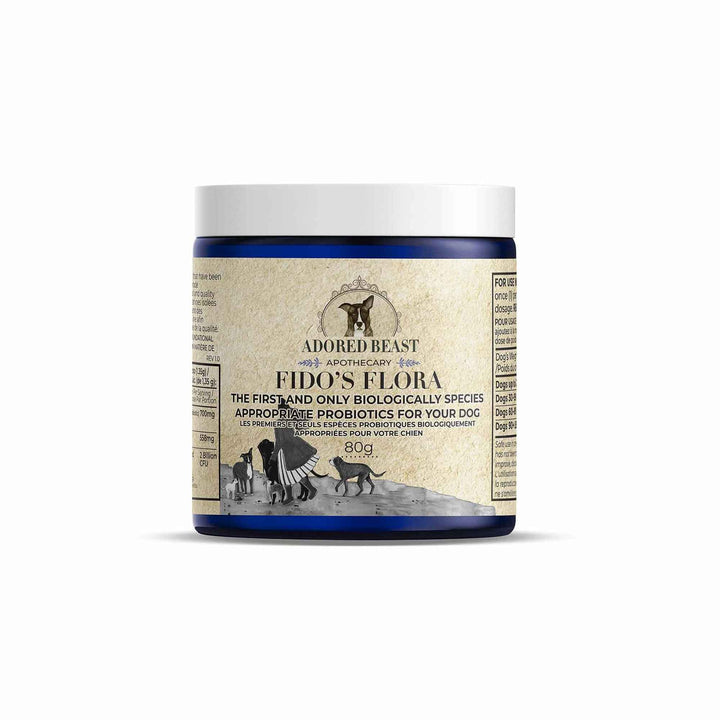
What goes in Milka's bowl every day
Fido's Flora Canine Specific Pre & Probiotic
There are a lot of probiotics on the shelf, and most of them are built on human strains that do not settle into a dog's gut the same way. Fido's Flora is the one I reach for during a diet change because it was formulated for dogs specifically, and because the prebiotic is already in there rather than sold separately.
- 16-strain blend including two canine-specific strains
- Larch arabinogalactan prebiotic, plus humic and fulvic acids
- No synthetics, fillers, grains or GMOs
- Dosed by weight, from a quarter teaspoon a day
Won't my dog be hungry on less food?
This is the question that stops most pet parents, and it deserves a real answer rather than a brush-off. A hungry dog is a stressed dog, and a stressed household goes back to the old routine within a fortnight.
Three things change how full a meal feels without changing how many calories it carries. Protein is the most satisfying part of a meal. Water adds volume, which is one reason fresh and rehydrated food goes further than the same calories of dry food. And fiber fills space, which is the whole logic behind the high-fiber weight-control foods on the shelf, though the type and amount of fiber matters a great deal more than the word on the bag.
Then there is how the food is delivered. Feeding from a LickiMat or a slow feeder stretches a smaller meal over several minutes, and licking is naturally calming for dogs, so the meal does double duty. Splitting the daily amount across three servings rather than two helps the dogs who get frantic by late afternoon.
Fiber is where I see the most well-meant mistakes, so we put everything we know into a free guide you can download below.
What about snacks, chews and training rewards?
You do not have to give them up. You have to make them count, in both senses.
Two rules carry most of the result. First, everything handed over comes out of the day's measured food rather than on top of it. Second, single-ingredient beats everything else, because you know exactly what the calories are made of and there is no sugar, grain or synthetic filler riding along. Break pieces smaller than feels right. Dogs respond to the event of being given something, not the size of it.

For the training pocket
Bison Liver Trainers, Whole Food Bites
One ingredient: grass-fed bison liver, freeze-dried. They break into tiny pieces, which is what you want when a training session means twenty rewards rather than two, and 73 calories per cup gives you plenty of room to work inside the daily total.
See Bison Liver TrainersHow much exercise does an overweight dog need?
Less than you would think at the start, and more variety than you would think overall.
Low exercise shows up consistently as a risk factor in studies of canine weight, but food is the lever that moves weight, and movement is the lever that protects muscle and joints while it comes off. A dog carrying extra weight is already loading sore joints, so adding a long hike in week one tends to produce a limp rather than progress.
Build it the way you would for yourself after an injury. Add five minutes a week to the existing walk. Use sniffing walks, which tire a dog mentally at a pace their joints can handle. Swimming, if you have access to it, takes the load off completely. Keep an eye on breathing, on hot ground, and on any flat-faced breed in warm weather, where overheating comes on faster than most people expect.
What if the weight is not about food at all?
Sometimes it is not. A slow metabolism has causes, and some of them need your vet rather than your kitchen scale.
Hypothyroidism lowers metabolic rate and brings weight gain that is not matched by a bigger appetite, usually alongside lethargy and coat or skin changes. Cushing's disease, and steroid medication of any kind, can also change body shape and appetite. Neutering is another real factor: a Danish study of companion dogs found neutering sharply raised the risk of being heavy or living with obesity in male dogs, which is a reason to adjust portions after the procedure rather than a reason to avoid it.
Ask your vet about full thyroid bloodwork if your dog is gaining weight on a measured amount of food, is tired, is seeking out warm spots, or has a dull coat. That is a reasonable question, and a good vet will be glad you asked it rather than irritated.
Please keep in mind that I'm not a veterinarian, and this isn't medical advice. Every pet is unique, so I always recommend working alongside your vet, ideally a holistic or integrative vet, especially for anything ongoing or serious.
How long should this take?
Longer than you want, and that is the honest answer rather than the comfortable one. Veterinary weight programs generally aim for around 1% of bodyweight per week, and faster is not better. Muscle goes first when the drop is too steep, and muscle is exactly what an aging dog needs to keep.
For a dog who needs to lose a fifth of their bodyweight, you are looking at several months. Weigh every two weeks, not every day. Take the photo from above every month, because the change is visible there long before it feels dramatic. Research into failed weight programs keeps landing on the same culprit, and it is not the diet. It is the plan quietly being abandoned. Anything you can keep doing beats a perfect plan you drop in March.
Here is what I have watched happen in dogs who get there. The stiffness in the mornings eases. They start asking for the walk again instead of enduring it. They sleep differently. The weight was never the point. The years on the other side of it are.
You are not powerless here, and you are not being cruel. You are the one person in your dog's life who can change this.
Much love,
Larry
Sources
- Association for Pet Obesity Prevention, Pet Obesity Prevalence Survey, 2022 data. petobesityprevention.org
- Association for Pet Obesity Prevention, 2024 Pet Obesity and Nutrition Opinion Survey. petobesityprevention.org
- Overweight and obese body condition in approximately 4.9 million dogs and 1.3 million cats seen at primary practices across the USA. Preventive Veterinary Medicine, 2024. sciencedirect.com
- Salt C, Morris PJ, Wilson D, Lund EM, German AJ. Association between life span and body condition in neutered client-owned dogs. Journal of Veterinary Internal Medicine, 2019. University of Liverpool Repository
- Kealy RD, Lawler DF, Ballam JM, et al. Effects of diet restriction on life span and age-related changes in dogs. Journal of the American Veterinary Medical Association, 2002. Reviewed in: Lawler DF et al, Diet restriction and ageing in the dog, British Journal of Nutrition. cambridge.org
- Inaccurate assessment of canine body condition score, bodyweight, and pet food labels: a potential cause of inaccurate feeding. Veterinary Sciences, 2017.
- Coe JB, Rankovic A, Edwards TR, Parr JM. Dog owner's accuracy measuring different volumes of dry dog food using three different measuring devices. Veterinary Record, 2019. Ontario Veterinary College
- Assessment of the nutritional impact of the 10% snack recommendation in pet diets. Veterinary Sciences, 2025. ncbi.nlm.nih.gov
- Kieler IN, Molbak L, Hansen LL, Hermann-Bank ML, Bjornvad CR. Fecal microbiota in client-owned obese dogs changes after weight loss with a high-fiber-high-protein diet. PeerJ, 2020. peerj.com
- Vecchiato CG, Golinelli S, Pinna C, et al. Fecal microbiota and inflammatory and antioxidant status of obese and lean dogs, and the effect of caloric restriction. Frontiers in Microbiology, 2023. doaj.org
- Bjornvad CR, Gloor S, Johansen SS, Sandoe P, Lund TB. Neutering increases the risk of obesity in male dogs but not in bitches. Preventive Veterinary Medicine, 2019. pubmed.ncbi.nlm.nih.gov
- Hypothyroidism in Animals. Merck Veterinary Manual. merckvetmanual.com
- Porsani MYH, Teixeira FA, Oliveira VV, et al. Factors associated with failure of dog's weight loss programmes. Veterinary Medicine and Science, 2020. ncbi.nlm.nih.gov