If your dog will not stop scratching and you are wondering whether CBD for dog allergies actually helps, here is the honest answer. In the only randomized, placebo-controlled trial run in dogs with atopic dermatitis, owner-reported itch scores dropped meaningfully after two and four weeks, while the investigator-scored skin lesion index did not move. That is a real signal, and it is a narrow one. CBD, given as a full-spectrum hemp extract, has controlled evidence for reducing how much an allergic dog scratches, but not yet for clearing the skin damage underneath, and it is a supportive tool alongside veterinary care rather than a replacement for it.
I asked Angela Ardolino, the certified cannabis and fungi clinician who formulates the CBD Dog Health line, about all of this directly on our podcast episode. This article is what I found when I went looking for the published evidence behind those answers. Her views are her own. Below is what the research says, what it does not say, and how to tell whether the bottle in your hand contains what the label claims.
In this article
- Does CBD actually help dogs with allergies?
- How does CBD work on itchy skin for dogs?
- Full spectrum, broad spectrum, or CBD isolate?
- How do you know a CBD product contains what it says?
- How does CBD compare with Apoquel and Cytopoint?
- Does Apoquel cause cancer in dogs?
- Can you give CBD alongside Apoquel or Cytopoint?
- How much CBD does a dog with allergies need?
- Does a hemp salve help a hot spot?
- Is CBD safe for my dog's liver?
- What I learned with Milka
- Sources
Does CBD actually help dogs with allergies?
Let's be real for a second. Almost every page you will find on this subject is written by a hemp brand, and almost none of them tell you what the trials found. So here is the actual evidence, in order of how much weight it carries.
The strongest study is a prospective, randomized, double-blinded, placebo-controlled trial published in Veterinary Dermatology in 2022. Thirty-two dogs with mild to moderate atopic dermatitis were assigned to either 2 mg per kilogram of an equal mix of CBD and CBDA, or a placebo, for four weeks. Owner-scored itch, measured on a visual analog scale, was significantly lower in the hemp group at both day 14 and day 28. The lesion index scored by the investigators showed no significant difference between the groups, and the measured inflammatory cytokines did not shift either.
Read that carefully, because it is the whole story. The dogs scratched less. Their skin, as scored by a clinician, looked about the same. Four weeks is a short window for skin to repair, and thirty-two dogs is a small trial, so this is a starting point rather than a verdict.
Around it sit smaller studies pointing the same direction. A 2023 study in Frontiers in Veterinary Science ran full-spectrum high-CBD oil at 2.5 mg per kilogram against an olive oil control in fourteen dogs. A 2022 retrospective series in the Canadian Veterinary Journal followed eight dogs on a broad-spectrum oil for at least eight weeks and recorded improvement in both lesion and itch scoring, with no adverse events, though it had no control group and the dogs stayed on other therapies at the same time.
A 2025 review in Veterinary Sciences pulled all of this together and reached a conclusion I think is worth quoting the sense of: the results are encouraging, the placebo-controlled trials are few, the doses used vary widely between studies, and the products themselves are inconsistent enough that comparing one trial to another is difficult. Absence of a large trial is not evidence that nothing is happening. It means nobody has funded the large trial yet.
How does CBD work on itchy skin for dogs?
Here's what the research tells us about the mechanism. Dogs have an endocannabinoid system, a signaling network involved in regulating inflammation and immune response. A 2012 study in the American Journal of Veterinary Research confirmed that both CB1 and CB2 cannabinoid receptors are present in the skin of healthy dogs and dogs with atopic dermatitis. The receptors are physically there, in the organ that is itching.
One nuance worth correcting, because it circulates widely in this space: cannabidiol does not appear to bind CB1 or CB2 receptors directly. Pharmacology reviews describe it as acting more indirectly, including by altering the levels of the body's own endocannabinoids. This matters because it explains why the whole-plant extract behaves differently from a single isolated compound, which is the next question.
Full spectrum, broad spectrum, or CBD isolate?
These three words describe genuinely different products, and the distinction is the single most useful thing a pet parent can learn here.
- Full spectrum retains the plant's other cannabinoids, terpenes and compounds alongside CBD, including trace THC at or below the legal 0.3 percent threshold.
- Broad spectrum retains the supporting compounds but has the THC stripped out.
- Isolate is purified CBD alone, with everything else removed.
The argument for full spectrum is that the plant's compounds work better in company than alone, an idea usually called the entourage effect. Angela Ardolino makes this point as firmly as anyone in the field, and it is why her formulas are extracts rather than isolates.
Here is that part of the conversation, in her own words. A note before you press play: Angela speaks strongly about prescription medications in this episode, those are her views rather than veterinary advice, and nothing in it is a reason to change or stop a medication your dog has been prescribed without your veterinarian involved.
What I will not tell you is that this is settled science in dogs. The controlled canine trials have used different preparations, including CBD and CBDA mixes and high-CBD full-spectrum oils, and no study has yet put full spectrum head to head against isolate in allergic dogs. The mechanism argument is strong. The direct comparison has not been run.
How do you know a CBD product contains what it says?
This is where the category falls apart, and it is not a small problem. When researchers bought 202 retail CBD products in the United States and tested them, 74 percent were off their stated potency by at least 10 percent, and 26 percent did not meet the definition of the product type printed on their own packaging. Products sold as full spectrum were not full spectrum. Heavy metals turned up in 44 of the 202, with lead the most common. A separate analysis of 80 products found only 54 percent landed within 10 percent of the label claim.
So a product can be labeled full spectrum, cost real money, and contain neither the potency nor the profile you paid for. The only document that closes this gap is a Certificate of Analysis, a third-party lab report on the actual batch. Here is what to look at on one:
- The cannabinoid profile. A full-spectrum product should show a range of cannabinoids, not a single line for CBD.
- The THC line. Trace THC at or below 0.3 percent is what separates a full-spectrum extract from a broad-spectrum one. If it reads zero, the product is broad spectrum whatever the front label says.
- Measured potency against the label. Compare the milligrams the lab found with the milligrams the bottle claims.
- Contaminant panels. Heavy metals, pesticides and residual solvents, each with a pass result.
- The batch number and date. A COA that does not match the batch in your hand is a marketing document, not a test result.
If a company cannot produce that report for the batch you own, you have no way to know what you are giving your dog. That is the practical takeaway from this entire article.
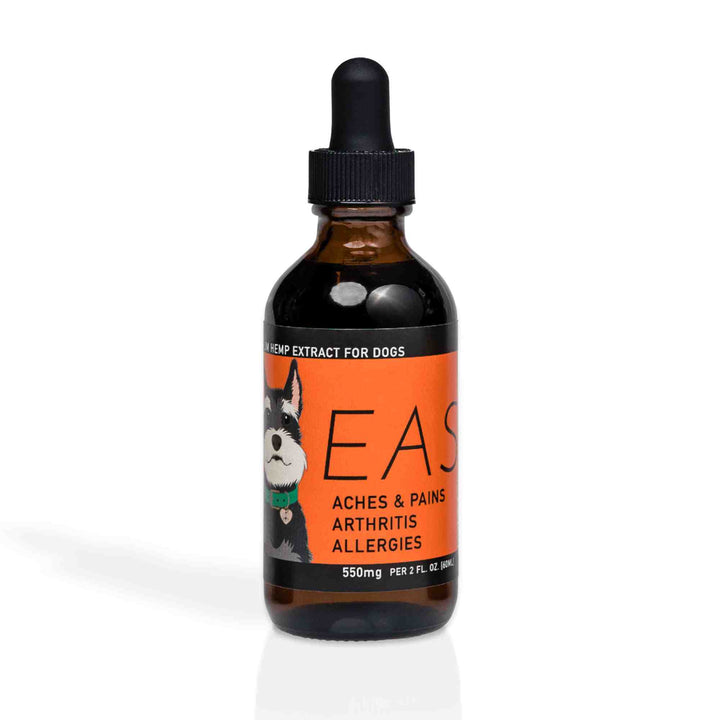
The one we give Milka
EASE, Full-Spectrum Oil for Dogs
We stock this one because it clears the bar this article sets. It is a full-spectrum extract rather than an isolate or a distillate, it is third-party lab tested, and the label states the extract content per serving rather than only the total for the bottle, which is what lets you dose by the number instead of by the dropper.
- Full-spectrum hemp extract with turmeric and frankincense
- Two strengths, so you can dose without giving a large volume of oil
- CO2 extracted from American hemp grown without pesticides
- Formulated for pets by Angela Ardolino
How does CBD compare with Apoquel and Cytopoint?
This comparison gets made badly in both directions, so let's use documents rather than opinions. Everything in the left column below comes from the manufacturer's own FDA label.
| Question | Oclacitinib (Apoquel) | Full-spectrum hemp extract |
|---|---|---|
| What it acts on | Janus kinase signaling, interrupting the cytokine pathways that carry the itch signal | Endocannabinoid signaling, with CB1 and CB2 receptors documented in dog skin |
| Regulatory status | FDA approved for control of itching from allergic dermatitis in dogs at least 12 months old | Not an approved animal drug. Sold as a supplement, with no approved veterinary indication |
| Speed | Label dosing is twice daily for up to 14 days, then once daily for maintenance | Trials measured change at 14 and 28 days. This is not a same-day effect |
| Evidence in dogs | Manufacturer field studies plus years of post-approval safety surveillance | One placebo-controlled trial in 32 dogs, plus small and mostly uncontrolled series |
| Documented cautions | The label states it modulates the immune system, is not for dogs with serious infections, may increase susceptibility to infection including demodicosis, and may worsen neoplastic conditions | Raised alkaline phosphatase in around half of dogs on long-term daily dosing in one six-month study, returning toward baseline after stopping |
| Who decides | Your veterinarian, by prescription | You, ideally with your veterinarian informed |
Notice what the table does not say. It does not say one of these is safe and the other is dangerous. It says one has an approval, a label, a known caution list and a large body of post-market data, and the other has a promising four-week trial and a supplement's regulatory freedom. Those are different kinds of uncertainty, not different amounts of it.
But here's what many pet parents are not told clearly: that caution list is printed on the insert, and most people never see the insert. It is worth reading whatever you decide.
Does Apoquel cause cancer in dogs?
The label does not say that, and neither will I. What the label does say is more specific, and in some ways more useful. Zoetis states on its own FDA label that new neoplastic conditions, both benign and malignant, were observed in dogs given oclacitinib during clinical studies and have been reported since approval, and it directs veterinarians to monitor dogs on the drug for neoplasia.
That is not an activist's claim. It is the manufacturer's own regulatory document, and it goes further. The label tells veterinarians to weigh risks and benefits before starting the drug in a dog with a history of recurrent serious infections, recurrent demodicosis, or neoplasia. It also states plainly that the drug modulates the immune system.
The numbers behind that language come from the masked field study, where 152 dogs received oclacitinib and 147 received a vehicle control. Two dogs in the oclacitinib group were withdrawn and euthanized after suspected or confirmed malignant neoplasia, one with signs of a heart base mass at 21 days and one with a Grade III mast cell tumor at 60 days. One dog in the control group developed a Grade I mast cell tumor and was withdrawn. Across the 283 dogs that received the drug in the wider safety population, non-specified dermal lumps were recorded in 12 percent and histiocytoma in 3.9 percent.
Now the other side, because leaving it out would make this article exactly what I am criticizing. An age and breed matched retrospective cohort study of dogs with allergic dermatitis found no significant difference in the incidence of neoplasia between dogs on oclacitinib and dogs on other systemic therapies, and a 2023 review in the Journal of the American Veterinary Medical Association reached the same conclusion about long-term use.
So both things are true at once. New growths, benign and malignant, were documented in dogs on the drug and the label says to watch for them. The retrospective data available so far has not shown a higher overall rate than other systemic options. Anyone telling you the first part without the second is selling something, and so is anyone telling you the second without the first.
What this means for you is not a verdict, it is a conversation. If your dog is on this long term, ask your veterinarian how they are monitoring for the things the label names, and ask for the client insert if you were never handed one. That is a reasonable question, and a good vet will welcome it.
Can you give CBD alongside Apoquel or Cytopoint?
This is the question we get most often, and the honest answer is that it is a conversation for your veterinarian, not for a blog post. What I can tell you is that in the placebo-controlled trial, dogs were allowed to stay on their existing therapies provided nothing changed, so the itch reduction was measured on top of whatever else those dogs were already receiving.
If you are considering reducing or stopping a prescription, do not do it on your own. Some dogs come off these medications without incident and some flare noticeably as the suppressed immune response returns, and telling the difference in advance is not something you can do from a website. Work with your vet, ideally a holistic or integrative one, and change one thing at a time so you can read what is actually happening.
And please do not carry any guilt about being on a prescription in the first place. You're not alone, so many pet parents go through this. You went to a professional with a suffering dog and you followed the advice you were given, which is what a good pet parent does.
How much CBD does a dog with allergies need?
The research doses and the label doses are not the same thing, and I would rather say that plainly than let you discover it yourself.
Studies express dosing per kilogram of body weight. The allergy trial used 2 mg per kilogram daily, the full-spectrum study used 2.5 mg per kilogram, and the six-month safety study ran 4 mg per kilogram. Retail product labels give a fixed starting amount instead, because a label has to work for a Chihuahua and a Great Dane. On EASE, the label's suggested starting point for allergies is 9 to 12 mg of extract daily, with the instruction to increase by the same amount if you see no change in one to two weeks.
For a small dog those numbers land close together. For a large dog the label start is well below the research dose, which is exactly why the label tells you to titrate upward. A starting dose is a starting point, not a target.
On timing, set your expectations to weeks rather than days. Every controlled study measured at 14 days at the earliest, and the eight-dog series ran eight weeks. Absorption matters too: applied to the gums the extract crosses the mucous membrane directly, while mixed into food it passes through digestion first and less arrives. Track it properly. Photograph the skin, note the scratching, and keep the dose consistent, because a change you cannot measure is a change you will talk yourself out of.
Does a hemp salve help a hot spot?
Oral and topical answer different problems. An oral extract works on the whole dog, which is what you want when the itch is everywhere and seasonal. A salve works on the patch you can point at, which is what you want when there is one angry, chewed, raw spot behind a knee.
The receptor research supports the topical route in principle, since the cannabinoid receptors sit in the skin itself. The controlled canine trial evidence is on oral dosing, so a salve is the less studied of the two and I would not pretend otherwise. In our house we have used both, on the same dog, for different reasons.
Is CBD safe for my dog's liver?
This is the question I care most about, because our own dog has a liver history. Here is the honest picture.
In a six-month randomized, placebo-controlled study of forty healthy dogs at 4 mg per kilogram daily, biochemistry and hematology showed no clinically significant changes apart from one: alkaline phosphatase rose in slightly more than half the dogs receiving CBD. It rose without any of the other liver markers moving with it, without any effect on the dogs' health or wellbeing, and it tracked closely with the bone-derived form of the enzyme rather than the liver-derived form. A separate pharmacology review reports the same pattern across studies, with the enzyme returning to baseline after a washout period.
What that means in practice: this is a real, repeatable, measurable finding, its clinical significance is still unknown, and the sensible response is bloodwork rather than worry. If your dog is going on anything daily and long term, get a baseline panel first and recheck it. That is good practice for hemp extract, and it is good practice for the prescription too. It is worth noting that the six-month study was run by researchers employed by a pet food manufacturer, which they disclosed.
What I learned with Milka
This section is my experience, not evidence, and I want the line between the two to stay visible.
Milka is our French Bulldog and she turned ten this year, which anyone who knows the breed will recognize as a milestone. As a puppy she had gut trouble, itchy skin and hot spots, and we spent a long time chasing symptoms before we understood we were chasing symptoms. Years later she had a spinal injury from IVDD, and full-spectrum hemp extract was part of how we supported her through a recovery that ended up being complete and entirely natural. It was not the only thing we did, and I would be doing you a disservice to suggest it was.
The lesson that transferred from her liver history to everything else we do is this: more is not better, and a stack of products is not a strategy. We got the best results from Milka when we added one thing, gave it long enough to read, measured, and only then decided what came next. If you take one habit from this article, take that one.
Which format for which dog
| EASE, oral extract | SOOTHE Salve, topical | |
|---|---|---|
| Best for | Whole-body, seasonal or year-round itching with no single source | One localized patch: a hot spot, a bite, a chewed area you can point at |
| Key difference | Dosed daily by body weight, works systemically, builds over weeks | Applied to clean skin two to three times daily, acts where you put it |
| Evidence status | The route used in every controlled canine trial cited here | Supported by skin receptor research, not by a controlled canine trial |
| Where to look | EASE, Full-Spectrum Oil for Dogs | SOOTHE Salve for allergies and hot spots |
If you want to see the rest of what we stock in this category, the full Hemp Dog Health range sits alongside our wider allergy relief collection, because for most itchy dogs the extract is one part of a plan that also involves diet and gut support.
You do not have to stay stuck. Read the label, ask one better question, change one thing you can actually sustain.
Go wider than the itch
If what you have read here has you rethinking the whole routine rather than only the scratching, our free Holistic Pet Wellness Blueprint lays out the foundations we work from at PAWDEGA: food, gut, toxin load, and what to reach for in what order.
Get the Holistic Pet Wellness BlueprintSources
- Loewinger M, Wakshlag JJ, Bowden D, Peters-Kennedy J, Rosenberg A. The effect of a mixed cannabidiol and cannabidiolic acid based oil on client-owned dogs with atopic dermatitis. Veterinary Dermatology, 2022;33:329. Link
- The Potential of Cannabidiol for Canine Atopic Dermatitis. Veterinary Sciences, 2025;12:159. Link
- Mogi C, Yoshida M, Kawano K, Fukuyama T, Arai T. Effects of cannabidiol without delta-9-tetrahydrocannabinol on canine atopic dermatitis: a retrospective assessment of 8 cases. Canadian Veterinary Journal, 2022;63:423.
- Mariga C, et al. Dermatological evaluation in dogs with atopic dermatitis given full-spectrum high cannabidiol oil. Frontiers in Veterinary Science, 2023. Link
- Campora L, et al. Cannabinoid receptor type 1 and 2 expression in the skin of healthy dogs and dogs with atopic dermatitis. American Journal of Veterinary Research, 2012;73:988.
- Bradley S, et al. Long-term daily feeding of cannabidiol is well-tolerated by healthy dogs. Frontiers in Veterinary Science, 2022;9:977457. Link
- Pharmacokinetics, efficacy, and safety of cannabidiol in dogs: an update of current knowledge. Frontiers in Veterinary Science, 2023. Link
- APOQUEL (oclacitinib maleate) prescribing information, DailyMed, U.S. National Library of Medicine. Link
- Oclacitinib 10 years later: lessons learned and directions for the future. Journal of the American Veterinary Medical Association, 2023;261(S1). Link
- Product labeling accuracy and contamination analysis of commercially available cannabidiol product samples, 2024. Link
- Label accuracy of unregulated cannabidiol products: measured concentration vs. label claim, 2022. Link
The content on this website is intended to provide information only. Each animal's health situation is unique. This content is not intended for use in diagnosis or treatment of specific health problems or diseases, and should never be considered as a substitute for veterinary advice.