Dog dental health without anesthesia comes down to two honest halves. The first: daily home care is the biggest lever you have, and none of it requires anesthesia. Brushing, a dog-safe dental powder, sensible chews, and a diet that is not feeding plaque will slow the tartar that leads to gum disease. The second half is the part nobody selling you a service leads with. Home care cannot clean below the gum line, and below the gum line is where periodontal disease does its real damage.
A daily routine at home is how you reduce how often your dog needs a professional cleaning, not how you avoid one forever.
What is in this guide
- Can you support dog dental health without anesthesia?
- Is anesthesia-free dog teeth cleaning safe?
- Does it depend on the dog and the person doing it?
- How risky is anesthesia for a senior dog?
- What a daily dog dental routine looks like
- What if your dog will not let you brush?
- Do chews, antlers, and bones clean teeth?
- When bad breath is not a teeth problem
- Signs your dog needs a professional cleaning
Can you support dog dental health without anesthesia?
Partly. And the part you can do matters more than most pet parents are told.
There are two different substances on your dog's teeth, and they behave nothing alike. Plaque is the soft film that starts forming within hours of a cleaning. It wipes off with a brush. Tartar, also called calculus, is what plaque becomes once minerals from saliva harden it onto the tooth, and veterinary reviews put that window at roughly two to three days without brushing.
So the honest split is this. At home, you are working on plaque, every day, before it turns into anything. At the clinic, they are removing tartar and cleaning the pocket between the gum and the root, which is not a surface you can reach with a toothbrush or a spray.
Once you see the distinction, a lot of confusing advice sorts itself out. And one particular service stops looking like a shortcut.
Is anesthesia-free dog teeth cleaning safe?
This is where I want to be careful, because it is the thing readers most often ask us about, and the answer is not the comfortable one.
Anesthesia-free dental cleaning, where a dog is held still while someone scrapes the visible tartar off with hand instruments, is opposed by the veterinary dental profession. The American Veterinary Dental College prefers the term non-professional dental scaling, and its position statement lays out why: the instruments are sharp, a slight head movement can injure the mouth, and access to the space under the gum of every tooth is not possible in an awake dog. The 2019 AAHA Dental Care Guidelines put it in similar terms, describing the practice as not appropriate because of patient stress, injury, aspiration risk, and the lack of any way to assess what is happening under the gums.
Here is the part that changed how I think about it. A scraped crown looks clean. Periodontal disease carries on underneath, quietly, without the brown build-up that would have told you something was wrong. You have not fixed anything. You have removed the warning light.
Veterinary dentists also point out that scaling without polishing leaves the enamel surface roughened, and a roughened surface holds plaque more readily than a smooth one.
None of that is an argument against your groomer or your vet. It is an argument about what a set of hand tools can physically reach in a mouth that is awake.
Does it depend on the dog and the person doing it?
Fair question. It was mine, and I have a stake in the answer.
We take Milka for awake scaling twice a year, and have done for years. The person doing it is careful, Milka is calm about it, and her teeth look clean afterwards. I am not going to pretend otherwise to make a tidier argument.
Here is what changed my thinking. The limit is not how steady the hands are. It is what can be reached. The pocket between gum and root is where periodontal disease is active, and that space cannot be probed, cleaned, or x-rayed in a dog who is awake, however cooperative she is. When researchers staged 108 dogs visually while the dogs were awake, then staged the same dogs again under anesthesia with dental x-rays, the two assessments agreed only moderately. That was veterinarians doing the looking, inside veterinary practices.
So a calm dog and a careful operator get you a genuinely cleaner crown. They do not get you an assessment. Those are two different things, and the second one is what finds a problem while it is still small.
Which brings me to the uncomfortable part. Milka has never had a full oral assessment with x-rays. Years of clean-looking crowns tell me the visible surfaces are being maintained. They tell me nothing about her roots, and she is a French Bulldog, which means 42 teeth in a jaw built for fewer. Crowding and rotation are well described in flat-faced breeds, and plaque settles into the overlaps where a brush struggles to reach, although I should say that at least one large study did not find skull shape to be an independent risk factor on its own. I am booking her assessment. That is not a confession dressed up as advice. It is where following my own reasoning landed me.
If you are doing what we do, you do not have to stop. Count it as cosmetic maintenance sitting on top of daily brushing, rather than as your dog's dental care, and ask five questions:
- Who is holding the instruments, and are they a licensed vet or a vet tech working under supervision? AAHA's position is that groomers should never scale a pet's teeth.
- Is a veterinarian examining the mouth as part of the appointment?
- Do they stop and refer you on when they see disease, or finish the job either way?
- Are the teeth polished afterwards? Scaling leaves a roughened surface that holds plaque more readily than a smooth one.
- What is the plan for a full assessment, and when is it happening?
How risky is anesthesia for a senior dog?
You are allowed to be nervous about this. Most pet parents who search for dog dental health without anesthesia are not looking for a loophole. They have a grey-faced dog, a recommendation for a dental procedure, and no real numbers to weigh it against.
So here are the numbers. The largest prospective study of the question, the Confidential Enquiry into Perioperative Small Animal Fatalities, followed 98,036 dogs across 117 UK practices.
Scroll sideways to see the full table.
| Group | Deaths per 10,000 events | Same figure as odds |
|---|---|---|
| All dogs in the study | 17 | About 1 in 601 |
| Healthy dogs, ASA 1 to 2 | 5 | About 1 in 1,849 |
| Sick dogs, ASA 3 to 5 | 133 | About 1 in 75 |
A more recent analysis of UK primary care records, covering dogs anesthetized or sedated between 2010 and 2013, found a lower figure again: around 1 in 1,000 within 48 hours, and around 1 in 700 within two weeks.
Read the middle row twice. The gap between a healthy dog and a sick one is not small, and it is the clearest answer to the question people are really asking. Age on its own is not what moves the number most. Overall health status does, alongside older age and emergency procedures. That is exactly why annual bloodwork on a healthy dog is worth doing before you ever need it. When your vet has current values in front of them, your dog goes into the procedure as a known quantity rather than an unknown one.
The other side of the ledger deserves saying plainly too. A large observational study of 59,296 dogs with periodontal disease found that more advanced stages were associated with a higher rate of cardiovascular findings, including endocarditis, and a related study reported an association with chronic kidney disease. These are associations, not proof of cause, and a letter published in the same journal questioned how firmly the cardiac link could be drawn. But the direction of the evidence is consistent enough that leaving an infected mouth alone is not the safe choice it feels like. We have written more about the heart side of this in our guide to natural heart health support for dogs.
What a daily dog dental routine looks like
This is the part you control. Five steps, most of them under two minutes.
- Look, once a week. Lift the lip on both sides and check the gum line rather than the tooth face. You are looking for redness where gum meets tooth, brown build-up at that margin, and anything that bleeds easily.
- Brush daily, or at the very least every other day. In a trial comparing brushing frequencies, daily and every-other-day brushing produced significantly better results for plaque, tartar, and existing gingivitis than weekly or every-two-weeks brushing. The authors recommended daily. This is the one step that carries most of the outcome.
- Angle the brush at the gum line, and stay on the outer surfaces. That is where plaque collects, and your dog's tongue handles a good deal of the inner surfaces. You do not need to hold the mouth open.
- Use something made for dogs. Human toothpaste is not an option, because dogs swallow what you put in their mouth and some formulas contain xylitol.
- Feed with the mouth in mind. The 2019 AAHA guidelines note that the physical form of a diet affects oral health, not only its nutritional content. In our experience at PAWDEGA, dogs on fresh and raw diets with fewer starchy fillers tend to build tartar more slowly, though this is our observation and the pet parents we speak to, not a controlled trial.
Now the uncomfortable statistic. In a Swedish survey sent to more than 200,000 dog owners, fewer than 4% brushed their dog's teeth daily. In the same survey, close to two thirds said they could see themselves doing it. The gap is not willingness. It is that nobody showed them how to start, or what to put on the brush.
And if your dog has never had a professional cleaning at all, home care still does measurable work. A 2025 trial followed 125 client-owned dogs, none of them scaled at the start, for 16 weeks. One dental chew a day, or brushing every other day, or both, partly removed existing deposits in dogs that had build-up but no gingivitis. The authors were careful to say their study is not an argument for managing gum disease without scaling. It is an argument that starting where you are is worth something.
With Milka, our senior French Bulldog, we brush at night after her last meal. It took about three weeks of doing a few teeth at a time before she stopped reacting to it as an event. She is not enthusiastic. She is tolerant, which is all you need.
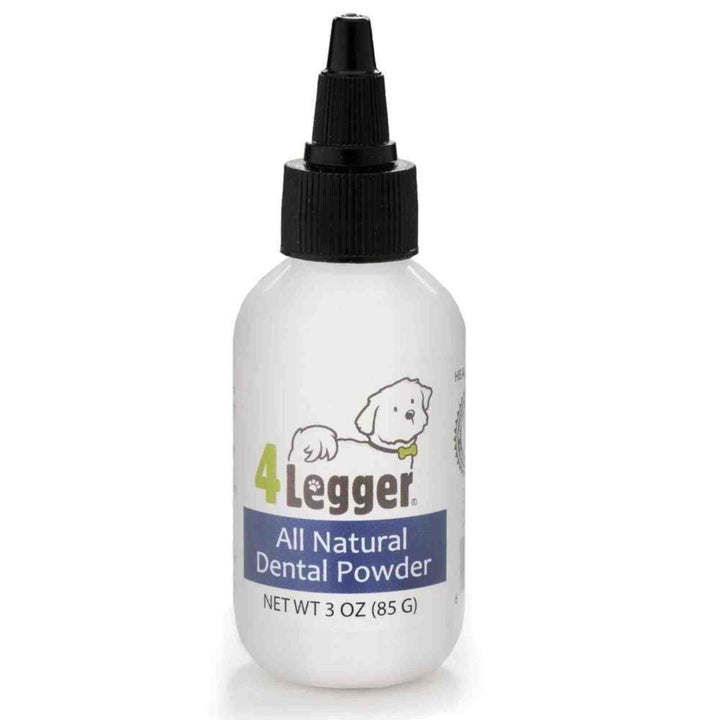
What goes on Milka's brush
All Natural Dental Powder
Most pet toothpastes carry a long ingredient list for a product your dog is going to swallow. This one is three ingredients, made by 4-Legger, which is the reason it has held its place in a routine we repeat every night.
- Sea salt, baking soda, and peppermint essential oil, and nothing else
- Wet the brush, dip it in the powder, lift the lip, brush the gum line
- Mix it with MCT or coconut oil if you prefer a paste texture
- No sodium hexametaphosphate, no synthetics, no fillers
What if your dog will not let you brush?
Then you are in the majority, and it is worth knowing that. In a follow-up survey of pet parents whose dogs had already been through a dental procedure and been given brushing instructions, 64% reported some level of difficulty and 31% described it as very difficult.
Build it in stages rather than in one session. Let your dog taste the powder off your finger for a few days. Then lift the lip and touch the outside of a few teeth with a finger. Then a soft brush on the canines only. Then add the back teeth. Reward every stage. If a stage goes badly, drop back to the previous one rather than pushing through, because a dog who learns that hands near the mouth means restraint will be harder to work with for years.
And if brushing is genuinely off the table right now, a spray applied straight to the gums is a reasonable way to keep something working in the mouth while you build tolerance. It is a support, not an equal swap for mechanical brushing, and I would rather say that than pretend otherwise.
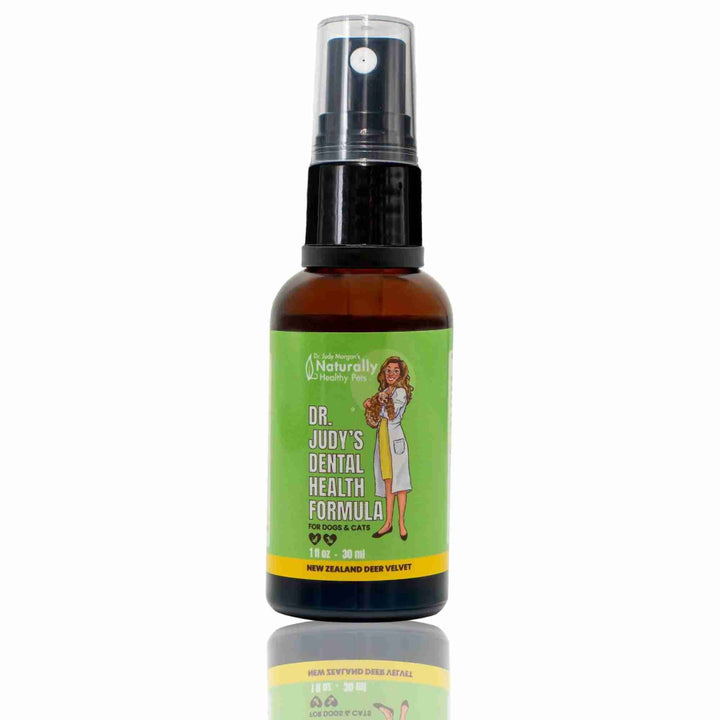
For the dog who says no to a brush
Dr. Judy Morgan's Dental Health Formula
A spray you apply to the gums, formulated with manuka honey, propolis, and deer velvet. For dogs who will not accept a brush yet, or seniors with sore gums, it keeps something working in the mouth while tolerance is built.
- Label directions: both sides of the upper and center gums, three times a week
- Can be applied on a cotton swab for small or wary dogs
- No food or water for an hour either side of application
Do chews, antlers, and bones clean teeth?
Chewing does mechanical work on the tooth surface. That much is real. The problem is what people hand over to achieve it.
Veterinary dentists consistently name the same culprits for fractured teeth: antlers, marrow bones, nylon bones, cow hooves, and ice. One review reported dentoalveolar trauma in as many as 26.2% of dogs and cats presented, with fracture the most common form. The tooth that usually goes is the large upper fourth premolar, the one doing the heavy cutting work at the back. A slab of it shears off, often below the gum line, and your dog frequently carries on eating as though nothing happened.
The rule of thumb veterinary dentists use is a thumbnail test. Press your thumbnail into the item. If it does not dent, it is too hard for your dog's teeth. Enamel is hard, but it is also brittle, and dog enamel is considerably thinner than ours.
We sell antler in powdered form rather than as a whole chew for this exact reason, and we have written separately on whether elk antlers are safe for dogs if you want the longer version.
On the product side, there is one credential worth knowing. The Veterinary Oral Health Council, set up in 1997 within the American Veterinary Dental College, reviews trial data submitted by manufacturers and awards a seal to products that show a minimum 15% reduction in plaque or tartar in either of two trials and a 20% mean reduction across both. It is a narrow list. Most dental products on the market, including the natural ones we carry, have not been through those trials, and I would rather tell you that than imply a standard we have not met. What the seal tells you is that a specific finished product was tested, not that a category works.
When bad breath is not a teeth problem
Worth flagging, because it sends pet parents looking in the wrong place.
Mouth odor usually starts in the mouth, and a sudden change in odor is a reason to look at the gum line first. But not always. At PAWDEGA we see plenty of dogs whose breath improves when their digestion is addressed rather than their teeth, and holistic vets have long linked oral odor to what is happening further down. Low water intake plays a part as well. This is reasoning from practice rather than from a controlled trial, so hold it loosely, and check the mouth before you go looking anywhere else. If the teeth and gums look fine and the smell persists, our explainer on dog gut health and why symptoms trace back to digestion is the better next read.
Signs your dog needs a professional cleaning
Home care does not replace an assessment. It changes how often you need one, and how small the job is when you go.
Book an appointment if you see any of these:
- A red or puffy line where the gum meets the tooth
- Brown or yellow build-up at that gum margin, not on the tooth face
- Bleeding when you brush or touch the gums
- Chewing on one side, dropping food, or pawing at the mouth
- A sudden change in mouth odor
- Any loose tooth, or a tooth with a flat broken face
A fractured tooth is painful whether or not your dog shows it, and dogs are exceptionally good at not showing it. AAHA recommends oral assessments roughly every six months for a healthy dog, and every three to six months once periodontitis is in the picture. Small and toy breeds sit at the higher-risk end and tend to need attention earlier than their size suggests.
If you want a second opinion from someone who works the way we do, we keep a list of holistic vets offering online consultations. I am not a veterinarian, and none of this is medical advice. Your dog's mouth needs someone who can actually look in it.
One last thing, for the pet parent whose dog is fine right now. Fine is the moment to start. The routine is worth something later precisely because you built it while nothing was wrong.
Awake scaling or a cleaning under anesthesia: which does what
Scroll sideways to see the full table.
| Question | Awake scaling | Cleaning under anesthesia |
|---|---|---|
| Who it appeals to | Pet parents avoiding anesthesia | Dogs with disease below the gums |
| What it reaches | The visible crown only | Above and below the gum line |
| What it can assess | Nothing under the gums | X-rays show roots and bone |
| Professional position | Opposed by AVDC and AAHA | The standard in both guidelines |
| Main risk | Injury, stress, missed disease | Anesthetic risk, about 1 in 601 |
| Your move | Build the daily routine instead | Book the oral assessment |
Much love, Larry
Sources
- American Veterinary Dental College. Position Statement: Companion Animal Dental Scaling Without Anesthesia. Adopted 1998, revised 2022. avdc.org
- Bellows J, Berg ML, Dennis S, et al. 2019 AAHA Dental Care Guidelines for Dogs and Cats. Journal of the American Animal Hospital Association, 2019. aaha.org
- American Animal Hospital Association. Dog and cat dental disease: signs, professional cleanings, anesthesia, and home care. aaha.org
- Harvey C, Serfilippi L, Barnvos D. Effect of frequency of brushing teeth on plaque and calculus accumulation, and gingivitis in dogs. Journal of Veterinary Dentistry, 2015;32(1):16-21.
- Larsen J. Effects of diets, treats, and additives on periodontal disease. Today's Veterinary Practice. todaysveterinarypractice.com
- Brodbelt DC, Blissitt KJ, Hammond RA, et al. The risk of death: the Confidential Enquiry into Perioperative Small Animal Fatalities. Veterinary Anaesthesia and Analgesia, 2008;35(5):365-373.
- Shoop-Worrall SJW, O'Neill DG, Viscasillas J, Brodbelt DC. Mortality related to general anaesthesia and sedation in dogs under UK primary veterinary care. Veterinary Anaesthesia and Analgesia, 2022.
- Glickman LT, Glickman NW, Moore GE, et al. Evaluation of the risk of endocarditis and other cardiovascular events on the basis of the severity of periodontal disease in dogs. JAVMA, 2009;234(4):486-494.
- Peddle GD, et al. Letter: questions validity of study on periodontal disease and cardiovascular events in dogs. JAVMA, 2009;234(12):1525-1528.
- Glickman LT, Glickman NW, Moore GE, et al. Association between chronic azotemic kidney disease and the severity of periodontal disease in dogs. Preventive Veterinary Medicine, 2011;99(2-4):193-200.
- Enlund KB, Brunius C, Hanson J, et al. Dog owners' perspectives on canine dental health. BMC Veterinary Research, 2020.
- Enlund KB, et al. Adherence to dental home care in dogs with periodontitis: a post-treatment survey. Acta Veterinaria Scandinavica, 2023.
- Kling K. Diagnosis and treatment of fractured teeth. Today's Veterinary Practice. todaysveterinarypractice.com
- Bauer AE, Stella J, Lemmons M, Croney CC. Evaluating the validity and reliability of a visual dental scale for detection of periodontal disease in non-anesthetized dogs. PLOS ONE, 2018;13(9):e0203930. plos.org
- American Animal Hospital Association. Nonanesthetic scaling of teeth, 2019 AAHA Dental Care Guidelines. aaha.org
- Gawor J, Jank M, Harvey CE, Nicolas CS. Effectiveness of dental homecare protocols in unscaled dogs. Journal of Veterinary Dentistry, 2025. sagepub.com
- A cross-sectional study to estimate prevalence of periodontal disease in a population of dogs in commercial breeding facilities in Indiana and Illinois. PLOS ONE, 2018. plos.org
- Niemiec BA. Breed predispositions to dental and oral disease in dogs. Wiley, 2021. wiley.com
- Veterinary Oral Health Council. Trial protocol requirements and about the VOHC. vohc.org