Does kibble cause yeast in dogs? Not in the way most of the internet tells you. The yeast living on your dog's skin, Malassezia, cannot live on sugar, so the starch in the bowl is not feeding it directly. What a highly processed, high-starch diet can do is help build the conditions yeast needs to take over: an inflamed gut, a reactive immune system, and a food your dog is quietly reacting to. That difference matters, because it changes what you do on Monday morning.
Kibble does not feed skin yeast directly, because Malassezia lives on skin oils rather than dietary sugar, but a high-starch, highly processed diet can worsen the gut inflammation and food sensitivity that allow yeast to overgrow in the first place.
What you will find here
- So does kibble cause yeast in dogs, or not?
- What does the yeast on your dog's skin actually eat?
- Then why do so many yeasty dogs improve off kibble?
- Is grain-free kibble better for a yeasty dog?
- What should you feed a dog with yeast?
- What if you cannot leave kibble right now?
- How long before you see anything change?
- When is this not a food problem at all?
- Sources
So does kibble cause yeast in dogs, or not?
You have read the labels. You have compared bags. You have already paid for the food with the nice photography on the front.
And your dog still smells like corn chips at 11pm.
Here is what makes this question so hard to answer honestly. There are two loud camps, and each one is right about something and wrong about something. One camp says kibble is full of sugar and sugar feeds yeast, so throw the bag out. The other camp says diet has nothing to do with skin yeast, so stop reading pet blogs and use the medicated shampoo. Neither answer survives contact with the research, and neither one helps the pet parent standing in her kitchen at midnight.
The accurate answer is narrower and more useful. Kibble is not the direct fuel. It is very often part of the environment that lets yeast hold on, month after month, while everyone keeps addressing the skin.
What does the yeast on your dog's skin actually eat?
Skin oil. Not dinner.
Malassezia pachydermatis is the yeast found on the skin and in the ears of most healthy dogs. It is lipophilic, meaning it lives on fats, and genome work has shown these yeasts lack the gene machinery to build their own long-chain fatty acids, so they take them from the host's skin instead (Puig and colleagues, PLOS ONE, 2017). A 2024 veterinary dermatology review by Guillot and Bond states the position plainly: Malassezia cannot metabolize sugars, and M. pachydermatis assimilates only a narrow set of carbohydrates such as mannitol, glycerol and sorbitol.
So the rice in the bowl is not landing on the paw. That claim, repeated across thousands of pages, does not hold.
What the dermatology literature is equally clear about is that yeast overgrowth is almost never the starting point. The World Association for Veterinary Dermatology consensus guidelines on Malassezia describe it as an organism that proliferates when something else has already gone wrong, most commonly allergic skin disease, along with endocrine conditions such as hypothyroidism and barrier or keratinization problems (Bond and colleagues, Veterinary Dermatology, 2020). Yeast is the second event. Something opened the door.
Scroll sideways to see the full table.
| What you hear | Evidence status | What we actually know |
|---|---|---|
| Kibble sugar feeds the yeast on the skin | Not supported | Malassezia cannot metabolize sugars |
| Grain-free kibble starves yeast out | Not supported | Grain-free is rarely low in starch |
| Food reactions drive recurring yeast | Well supported | Yeast follows allergic skin disease |
| Diet change helps many yeasty dogs | Supported, other reason | It works through allergy and the gut |
| Kibble is uniquely high in AGEs | Overstated | Canned foods measured higher than extruded |
That last row is one our own side of the industry gets wrong. When van Rooijen's group at Wageningen University measured Maillard reaction products across 67 commercial pet foods, canned foods carried the highest concentrations on a dry matter basis, above pelleted and extruded (Journal of Agricultural and Food Chemistry, 2014). Processing load is real and worth taking seriously, and the same body of work estimated that a dog's daily intake of one marker compound runs far above a typical adult human's. But "kibble is the worst thing in the bowl for AGEs" is not what the measurements say, and repeating it costs credibility we need for the parts that are true.
Then why do so many yeasty dogs improve off kibble?
Because the diet change is working through a different door than the one everyone points at. There are three real ones.
The allergy door. In a review of the evidence, food allergy accounted for roughly 18% of dogs presenting with itching, with reported ranges from 9% to 40%, and the proportion rose in dogs presenting specifically with allergic skin disease (Olivry and Mueller, BMC Veterinary Research). When an elimination diet is followed strictly, more than 90% of dogs with a food-driven skin reaction are in remission by eight weeks. Take away the protein a dog is reacting to, and you take away the inflammation that let yeast overgrow. The yeast recedes because the door closed, not because anything was starved.
The gut door. Dogs fed raw meat-based diets and dogs fed kibble carry measurably different gut bacterial populations (Hiney and colleagues, Frontiers in Veterinary Science, 2024). In that study, healthy dogs showed no significant difference in systemic inflammatory markers, which is worth saying out loud rather than skipping. What did differ was the microbiome itself, and a separate digestibility trial found that an extruded kibble diet was digested less completely than comparable fresh diets across protein, fat and carbohydrate (Tanprasertsuk and colleagues, Translational Animal Science, 2021). Undigested carbohydrate reaching the colon is food for the bacterial population, and the population is what holds yeast in balance.
The volume door. Carbohydrate makes up roughly 30% to 60% of dry dog food (Journal of Animal Science and Technology, 2024). That is a large, daily, unchanging load in an animal built to run on protein and fat. Julie Anne Lee, DCH, the holistic practitioner who formulated the protocols we stock, puts it in clinical terms: heavily processed carbohydrate is effectively already sugar by the time a dog eats it, and hidden sugars add up faster than most pet parents realize once you count root vegetables, chews and prebiotic ingredients such as inulin and maltodextrin.
Three doors. None of them is "sugar reaches the skin."
Is grain-free kibble better for a yeasty dog?
Usually not, and this is the swap I see pet parents make first.
Grain-free is not starch-free. Extruded food needs starch to hold its shape, so when grains come out, potato, peas, lentils, chickpeas or tapioca go in. The bag changes. The carbohydrate load often does not. If you are considering the switch because of yeast, the honest move is to work out the actual carbohydrate percentage rather than trusting the front of the bag, and to ask whether the protein source has changed at all, because the protein is the part with the evidence behind it.
We have written separately about whether rice is bad for dogs with yeast, which covers the single-ingredient version of this same question.
What should you feed a dog with yeast?
Here is the sequence I would use, in order. Not five things at once. In order.
- Write down what you see, before you change anything. Time of day, how long the itching lasts, which paw, which ear. Two weeks of notes is the single most useful tool you will have, because improvement in yeast is proportional, not binary. An itching episode dropping from fifteen minutes to five is a real win, and without notes you will miss it and quit while things are working.
- Lower the processing and the starch load for two weeks. Raw or freeze-dried raw gives the cleanest conditions. Fresh or gently cooked is the next step down. This window matters on its own, and it is also the prerequisite step printed on the protocol below.
- Change one protein, properly. If you suspect a food reaction, a real elimination trial runs eight weeks with nothing else going in, no flavored chews, no table scraps, no flavored medication if your vet can avoid it. Four weeks of nearly is not an answer.
- Then support the gut and the liver, in that order, with a defined program rather than a shelf of supplements. Yeast that has been building for years does not resolve in a fortnight, and loading probiotics into a yeasty dog all at once is one of the most common ways to make a dog look worse.
- Follow with gut repair. Yeast inflames the gut lining on its way out, and skipping this step is the most common reason signs return three to twelve months later.
Step four is where most pet parents stall, because it is where the internet hands you forty products and no order of operations. This is the one I would start with, and the reason I would start there rather than with a single probiotic.
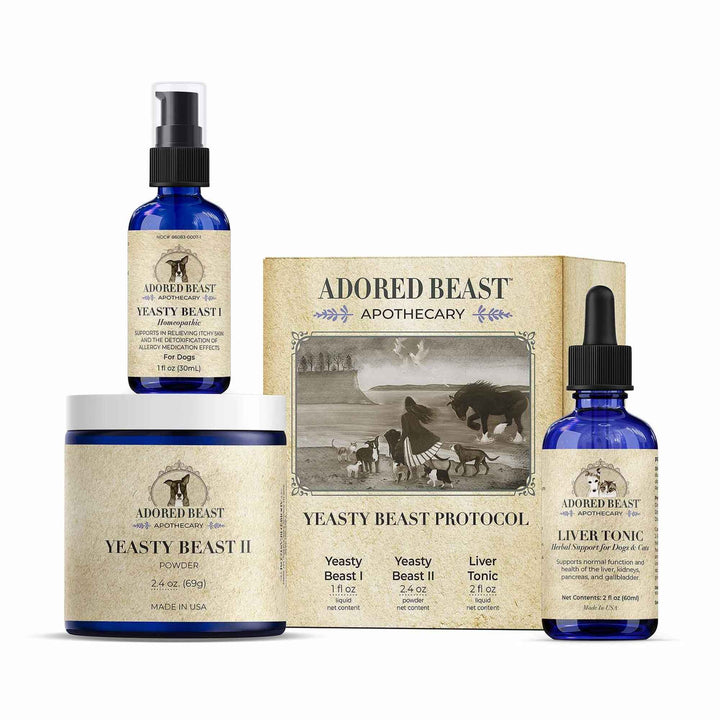
Where I would start with a yeasty dog
Yeasty Beast Protocol
A three-part program from holistic practitioner Julie Anne Lee, built to work slowly and in sequence rather than hitting yeast hard and dealing with the fallout. Its first printed step is a diet change, which is exactly why it belongs in this article rather than in a list of supplements.
- Step one is removing starches and sugars for two weeks, before anything else begins
- Liver support runs throughout, because the organs handling die-off are already working hard
- Deliberately contains no conventional probiotics, since probiotic loading is itself a common die-off trigger
- Designed for dogs with the familiar signals: corn-chip smell, brown paws, waxy ears, constant licking
If your dog has years of history behind him, or has been through rounds of medication, a single round of anything is unlikely to be the whole answer, and a cycling approach suits him better. That is a conversation worth having with us by email before you buy, not after.
What if you cannot leave kibble right now?
Then you work with what you have, and you can still make real progress. I would rather tell you that than watch you do nothing because raw feels impossible this month.
What actually helps a kibble-fed dog with yeast:
- Choose a less processed option, oven-baked rather than extruded where you can find it, with less grain and a single named protein.
- Replace a portion of the bowl with fresh food rather than adding on top of a full ration. Blueberries, green beans, broccoli, kale, and affordable organ meats such as heart and kidney all earn their place.
- Audit everything that is not dinner. Dental chews, training rewards, the dog-safe ice cream, the peanut butter in the puzzle toy. This is where hidden sugar usually lives.
- Expect the process to take longer on a highly processed diet, and possibly to need repeating. That is not failure, it is the honest timeline.
If kibble is staying for now, our guide to the best supplements for dogs on kibble covers what to add to close the gaps a dry diet leaves.
And if you want the whole picture in one place, including the signal checklist and what to change first, this is the free guide I would hand you.
How long before you see anything change?
Let me be honest with you, because the compressed version of this timeline is why so many pet parents give up two weeks before it would have worked.
The earliest changes are usually not the skin. They are calmer energy, better sleep, less audible licking at night, less scooting, a reducing smell, ears that look less angry. Skin and coat are slower, because the body sorts itself from the inside out. On an eight-week elimination trial, the dermatology evidence puts most responders in remission by week eight, not week two.
There is one pattern worth knowing before it frightens you. Some dogs improve for a day or two, then look worse. That is usually die-off, not failure, and the response is to ease off and build back up rather than reach for an antifungal. We have written about why a dog with yeast gets worse before better in detail, and it is worth reading before you start, not during the week it happens.
My own dog, Milka, went through her version of this as a puppy. Chronic gut issues, itchy hot spots, vomiting we woke up to most nights. We did everything we were told. Countless vet visits. "Premium" kibble. Expensive medication. Nothing held. The change that finally moved her was the food, and even then it was not overnight, and it was not one product. She is a healthy senior now, and the thing I remember most is how long the first month felt.
When is this not a food problem at all?
Sometimes the bowl is not the story, and I would rather you knew the signs than spent six months on diet alone.
Darkening skin can come from hypothyroidism, which itself makes yeast and skin sensitivity worse, so thyroid testing is worth raising. Endocrine conditions generally sit on the list of underlying causes in the dermatology consensus. And no signal set is fully conclusive, which is why a swab or a slide impression from your vet is worth asking for, rather than accepting a combined steroid, antibiotic and antifungal drop as the default first move.
Three questions to take to your appointment, so you are asking rather than arguing:
- Can we confirm yeast with cytology before we choose anything?
- Has thyroid function been checked, given the coat and skin changes?
- If we are using medication now, what does a slow, supported wean look like later?
On that last point: never stop a prescribed medication abruptly. Suppressed skin conditions rebound, and they rebound harder than the original picture. Any reduction happens with your vet, more slowly than feels necessary, while the body is being supported. If you would like a practitioner who works this way, our directory of holistic vets offering online consultations is there for exactly that.
If you want the fuller picture of the whole cycle, start with our anchor article on why yeast in dogs keeps coming back.
You are not doing this badly. You have been given a question with two loud wrong answers, and you have been trying to pick one. The kibble is not feeding the yeast. It may well be feeding the conditions. That is a smaller claim, and it is the one you can actually act on.
I am rooting for you, and for your dog, every step of the way.
I am not a veterinarian and this article is not medical advice. Every pet is unique, so I always recommend working alongside your vet, ideally a holistic or integrative vet, especially for anything ongoing or serious.
Much love, Larry
Sources
- Puig L, Bragulat MR, Castellá G, Cabañes FJ. Characterization of the species Malassezia pachydermatis and re-evaluation of its lipid dependence using a synthetic agar medium. PLOS ONE, 2017. Link
- Guillot J, Bond R. Malassezia dermatitis in dogs and cats. Veterinary Dermatology / ScienceDirect, 2024. Link
- Bond R et al. Biology, diagnosis and treatment of Malassezia dermatitis in dogs and cats: Clinical Consensus Guidelines of the World Association for Veterinary Dermatology. Veterinary Dermatology, 2020. Link
- Olivry T, Mueller RS. Critically appraised topic on adverse food reactions of companion animals: duration of elimination diets. BMC Veterinary Research, 2015. Link
- Tham HL. Elimination diet trials: steps for success and common mistakes (citing Olivry and Mueller on prevalence). Today's Veterinary Practice. Link
- Hiney K, Sypniewski L, DeSilva U et al. Fecal microbiota composition, serum metabolomics, and markers of inflammation in dogs fed a raw meat-based diet compared to those on a kibble diet. Frontiers in Veterinary Science, 2024. Link
- Tanprasertsuk J, Perry LM, Tate DE, Honaker RW, Shmalberg J. Apparent total tract nutrient digestibility and metabolizable energy estimation in commercial fresh and extruded dry kibble dog foods. Translational Animal Science, 2021. Link
- Nutritional value of common carbohydrate sources used in pet foods. Journal of Animal Science and Technology, 2024. Link
- van Rooijen C, Bosch G, van der Poel AFB, Wierenga PA, Alexander L, Hendriks WH. Quantitation of Maillard reaction products in commercially available pet foods. Journal of Agricultural and Food Chemistry, 2014; and Maillard reaction products in pet foods, PhD thesis, Wageningen University, 2016. Link
- Julie Anne Lee, DCH RCSHom, on yeast, hidden sugars and protocol sequencing. Next Level Pet Parent Podcast interviews.