Chaga mushroom for dogs is a food-derived, antioxidant-rich supplement most often used to support immune balance, healthy inflammation levels, and cellular resilience as a dog ages. It is not a medicine, and canine-specific studies are still limited, but its main compounds, beta-glucans, triterpenes, and antioxidant melanin, are well studied in the lab and in people. For most healthy dogs, a quality liquid extract dosed by bodyweight is a reasonable daily addition. Dogs with a history of kidney or bladder stones should skip it, because chaga is very high in oxalates.
Here is the one line to hold onto: chaga is best understood as daily support for your dog's own defenses, not a fix for any single illness.
Now let me tell you what most pet parents are never told about this strange, blackened fungus... and how to use it in a way that is actually safe.
On this page
What does chaga mushroom for dogs actually support?
Chaga (Inonotus obliquus) grows on birch trees in cold climates like Siberia, northern Canada, and parts of North America. It looks like a lump of burnt charcoal on the outside and soft orange-brown wood on the inside. For centuries it was a folk remedy. Modern research is finally catching up, and here is what the research tells us.
A 2025 review in the journal Nutrients described chaga's main bioactive compounds, its polysaccharides (including beta-glucans), phenolic compounds, and triterpenoids, as producing antioxidant, anti-inflammatory, and immune-regulating effects, in part by activating the body's antioxidant systems and helping regulate immune responses (1). A 2024 review in Heliyon highlighted that chaga's natural melanin has antioxidant and gut-supportive (bifidogenic) properties, meaning it may help nourish beneficial bacteria. (2)
That immune-regulating piece is the part I find most interesting. Chaga is what researchers call an immune modulator. It does not push the immune system into overdrive. It has been associated with helping bring balance, supporting a system that is running low, and calming one that is overreacting. For dogs with environmental sensitivities or seasonal itch, that balancing quality is often the whole point.
Here is what chaga is most commonly used to support in dogs:
- Immune balance. Chaga mushroom immune support for dogs is the number one reason pet parents reach for it, thanks to its beta-glucan content.
- Antioxidant load. Chaga is rich in antioxidants that may help the body handle oxidative stress, the everyday cellular wear and tear that adds up with age.
- Healthy inflammation levels. Its compounds have been associated with anti-inflammatory activity in research settings.
- Gut and skin resilience. The melanin and polysaccharides may support a balanced gut environment, and chaga's melanin is also tied to skin and coat health.
One honest caveat, and it matters: most of this evidence comes from laboratory, human, and rodent studies. PetMD notes that chaga may help support a dog's immune system and may have anti-inflammatory relevance for issues like arthritis or allergies, while being clear that research on these effects in dogs specifically is still ongoing (3). The American Kennel Club describes chaga in similar terms, as a high-antioxidant mushroom considered to support immunity and help neutralize free radicals (4). So we recommend chaga the way we recommend most whole-food support: as a thoughtful daily addition, not a promise.
Is chaga safe for dogs?
For most healthy dogs, chaga is well tolerated when it is properly sourced and dosed. The most common side effect is mild digestive upset if you give too much too fast, which is why you always start small.
But here is the part the glowing benefit lists tend to skip, and it is the reason I want you reading this page instead of theirs.
Chaga is extremely high in oxalates. In human medicine, there are documented case reports of long-term, high-dose chaga use being linked to serious kidney injury. In one case published in the Journal of Korean Medical Science in 2020, researchers connected prolonged chaga intake to kidney failure and concluded that, given its high oxalate content, chaga is a potential risk factor for chronic kidney disease (5). A related case measured the mushroom's oxalate content at roughly 14 grams per 100 grams, which is very high.
Those were high-dose human cases, not dogs on a few drops a day. I am not sharing this to scare you. I am sharing it because it is real, it is sourced, and it should shape who uses chaga and who does not.
Which dogs should NOT take chaga
- Dogs with a history of kidney stones, bladder stones, or urinary crystals (because of the oxalate content).
- Dogs on blood-thinning or anticoagulant medication, since chaga has been reported to affect clotting.
- Diabetic dogs, or dogs on blood-sugar medication, without veterinary oversight, because chaga may influence blood sugar. Monitor closely if your vet approves it.
- Dogs on immunosuppressant medication, since an immune modulator and an immunosuppressant can work against each other.
If your dog has a chronic condition or takes any daily medication, talk to a holistic or integrative veterinarian before you start. This is not about fear. It is about being your pet's most informed advocate.
If chaga is off the table for your dog
If your dog is on that list, you do not have to give up on mushroom support altogether. Turkey tail is the mushroom most pet parents move to instead. It is used for immune and gut support rather than antioxidant load, and unlike the chaga label, the Turkey Tail Mushrooms Liquid Triple Extract label does not carry an oxalate caution. That is not the same as a green light, so if your dog has a stone or kidney history, please still run it past your vet first.
Does chaga contain xylitol?
No. This myth circulates online and it worries a lot of pet parents, understandably, since xylitol is genuinely dangerous for dogs. Chaga mushrooms do not contain xylitol. What you do want to watch for is the quality and sourcing of the product itself, which brings us to the next question.
How much chaga can I give my dog?
Chaga dosage for dogs depends on the product and your dog's weight, so always follow the label on the specific bottle you buy. As a real-world reference point, here is how our own liquid extract is dosed:
- Start low. Begin with a smaller amount than the full serving for the first several days so you can watch how your dog responds.
- Dose by bodyweight. Our liquid triple-extract Chaga is labeled at 1 drop per pound of bodyweight daily, where 1 drop equals about 10 mg.
- Give it with food. Add the drops right into your dog's meal. Most dogs do not mind the taste at all.
- Build up gradually. Work toward the full serving over several days, and keep it consistent. Functional mushrooms do their best work as a daily habit, not a one-off.
- Adjust only with your vet. For dogs with a serious diagnosis, any change to dosing should be guided by your veterinarian.
Worked out by weight, the full daily serving on that label looks like this:
| Dog's weight | Drops per day | Approx. chaga extract per day |
|---|---|---|
| 10 lb | 10 drops | 100 mg |
| 20 lb | 20 drops | 200 mg |
| 40 lb | 40 drops | 400 mg |
| 60 lb | 60 drops | 600 mg |
| 80 lb | 80 drops | 800 mg |
| 100 lb | 100 drops | 1,000 mg |
If you are using a multi-mushroom blend instead of a single extract, follow that product's own instructions rather than the single-extract math above.
Liquid chaga extract vs powder for dogs, which is better?
This is where a lot of money gets wasted. Dried chaga powder is not easily absorbed on its own. To unlock the full range of compounds, chaga needs to be extracted, ideally in both hot water and alcohol, because some of its beneficial compounds are water-soluble and others are not.
| Dried chaga powder | Liquid triple extract | |
|---|---|---|
| How it is processed | Dried and ground, nothing extracted | Three stages: hot water, then organic alcohol, then glycerin |
| Absorption | The body has to digest it first | Absorbed directly, no digestion required |
| Which compounds you get | Limited, much stays locked in the cell wall | Both water-soluble and alcohol-soluble compounds |
| Triterpenes | Not reliably available | Released in the organic alcohol stage |
| Alcohol left in the bottle | Not applicable | 0%, and every batch is tested to confirm it |
| What PAWDEGA stocks | We do not stock powdered chaga | Fruiting body only, never mycelium grown on grain |
The takeaway: if you want the best mushroom for dog immune system support from chaga specifically, choose a liquid extract that has been double or triple extracted, made from organic, ethically wildcrafted mushrooms. Sourcing is not a small detail. How chaga is grown and harvested directly affects the quality of what ends up in the bottle.
The chaga we use and stock
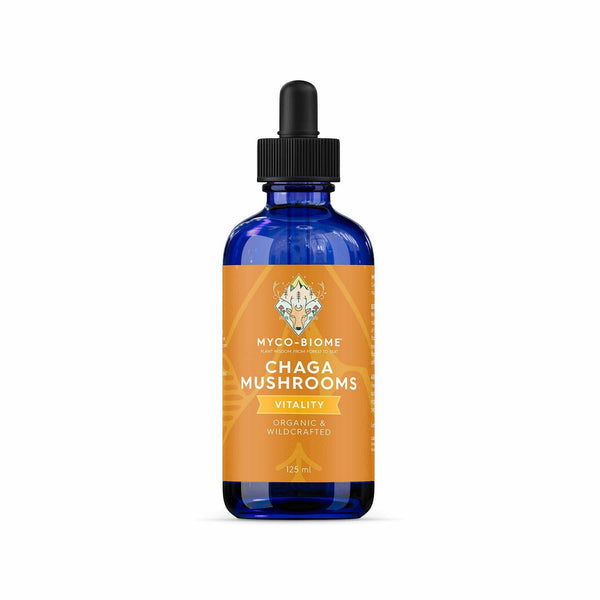
Chaga Mushrooms | Liquid Triple Extract
Adored Beast MYCO-BIOME · 125 ml · for dogs and cats
- Triple extracted in hot water, organic alcohol, and glycerin, with 0% alcohol left and every batch tested
- Fruiting body only, never mycelium grown on rice or oats
- Organic and ethically wildcrafted, certified organic by Ecocert
- Grown in a private forest in Maritime Canada or foraged in British Columbia
- Zero synthetics, zero fillers, zero additives
- 1 drop equals about 10 mg, dosed at 1 drop per pound of bodyweight daily
- Available on Subscribe & Save if you are using it as a daily habit
Chaga is high in oxalates, so this is not recommended for pets with a history of urinary or kidney stones.
Chaga vs turkey tail for dogs, what is the difference?
They are cousins, and they complement each other beautifully. Chaga leans toward antioxidant power, cellular resilience, and skin and coat support. Turkey tail is one of the most researched mushrooms for immune and gut support, prized for its prebiotic effect on the microbiome. Many pet parents use them together for whole-body immune support. If you want to layer them, our Turkey Tail mushroom extract pairs naturally with chaga in a daily routine.
Here they are side by side, so you can see which one fits the dog in front of you.
| Chaga Liquid Triple Extract | Turkey Tail Liquid Triple Extract | |
|---|---|---|
| Leans toward | Antioxidant load, cellular resilience, skin and coat | Immune and gut support, prebiotic effect on the microbiome |
| Choose it when | You are thinking about aging, oxidative stress, and coat quality | You are thinking about immune resilience and gut balance |
| Oxalate caution on label | Yes, not for pets with a urinary or kidney stone history | No oxalate caution on this label |
| Daily serving | 1 drop per pound of bodyweight | 1 drop per pound of bodyweight |
| Can you give both? | Yes. Many pet parents run them together for whole-body immune support, adding one at a time. | |
| Shop Chaga | Shop Turkey Tail | |
How to add chaga to your dog's routine
At PAWDEGA, we think about chaga the way we think about all real support: it works with the body, not instead of it. I add supplements straight into my dog Milka's meals, and at 10-plus years old, with a snout that is more white than black these days, supporting her immune resilience is something I think about every single day.
If you want a clean, honest place to start, PAWDEGA's liquid triple-extract Chaga is organic, ethically wildcrafted, and full-spectrum, with no synthetics, fillers, or additives. You can browse everything we stock in our medicinal mushrooms collection, or see the wider range of immune support supplements if you are building a routine from scratch. For pet parents who want broader daily coverage, our Immunity Support Bundle brings immune-supporting products together in one place. One note if your dog is on the do-not-use list above: the Vitality mushroom blend inside that bundle does contain chaga, so it is not the right pick for a dog with a stone or kidney history.
Whatever you choose, remember the frame. Chaga is daily support for your dog's own defenses. It is not a medicine, it is not a guarantee, and it is not right for every dog. But for the right dog, given thoughtfully, it can be a lovely addition to a whole-body wellness routine.
You are not powerless in your dog's health. You are their biggest advocate. And now you know more about chaga than most of the internet does.
Sources
- "Natural Products and Health Care Functions of Inonotus obliquus," Nutrients (MDPI), 2025. https://www.ncbi.nlm.nih.gov/pmc/articles/PMC12026145/
- "A brief overview of the medicinal and nutraceutical importance of Inonotus obliquus (chaga) mushrooms," Heliyon (ScienceDirect), 2024. https://www.ncbi.nlm.nih.gov/pmc/articles/PMC11336990/
- "Medicinal Mushrooms for Dogs," PetMD (veterinary-reviewed), 2023. https://www.petmd.com/dog/general-health/medicinal-mushrooms-for-dogs
- "Medicinal Mushrooms for Dogs," American Kennel Club (AKC), 2026. https://www.akc.org/expert-advice/health/medicinal-mushrooms-for-dogs/
- "Development of End Stage Renal Disease after Long-Term Ingestion of Chaga Mushroom: Case Report and Review of Literature," Journal of Korean Medical Science, 2020. https://pmc.ncbi.nlm.nih.gov/articles/PMC7234858/
- PAWDEGA product label, Chaga Mushrooms Liquid Triple Extract. https://pawdega.us/products/chaga
- PAWDEGA product label, Turkey Tail Mushrooms Liquid Triple Extract. https://pawdega.us/products/turkey-tail
Disclaimer: This blog may contain affiliate links, and PAWDEGA may earn a small commission at no extra cost to you if you purchase through them. It may also link to products on our website, and this content is for educational purposes, not a replacement for veterinary advice.