Do dogs need fiber? Yes, even though no official standard says they do.
Fiber is not listed as a required nutrient in the AAFCO Dog Food Nutrient Profiles, the standard behind almost every bag in the USA labeled complete and balanced. Those profiles set a maximum for crude fiber on the label. They never set a minimum. But your dog's large intestine is home to bacteria that ferment plant fiber into short-chain fatty acids, and those compounds are the main fuel for the cells lining the colon. Dogs have no fiber requirement on paper. What they have is a microbiome, and that microbiome runs on plant fiber.
In this article
- Do dogs need fiber if AAFCO does not require it?
- What fiber is actually doing inside your dog's body
- What are postbiotics, and why they matter more than the fiber itself
- Can a healthy dog still be short on fiber?
- The three types of fiber dogs need
- How much fiber to add, and how fast
- The best sources of fiber for dogs
- When more fiber is not the answer
- Whole food fiber or a fiber supplement?
I want to tell you how I ended up writing this, because it still bothers me a little.
We ran a comprehensive gut analysis on Milka. She is a senior now, she eats a fresh diet I have built and rebuilt over ten years, and she is thriving. I expected the results to be a formality.
One of the key recommendations came back: increase prebiotic fiber.
No diarrhea. No constipation. No soft stools. No sign at all that anything was missing. Her diet was already around 90% meat, organs, and bone, with roughly 10% plant matter, and she was on prebiotics and probiotics daily.
And she still needed more fiber.
If you have been feeding what looks like an excellent diet and assuming fiber is handled, I understand completely. That was me. Here is what I learned once I looked into it.
Do dogs need fiber if AAFCO does not require it?
AAFCO's nutrient profiles are built around nutrients the body itself needs to absorb: protein, specific amino acids, fats, vitamins, minerals. Carbohydrates and fiber are not recognized as essential nutrients in those profiles, which is why there is no minimum for them. Crude fiber appears on the guaranteed analysis panel as a maximum, a ceiling rather than a target.
And on the logic those profiles were built on, that is defensible. Your dog has no enzyme that digests fiber. Nothing about fiber is absorbed the way protein or zinc is absorbed.
But here is what most pet parents are never told. Those standards were written to describe what the dog needs to absorb. They were never written to describe what the dog's bacteria need to eat. A diet can clear every box on that profile and still leave the microbiome underfed, and nothing on the label will tell you.
Complete and balanced is a real standard. It is also a floor, not a ceiling.
What fiber is actually doing inside your dog's body
When most of us hear fiber, we think stool. Firmer poops, less straining, pumpkin for an upset tummy. All real. All a fraction of the story.
Fermentable plant fiber is the raw material your dog's gut bacteria live on. A 2024 study of healthy dogs found that different fiber sources enriched different bacterial species, and that the change in gut metabolites was even more pronounced than the change in bacteria themselves. Short-chain fatty acids, fiber-bound sugars, and polyphenols all rose in step with the specific fibers the dogs were eating.
Read that again, because it is the whole argument: which plants you feed changes which bacteria grow, and which compounds those bacteria produce.
This is also why the conversation has shifted. For years, fiber was a digestion tool. Now it is being studied as a microbiome input, and the microbiome is being connected to almost everything else.
What are postbiotics, and why they matter more than the fiber itself
Here is the chain, in plain language:
Prebiotic (the plant fiber) feeds the probiotic (the friendly bacteria), and what the bacteria produce is the postbiotic.
Those postbiotics are short-chain fatty acids: butyrate, propionate, and acetate. And they are not a by-product. A veterinary review of canine chronic enteropathy describes short-chain fatty acids as an essential energy source for colon cells, notes that they strengthen the tight junctions holding the gut barrier together, and that they help regulate the immune cells that keep the gut lining calm.
That matters because it reframes what you are feeding. You are not feeding your dog fiber. You are feeding the organism that makes the compound that fuels and seals the gut wall.
When I sat down with Julie Anne Lee, DCH, a holistic practitioner who has spent close to thirty years on gut health, she said something I have not stopped thinking about: there is no gut health without prebiotics. Without them, you lose the diversity, and without diversity, you lose the resilience.
One honest caveat, because you deserve it. In dogs with chronic gut inflammation, researchers still cannot say with certainty whether the microbial imbalance causes the inflammation or follows it. The association is well established. The direction is not settled. Anyone telling you otherwise is ahead of the evidence.
What is not in dispute is that the gut lining is one of the fastest renewing tissues in the body, turning over roughly every three to five days in mammals. Whatever you feed today, you are feeding a gut wall that will largely be rebuilt by next week.
Can a healthy dog still be short on fiber?
Yes. Milka is the proof I did not want.
Stool quality is a lagging indicator. It tells you about bulk, moisture, and transit. It does not tell you how many bacterial species are living in there, or how much butyrate they are making. A dog can produce a textbook stool on a narrow diet, because narrow does not mean inadequate for bulk.
The human research makes this uncomfortably clear. In the American Gut Project, the people eating more than thirty different plant types a week had measurably more diverse gut microbiomes than people eating ten or fewer. Not more grams of fiber. More kinds of plants. And plant variety predicted microbial diversity better than whether someone called themselves vegan or omnivore.
That study was in people, and the equivalent trial has not been run in dogs. I am not going to pretend it has. But it is the clearest demonstration we have that the question is not how much fiber. It is how many different plants.
And if you want to know why the whole food version matters rather than the number on a label, there is a controlled human trial worth knowing about. Participants ate an ultra-processed diet and an unprocessed diet, matched for calories, sugar, fat, sodium, macronutrients, and fiber, and were allowed to eat as much as they wanted of either. On the ultra-processed version, they ate around 500 more calories a day and gained weight. Same numbers on paper. Different outcome in a body.
This is the part I wish someone had said to me five years ago. A nutrient panel is a description of food. It is not a prediction of what the food will do.
The three types of fiber dogs need
You will see fiber split into three categories. They behave differently, and your dog benefits from all three.
| Type of fiber | What it does in the gut | Whole food examples |
|---|---|---|
| Soluble | Dissolves and forms a gel. Acts like a sponge, which is why it helps both loose and hard stools. Highly fermentable, so it feeds bacteria well. | Pumpkin, apple without seeds, zucchini, blueberries |
| Insoluble | Does not dissolve. Adds bulk and keeps things moving through the tract. Less fermentable, so it does less for the bacteria. | Kale, celery, dark leafy greens, green beans |
| Resistant starch | Passes the small intestine undigested and ferments in the large intestine. Strongly linked to short-chain fatty acid production. | Cooked and cooled sweet potato, green banana |
Now the part that lets you stop worrying about the table. Most real plants contain a mix of all three. Nobody needs to calculate ratios. Feed a genuine range of whole plants, and your dog gets the range by default, and the microbiome takes what it needs.
And by plants, I do mean all of it. Herbs count. Spices count. Brewed herbal teas count. In the human thirty-plant framework, herbs, spices, teas, and grains are all included in the tally, and there is no reason to count differently for a dog.
How much fiber to add, and how fast
There is no universal number, and I would be suspicious of anyone who gives you one. What I can give you is the sequence I follow with Milka, which is the go-slow approach holistic vets commonly recommend. This is practice-based guidance, not a published protocol.
- Start from where you actually are. Work out roughly what percentage of the bowl is plant matter today. For many fresh-fed dogs, it sits around 10%. For most kibble-fed dogs, the fiber present is largely cellulose, which adds bulk and ferments poorly.
- Add about 5% more plant matter, not more. Going from 10% to 15% is a real change. Going from 10% to 40% in a week is how you end up with gas, loose stools, and a dog who now distrusts vegetables.
- Hold for two to three weeks and watch the stool. You are looking for well-formed with a little give. Chalky white and crumbly means too much bone and not enough fiber. Loose and unformed means you moved too fast.
- Then raise it again by another 5%. Repeat the hold and the watch. Energy, coat and stool are your three readouts, and they are free.
- Go slower on kibble. A kibble-fed dog's microbiome is a different ecosystem from a raw-fed dog's. Smaller increments, longer holds.
- Rotate rather than escalate. Once you find the level, stop raising the amount and start changing the plants. Five different vegetables this fortnight, five different ones next. Variety is the goal, not volume.
And do not push plant matter so high that you displace the meat, organs, and bone your dog's diet is built on. More fiber is a supporting change, never a replacement for the foundation.
If you want this written out properly, with the common mistakes laid out before you make them, I put together a free guide you can keep.
The best sources of fiber for dogs
The best source is a varied rotation of whole plants. Dark leafy greens, cruciferous vegetables, low-sugar fruit, herbs, and the occasional resistant starch.
And before anyone objects that dogs are carnivores and should not be eating plants at all: dogs separated from wolves partly through diet. A landmark genomic study found that domestication selected for increased copies of the pancreatic amylase gene, improving starch digestion compared with wolves. Even wolves themselves forage heavily when prey is thin. In the Greater Voyageurs Ecosystem in Minnesota, blueberries have been recorded making up as much as 83% of a wolf pack's weekly diet in July, and adults have been filmed regurgitating berries for their pups.
Three things that make this stick in real life:
- Blend or purée. Whole broccoli florets get spat out and also pass largely intact. Breaking the cell walls is what makes the fiber and the phytonutrients available.
- Use bone broth or liver as a carrier. The smell does the convincing for you, and a hunk of liver stirred through a vegetable blend covers almost anything.
- Batch and freeze. Larry and I blend a mix, freeze it in cubes, and drop one into Milka's bowl daily. One hour on a Sunday covers a fortnight.
That is the honest version, and it works. It also takes a Sunday. If the real obstacle is time rather than willingness, which it usually is, a ready-made whole food vegetable blend gets you the same diversity without the prep, and it is what I reach for on the weeks life gets loud.
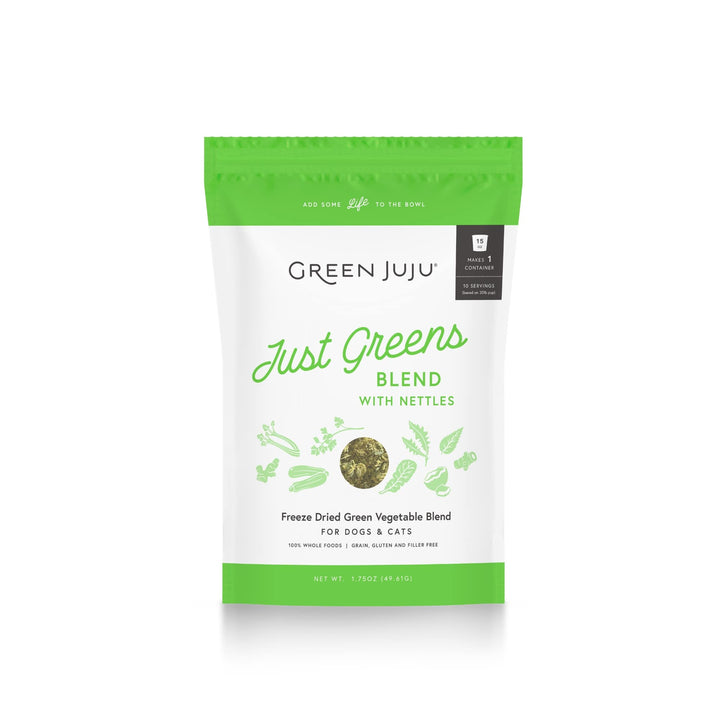
What goes in Milka's bowl
Just Greens, Organic Vegetable Blend with Nettles
I chose this one over a fiber powder for a specific reason. A powder gives you one isolated fiber. This gives you ten different organic plants in a single scoop, which is exactly the diversity the research keeps pointing to. It is freeze-dried rather than heat-processed, so the plant material arrives intact.
- Ten organic plants: zucchini, celery, kale, dandelion greens, coconut flour, parsley, coconut oil, nettles, ginger, turmeric
- Crude fiber up to 11%, a meaningful step up from a bowl at 10% plant matter
- Zero synthetics, fillers, or grains, and no isolated inulin or FOS
- Shelf-stable, so it suits travel and small freezers
One thing I would do differently if I were starting again: rotate the blend as well as the vegetables. Each one in the Green Juju range is built on a different plant and protein base, so alternating them widens the plant count without any extra thought. The same logic applies to pre and probiotics, which are worth rotating rather than running one formula forever.
When more fiber is not the answer
I would be doing you a disservice if I sent you off to pile vegetables into every bowl. There are dogs for whom this is the wrong move right now.
- A dog with active yeast overgrowth. Rust-coloured paws, that distinctive smell, recurring ear issues. Sugars feed yeast, and fruit and starchy root vegetables carry sugar. Get the yeast under control first, then build plant diversity back in.
- A dog mid-flare with a gut condition your vet has already identified. Chronic enteropathy, pancreatitis, a current episode of anything. Changing the diet during a flare makes it impossible to read what is happening. Work with your vet on timing.
- A dog whose stools are already loose. Fix the baseline before adding a variable.
One more, and it is a label-reading point rather than a dog-type point. Watch for FOS, inulin, and maltodextrin on ingredient panels. They are technically prebiotics, and they do feed bacteria, but they are isolated fractions, and in a dog already fighting yeast, they can feed the wrong residents. A whole plant is a different proposition from a purified sugar chain.
Whole food fiber or a fiber supplement?
This is the decision most pet parents are actually facing, usually standing in front of a shelf. Here is how I would think about it.
| Whole food plant blend | Isolated fiber supplement | |
|---|---|---|
| Best for | Daily, long-term microbiome support in a dog with no acute problem | A short-term, specific stool issue, or travel where fresh food is not practical |
| Key difference | Many plants, so many fiber types plus polyphenols and micronutrients arriving together | One fiber, delivered in isolation, with nothing else attached to it |
| What the evidence shows | In healthy dogs, different fiber sources enrich different bacteria and different metabolites. Diversity of source is the active variable | Single prebiotics reliably shift stool quality and raise short-chain fatty acids. Narrower effect, well documented |
| Where to start | Just Greens with Nettles, then rotate through the other blends | Reach for it alongside the whole food base, not instead of it. Browse gut health support |
Neither column is wrong. But if you buy only one thing after reading this, buy plants.
Because the shift that changed how I feed Milka was not learning that fiber matters. It was realizing that fiber is not a problem-solving tool you reach for when something goes wrong. It is a longevity input, working quietly, on a dog who looks perfectly fine.
You do not have to overhaul anything this week. Add one vegetable you have never fed before. Then another. Watch the stool, watch the coat, watch the energy, and let it build.
You are your pet's biggest advocate, and this is one of the least complicated places to use that.
Much love, Larry
Please keep in mind that I am not a veterinarian, and this is not medical advice. Every pet is unique, so I always recommend working alongside your vet, ideally a holistic or integrative vet, especially for anything ongoing or serious.
Sources
- Association of American Feed Control Officials. Model Regulations for Pet Food and Specialty Pet Food, and AAFCO Dog Food Nutrient Profiles. aafco.org
- Response of the gut microbiome and metabolome to dietary fiber in healthy dogs. mSystems, 2024. pmc.ncbi.nlm.nih.gov
- Dandrieux J. and Mansfield C. Canine chronic enteropathy, current state-of-the-art and emerging concepts. Frontiers in Veterinary Science, 2022. pmc.ncbi.nlm.nih.gov
- van der Flier L. and Clevers H. Stem cells, self-renewal, and differentiation in the intestinal epithelium. Annual Review of Physiology, 2009. annualreviews.org
- McDonald D. et al. American Gut, an open platform for citizen science microbiome research. mSystems, 2018. University of California San Diego summary
- Hall K. et al. Ultra-processed diets cause excess calorie intake and weight gain, an inpatient randomized controlled trial of ad libitum food intake. Cell Metabolism, 2019. cell.com
- Axelsson E. et al. The genomic signature of dog domestication reveals adaptation to a starch-rich diet. Nature, 2013. Follow-up analysis, Animal Genetics
- Gable T., Voyageurs Wolf Project. Talking wolves' diets with the University of Minnesota. twin-cities.umn.edu
- Homkes A. et al. Berry important? Wolf provisions pups with berries in northern Minnesota. Wildlife Society Bulletin, 2020. wildlife.onlinelibrary.wiley.com
- Getty C., DVM, PhD, DACVIM (Nutrition). How prebiotics and postbiotics support dogs' and cats' gut health. dvm360, 2026. dvm360.com