A mushroom supplement for dogs is worth buying when the label can answer six questions: which part of the fungus is in the bottle, what that fungus was grown on, whether it was extracted, whether the potency figure is beta-glucans rather than total polysaccharides, whether a third-party certificate of analysis is available, and what else is in the bottle. Products that cannot answer those six are usually mycelium grown on grain, where industry testing has found starch making up a third or more of the finished powder.
The short version: the front of a mushroom supplement label tells you what the brand wants you to think, and the ingredient panel tells you what you are actually feeding your dog.
What's in this guide
- What is actually inside a mushroom supplement for dogs?
- Fruiting body or mycelium: why does it matter?
- Why do mushrooms have to be extracted at all?
- Beta-glucans or polysaccharides: which number tells the truth?
- What should a certificate of analysis actually show?
- What else is in the bottle, and what should not be?
- The six-check label test
- One mushroom or a blend?
- What does the research actually show in dogs?
- How to start, without overthinking it
- So which should you actually buy?
- Sources
Let's be real for a second. Mushrooms for dogs went from niche to everywhere in about three years, and the supplement aisle got very crowded, very fast. Powders, capsules, tinctures, chews, blends with ten species on the front. Some cost a few dollars. Some cost sixty. And almost all of them use the same words.
I have been feeding Milka medicinal mushrooms for years. She is a eleven-year-old French Bulldog and they are one of the few things that have stayed in her bowl the whole way through. So I have bought a lot of these products, and I have read a lot of these labels, and here's what most pet parents are never told: the difference between two bottles that both say "mushroom" on the front can be the difference between a real fungal extract and a bag of ground oats.
That is not me being dramatic. It is a documented, testable, industry-wide labelling problem. Here's what the research tells us, and exactly what to look for before you spend a cent.
What is actually inside a mushroom supplement for dogs?
One of four things, and the word "mushroom" on the front does not tell you which:
- Fruiting body. The mushroom itself, the part you would recognize growing on a log. This is what traditional use and most of the published research is built on.
- Mycelium. The fine root-like network the fungus grows through its substrate before it fruits.
- Mycelium grown on grain. Mycelium cultivated across rice, oats or sorghum, then milled together with that grain. Often labelled with terms like "mycelial biomass" or "full spectrum".
- Whole dried powder, unextracted. Mushroom material dried and ground, with nothing done to make the active compounds available.
All four can legally be called a mushroom supplement. They are not the same product, and they do not deliver the same thing to your dog.
Fruiting body or mycelium: why does it matter?
Because of what comes along with the mycelium.
When mycelium is grown on grain, the grain does not get removed at the end. It cannot practically be separated, so it is milled into the finished product. Nammex, a Canadian mushroom ingredient supplier that has run beta-glucan and starch testing across close to a hundred commercial samples, has reported that the residual grain can make up the majority of a mycelium product, with starch running as high as 60% in some cases. Across the mycelium-on-grain samples in that testing, starch averaged roughly 35% to 40% of dry weight.
The contrast in the same testing is stark. Whole dried reishi measured around 28% beta-glucan and almost no starch. Reishi mycelium samples measured between roughly 1% and 7% beta-glucan, with starch between 45% and 51%.
This is not a fringe complaint. Nammex filed a citizen petition asking the US Food and Drug Administration to require labels to state the fungal part used and to disclose any grain substrate included in the product. The Natural Products Association filed a related petition. It is worth saying that the position is contested: the Functional Mushroom Council and mycologist Paul Stamets argue that grain colonised by mycelium is transformed rather than inert, and that beta-glucan testing is not the only measure that matters. That argument is ongoing and honest people sit on both sides of it.
My take, and it is a take rather than a settled fact: until labels are required to disclose substrate, I want the part of the fungus that thousands of years of traditional use and most of the veterinary research are actually built on. That is the fruiting body.
Why do mushrooms have to be extracted at all?
Because of chitin.
Fungal cell walls are built from chitin, the same structural material in the shells of shellfish. Neither we nor our dogs produce the enzymes to break it down efficiently. So the beta-glucans and other compounds inside those cells stay locked in there unless something opens the cell wall first.
That something is extraction, and there are two kinds that matter:
- Hot water extraction releases the water-soluble compounds, including beta-glucans.
- Alcohol extraction releases the compounds water cannot reach, including triterpenes and ganoderic acids in reishi, and hericenones and erinacines in lion's mane.
Use only one method and you get half the mushroom. Dual extraction means both have been done, which is why it is the phrase worth hunting for on a label. Some producers add a third step, recovering the mineral salts, which is where the term spagyric comes from.
A dried, ground, unextracted powder is not useless. Cooked culinary mushrooms in the bowl are a genuinely good source of insoluble fibre for the gut microbiome. But fibre is a different job from the immune and cognitive support people are buying these products for, and it is worth being clear with yourself about which one you are paying for.
Beta-glucans or polysaccharides: which number tells the truth?
This is the check almost nobody knows about, and it is the one that separates a real potency claim from a number designed to look like one.
Beta-glucans are the fungal cell wall compounds most of the published research concerns. They are recognised by immune receptors including Dectin-1, and unlike starches, they are not broken down by digestive enzymes, so they reach the intestine intact where that recognition happens.
Here is the catch. "Total polysaccharides" is a broader measurement that captures alpha-glucans as well, and starch is an alpha-glucan. So a product built on grain-grown mycelium can post a big, impressive polysaccharide number that is substantially made of the oats or rice it was grown on.
And there is a second layer to this that Carter Easler, Director of Research and Education at MycoDog, raised when I had him on the Next Level Pet Parent Podcast: oats contain beta-glucans too. But cereal beta-glucans and fungal beta-glucans are structurally different molecules. A 2026 review of fungal beta-1,3-glucans sets out the distinction plainly. Cereal beta-glucans are unbranched with mixed linkages and engage immune receptors minimally and indirectly. Fungal beta-glucans carry a branched structure with high affinity for Dectin-1 and CR3. Both can be counted on a certificate. Only one is the thing you came for.
So: look for a stated beta-glucan percentage. If a label or certificate gives you only "polysaccharides", ask the brand for the beta-glucan figure and, for anything mycelium-based, the starch figure. Note whether an answer arrives.
What should a certificate of analysis actually show?
A certificate of analysis is third-party lab testing of the finished product. It should be available without you having to chase it, and it matters more with mushrooms than with almost any other supplement category, for one specific reason.
Fungi are bioaccumulators. They actively draw heavy metals out of whatever they are growing in, often concentrating them well above the levels in the substrate itself. Cadmium and lead are the usual concerns. A study of 164 samples of commercial dried mushrooms found contamination levels varied significantly with species, supplier and certification status, which is the whole argument for testing the actual batch rather than trusting a category.
This is also why growing region is a real question and not marketing flourish. Where a mushroom grew is in the mushroom.
A certificate worth its name covers what you want in the product, meaning beta-glucans, and what you do not, meaning heavy metals, pesticides and microbials.
What else is in the bottle, and what should not be?
Three things to scan for on the inactive ingredients line:
- Flow agents and bulking fillers. Microcrystalline cellulose is wood pulp. It is there to fill space. Some capsule products run 40% to 60% filler.
- Xylitol, including under other names. Xylitol causes a rapid insulin release in dogs, leading to hypoglycaemia, and at higher doses it has been associated with liver failure. The ASPCA Animal Poison Control Center flags it as one of the most dangerous common household ingredients for dogs. It also appears on labels as birch sugar, birch sap or birch bark extract, so scan for those too.
- Alcohol left in a tincture. Alcohol is used in extraction, which is a good thing. Whether it remains in the finished bottle is a separate question, and a fair one to ask a brand directly. Glycerin-preserved tinctures are one way around it.
The six-check label test
Print this, screenshot it, whatever works. It takes about ninety seconds per product once you know what you are looking at.
| The check | What a good label says | What a red flag looks like |
|---|---|---|
| 1. Which part | "Fruiting body" stated explicitly | "Mycelial biomass", "full spectrum", or silence on the part used |
| 2. Grown on what | Wood, logs, or the species' native substrate, with the region named | Rice, oats, sorghum, or no substrate disclosed at all |
| 3. Extraction | "Dual extracted" or "hot water and alcohol" | Ground powder with no extraction step described |
| 4. The potency number | A stated beta-glucan percentage | "Total polysaccharides" only, or a bare milligram figure |
| 5. Third-party testing | A certificate of analysis you can view, covering heavy metals | "Lab tested" as a phrase, with no document behind it |
| 6. Everything else | A short inactive list you can read in one breath | Cellulose, xylitol or birch sugar, unnamed "proprietary" bulk |
A brand doing this properly is usually proud of it, because every one of these checks costs them money. Growing on wood takes months where grain takes days. If a company is not excited to tell you how their mushrooms were grown, that silence is your answer.
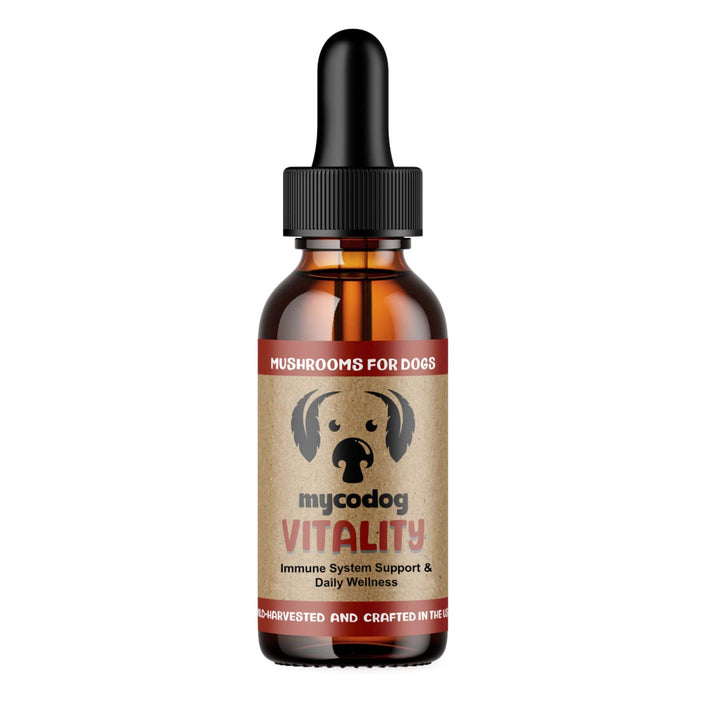
The one I rotate through Milka's bowl
MycoDog Vitality
I picked this one because it passes all six checks without me having to email anyone. It is a fruiting body extract of turkey tail, reishi, shiitake, maitake, chaga, artist conk and red belted conk, with astragalus root and ashwagandha alongside them. If you only ever use the table above and nothing else from this post, this is the product it points at.
- Fruiting body only, stated on the label
- Grown outdoors on natural substrate in the Pacific Northwest, not in a bag on grain
- No grain, no mycelium, no fillers
- Triple extracted, so both the water-soluble and alcohol-soluble compounds are available
- Third-party lab tested
- Liquid, so it goes on food without a fight
One mushroom or a blend?
Both are defensible, and the answer depends on what you are doing.
A single-species extract is the easier product to evaluate, and it is the right call when a vet has named a specific mushroom, or when you want to understand one species properly before adding another. Our individual guides go deeper on each one: turkey tail, reishi, chaga, and lion's mane.
A blend has a different argument behind it. Different species have overlapping properties with individual specialisations, and mycologists describe a synergy where combined species do more together than the same species do alone. In the wild, these fungi often grow in the same regions on similar substrates. Carter's point on the podcast was that we evolved alongside a variety of them, not one at a time.
What makes a blend suspect is not the number of species. It is a long species list with no stated amounts, which usually means a sprinkle of each for the label rather than a formulator's decision. A disclosed two-to-three species formula at meaningful amounts is a considered product. Ten species and no numbers is a marketing exercise.
What does the research actually show in dogs?
Less than the marketing implies, and more than the sceptics allow. Both things are true, and you deserve the honest version.
Turkey tail and hemangiosarcoma. In 2012, a team at the University of Pennsylvania School of Veterinary Medicine ran a randomised, double-blind pilot study of a standardised turkey tail polysaccharopeptide extract in fifteen dogs with splenic hemangiosarcoma, an aggressive cancer with a grim baseline. Dogs received 25, 50 or 100 mg per kilogram daily. Median survival in the highest group was 199 days, against a previously reported median of 86 days for dogs receiving no further care after surgery. The lead researcher, Dorothy Cimino Brown, said publicly that the team was stunned by the result. Here is the part the supplement ads leave out: a larger 2022 follow-up did not confirm that survival benefit, and both studies reported funding from companies associated with the product. One promising small pilot is a reason to keep studying something. It is not a settled answer.
Mushrooms and cognitive decline in senior dogs. MycoDog's Senior Dog Study enrolled thirty senior dogs showing signs of cognitive decline in a twelve-week protocol using their Clarity formula, which combines lion's mane, reishi and cordyceps with bacopa monnieri and ashwagandha. They reported 81% of dogs either stabilising or improving on cognitive scoring, an average 39% reduction in cognitive dysfunction scores, activity-collar data showing calmer nights, and blood biomarkers moving in the right direction with CRP down and BDNF up. It is a manufacturer-run study without a placebo arm, and I will say that plainly rather than let you find it out later. It is also the first formal work of its kind in this area, and the mixed design of real-world tracking plus clinical biomarkers is a genuinely useful contribution.
The mechanism research is the strongest part. How fungal beta-glucans are recognised by the immune system, why their branched structure matters, why they survive digestion intact, and why extraction is required to access them at all: that body of work is substantial and not in dispute.
And one framing shift worth carrying with you. We talk about "boosting" the immune system as though more is always better. For a dog whose immune system is already overactive, which is what is happening with a lot of allergy pictures, more is not the goal. Adaptogens are described as supporting balance rather than pushing in one direction, which is why the same mushroom may be used across very different dogs. Modulation, not amplification.
How to start, without overthinking it
Start low and build up over a week or two while you watch how your dog responds. That is not a hedge, it is how you learn what is working. Mushroom extracts are described as having a broad therapeutic window, meaning you do not have to hit an exact milligram per kilogram to see benefit, but building slowly still lets you notice changes rather than guess at them.
Follow the serving guidance on the label you have chosen, since concentration varies enormously between products and a dropper of one thing is not a dropper of another. And be consistent. Some effects show up quickly, particularly the calming ones. The systemic, balancing work takes months, and it only happens if the bottle actually gets used.
If your dog has a named condition, is on medication, or you want a serving amount worked out for your specific dog, that is a conversation for a vet who knows this territory. We keep a list of holistic vets offering online consultations for exactly that.
Once you have applied these six checks to a mushroom supplement, you will find you cannot stop applying them. The same questions work on an omega, a probiotic, a joint formula, everything. If you want the whole standard in one place, the Holistic Pet Wellness Blueprint is where we have written it down.
And please, take the pressure off yourself. You do not need to change everything at once. One good bottle, used consistently, does more than a cupboard full of things you bought in a panic and stopped after a week.
So which should you actually buy?
| A multi-species blend | A single-species extract | |
|---|---|---|
| Best for | A healthy dog and a daily proactive routine you intend to keep for years | A vet has named one mushroom, or you want to learn one species at a time |
| Key difference | Overlapping properties across species, with the synergy argument behind it | Easiest product to evaluate, because there is one thing to check |
| Evidence status | One manufacturer-run canine study, strong mechanism research, long traditional use | Turkey tail carries the only published canine clinical work, with a pilot unconfirmed by follow-up |
| Where to look | Vitality, or the full MycoDog range | The medicinal mushroom collection |
Either way, run the six checks first. The brand that survives them is the one worth your money.
Please keep in mind that I'm not a veterinarian, and this isn't medical advice. Every pet is unique, so I always recommend working alongside your vet, ideally a holistic or integrative vet, especially for anything ongoing or serious.
With gratitude, Charly
Sources
- Brown DC, Reetz J. Single agent polysaccharopeptide delays metastases and improves survival in naturally occurring hemangiosarcoma. Evidence-Based Complementary and Alternative Medicine, 2012. Study summary
- University of Pennsylvania. Mushroom-derived compound lengthens survival in dogs with cancer, Penn Vet study finds. 2012. Penn Vet release
- Basedow K, reviewed by Hass JA, DVM. Turkey Tail Mushroom For Dogs, covering the 2022 follow-up study. DogCancer.com, 2024. Article
- Fungal beta-1,3-glucans: Cell Wall Constituents That Promote Gut Health Through Innate Immune Modulation. 2026. Review
- Batbayar S, Lee DH, Kim HW. Immunomodulation of Fungal beta-Glucan in Host Defense Signaling by Dectin-1. Biomolecules and Therapeutics. Review
- NutraIngredients, interview with Jeff Chilton of Nammex on mycelium-on-grain starch content. 2017. Article
- Nammex renews call for functional fungi label accuracy and transparency. Nutrition Industry Executive. Article
- FDA citizen petitions on mushroom supplement labelling. Shroomer. Article
- Evaluation of Toxic Elements in Commercial Dried Mushrooms: Exposure Assessment and Health Risk Characterization. 2026. Study
- MycoDog. The Senior Dog Study. Report and Pet Age coverage
- ASPCA Animal Poison Control Center. Updated Safety Warning on Xylitol: How to Protect Your Pets. Advisory
- Carter Easler, Director of Research and Education at MycoDog, in conversation on the Next Level Pet Parent Podcast. Episode