Chamomile for dogs is used for three things: taking the edge off situational stress, settling a mildly upset stomach, and soothing irritated skin when it is applied to the outside. The calming effect comes from a flavonoid called apigenin. Most of the good evidence behind it is human rather than canine. And the species printed on the label matters far more than almost anyone tells you, because German chamomile is the one used in pet formulas, while Roman chamomile is the one the ASPCA lists as toxic to dogs, cats and horses.
Here is the honest version in one sentence: chamomile is safe for most dogs in small, sensible amounts and may support a calmer, more settled dog, but it works on the signal rather than on the reason the signal is there.
In this article
- What are the real benefits of chamomile for dogs?
- German or Roman: which chamomile is safe for dogs?
- Can dogs drink chamomile tea, and how much?
- Is chamomile safe for dogs?
- Why is your dog anxious in the first place?
- How do you add chamomile to your dog's routine?
- How long before you see a difference?
- Chamomile tea or a chamomile supplement?
- Sources
You have probably already had the conversation. Your dog paces at night, or panics at the door, or throws up when the car keys come out, and someone suggested chamomile tea. It sounds gentle. It sounds like something you can do tonight without another appointment.
So let's look at what it actually does, where the evidence stops, and the one label detail that separates a sensible herb from a plant on a poison-control list.
What are the real benefits of chamomile for dogs?
Most pet parents arrive at chamomile for dog anxiety, so let's start there. Chamomile has three areas where it earns its reputation, and one where it does not.
Calming. The active compound is apigenin. Research summarised in a widely cited review of chamomile pharmacology describes apigenin binding at the benzodiazepine site in the brain, the same allosteric pocket prescription sedatives use, but far more weakly. The same review reports a separation index, the ratio between the largest calming dose and the smallest sedating dose, of 3 for diazepam and 10 for apigenin. In plain terms, the gap between calm and drowsy is wider with the herb.
Digestion. Chamomile is associated with reduced smooth muscle spasm in the gut, which is the mechanism behind its long use for gas, cramping and mild nausea. In one infant colic trial cited in that same review, a chamomile-containing tea resolved colic in 57% of babies against 26% on placebo.
Skin, applied topically. Cooled chamomile is a traditional rinse for hot, weeping skin. This is also where I want to be straight with you: that review notes the value of chamomile for skin irritation has not been established through evidence-based research. It is traditional use with a plausible anti-inflammatory mechanism, not a proven one.
Where the evidence gets thin. The strongest chamomile trials were run in people, not dogs. In a randomised, double-blind, placebo-controlled trial published in 2009, 57 adults with mild to moderate generalised anxiety took a standardised chamomile extract at 1,100 mg a day for eight weeks and showed a significantly greater drop in anxiety scores than placebo. A later open-label study of 179 people at 1,500 mg a day reported that 58.1% met the criteria for response. A 2016 randomised trial then followed responders for 26 more weeks and found long-term use well tolerated.
Those are real, replicated results. They are also results in humans, at extract doses far above what is in a teacup, and nobody has run the equivalent study in dogs. Anyone telling you chamomile is clinically proven for canine anxiety is stretching what the research says.
German or Roman: which chamomile is safe for dogs?
This is the part most articles skip, and it is the part that matters if your dog has access to a garden.
Scroll sideways to see the full table.
| What to check | German chamomile | Roman chamomile |
|---|---|---|
| Botanical name | Matricaria chamomilla | Anthemis nobilis |
| Also sold as | Hungarian, wild, true chamomile | English, garden, ground apple |
| On the ASPCA plant list | Not the species listed | Listed toxic to dogs and cats |
| Used in pet formulas | Yes, the usual choice | Rarely |
The ASPCA lists Anthemis nobilis, sold under names including Roman chamomile, garden chamomile and ground apple, as toxic to dogs, cats and horses. It names the toxic principles as volatile oil compounds including bisabolol, chamazulene, anthemic acid and tannic acid, and the signs as contact dermatitis, vomiting, diarrhoea, loss of appetite and allergic reactions. It also notes that long-term use has been associated with bleeding tendencies. A second entry covers Anthemis cotula, stinking chamomile, with the same profile. We did not find a corresponding ASPCA entry for Matricaria chamomilla.
Here is what most pet parents are never told about that listing. A poison-control plant entry describes a dog grazing the growing plant, unmeasured, in an unknown quantity. That is a completely different exposure from a measured amount of German chamomile in a formulated product. Both facts are true at once. The listing is not a reason to panic if your dog has had chamomile, and it is a very good reason to know which species you are holding.
German chamomile is the one with the weight behind it. The International Herb Association named it Herb of the Year for 2025.
Can dogs drink chamomile tea, and how much?
Chamomile tea for dogs is where most pet parents start. Yes, dogs can have it, in small amounts, fully cooled, unsweetened, with nothing else in the bag. No caffeinated blends, no added sweeteners, no milk.
The amount is where it falls apart. There is no agreed chamomile dosage for dogs. We went looking for a published veterinary dosing standard and could not find one. What exists instead is consumer guidance that disagrees with itself by a wide margin.
Scroll sideways to see the full table.
| Published guidance | Amount suggested | How often |
|---|---|---|
| Hundeo | 1 to 2 tbsp, dog under 10 kg | Once or twice a week |
| Houndsy | 1 to 2 tsp per 10 lb of dog | Daily |
| PetsCare | 1 to 2 tsp small, 1 to 2 tbsp large | Occasional only |
| Peer-reviewed canine dose | None found | Not established |
Those rows are in different units, so run the first two on the same dog. Take a 10 kg dog, about 22 lb. Hundeo's ceiling is 2 tbsp twice a week, which is roughly 4 tbsp across the week. Houndsy's is 2 tsp per 10 lb every day, which is a little over 4 tsp a day, or roughly 10 tbsp across the week. Same dog, same herb, about two and a half times the weekly amount, from two pages that both read as careful advice. The sources above are consumer guidance pages, listed here to show the spread rather than as authorities to follow.
That spread is the honest argument for using a product formulated for dogs, where the amount per serving is fixed by weight and does not depend on how long you left the bag in the water.
Is chamomile safe for dogs?
For most dogs, yes, in sensible amounts. There are four situations where it is a conversation with your vet before it becomes a routine, not after.
- Your dog is on a blood thinner or has surgery coming up. Chamomile carries coumarin compounds. A 2006 case report in the Canadian Medical Association Journal described a 70-year-old woman on warfarin who developed multiple internal bleeds after heavy use of chamomile tea and lotion, and the authors attributed it to a herb and drug interaction. The ASPCA separately notes bleeding tendencies with long-term use. This one is worth raising even if it feels cautious.
- Your dog reacts to the daisy family. Chamomile sits in the Asteraceae family alongside ragweed, daisies and marigolds. A dog sensitive to those can react to this.
- Your dog is pregnant or nursing. Chamomile may stimulate the uterus, so it is generally avoided here.
- Your dog is already on a sedative or an anti-anxiety medication. Apigenin acts at the same receptor site family those drugs use. Stacking two things at one receptor is a decision for the person holding the prescription.
Too much chamomile, in any dog, can cause vomiting, diarrhoea, drooling, loss of appetite or unusual sleepiness. If you see any of those after starting it, stop and call your vet.
And to answer the question you are probably actually asking: yes, you can raise this with your vet without it becoming a fight. Ask whether chamomile interacts with anything your dog is already taking. That is a factual question with a factual answer, and a good vet will give it to you.
Why is your dog anxious in the first place?
This is the part I care about most, because it is the part that changed things for my own dog.
Milka came to us with chronic gut problems. Vomiting. Loose stool. Itchy, angry skin. We did everything we were told. Countless vet visits. Premium kibble. Expensive medication. And she was also a wound-up, unsettled dog, which everyone put down to her being a Frenchie. Nobody ever suggested those two things were the same problem.
They often are. The gut and the brain talk to each other constantly, and in dogs that conversation is measurable. Research published by the Purina Institute followed anxious Labradors in a blinded crossover study and reported that dogs given the probiotic strain Bifidobacterium longum BL999 showed significant reductions in anxious behaviours, along with lower salivary cortisol and lower heart rates when facing anxiety-provoking situations. That research is funded by a pet food manufacturer, which you should factor in. It is also the most robust canine-specific work in this area, which is why it is here.
So here is the reframe. If your dog is anxious and has inconsistent stool, or gas, or skin that flares, the anxiety is not a separate problem sitting on top of a gut problem. Chamomile can take the edge off the signal tonight. Something has to address why the signal keeps arriving.
Two things worth knowing while you work that out. Licking is genuinely self-soothing for dogs, so a lick mat with something spread on it is a real calming tool and not a gimmick. And a highly processed, pro-inflammatory diet works against everything else you are trying to do, which is why food comes before supplements every time.

If the anxiety travels with a gut problem
The Wolf, Species Appropriate Pre & Probiotic
Chamomile works on the moment. This works on the terrain underneath it. Three lupine probiotic strains with triple-extracted turkey tail mushroom as the prebiotic, in a liquid you dose by drop rather than a powder a suspicious dog can refuse.
- 15 billion CFU per serving, 1 drop per 2 lb of body weight
- Prebiotic included, which most probiotics leave out
- Free from maltodextrin, cellulose and animal fat
If you want to compare the options side by side, our range of dog probiotics that pair prebiotics with the strains is the place to start.
How do you add chamomile to your dog's routine?
Three formats, in order of how much control you have over the amount.
Cooled tea, poured over food or added to the water bowl. Cheapest, least consistent. Brew strength varies every time.
A cooled tea compress, held on irritated skin. This is the traditional use with the longest history and the least risk, since almost nothing is swallowed.
A formulated organic supplement, measured by weight. Same herb, fixed amount, no brewing variable. This is what I use, because the point of the research above is that dose consistency is the whole game.
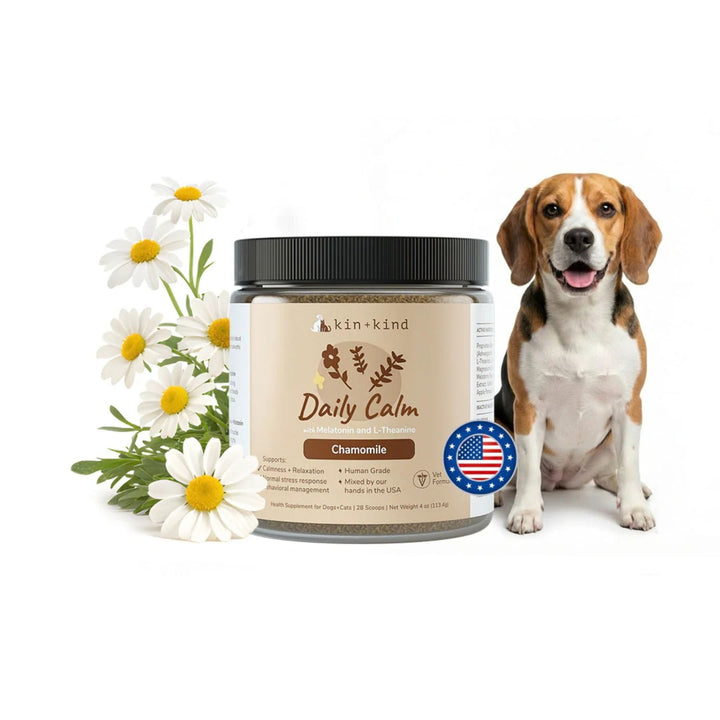
The one I keep in Milka's cupboard
Organic Daily Calm Supplement
Six ingredients, no synthetics, no fillers, and chamomile sitting alongside ginger and thyme rather than buried in a flavoured chew. You sprinkle it on whatever your dog already eats, which matters when the dog you are trying to settle is also the fussy one.
- Organic coconut, flax seed, apple pomace, chamomile, thyme, ginger
- 100% USDA Certified Organic, no GMOs, grains or fillers
- For dogs and cats from six weeks old, at every life stage
- Measured by body weight, so the amount is the same every day
The serving guide on the label works by weight:
Scroll sideways to see the full table.
| Your dog's weight | Daily serving |
|---|---|
| Under 25 lb | Half a tbsp |
| 25 to 55 lb | 1 tbsp |
| 56 to 90 lb | 1 and a half tbsp |
| Over 90 lb | 2 tbsp |
Start at a quarter of that amount for the first few days and work up. A fussy dog notices a new smell far more than a new ingredient, and a slow introduction gets you past that. Always follow the label on the jar you are holding, since formulas do get updated.
If chamomile alone is not enough for your dog, the rest of our natural calming and stress support options for dogs and cats covers herbal blends, hemp and homeopathic remedies in one place.
How long before you see a difference?
I am not going to compress this to make it sound better.
For situational stress, a thunderstorm or a car journey, a calming herb is working within an hour or two if it is going to work at all. Give it before the trigger, not during.
For daily, background anxiety, look at the human research again. Those trials ran for eight weeks before measuring, and the long-term study followed responders for another 26 weeks. Nobody in that research expected an answer in three days.
For the gut work underneath it, six weeks is the honest minimum, and dogs carrying something for a year or more usually need longer than that.
What to watch for in the first month is not a transformed dog. It is smaller: settling faster after the doorbell, sleeping through instead of pacing at 2am, less licking. Those are the things that move first.
Pet wellness newsletter
Don't miss the next one
This is one post in a series on anxious dogs. The ones coming next go ingredient by ingredient through what is actually in a calming supplement, and cover what to do when you have worked at this for months and nothing has moved. If that sounds like your dog, it is worth being on the list.
- New posts when they publish, with the research behind them
- What we are learning with our own dogs, including the things that did not work
- First access to our free guides as they are released
One email at a time, no noise. Unsubscribe whenever you like. Prefer the full signup page? Join here instead.
Chamomile tea or a chamomile supplement?
If you only take one decision away from this article, take this one.
Scroll sideways to see the full table.
| Deciding factor | Cooled chamomile tea | Organic Daily Calm |
|---|---|---|
| Best for | One-off events, skin compress | A daily, repeatable routine |
| Amount per serving | Varies with every brew | Fixed, measured by body weight |
| Species certainty | Check the box, often unlabelled | Certified organic, named on pack |
| Evidence status | Traditional use, no canine dose | Same herb, consistent amount |
| Where to go next | Your kitchen cupboard | See the product page |
Neither one is a fix. Both are support. The dog's body does the work, and you decide what to hand it.
One last thing, and I mean this sincerely. I am not a veterinarian. Everything above is education, drawn from published research and from years of doing this alongside holistic and integrative vets. Anything ongoing or serious belongs in a conversation with yours, and you are allowed to walk in with questions.
You are not powerless here. You are your dog's biggest advocate.
Much love, Larry
Sources
- Srivastava JK, Shankar E, Gupta S. Chamomile: a herbal medicine of the past with a bright future (Review). Molecular Medicine Reports, 2010. pmc.ncbi.nlm.nih.gov
- Amsterdam JD, Li Y, Soeller I, et al. A randomized, double-blind, placebo-controlled trial of oral Matricaria recutita (chamomile) extract therapy for generalized anxiety disorder. Journal of Clinical Psychopharmacology, 2009.
- Keefe JR, Mao JJ, Soeller I, Li QS, Amsterdam JD. Short-term open-label chamomile therapy of moderate to severe generalized anxiety disorder. Phytomedicine, 2016. pubmed.ncbi.nlm.nih.gov
- Mao JJ, Xie SX, Keefe JR, et al. Long-term chamomile therapy for generalized anxiety disorder: a randomized clinical trial. Phytomedicine, 2016. pubmed.ncbi.nlm.nih.gov
- ASPCA Animal Poison Control. Toxic and Non-toxic Plants: Garden Chamomile (Anthemis nobilis). aspca.org
- ASPCA Animal Poison Control. Toxic and Non-toxic Plants: Stinking Chamomile (Anthemis cotula). aspca.org
- Segal R, Pilote L. Warfarin interaction with Matricaria chamomilla. Canadian Medical Association Journal, 2006. cmaj.ca
- Purina Institute. The Gut-brain Axis, and Microbiome-Centric Approach to Brain Health (McGowan et al., Bifidobacterium longum BL999 in dogs). purinainstitute.com
- Whole Dog Journal. Chamomile for Dogs: German chamomile named Herb of the Year 2025 by the International Herb Association. whole-dog-journal.com
- Consumer guidance compared in the tea table: Hundeo, hundeo.com; Houndsy, houndsy.com; PetsCare, petscare.com.