Your dog's allergies keep coming back because the food was almost never the only driver. Genetics, a sanitised indoor life, everyday chemical contact and a gut microbiome with very little diversity all feed the same immune response. Change one of those and the other three carry on. The pet parents who get lasting change work on three levers at once, a genuinely simple diet, daily plant variety and microbial variety, over months rather than weeks.
The symptom shows up on the skin, but in most dogs the cause is a combination of genetics, environment and gut, which is why changing one thing at a time keeps failing.
In this article
- Why do my dog's allergies keep coming back?
- Is it the food, or is it the environment?
- Why didn't the limited ingredient food work?
- What does gut health have to do with itchy skin?
- Is your dog getting too little exposure, not too much?
- What order should you do all of this in?
- What about Apoquel and Cytopoint?
- How long before you see a change?
- Sources
If your dog is still itching after changing food, if you have sat through four vet visits, and if you have watched the paws go rust brown again three weeks after the steroid wore off, you are not doing it wrong. You are doing one thing at a time to a problem that has several causes running in parallel.
I sat down with Billy Hoekman, Vice President of Nutrition and Formulation at Green Juju, for an episode of the Next Level Pet Parent Podcast. Billy formulates food and supplements for a living. He also spent a summer watching his own French Bulldog, Huckleberry, wear a cone. What he did next is the most useful allergy conversation we have had on the show, and you can watch the full episode here.
Why do my dog's allergies keep coming back?
Here is the pattern Billy sees most often, and it is not a pet parent failure. It is a design problem in how the plan gets built.
Two things change on the same day. The prescription food starts, and so does the Apoquel or the Cytopoint injection. The itching settles. Nobody ever finds out which of the two did the work, because they were never separated. So the medication stays, indefinitely, because stopping it is the only experiment left and nobody wants to run it on a dog who is finally comfortable.
Billy put it plainly. If you had a headache every single day for a year, at some point you would stop reaching for the painkiller and start asking what was causing the headache. With our dogs, we tend to skip that step.
The other half of the pattern is that the plan only ever touches food. The root cause of dog allergies is rarely one ingredient, and the research on where canine skin allergies actually come from has moved a long way past the bowl.
Is it the food, or is it the environment?
Usually both, and the environment side is the part almost nobody gets told about.
The largest study of its kind on environmental risk, published in Veterinary Dermatology in 2019, looked at Labradors and golden retrievers and found something counterintuitive. Being raised in an urban setting was a risk factor for atopic dermatitis, and it was where the dog was raised that mattered, not where the dog lives now. Walking in woodland, fields or on beaches was protective. So was living with other dogs.
A 2024 review in the same journal pulled together the Finnish and Swiss data and found the same shape. Rural settings, bigger households and contact with other animals were relatively protective. Dogs in extremely clean households showed an increased risk. A 2025 review went further and pointed at pollutants, plastics, surfactants and detergents as things that chronically disrupt the skin, gut and airway barriers, which is a different mechanism from an allergen and one that gets almost no airtime.
Then there is what is on the ground. Purdue researchers collected urine from pet dogs after home lawn herbicide application and found the chemicals widely present. They also found them on lawns that had never been sprayed, and they found residues persisting on grass for at least 48 hours after application.
Your dog walks through that, then licks their paws. Billy described Huckleberry stopping mid walk in the snow to lick his feet, and the ice melt going straight in with it. This is the least glamorous advice in this entire article and it costs nothing: keep a towel by the door and wipe the paws when you come in.
Why didn't the limited ingredient food work?
Because there is a very real chance it was not limited.
This is the number I wish every pet parent knew. A 2018 review in BMC Veterinary Research pooled sixteen studies that DNA tested commercial pet foods. Across foods specifically marketed as novel or limited ingredient, the ones sold for elimination diet trials, ingredients that were not on the label turned up in between 33 and 83 percent of the diets tested.
Sit with that. You run a strict eight week trial. You refuse every crumb from every visitor. And the bag itself may be carrying the protein you are trying to remove.
Two more things that quietly sink an elimination diet:
- It gets stopped too early. Veterinary dermatology guidance published in 2024 notes that extending the trial to eight weeks raises its diagnostic sensitivity above 90 percent, and that a flare after you reintroduce a food can take one to two weeks to appear. Four weeks tells you very little.
- The allergy test came first. When researchers sent saliva and hair samples from allergic dogs, healthy dogs and fake samples to these testing companies, the results were indistinguishable from random chance, and resubmitting the same sample produced different answers. A separate 2019 assessment in JAVMA ran serum and saliva assays on dogs with no signs of disease at all and got positives suggesting most of them were allergic to many everyday foods.
So if you are going to do this, do it properly, and do it with food where the ingredient panel is short enough that you can hold the whole thing in your head. This is the point where most people ask what to actually buy.
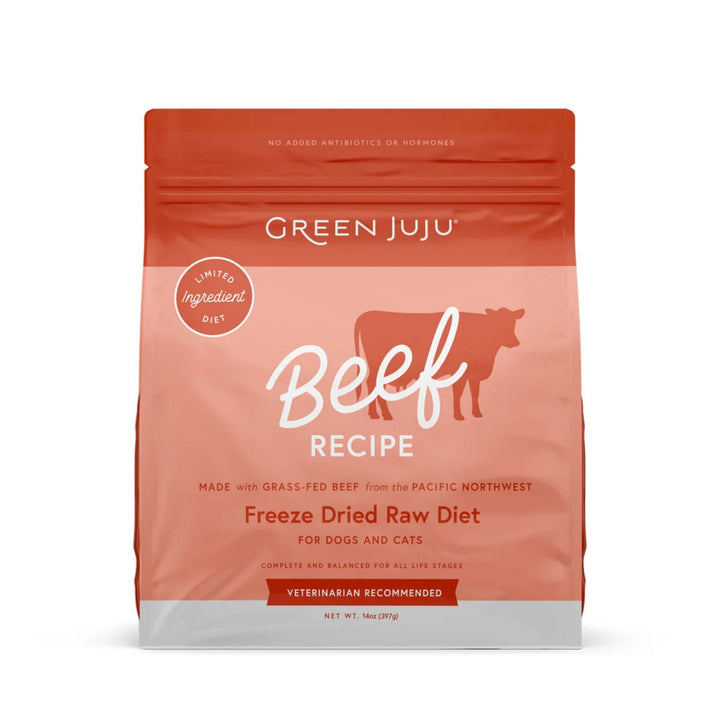
What we hand people starting a trial
Green Juju Beef Recipe, Freeze-Dried Raw
The reason we point at this one rather than at the limited ingredient shelf generally is the panel. Beef heart, beef liver, beef kidney, beef bone, organic kale, organic kelp, vitamin E. That is the whole label. You can read it in five seconds and know exactly what your dog is getting, which is the entire requirement of a clean baseline.
- Complete and balanced, so it can be the only thing in the bowl for eight weeks
- Organ rich rather than muscle meat plus a synthetic vitamin pack
- Also available in lamb, goat, bison, rabbit and pork if beef is already suspect
- Rehydrate with water or bone broth, or serve dry
What does gut health have to do with itchy skin?
More than most of us were taught, though I want to be honest with you about where the evidence is firm and where it is still moving.
A 2025 study in BMC Microbiology compared dogs with atopic dermatitis to healthy dogs and found significantly lower gut microbial diversity in the affected group. The striking part was the correlation: the more severe the clinical signs, the less diverse the gut. When those dogs were given a probiotic, both the gut profile and the clinical scores improved.
A 2023 study in Microbiome looked at Shiba Inus and found imbalance in the gut and on the skin of affected dogs. One proposed mechanism is short chain fatty acids, compounds gut bacteria produce that have anti-inflammatory effects elsewhere in the body, including the skin.
Here is the part the holistic corner of the internet tends to leave out. A 2025 study of West Highland White Terriers, a breed with a high rate of skin allergy, found no significant difference in gut diversity between allergic and healthy dogs at all. The gut and skin link is real and worth acting on. It is not the whole story in every dog, and anyone telling you it is has not read all of the papers.
Is your dog getting too little exposure, not too much?
This is the reframe that made the episode worth publishing, and it turns the usual advice inside out.
Every allergy article you have read frames your dog as reacting to too much of something. Billy's argument, and the environmental research above, points the other way. The modern indoor dog encounters a fraction of the microbial and plant variety their immune system was built around. The dog sleeps on a couch, walks on pavement, lives in a house we work hard to keep sterile, and their immune system never gets the education that would teach it what is worth reacting to.
Billy's own theory, and he is explicit that it is a theory rather than something that has been formally studied, is that daily variety in plant material does some of that work. Different plants share many of the same structures and compounds, so feeding a wide range of them every day may give the body repeated, low stakes contact with those constituents. It is the argument behind why Green Juju's Just Greens organic vegetable blend with nettles and Bailey's Blend with cleavers come up so often in allergy conversations. Take it as a hypothesis worth trying, not as settled science, because that is what it is.
The microbial half of the equation has firmer ground under it, given what we know about diversity and severity, and it is the piece most pet parents skip entirely.
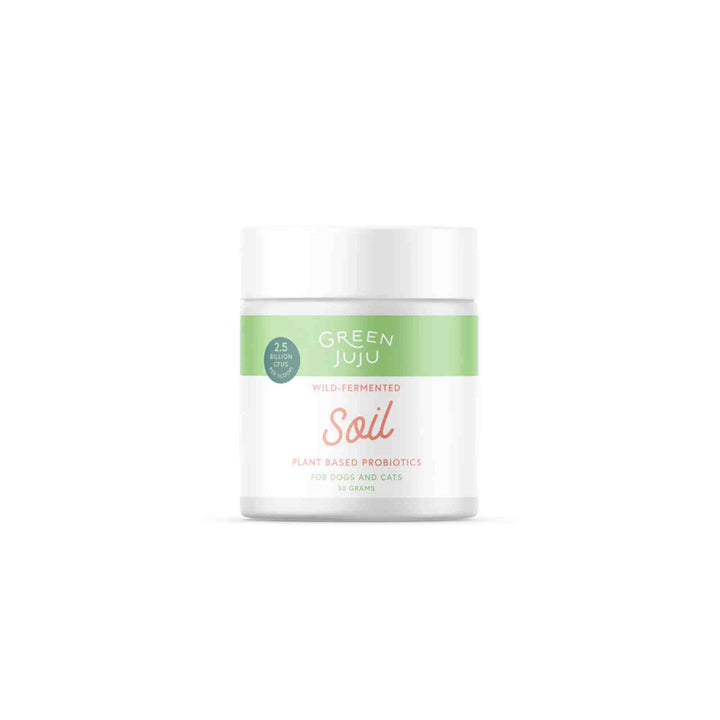
For the microbial layer
SOIL, Wild-Fermented Plant-Based Probiotic
Billy reaches for this one specifically because of how it is made. The strains are extracted from wild-fermented plants and then grown separately, so your dog gets the bacteria without the food proteins that come with a fermented product. That matters if your dog has flared on fermented foods before, which is common enough that it is worth planning around. Over 500 soil-derived strains, plus organic artichoke fibre.
Read how SOIL is madeWhat order should you do all of this in?
Order matters more than the individual items, because the whole reason people stay stuck is that they change several variables at once and learn nothing. Here is the sequence Billy used with Huckleberry, with honest timeframes attached.
Scroll sideways to see the full table.
| Step | What it is for | Give it |
|---|---|---|
| Step 1, simplify the food | A clean baseline you can actually read | 8 weeks minimum |
| Step 2, add plant variety | Daily contact with a wider plant range | 8 to 12 weeks |
| Step 3, add microbial variety | Rebuilding what a clean home removes | 12 weeks and ongoing |
| Step 4, reintroduce foods | One new item at a time, nothing else | 1 to 2 weeks each |
Step 4 is where most plans fall apart. A veggie blend, a new protein and a fish oil added in the same week means a flare tells you nothing. One item, one to two weeks, watch, then the next.
On fish oil, one note worth having. A blinded, placebo controlled trial of 29 dogs found clinical scores improved with flax oil and with an EPA and DHA preparation but not with placebo. What the researchers did not find was any correlation between the omega-6 to omega-3 ratio and how well a dog responded. So the ratio you see quoted everywhere is not the lever people think it is. The quality of the oil is.
What about Apoquel and Cytopoint?
I want to answer this carefully, because it is the question that stops people from starting.
Apoquel is a JAK inhibitor. It sits on the pathway that carries the itch signal from the immune system to the skin, and it blocks it, which is why it works within hours. It is doing something specific and it is doing it well. It is not aimed at whatever is generating the signal in the first place, and it was never designed to be.
The FDA approved label states that the product modulates the immune system, that it may increase susceptibility to infection including demodicosis, and that it may worsen neoplastic conditions, and it advises monitoring for infections and neoplasia. That is public information, printed on the label, and you are allowed to read it. Alongside that, a 2025 safety review in the Journal of Veterinary Pharmacology and Therapeutics reports that the adverse events seen after approval matched the types and ranking seen in the original field studies, with diarrhoea, reduced appetite and lethargy most commonly reported. Both of those things are true at once, and you deserve both of them rather than whichever one supports a position.
None of this is a reason to stop a medication your dog is on. It is a reason to have a plan running underneath it, so that in three months there is something to wean towards. I am not a vet, and this is not medical advice. Work the plan alongside your vet, ideally a holistic or integrative one, rather than around them, and take the label with you if it helps the conversation.
One more option that came up in the episode and surprised me, because it has better evidence behind it than most natural options do. PEA, or palmitoylethanolamide, is a fatty acid the body produces on its own. A 2015 study in Veterinary Dermatology enrolled 160 dogs across 39 clinics and gave them ultra-micronised PEA for eight weeks. Mean itch scores fell significantly, 58 percent of dogs improved by more than 2cm on the visual scale, and 62 percent reached lesion scores in the remission range. It was open label with no placebo group and it was industry sponsored, so hold it loosely. Billy used it as the last piece for Huckleberry and credits it with the final stretch. You can read more about Dr. Judy's PEA, and the rest of what we carry for this sits in our allergy relief collection.
How long before you see a change?
Longer than you want. This is the honest part, and it is the part that decides whether you stick with it.
Billy's own dog went from wearing a cone to being, in his words, a different dog. It was not fast. It was gradual, and it happened because several things changed together over a long stretch. He quotes his vet, Dr. Keith Wernimont, on a rule of thumb worth carrying: if your dog has had a problem for a couple of years, it may take that long to resolve. That is clinical experience rather than a study, and I am labelling it as such.
It matches what we see. We have worked through hundreds of these cases at PAWDEGA. Some pet parents notice a change in weeks. Some take a year. A few take longer than that. With Milka it was about two weeks after we moved her onto fresh food, and I know how lucky that makes us, because it is not the usual timeline and I am not going to pretend it is.
The other lesson Billy volunteered on himself is worth repeating: more is not better. Huckleberry does well on a mushroom probiotic at two teaspoons a day and throws up bile on a diet heavy in fermented foods. The person who formulates the products got that wrong with his own dog first. If it can happen to him it can happen to you, and it is not a failure, it is information.
You are not powerless here. You have more levers than anyone has handed you so far.
Sources
- Harvey ND et al. Environmental risk factors for canine atopic dermatitis: a retrospective large-scale study in Labrador and golden retrievers. Veterinary Dermatology, 2019. Link
- Hensel P et al. Update on the role of genetic factors, environmental factors and allergens in canine atopic dermatitis. Veterinary Dermatology, 2024. Link
- Marsella R. Environmental factors are responsible for the rise of atopic dermatitis in dogs. JAVMA, 2025. Link
- Knapp DW et al. Detection of herbicides in the urine of pet dogs following home lawn chemical application. Science of the Total Environment, 2013. Link
- Olivry T, Mueller RS. Critically appraised topic on adverse food reactions of companion animals (5): discrepancies between ingredients and labeling in commercial pet foods. BMC Veterinary Research, 2018. Link
- Tham HL. Elimination Diet Trials: Steps for Success and Common Mistakes. Today's Veterinary Practice, 2024. Link
- Coyner K, Schick A. Hair and saliva test fails to identify allergies in dogs. Journal of Small Animal Practice, 2019. Link
- Lam ATH, Johnson LN, Heinze CR. Assessment of the clinical accuracy of serum and saliva assays for identification of adverse food reaction in dogs without clinical signs of disease. JAVMA, 2019. Link
- Song H et al. Probiotics ameliorate atopic dermatitis by modulating the dysbiosis of the gut microbiota in dogs. BMC Microbiology, 2025. Link
- A comprehensive analysis of gut and skin microbiota in canine atopic dermatitis in Shiba Inu dogs. Microbiome, 2023. Link
- An insight into the gut microbiota of healthy and allergic West Highland White Terrier dogs, 2025. Link
- Mueller RS et al. Effect of omega-3 fatty acids on canine atopic dermatitis. Journal of Small Animal Practice, 2004. Link
- APOQUEL (oclacitinib maleate) FDA-approved prescribing information, via DailyMed. Link
- Nederveld S et al. Safety of the Selective JAK1 Inhibitor Oclacitinib in Dogs. Journal of Veterinary Pharmacology and Therapeutics, 2025. Link
- Noli C et al. Efficacy of ultra-micronized palmitoylethanolamide in canine atopic dermatitis: an open-label multi-centre study. Veterinary Dermatology, 2015. Link
- Billy Hoekman, Green Juju, in conversation on the Next Level Pet Parent Podcast, 2026. Watch the episode
Disclaimer: This blog may contain affiliate links, and PAWDEGA may earn a small commission at no extra cost to you if you purchase through them. It may also link to products on our website, and this content is for educational purposes, not a replacement for veterinary advice.