The most effective natural heart health support for dogs combines a fresh, low-carbohydrate diet, marine-sourced omega-3s (EPA and DHA), CoQ10-rich whole foods, a healthy body weight, and good oral hygiene, alongside your vet's care rather than instead of it. Heart-healthy supplements like CoQ10 and omega-3s have real research behind them, but most of that research is stronger in humans than in dogs, and a few popular claims (like "grain-free food causes heart disease" or "probiotics lower a dog's cholesterol") are more complicated than they sound.
Senior dog heart disease is common enough that most dogs will face some version of it eventually. If you've been researching this because your senior dog's vet just found a heart murmur, or you're trying to be proactive as your dog gets older, here's the short version: there is no single supplement that replaces your vet's care, but there is a lot you can do through food, weight, and daily habits that genuinely supports how hard your dog's heart has to work.
Milka's snout has been turning white for a few years now. She's a senior. And every time I catch her sleeping a little harder than she used to, that quiet worry creeps in: is her body keeping up the way it should? If you've felt that same low hum of concern watching your own dog slow down, you're not alone. That feeling is exactly why I wanted to write this the right way, with real research, not just a list of trendy supplements.
What's in this guide
- Is grain-free dog food really linked to heart disease?
- What is the best diet for a dog's heart health?
- Does CoQ10 actually help dogs with heart disease?
- What's the right omega-3 for a dog's heart?
- Is there a real connection between gut health and heart health?
- Does dental health really affect a dog's heart?
- How much does weight affect a dog's heart health?
- Why do heart supplements often include breathing support?
- What does the research actually show, at a glance?
- Is "detoxing" actually good for a dog's heart?
- What should I actually do for my dog's heart health?
- Algae oil vs fish oil vs flax oil, side by side
- Sources
Is Grain-Free Dog Food Really Linked to Heart Disease in Dogs?
This is the one everyone's confused about, and honestly, the confusion is fair.
In 2018, the FDA opened an investigation after veterinary cardiologists reported an unusual number of dilated cardiomyopathy (DCM) cases in dog breeds that don't typically get it. Most of the diets involved were grain-free and high in peas, lentils, or other legumes. That part is well documented.
Here's what most pet parents are never told, though: the FDA never confirmed exactly why this was happening. Taurine deficiency, the thing everyone assumed was the culprit, doesn't explain most of the reported cases. And more recent research has complicated the story further. An 18-month controlled feeding trial comparing grain-free and grain-inclusive diets, all complete and balanced, found no meaningful differences in heart biomarkers or blood taurine levels between the groups. Reported DCM cases have also dropped significantly since that first 2018 alert.
So what should you actually take from this? Not "grain-free is dangerous." More like: legume-heavy, boutique-style formulas deserve a second look, "complete and balanced" matters enormously, and if your dog is on a nontraditional diet, asking your vet about a taurine test is a reasonable, low-stress way to put your mind at ease.
What Is the Best Diet for a Dog's Heart Health?
A fresh, whole-food diet is the foundation here, and it's not just a holistic talking point. Ultra-processed kibble tends to be higher in the kind of carbohydrates and processing byproducts that contribute to chronic, low-grade inflammation, and inflammation is a known contributor to cardiovascular strain. A high-protein, low-fat, lower-carbohydrate fresh food diet is what most holistic vets recommend for dogs with existing heart concerns, and it's a reasonable target for proactive support too.
Heart muscle itself is worth calling out specifically. It naturally contains high concentrations of CoQ10 and taurine, which is part of why raw or freeze-dried heart is such a popular addition in holistic circles. If you want an easy way to work this into your dog's routine without cooking anything, PAWDEGA's Beef Heart is a single-ingredient, dehydrated source of exactly this, no prep required.
If you're feeding a full raw or freeze-dried diet rather than just adding a topper, Green Juju's Beef Recipe and Bison Recipe are both complete and balanced formulas that use heart as a main ingredient, so you're getting that natural CoQ10 and taurine built into the meal itself, not just a bonus treat on the side.
Does CoQ10 Actually Help Dogs With Heart Disease?
Here's where I want to be honest with you instead of just repeating what every supplement page says.
CoQ10 is an antioxidant your dog's body produces naturally, and production declines with age. In a small 2018 pilot study out of Thailand, dogs with mitral valve disease who were given CoQ10 for four weeks showed improved cardiac biomarkers, with the clearest benefit in smaller dogs. A 2021 study confirmed how much CoQ10 it actually takes to raise blood levels meaningfully in dogs with the same condition.
That's genuinely encouraging. It's also a small, short-term body of evidence. Most of what we know about CoQ10 and heart function comes from human research, and veterinary sources are consistent that dog-specific data, while promising, is still limited. If your dog is on heart medication or blood pressure medication already, CoQ10 is one of those supplements worth running by your vet first, since interactions are possible.
If you'd rather do this through the bowl
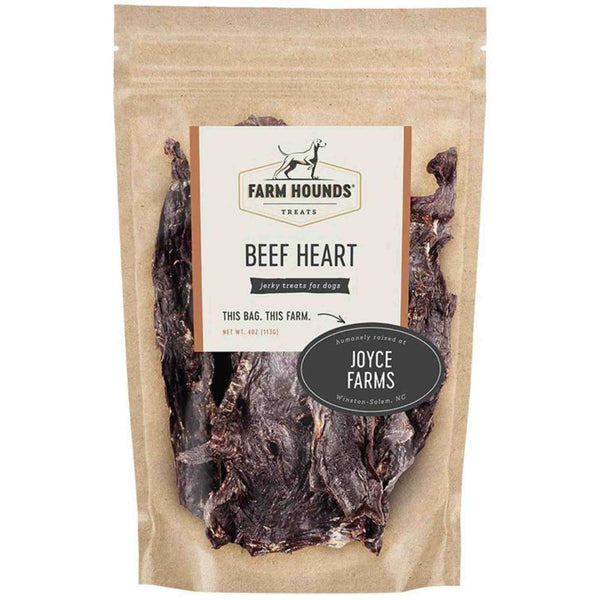
Beef Heart
Farm Hounds · Single ingredient, dehydrated
Some pet parents would rather add a food than a supplement, and for CoQ10 that is a reasonable route. Heart muscle is the richest natural food source of CoQ10, and it carries taurine as well, which is the whole reason heart keeps showing up in holistic feeding plans. This is 100% grass-fed, pasture-raised beef heart with nothing else in the bag, and the exact farm partner printed on the front label.
Being straight with you: this is food, not a measured dose. Whole-food CoQ10 has not been tested head to head against the supplement amounts used in the studies above, so think of it as a good addition to the diet rather than a stand-in for what your vet recommends.
See Beef HeartWhat's the Right Omega-3 for a Dog's Heart?
Omega-3s are one of the more genuinely well-supported pieces of this puzzle, but the source matters more than most heart-health content lets on.
In a controlled trial of Boxer dogs with a naturally occurring arrhythmia condition, six weeks of fish oil measurably reduced their arrhythmias. Flax oil, a plant-based omega-3 source, did not produce the same effect. That's a meaningful distinction: the marine-sourced fatty acids (EPA and DHA) appear to be doing the real work here, not omega-3s in general.
We don't carry fish oil at PAWDEGA, and that's not because the marine source doesn't matter. It's a quality issue. Fish oil oxidizes easily and can carry heavy metals, and oxidized oil is itself pro-inflammatory, which somewhat defeats the purpose. Potent-Sea, our algae-derived Omega-3, delivers the same EPA and DHA from a heavy-metal-free source without the oxidation risk. If your dog has a seafood sensitivity, hemp seed oil is a reasonable alternative, though it's worth knowing it works through a different mechanism (a favorable omega-6 to omega-3 ratio) rather than delivering EPA and DHA directly.
Our pick for marine omega-3
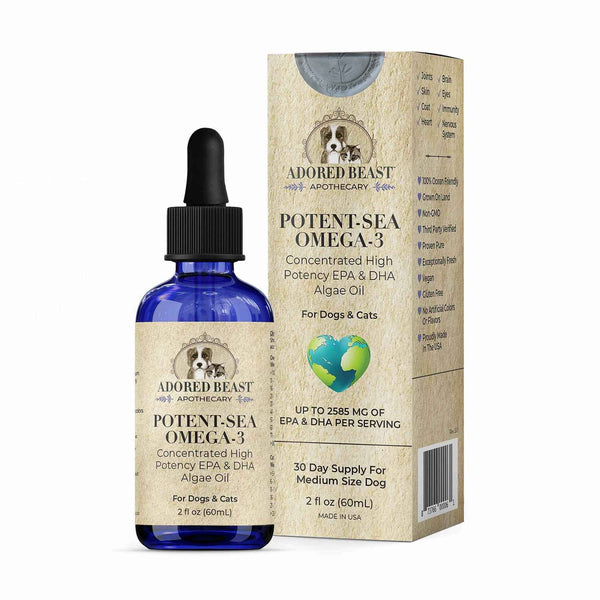
Potent-Sea Omega-3 Oil | EPA & DHA
Adored Beast · Algae-derived EPA and DHA
Of everything on this page, marine omega-3 has the most direct dog research behind it, which is why it's the one I'd start with. Potent-Sea delivers the same two fatty acids that reduced arrhythmias in the Boxer trial, EPA and DHA, from microalgae grown on land in triple-filtered ocean water instead of from fish. That sourcing is the entire point: no heavy metals, and none of the oxidation problem that turns a rancid fish oil into an inflammatory ingredient. It's concentrated, so most dogs need only a few drops on food once a day.
Two things to check first: it contains rosemary extract, which can be contraindicated in dogs with epilepsy, so ask your vet if that applies to your dog. And if your dog is already on heart medication, loop your vet in before adding any new omega-3.
See Potent-SeaIs There a Real Connection Between Gut Health and Heart Health?
This one surprised even me when I dug into it, and it's honestly some of the most interesting recent research in this whole space.
A study looking at dogs across every stage of mitral valve disease, from early and asymptomatic to full congestive heart failure, found that gut bacterial imbalance became more pronounced as the disease progressed. A specific gut-produced compound rose right alongside it. The researchers were careful to say they don't yet know if the gut imbalance is a cause of worsening heart disease or a downstream effect of it. But the association itself is real, and it fits with everything we already talk about on this blog regarding the gut being connected to nearly every other system in the body. If you haven't read our deep dive on dog gut health, it's a good companion piece to this one.
This is part of why species-specific gut support, like Fido's Flora, shows up so often in our holistic protocols even when the primary concern isn't digestive at all.
Does Dental Health Really Affect a Dog's Heart?
Somewhat, yes, though not quite as dramatically as it's often framed.
One retrospective study found dogs with severe periodontal disease had roughly six times the risk of bacterial heart valve infection compared to dogs with mild or no periodontal disease. Bacteria from the mouth have also been isolated directly from infected heart valves in other studies. That's a real, documented association.
Here's the honest caveat: several veterinary sources note that, unlike in humans, there isn't strong evidence that periodontal disease is a frequent, direct cause of heart valve infection in dogs. Endocarditis itself is relatively uncommon. So the takeaway isn't "your dog's plaque is about to cause heart failure." It's that regular brushing and a natural dental care routine (we like Dr. Judy's Dental Spray for daily maintenance) is one more low-effort, well-supported habit that supports the whole picture.
How Much Does Weight Affect a Dog's Heart Health?
A lot, and this is one of the more underestimated pieces of the puzzle.
A recent analysis of nearly 5 million dogs seen in general veterinary practice found that 52.9% of adult dogs were overweight or obese, and that excess weight was associated with measurable changes to heart structure and function, not just a general "it's not great for them" kind of association. If you can't easily feel your dog's ribs with light pressure, that's worth addressing, and it may be one of the more impactful things you can do for their heart, full stop.
Why Do Heart Health Supplements Often Include Breathing Support Too?
This isn't a stretch. Breathing difficulty is actually one of the most common ways worsening heart disease shows up in dogs, especially seniors.
As heart disease progresses, particularly the mitral valve disease we've already talked about, fluid can build up around the lungs, and dogs start coughing, breathing faster, or tiring out on short walks. That's one of the most well documented, clinically recognized signs of worsening heart function in dogs, not a fringe holistic theory.
This is part of why we recommend Breathe alongside other heart support. It's a blend of cordyceps, reishi, artist conk, chaga, and ashwagandha, and cordyceps in particular has some genuinely interesting research behind it for oxygen utilization and stamina. I'll be honest with you, though: that research is mostly in humans and animal models, not dogs specifically, and there's no dog-specific cardiovascular trial data for this exact blend yet. What it is, reasonably, is a low-risk daily support for dogs who seem to work a little harder to breathe, especially seniors and short-snouted breeds like Frenchies, pugs, and bulldogs who already tend to breathe more heavily.
One line I want to draw clearly: if your dog is coughing at rest, breathing rapidly while sleeping, or struggling to catch their breath, that's not a supplement moment. That's an emergency vet visit, full stop. Daily supplements like Breathe are for ongoing support, not for managing an active breathing crisis.
What Does the Research Actually Show, at a Glance?
Here is every claim in this guide, side by side with what the research actually found and how much weight it deserves.
| The claim | What the research actually found | How strong is it in dogs? |
|---|---|---|
| Grain-free food causes DCM | The FDA opened an investigation in 2018 after cardiologists reported unusual DCM cases in atypical breeds, mostly on grain-free, legume-heavy diets. A cause was never confirmed, taurine deficiency does not explain most cases, an 18-month controlled feeding trial found no meaningful difference in heart biomarkers or taurine between complete and balanced grain-free and grain-inclusive diets, and reported cases have dropped since 2018. | Unresolved. Documented association, no confirmed mechanism. |
| CoQ10 supports the heart | In a small 2018 pilot study, dogs with mitral valve disease given CoQ10 for four weeks showed improved cardiac biomarkers, with the clearest benefit in smaller dogs. A 2021 study established how much is needed to raise blood levels meaningfully. | Promising but thin. Small, short-term studies; most data is human. |
| Omega-3 helps the heart | In a controlled trial of Boxers with a naturally occurring arrhythmia condition, six weeks of fish oil measurably reduced arrhythmias. Flax oil did not produce the same effect, pointing to marine EPA and DHA as the active piece. | Strongest item on this list, and source-specific. |
| Gut health is linked to heart health | Across every stage of mitral valve disease, gut bacterial imbalance became more pronounced as disease progressed, with a specific gut-produced compound rising alongside it. The researchers noted they cannot yet say which direction the relationship runs. | Real association, causation unknown. |
| Dental disease affects the heart | Dogs with severe periodontal disease had roughly six times the risk of bacterial heart valve infection compared with mild or no periodontal disease, and oral bacteria have been isolated from infected valves. Veterinary sources caution there is no strong evidence of frequent direct causation in dogs, and endocarditis is uncommon. | Documented association, modest real-world risk. |
| Weight affects the heart | An analysis of nearly 5 million dogs in general practice found 52.9% of adults overweight or obese, with excess weight associated with measurable changes to heart structure and function. | Strong, and the largest dataset here. |
| Breathing support belongs alongside heart support | Coughing and rapid breathing caused by fluid building up around the lungs is one of the most well documented clinical signs of worsening heart function in dogs. Cordyceps research on oxygen utilization and stamina is mostly human and animal-model. | Clinical sign well established. No dog cardiovascular trial data for the blend. |
Is "Detoxing" Actually Good for a Dog's Heart?
I want to tell you something we learned the hard way, because I think it might save you a mistake we made.
A few years ago, Milka's bloodwork came back with elevated liver enzymes. No symptoms. Nothing we could see. We did what a lot of holistic-minded pet parents do: we reached for support, and then more support, stacking several liver and detox supplements at once because we figured more must be better.
Her numbers went up.
We backed off to one single thing, our own Liver Tonic, and stopped stacking. Her ALT came back down to normal. That was the lesson, and it's one I think about every time someone asks me what to "detox" their dog with for heart health: support is not the same thing as detox, and more is not automatically better. The liver and kidneys do the real work of processing whatever your dog is exposed to, including any heart medication they may already be on. Gentle, singular support alongside your vet's guidance is the goal, not a stack of herbs taken on faith.
What Should I Actually Do for My Dog's Heart Health?
- Feed the freshest, least processed diet you can reasonably manage, and if it's grain-free, make sure it's a complete and balanced formula, not a boutique legume-heavy one.
- Work raw or freeze-dried heart muscle into the rotation a few times a week for natural CoQ10 and taurine.
- Choose a heavy-metal-free, marine-sourced omega-3 like algae oil over fish oil.
- Support gut health as part of the whole picture, not as an afterthought.
- Brush your dog's teeth, or use a natural dental spray if brushing is a fight you're not going to win.
- Keep your dog at a weight where you can easily feel their ribs.
- Add daily respiratory support if your dog is a senior or a short-snouted breed, but handle any sudden breathing distress as an emergency, not a supplement question.
- If your dog is already on heart medication, loop your vet in before adding any new supplement, since interactions are real and worth checking.
Free guide
The Holistic Pet Wellness Blueprint
That checklist above is really a foundations list, and foundations are what the Blueprint walks you through step by step: diet, gut, toxin load, and the daily habits that carry the most weight across your dog's whole body, not only their heart. It's free, and it's the guide I wish we'd had when Milka's bloodwork first came back off.
Algae Oil vs Fish Oil vs Flax Oil: Which Omega-3 for a Dog's Heart?
This is the one real either/or in this guide. All three get sold as "omega-3 for dogs," and they are not interchangeable.
| Algae oil (Potent-Sea) | Fish oil | Flax and other plant oils | |
|---|---|---|---|
| Delivers EPA and DHA? | Yes, directly, in high concentration | Yes, directly | No. Plant oils supply ALA, not EPA and DHA |
| Heavy metal risk | Grown on land in triple-filtered ocean water, free from solvents, pesticides and heavy metals | Can carry heavy metals from ocean contamination | Not a marine source, so not a concern |
| Oxidation and rancidity | Stable, without the oxidation risk that fish oil carries | Oxidizes easily, and oxidized oil is itself pro-inflammatory | Varies by oil and storage |
| Evidence in dogs, specifically for heart rhythm | Supplies the same EPA and DHA that produced the effect, though the trial itself used fish oil | The Boxer arrhythmia trial used fish oil and measured a reduction in arrhythmias | Flax oil did not reduce arrhythmias in the same trial |
| If your dog reacts to seafood | Algae is sea-derived but is not fish, so assess the risk with your vet | Not suitable | Hemp seed oil is a reasonable alternative through a different mechanism |
| Our position | What we stock and what I'd use | Right fatty acids, quality problems we would rather avoid | Useful oils, but not a substitute for EPA and DHA |
None of this replaces your vet, and if your dog already has a heart condition, please read this as a "support alongside" list, not an "instead of" list. Please keep in mind I'm not a veterinarian, and this isn't medical advice. Every dog is different, so I always recommend working with your vet, ideally a holistic or integrative one, especially for anything ongoing or serious.
You know your dog better than any article ever could. If something in here made you go "wait, that's not what I thought," that's a good thing. That's the whole point of writing it this way.
Much love, Larry
Sources
- FDA Center for Veterinary Medicine, "Investigation into the Potential Link Between Certain Diets and Canine Dilated Cardiomyopathy" (2018-2023). fda.gov
- 18-month prospective feeding trial, grain-free vs grain-inclusive diets, 2024-2025, PMC. pmc.ncbi.nlm.nih.gov
- Tachampa et al., Thai Journal of Veterinary Medicine, 2018 (CoQ10 pilot study, MMVD).
- American Journal of Veterinary Research, 2021 (CoQ10 dosing trial, MMVD). avmajournals.avma.org
- Journal of Veterinary Internal Medicine, 2007 (Boxer ARVC omega-3 trial). pubmed.ncbi.nlm.nih.gov
- "Gut Dysbiosis... in Dogs with Myxomatous Mitral Valve Disease," 2021, PMC. ncbi.nlm.nih.gov
- JAVMA case-control study, periodontal disease and endocarditis, cited via dvm360, 2026. dvm360.com
- ScienceDirect, approximately 4.9M dog cohort study, obesity and cardiac structure and function, 2024. sciencedirect.com
- Congestive heart failure symptom sources (VCA Animal Hospitals, PetMD, Small Door Vet) on coughing and pulmonary edema as the primary clinical sign of worsening heart disease in dogs.
- Cordyceps militaris and oxygen utilization and exercise performance, multiple human and animal-model studies (ResearchGate narrative review, 2024; peer-reviewed exercise physiology studies).
DISCLAIMER: Please note that this content is for informational purposes only and is not intended to be a substitute for professional veterinarian advice, diagnosis, or treatment. Our content may include affiliate and/or sponsored links which means your support helps move our mission forward. As content creators, we earn from qualifying purchases.