Natural joint support for dogs works best as a layered approach, not a single pill. The strongest, most research-backed levers are keeping your dog at a lean body weight, lowering everyday inflammation through a fresh whole-food diet, and adding omega-3 fatty acids, with supports like green lipped mussel, curcumin, and collagen layered on top based on your dog's needs. Weight and diet come first, because they change the inflammation that drives joint wear. Supplements build on that foundation. They do not replace it.
Here is the one-line version, in case that is all you came for: the most effective natural joint support for dogs is a lean body, an anti-inflammatory whole-food diet, and omega-3s, with targeted supplements added on top.
In this guide
- What is the best natural joint support for dogs?
- Why do dogs get stiff, sore joints?
- Does your dog's weight really matter that much?
- Do omega-3s actually help dog joints?
- What about green lipped mussel, turmeric, and collagen?
- What about bone broth and glucosamine?
- Can gut health affect your dog's joints?
- How do I put this together for my dog?
- When should you see your vet?
Now let me talk to you like a friend for a minute.
If you have noticed your dog taking the stairs a little slower. Hesitating before the jump into the car. Stiff after a long nap, then loosening up once they get moving. You are not imagining it. And you are not alone. So many pet parents watch these small changes and quietly wonder if they are doing enough.
I feel it too. My French Bulldog Milka is a senior now, her snout going white, still leading Charly and me on our long walks around the neighborhood. Watching her age has made me pay very close attention to what the research actually says about joints, and what is holistic marketing dressed up as fact. Here is what most pet parents are never told clearly: a lot of the popular joint advice is thinner on evidence than it sounds, and a few of the least glamorous basics are the things that matter most.
Let's get into it.
What is the best natural joint support for dogs?
There is no single best supplement. What the research supports most strongly is a stack, built in order of impact:
- Keep your dog lean. This is the highest-impact lever, and it costs nothing.
- Feed a fresh, whole-food, lower-inflammation diet. Food is where most of the daily inflammation is either fed or calmed.
- Add omega-3 fatty acids. The best-studied joint nutrient for dogs.
- Layer in targeted supports like green lipped mussel, curcumin, or undenatured collagen, based on your dog and your vet's input.
- Support the gut, since gut balance and whole-body inflammation appear to be connected.
Notice the order. Supplements are step three and beyond. Weight and diet are one and two for a reason.
Why do dogs get stiff, sore joints?
Joint discomfort in dogs is usually driven by low-grade, ongoing inflammation and the slow wearing of cartilage, most often as osteoarthritis. It is common, and it is easy to miss early.
How common is genuinely debated, and I would rather give you the honest picture than a tidy stat. A large UK study of more than 455,000 dogs found around 2.5% carried a formal osteoarthritis diagnosis in a given year, with risk rising in older, heavier, and neutered dogs and in breeds like Labradors and Golden Retrievers (Anderson et al., 2018). But that number reflects what gets diagnosed. When researchers actually X-rayed young dogs aged eight months to four years, nearly 40% already showed joint changes, and much of the associated pain was going untreated (Scientific Reports, 2024). So the real takeaway is not a single percentage. It is this: joint wear starts earlier and hides better than most of us assume.
Does your dog's weight really matter that much?
Yes. More than any supplement on the shelf. And here is the part that reframes everything.
Excess body fat is not only extra load on the joints. Fat tissue actively releases inflammatory signaling compounds that contribute to cartilage breakdown, so carrying extra weight damages joints biologically, not only mechanically (Marshall et al., 2010). That is why weight sits at the center of the whole conversation.
The evidence here is remarkable. In a multi-year study following Labradors across their lives, dogs fed about 25% fewer calories than their littermates developed hip arthritis later, needed treatment for it roughly three years later, and lived on average nearly two years longer (Kealy et al., published across JAVMA). And for dogs already carrying extra weight, losing as little as about 6% of body weight produced a measurable drop in lameness, with gait analysis confirming the improvement (Marshall et al., 2010; Impellizeri et al., 2000).
Read that again. A lean dog is your single most powerful, most natural joint support. No purchase required.
Do omega-3s actually help dog joints?
This is the supplement with the strongest evidence behind it. Omega-3 fatty acids, specifically EPA and DHA, are known for their anti-inflammatory properties, and they hold up in real canine trials.
Across a set of randomized, double-blind studies involving hundreds of dogs, diets high in fish-oil omega-3s improved weight-bearing and owner-rated arthritis signs, and in one trial allowed dogs to reduce their dose of anti-inflammatory medication under veterinary supervision (Roush et al., 2010). The mechanism is elegant: EPA and DHA partially replace a pro-inflammatory fatty acid in the body's cells, which calms inflammation in the joint. Cornell's canine health experts cite a commonly used starting point of roughly one teaspoon of fish oil per 20 pounds of ideal body weight, always confirmed with your vet.
This is exactly why omega-3s are woven through so much of our thinking on holistic care. If you want the deeper breakdown of sourcing, dosing, and why not all fish oil is equal, we covered it in the best omega-3 for dogs blog post. For a clean, sustainable source, Potent-Sea is an omega-3 algae oil rich in EPA and DHA that supports joints along with skin, heart, and brain. Algae based, so no fish required.
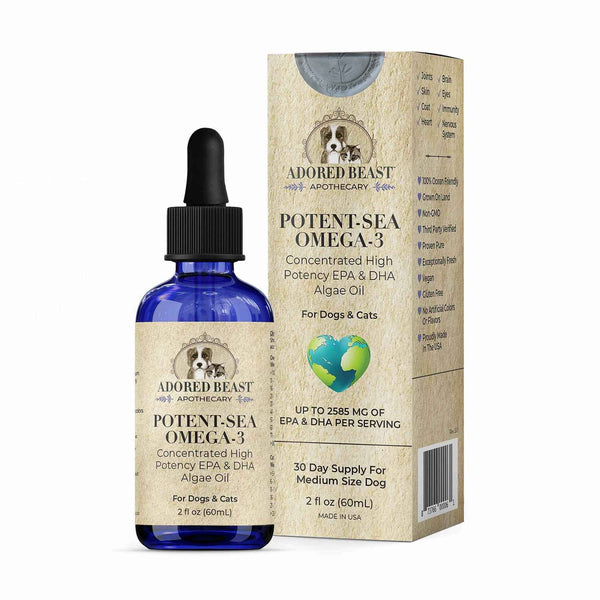
Potent-Sea Omega-3 (Algae Oil)
The single most evidence-backed joint nutrient in this guide, in a clean, sustainable algae oil rich in EPA and DHA. No fish required. An easy first step to support your dog's joints, skin, heart, and brain, without committing to a full protocol.
$39.99
Shop Potent-SeaWhat about green lipped mussel, turmeric, and collagen?
These are the popular ones, and here is where I will hold a line that a lot of holistic brands will not: the evidence is real but uneven, and honesty serves your dog better than hype.
Green lipped mussel is a genuine whole-food joint support. It naturally contains a rare omega-3 called ETA, plus glucosamine, chondroitin, and antioxidants. Some trials show reduced pain and swelling in dogs. Others show little effect. The results across studies are genuinely inconsistent (Corbee et al., 2022), so I would call it promising, not proven.
Turmeric (curcumin) has better mechanism data than most people realize. In dogs with osteoarthritis, curcumin supplementation lowered inflammatory gene activity, including markers like TNF-alpha and COX-2 (Colitti et al., 2012). The catch: plain turmeric powder is poorly absorbed. It needs a concentrated or phospholipid-bound form, given with a health fat source, and grounded black pepper, to actually reach the joint and maximize the benefits of curcumin.
Undenatured type II collagen (UC-II) may be the quiet standout. In one randomized trial, it improved mobility scores by an amount comparable to an anti-inflammatory drug (Di Cesare et al., 2019). Important honesty note, and it matters for the next section: this is the undenatured form of collagen, which works through the immune system and only if its structure stays intact. Cooking denatures it, so this is not the collagen you get from bone broth.
To make the evidence easy to hold in your head:
| Natural support | What it may help with | How strong is the evidence in dogs |
|---|---|---|
| Lean body weight | Lameness, disease progression, lifespan | Strongest |
| Omega-3 (EPA/DHA) | Comfort, mobility, inflammation | Strong |
| Undenatured type II collagen | Mobility | Moderate to strong |
| Curcumin (bioavailable form) | Inflammation markers | Moderate, absorption-dependent |
| Green lipped mussel | Pain, swelling | Mixed and inconsistent |
| Bone broth | Hydration, whole-food minerals | Weak and mostly indirect in dogs |
What about bone broth and glucosamine?
I love bone broth. Milka gets it. But I am not going to tell you it rebuilds cartilage, because the direct canine evidence for that is not there. Bone broth is a lovely whole-food source of collagen, gelatin, and minerals, and it is wonderful for hydration and for tempting a picky senior to eat. What it is not is a proven cartilage repair tool, and remember, the collagen actually studied for joints is the undenatured form that cooking breaks down. So enjoy broth for what it is: nourishing support, not a fix. A slow-simmered option like Bison Bone Broth is a beautiful daily addition for hydration and whole-food minerals, framed honestly.
Glucosamine and chondroitin sit in a similar honest place. They are popular and low-risk, some dogs seem to benefit, but the trial results are mixed and product quality varies widely. Worth trying, not worth guaranteeing.
Can gut health affect your dog's joints?
This is the frontier, and I want to be careful here. Emerging research has found that arthritic dogs show a different gut bacterial makeup and higher levels of a blood inflammation marker than healthy dogs (Cintio et al., 2020). The plausible idea is that gut imbalance feeds the whole-body inflammation that reaches the joints.
But here is the honest boundary: this is an association, and the researchers themselves say it is not yet clear whether the gut changes are a cause or a consequence. So I will not tell you that fixing the gut fixes joints. What I will say is that supporting the gut supports the whole inflammatory picture, and that fits everything we know about whole-body wellness. This is the same thread we follow in natural liver support for dogs, because the organs of detox and digestion set the inflammatory tone for the entire body. A pre- and probiotic with anti-inflammatory herbs like Gut Soothe, or Soil & Sea which supports immunity and joint health together, can help keep that foundation steady.
How do I put this together for my dog?
Here is the layered plan, in order of impact:
- Get and keep your dog lean. Ask your vet for an honest body condition score. This is step one, always.
- Shift toward fresh, whole food and lower the ultra-processed, high-inflammation load where you can.
- Add omega-3s
- Choose one or two targeted supports that fit your dog: a bioavailable curcumin, green lipped mussel, or undenatured collagen.
- Support the gut as part of the whole-body picture.
- Keep moving. Gentle, consistent, low-impact exercise maintains the muscle that protects the joint.
If you would rather not assemble it all yourself, our Jump for JOYnts tincture and EASE Hemp Oil are formulated to support joint comfort and mobility, and the Joint Support Bundle pulls the core supports together in one place. As always, these support the foundation. They do not stand in for it.

Joint Support Bundle (Premium)
Six of the supports in this article, curated into one protocol: Jump for JOYnts, Potent-Sea omega-3, EASE, Gut Soothe, Coco-Gold, and Inflapotion. A comprehensive way to support the joints, tendons, ligaments, and the whole inflammatory picture, without assembling it piece by piece.
Shop the bundle Choose your sizes and strength at checkout.When should you see your vet?
Always loop in your vet, and see one promptly if your dog is limping, suddenly reluctant to move, swollen, or in clear pain. Natural support works alongside veterinary care, never instead of it. Your vet can identify what is actually going on, and some joint conditions need medical management that food and supplements support but cannot handle alone.
Here is what I know from years of doing this with Milka and from talking with holistic and integrative vets around the world: your dog's body wants to move well. Your job is to lower what is working against it and add what genuinely helps. You are not powerless here. You are your dog's biggest advocate, and the most powerful tools are the ones already in your kitchen and your daily routine.
Much love, Larry
Sources
- Anderson, K. L., et al. "Prevalence, duration and risk factors for appendicular osteoarthritis in a UK dog population under primary veterinary care." Scientific Reports, 2018. https://www.nature.com/articles/s41598-018-23940-z
- "Prevalence of radiographic appendicular osteoarthritis and associated clinical signs in young dogs." Scientific Reports, 2024. https://www.nature.com/articles/s41598-024-52324-9
- Marshall, W. G., et al. "The effect of weight loss on lameness in obese dogs with osteoarthritis." Veterinary Research Communications, 2010. https://pmc.ncbi.nlm.nih.gov/articles/PMC2855019/
- Impellizeri, J. A., et al. "Effect of weight reduction on clinical signs of lameness in dogs with hip osteoarthritis." Journal of the American Veterinary Medical Association, 2000. https://pubmed.ncbi.nlm.nih.gov/20237844/
- Kealy, R. D., et al. Diet-restriction and lifespan studies in Labrador Retrievers. Journal of the American Veterinary Medical Association, 1997, 2000, 2002.
- Roush, J. K., et al. Clinical trials on fish oil omega-3 fatty acids in dogs with osteoarthritis. Journal of the American Veterinary Medical Association, 2010. https://pubmed.ncbi.nlm.nih.gov/20043800/ and https://pubmed.ncbi.nlm.nih.gov/20043801/
- Cornell University Riney Canine Health Center. "How joint supplements can help with orthopedic conditions." https://www.vet.cornell.edu/departments-centers-and-institutes/riney-canine-health-center
- Corbee, R. J., et al. "The efficacy of a nutritional supplement containing green-lipped mussel, curcumin and blackcurrant leaf extract in dogs and cats with osteoarthritis." Veterinary Medicine and Science, 2022. https://onlinelibrary.wiley.com/doi/full/10.1002/vms3.779
- Colitti, M., et al. Curcumin and inflammatory gene expression in dogs with osteoarthritis. Veterinary Immunology and Immunopathology, 2012.
- Di Cesare, F., et al. "Evaluation of the effects of undenatured type II collagen (UC-II) as compared to robenacoxib on the mobility impairment induced by osteoarthritis in dogs." 2019. https://www.ncbi.nlm.nih.gov/pmc/articles/PMC6789547/
- Cintio, M., et al. "Gut Microbiome of Healthy and Arthritic Dogs." Veterinary Sciences, 2020. https://www.researchgate.net/publication/342941942
Disclaimer: This blog may contain affiliate links, and PAWDEGA may earn a small commission at no extra cost to you if you purchase through them. It may also link to products on our website, and this content is for educational purposes, not a replacement for veterinary advice.