Probiotics are the beneficial bacteria. Prebiotics are the food those bacteria live on. Postbiotics are the compounds the bacteria produce once they have been fed, and they are where most of the benefit in your dog's gut actually shows up. Prebiotics and probiotics for dogs work as one system: the probiotic supplies the bacteria, the prebiotic decides whether those bacteria survive and do anything, and the postbiotic is the result your dog's body produces from the two working together.
Which means a probiotic with no prebiotic in it is doing half a job. And a jar of postbiotics on a shelf is not the same thing as a gut that is producing its own.
In this article
- Prebiotics, probiotics and postbiotics: the difference
- Should you give your dog probiotics every day?
- Why the prebiotic matters as much as the probiotic for dogs?
- Do dogs need probiotics after antibiotics?
- Are postbiotic supplements for dogs better than probiotics?
- How to read a dog probiotic label
- What about yogurt, kefir and fermented food?
- How long before you notice a difference?
- Which formula should you start with?
Here is what I keep running into. Pet parents who feed beautifully, read every label, and have a probiotic in the cupboard that they are no longer sure is worth giving. They started it after a bout of loose stool. Then the loose stool stopped. And now the jar sits there and nobody has told them whether to keep going.
We spoke with Julie Anne Lee, DCH, founder of Adored Beast Apothecary, for an episode of the Next Level Pet Parent Podcast about exactly this. She has been researching the microbiome since 1994, back when the veterinary association made her retract a newspaper column for saying gut bacteria mattered. What she said about prebiotics changed how I read every label in my own cupboard, and it is the part of this conversation almost nobody covers.
Prebiotics and probiotics for dogs: what is the difference, and where do postbiotics fit?
Three words, one system. This is the cleanest way I know to hold them apart.
| What it is | What it does in the gut | Where your dog gets it | |
|---|---|---|---|
| Probiotic | Live beneficial bacteria | Adds to the population of good bacteria and competes with pathogens for space and resources | Supplements, fermented foods, raw goat milk kefir |
| Prebiotic | Fiber the dog cannot digest, but the bacteria can | Feeds the bacteria so they stay viable and multiply instead of passing straight through | Larch, chicory root, certain vegetables, a prebiotic built into the supplement |
| Postbiotic | The compounds produced when bacteria ferment that fiber, including short-chain fatty acids | Feeds the cells lining the colon, supports the gut barrier, signals the immune system | Produced inside the gut, or supplied as an inactivated preparation in a supplement |
Cornell's Riney Canine Health Center describes probiotics as changing the acidity of the digestive tract and releasing short-chain fatty acids, which makes it harder for organisms like Salmonella to take hold, partly because the good bacteria are competing for the same resources. They also note that around 70 percent of a dog's immune system sits in the gastrointestinal tract.
Seventy percent. In the gut. That is why gut support keeps showing up in conversations about skin, ears, allergies and anxiety, which sound like completely different problems until you follow them back to the same room.
Should you give your dog probiotics every day?
For most dogs, yes, and the reasoning is not what you would expect. It is not that a daily probiotic fixes something. It is that the things which erode gut diversity happen daily.
Processed food. Stress. Medication. And something Julie raised that I had never thought about: our food supply has been sterilised. Vegetables used to come out of bacteria-rich topsoil and go into the body with those microbes still attached. Now almost nothing we hand our animals arrives carrying live bacteria at all.
Cornell puts the working range at 1 to 10 billion colony forming units daily for dogs, and states plainly that probiotics can be given daily as part of long-term care rather than only during a problem.
Here is what most pet parents are never told, though. Julie's position is not "one product forever." It is rotation. Different formulas, different strains, different prebiotics, moved around over months, because the goal is diversity rather than loyalty to one jar. I should be straight with you about the evidence tier there: rotation itself has not been tested in a canine trial. It is her clinical reasoning after nearly three decades of formulating and 40,000-odd patients. What the research does support is the diversity part, and that is worth understanding on its own.
A 2025 study in BMC Microbiology compared dogs with atopic dermatitis against healthy dogs and found the atopic dogs had significantly lower gut microbial diversity at baseline. Clinical severity tracked inversely with diversity. Over 16 weeks of daily probiotics, the dogs whose diversity rose were the dogs who improved, and the ones whose diversity stayed flat did not.
It would be easy to stop there. So let me give you the other side. A separate study of 21 West Highland White Terriers found no significant difference in diversity between allergic and healthy dogs. This field is young, and the honest summary is that diversity looks like it matters a great deal, and the picture is not uniform across every breed and every study yet.
Why does the prebiotic matter as much as the probiotic for dogs?
This is the part I want you to take away if you take away nothing else.
A probiotic with no prebiotic alongside it is bacteria with no food. In a canine colonic fermentation model built to mimic a dog's large intestine, researchers tested a prebiotic and a probiotic separately and then together. Both modulated the microbiota. The combination did more than either alone.
So the question is not only whether there is a prebiotic in your dog's supplement. It is which one, and what else it is doing while it is in there.
Julie's standard is what she calls a functional prebiotic: an ingredient that feeds the bacteria and carries a second job at the same time. Her example is larch, a fiber from the bark of the larch tree, which she landed on after asking a very good question. What is the one thing nearly every prey animal a wild canine eats has already been eating? Bark.
Larch arabinogalactan holds up under scrutiny. A 2025 study combining sequencing with single-cell activity profiling found it reaches the colon undigested, is selectively fermented, consistently enriched Bifidobacterium across all ten donors tested, and contributes to short-chain fatty acid production. That work was done on human samples rather than dogs, and I am naming the tier rather than dressing it up. What it establishes is that larch behaves as a genuine prebiotic and not as a filler with a nice name.
Compare that with the prebiotics used in most of the category, which are usually inulin or a fructo-oligosaccharide. They function. They feed bacteria. They also do nothing else, and they cost the manufacturer a fraction as much.
Do dogs need probiotics after a course of antibiotics?
This is the one scenario where nearly everyone agrees, including the conventional side.
An antibiotic cannot tell the difference between the organism causing the problem and the beneficial population living alongside it. In a study of dogs given oral amoxicillin, the dogs receiving the antibiotic alone showed significant loss of microbiome diversity along with the emergence of antibiotic resistance genes. A 2024 study in Scientific Reports followed 22 dogs given metronidazole: diversity dropped and stayed down for up to three days after the final dose, and the altered bacterial community persisted for four to six weeks before settling back.
Four to six weeks. Long after the bottle is empty and everyone has moved on.
The honest counterweight: recovery is not identical across drugs. A study of healthy dogs on tylosin found most measured values were back at baseline by day 14 once the antibiotic stopped. So the disruption is real, and the length of it depends on the drug and on the individual dog.
Practically, Julie gives pre and probiotics during the course as well as after, spaced roughly four to six hours away from the antibiotic dose so the two are not arriving together. Talk that timing through with your own vet, especially if your dog is on anything else.
Are postbiotic supplements for dogs better than probiotics?
Postbiotics are having a moment on packaging right now, so it is worth knowing exactly what the word means before you pay extra for it.
In 2021 the International Scientific Association for Probiotics and Prebiotics published a consensus definition in Nature Reviews Gastroenterology and Hepatology. A postbiotic, formally, is a preparation of non-living microorganisms or their components that delivers a health benefit, and it has to contain inactivated microbial cells or cell parts to qualify.
Read that again, because there is a gap hiding in it. The formal definition describes something made in a facility and put in a jar. What happens inside your dog's colon when good bacteria ferment a good prebiotic is the postbiotic effect: short-chain fatty acids like butyrate, enzymes, peptides, compounds that feed the cells lining the gut and talk to the immune system. Related, but not the same purchase.
Julie's hesitation about the supplement version is the one I find most persuasive. We can only isolate and add back the compounds we currently know how to measure. The gut produces the full set, adjusted moment to moment, based on what that individual body needs today. Her line is that she would rather build a pre and probiotic good enough that the body produces its own, than assume in advance which end products a dog needs and hand them over ready-made.
So, are they better? No. They are a different thing. A postbiotic ingredient is stable and does not have to survive stomach acid, which is a genuine formulation advantage. It does not replace a live, diverse, well-fed microbiome, and any label implying it does is selling you the destination without the road.
How do you read a dog probiotic label?
Let's be real for a second: this category has a quality problem, and it is documented.
Weese and Martin bought 25 commercial veterinary probiotics and assessed both the labels and what was actually inside them. Only two carried a label that properly described the contents. Measured bacterial counts ranged from none at all up to roughly 2 billion per gram. That was published in the Canadian Veterinary Journal in 2011, and if you are hoping it has been resolved since, a 2025 assessment found the same pattern: defective labelling across most veterinary probiotic products, with prior work finding over a third of 92 animal probiotics inaccurately labelled or carrying contaminants.
Here is what I actually look at, in order.
- Is there a prebiotic in it at all? If not, put it down. You are buying bacteria with no food.
- Which prebiotic, and is it functional? Larch and similar functional fibers are doing a second job. A cheap sugar-based fiber is doing the minimum.
- Are the strains named individually? "Probiotic cultures" or "dried Lactobacillus" is not a strain list. Named organisms are the marker of a company that knows what is in its own jar.
- How many strains? Diversity is the point. Most of the category runs one to five. A multi-strain probiotic for dogs, with strains spanning complementary genera, is a meaningfully different product.
- Work out the CFU per actual serving, not per jar. More is not automatically better, and Cornell's daily range for dogs is 1 to 10 billion. What matters is what is delivered in the scoop you are told to feed.
- Check the scoop size against the ingredient list. This is the tell. If the label says feed a heaped tablespoon, ask what is filling that spoon. Maltodextrin, cellulose and silicon dioxide bulk a jar out so it looks generous on a shelf.
That last one reframes a complaint we hear often, which is that the jar looks small. It is small because it is not padded. Milka is a French Bulldog and her scoop is a quarter teaspoon, so one jar lasts us months. The size of the container tells you almost nothing. The size of the dose tells you a lot.
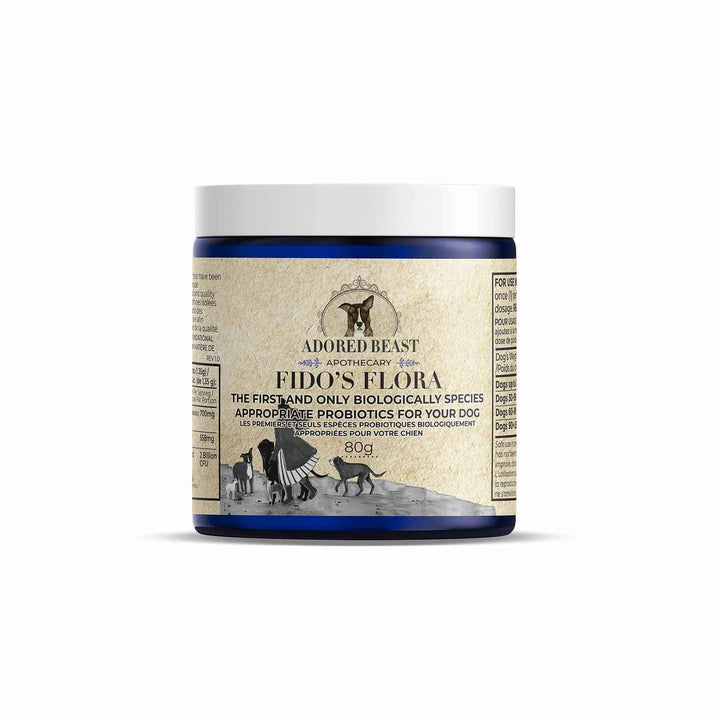
The one I feed Milka
Fido's Flora, Canine Specific Pre & Probiotic
This is the formula Julie names as the starting point for a healthy dog, and it is the one that passes every check in the list above. The 14-strain base carries two canine-specific strains isolated for dogs rather than borrowed from a human formula, and the prebiotic is larch rather than a sugar fiber.
- 16 strains total, including canine-specific Lactobacillus casei K9-1 and Lactobacillus fermentum K9-2
- Larch arabinogalactan as the functional prebiotic, plus humic and fulvic acids
- No maltodextrin, cellulose or fructo-oligosaccharides used as bulk
- A quarter teaspoon a day for a dog up to 29 lbs, stirred into food
What about yogurt, kefir and fermented food?
Worth adding, and not a replacement.
Raw goat milk kefir, fermented vegetables and green tripe all deliver beneficial bacteria, and Julie's reasoning for why they suit dogs so well is the one that stayed with me. A wild canine eating prey eats the gut of that prey, and the contents of that gut are fermented plant material. So fermented food is not a modern wellness idea imported from human nutrition. It is closer to the original delivery mechanism.
Two cautions. Ordinary supermarket yogurt is a poor vehicle: the cultures are often there for manufacturing rather than benefit, the lactose can upset a dog, and any product containing artificial sweetener is dangerous. And food sources give you variety rather than a known quantity of specific organisms, which is the whole reason a formulated supplement exists alongside them.
Also, and I say this as someone who has watched Milka do it on a German sheep field while Larry begged her to stop: herbivore manure is genuinely full of beneficial bacteria. You do not have to enjoy it. You can stop panicking about it.
How long before you notice a difference?
Stool quality usually shifts first, often within one to two weeks. The rest takes longer, and the honest horizon for anything you are actually working on is around six weeks minimum, which is the window Adored Beast asks for before judging a product.
The thing nobody warns you about is that you will miss the changes. You see your dog every single day, so the improvements arrive too gradually to register.
Julie's fix, which she used at her clinics for years, is a journal. Write down what your dog is like now, in more detail than feels necessary. Where does he sleep. Does he still hesitate at the bottom of the stairs. How often is he shaking his head. How does he stand when he drinks. Her patients would come back a month later and report one improvement, and then she would read their own baseline back to them and watch them realise five other things had changed too. The dog sleeping on the bed again, because he could get up there again.
Before and after photos work the same way. Take them now, not later.
Which formula should you start with?
Two different dogs, two different starting points. This is how Julie answers it when someone asks her directly.
| Fido's Flora | Canine Gut Soothe | |
|---|---|---|
| Start here if | Your dog is well, and you are building a daily routine. Also the one Julie names during and after a course of antibiotics | Your dog has a history of digestive trouble, or you are moving him onto a new diet |
| Key difference | Two canine-specific strains on top of the 14-strain base, plus humic and fulvic acids | The 14-strain base plus soothing herbs and nutraceuticals: slippery elm, marshmallow root, L-glutamine, aloe |
| Prebiotic | Larch arabinogalactan | Larch arabinogalactan |
| Evidence status | Strain diversity and the prebiotic are supported by published research. The species-specific isolation work is the manufacturer's own | The pre and probiotic base is supported by published research. The herbal additions come from traditional and clinical practice |
| View Fido's Flora | View Canine Gut Soothe |
After the first several weeks, both Julie and the Adored Beast guidance point the same way: rotate. You can see the full range on our pre and probiotics for dogs, cats and horses page, or browse everything we carry for gut health support.
If you take one thing from all of this, make it the prebiotic. It is the half of the label nobody reads, and it is the half that decides whether the rest of it was worth buying.
Sources
- Cornell University College of Veterinary Medicine, Riney Canine Health Center. The power of probiotics. vet.cornell.edu
- Salminen S. et al. The International Scientific Association of Probiotics and Prebiotics (ISAPP) consensus statement on the definition and scope of postbiotics. Nature Reviews Gastroenterology & Hepatology, 2021. nature.com
- Probiotics ameliorate atopic dermatitis by modulating the dysbiosis of the gut microbiota in dogs. BMC Microbiology, 2025. PMC12012994
- An insight into the gut microbiota of healthy and allergic West Highland White Terrier dogs. 2025. PMC12385407
- Conserved signatures of the canine faecal microbiome are associated with metronidazole administration and recovery. Scientific Reports, 2024. nature.com
- Oral beta-lactamase protects the canine gut microbiome from oral amoxicillin-mediated damage. PMC6560916
- Recovery of fecal microbiome and bile acids in healthy dogs after tylosin administration with and without fecal microbiota transplantation. PMC9318503
- Modulation of canine gut microbiota by prebiotic and probiotic supplements: a long-term in vitro study using a novel colonic fermentation model. PMC11591024
- Evaluating the prebiotic activity of arabinogalactan on the human gut microbiota using 16S rRNA gene sequencing and Raman-activated cell sorting. 2025. PMC12540051
- Weese J.S. and Martin H. Assessment of commercial probiotic bacterial contents and label accuracy. Canadian Veterinary Journal, 2011.
- Assessment of antibiotic resistance and microbial contamination in commercial veterinary probiotic products. 2025. PMC12649896
- Next Level Pet Parent Podcast with Julie Anne Lee, DCH, founder of Adored Beast Apothecary. Watch the episode
I am not a veterinarian, and this article is educational information rather than medical advice. Every animal is different, so please work alongside your own vet, ideally a holistic or integrative vet, for anything ongoing or serious with your dog.