Soil-based probiotics for dogs are spore-forming bacteria, mostly from the Bacillus family, that live naturally in soil, water and on plants. A tough outer spore coat helps them survive stomach acid and bile and reach the intestine intact, which makes them a different tool from the lactobacillus and bifidobacterium strains in most dog probiotics. Small studies in dogs have linked specific Bacillus strains to firmer stools, less stool odor and better digestion.
Soil-based probiotics are worth considering when a dog with a sensitive gut has not done well on regular probiotics, because they are a different family of bacteria, built to survive the trip.
In this guide
If you're reading this, I'm guessing you've already been down the probiotic aisle. The one your vet handed you. The one with fourteen strains. The expensive one with the beautiful label.
And the gas got worse. Or the stool firmed up for a week, then went soft again. Or nothing changed at all, and you started wondering whether probiotics do anything for dogs, or whether something else is going on with your dog's gut.
You're not alone, so many pet parents go through this. But here's what most pet parents are never told... "probiotic" is not one thing. The bacteria inside the jar matter as much as the fact that there are bacteria in it. And one family in particular, the soil-based strains, behaves very differently from what's in most probiotics on the shelf.
What are soil-based probiotics for dogs?
Soil-based probiotics, also called spore-based probiotics or SBO probiotics (SBO stands for soil-based organisms), are bacteria that can switch into a dormant, seed-like form called a spore. In that form they can ride out conditions that would destroy most other bacteria. A 2017 review in Frontiers in Microbiology describes Bacillus spores as able to withstand the extreme acidity of the stomach and tolerate bile salts, and notes that spore-formers are also more stable during processing and storage than many other probiotic bacteria.
The species you'll see most often on a soil-based probiotic label are Bacillus subtilis, Bacillus coagulans, Bacillus licheniformis and Bacillus pumilus. People have been eating Bacillus for centuries in fermented foods, which is part of why these bacteria are now being studied as probiotics.
Why does the "soil" part matter? Think about how a dog would have met these bacteria before modern life: digging, sniffing, chewing grass, eating prey straight off the ground. Most of our dogs now live indoors, walk on pavement and eat food that has been cooked and sealed.
There's interesting research pointing in this direction. A Finnish survey of 5,722 dogs published in Scientific Reports in 2018 found that allergic symptoms were more common in dogs living in urban areas, and that rural life factors, including regular contact with farm animals and other pets, were associated with fewer allergic symptoms. That's an association, not proof that any supplement can stand in for a childhood on a farm. But it does suggest that microbial variety in a dog's world matters, and that's the gap soil-based strains are meant to help fill.
How are soil-based probiotics different from regular probiotics?
Most dog probiotics are built on lactic-acid bacteria: lactobacillus and bifidobacterium strains, the same families you'd find in yogurt and kefir. These are the most studied probiotic groups overall, and they have a real place in a healthy gut. Soil-based probiotics come from a different family entirely. (If you want the bigger picture first, our guide to prebiotics and probiotics for dogs walks through how the pieces fit together.)
Scroll sideways to see the full table.
| Feature | Soil-based (spore-forming) | Lactic-acid (most probiotics) |
|---|---|---|
| Bacteria family | Bacillus | Lactobacillus, Bifidobacterium |
| Form in the jar | Dormant spore inside a protective coat | Live cells, usually freeze-dried |
| Stomach acid and bile | Spores tolerate both | Survival varies from strain to strain |
| Natural home | Soil, water and plants | The gut, fermented dairy and foods |
| Research in dogs | Several small trials, mostly in healthy dogs | More studied overall, strain by strain |
| Often chosen when | Regular probiotics brought on gas or bloating | Everyday gut support and rotation |
One honest note on that last row. It reflects how holistic practitioners use these two families, not the result of head-to-head trials in dogs. Nobody has run that study yet. More on why practitioners reach for spores in certain dogs below.
What does the research actually show in dogs?
Here's what the research tells us, and I want to give you the real picture rather than the marketing one.
Most of the dog studies on soil-based probiotics have looked at Bacillus subtilis, and several of them point the same way:
- Firmer stools and better digestion. In a 2019 study in the Journal of Applied Animal Nutrition, 16 adult beagles were split between a plain diet and the same diet with a Bacillus subtilis strain (C-3102) added for four weeks. The supplemented dogs had firmer stools, lower fecal ammonia, more short-chain fatty acids (the beneficial compounds gut bacteria make from food) and better digestion of fat and carbohydrates.
- Less stool odor. An earlier Brazilian study in 12 young beagles found the same strain gave drier, better-formed stools and lower fecal ammonia, the compound behind much of the smell. A 2020 study in BMC Veterinary Research found that Bacillus subtilis and Bacillus licheniformis together lowered the protein breakdown compounds that make stool smell, without changing digestibility.
- More "good" bacteria, not fewer. In a 2023 trial in 18 Golden Retrievers, dogs given Bacillus subtilis had firmer stools, lower ammonia, more short-chain fatty acids and higher counts of lactobacilli in their stool. That's a lovely detail, because it suggests soil-based strains and lactic-acid bacteria can work alongside each other rather than competing.
- Good tolerance. A 2021 study in the Journal of Animal Science tested graded doses of Bacillus coagulans in healthy adult dogs and found better nutrient digestibility with no apparent adverse effects at the doses tested.
Let's be real for a second, though. These studies were small, usually under 20 dogs. Most used healthy kennel dogs, not dogs with a chronic gut problem. Each tested one specific strain, often mixed into kibble, and the results belong to that strain. So the honest summary is a consistent pattern of firmer stools, less odor and better digestion in healthy dogs... not a promise about what any particular product will do for your dog.
Why do some dogs do worse on regular probiotics?
This is the question that brings most pet parents to soil-based probiotics, so let's walk through it carefully.
You may have heard the term SIBO, small intestinal bacterial overgrowth. In people, it describes too many bacteria living in the small intestine, where there should be relatively few. In dogs it's more complicated. Many vets now use the terms antibiotic-responsive enteropathy or microbiota-related modulation-responsive enteropathy instead, because it's still debated whether a true overgrowth exists in dogs at all. What isn't debated is that some dogs have chronic gut signs tied to the bacteria in their small intestine. Young, large-breed dogs and German Shepherds come up most often. (Our post on SIBO in dogs and why it gets missed goes deeper on the signs.)
So where do probiotics come in? There's a small but much-discussed human study from 2018 in Clinical and Translational Gastroenterology. Among patients with gas, bloating and brain fog, all were taking probiotics, and they were more likely to show bacterial overgrowth and a build-up of D-lactic acid, which lactobacillus can produce as it ferments sugars. When they stopped the probiotics and their overgrowth was addressed, their symptoms improved. It was a small, observational study in people, so it can't tell us how dogs respond.
Here's the reasoning many holistic practitioners follow from there. If a dog's small intestine already has too much bacterial activity, adding more lactic-acid bacteria may add to the problem. Spore-forming Bacillus strains are a different family, and they're the ones formulators and holistic vets tend to reach for when overgrowth is suspected. It's the reason Soil & Sea is the probiotic inside our SIBO Support Bundle. I want to be clear about what this is: sound clinical reasoning and a lot of practitioner experience, not a proven result in dogs. No canine trial has tested it yet.
What this means in practice: if your dog gets gassier, more bloated or looser on a regular probiotic, write it down. That reaction is useful information, and it's worth taking to your vet. A few questions you can bring to that appointment, without it ever needing to feel like a confrontation:
- Could a small intestinal bacterial problem be part of the picture here?
- Have my dog's cobalamin (vitamin B12) and folate levels been checked? Changes in these are common in dogs with chronic small intestinal problems, and vets measure cobalamin in chronic gut cases for good reason.
- Would it make sense to try a different type of probiotic, given how my dog reacted to the last one?
Are soil-based probiotics safe for dogs?
For the species used in dog products, the safety picture is reassuring. Bacillus subtilis, Bacillus coagulans, Bacillus licheniformis and Bacillus pumilus all sit on the European Food Safety Authority's list of microorganisms with a "qualified presumption of safety," with one condition attached: the strain must show no toxin-producing activity. The 2017 Frontiers review makes the same point from the research side. Safety is judged strain by strain, because the wider Bacillus family also includes bacteria you would never want in a supplement.
That's not a reason to fear the category. It's a reason to care about where your probiotic comes from. When researchers at the Ontario Veterinary College tested 25 commercial pet probiotics in 2011, ten didn't state how many bacteria they contained, and of the fifteen that did, only about one in four actually contained the amount on the label.
Here's what I look for before a soil-based probiotic goes anywhere near a dog's bowl:
- Every species named. Not "proprietary soil blend," but the actual Bacillus species.
- A stated count per serving, in CFU (colony-forming units), so you know what you're giving.
- No filler. No maltodextrin, flour or added sugars padding out the scoop.
- A prebiotic alongside it, so the bacteria have something to feed on.
- A brand that answers questions, and a store that has actually read the label.
And a few sensible cautions. If your dog is pregnant, used for breeding, seriously ill, on immune-suppressing medication, or living with a condition your vet has named, talk to your vet before adding any probiotic. Never stop something your vet prescribed to make room for a supplement. A probiotic works alongside veterinary care, never instead of it.
Which dogs are soil-based probiotics best for?
Based on the research and on how holistic practitioners use them, these are the dogs I'd think about a soil-based probiotic for first:
- Dogs who got gassier, more bloated or looser on a regular probiotic. A different family of bacteria is a logical next step.
- Dogs where your vet suspects a small intestinal bacterial problem, used alongside the plan your vet sets out.
- Dogs coming out of a course of antibiotics, as part of rebuilding. In one 2020 study, two weeks of metronidazole changed healthy dogs' gut bacteria for at least four weeks after the last dose. Our post on antibiotics and gut recovery in dogs covers that window in detail. During and right after the course, our go-to is Fido's Flora. A soil-based probiotic is a natural next rotation once the course is done.
- Healthy dogs, as one stop in a probiotic rotation. Holistic vet Julie Anne Lee recommends rotating probiotics rather than staying on one, with a soil or spore-based probiotic as the third step after Fido's Flora and The Wolf. Each round brings in a different set of bacteria, which builds a more varied, resilient gut instead of overloading it with the same strains.
So if your dog fits one of those, what do you actually reach for? This is the one we chose to carry.
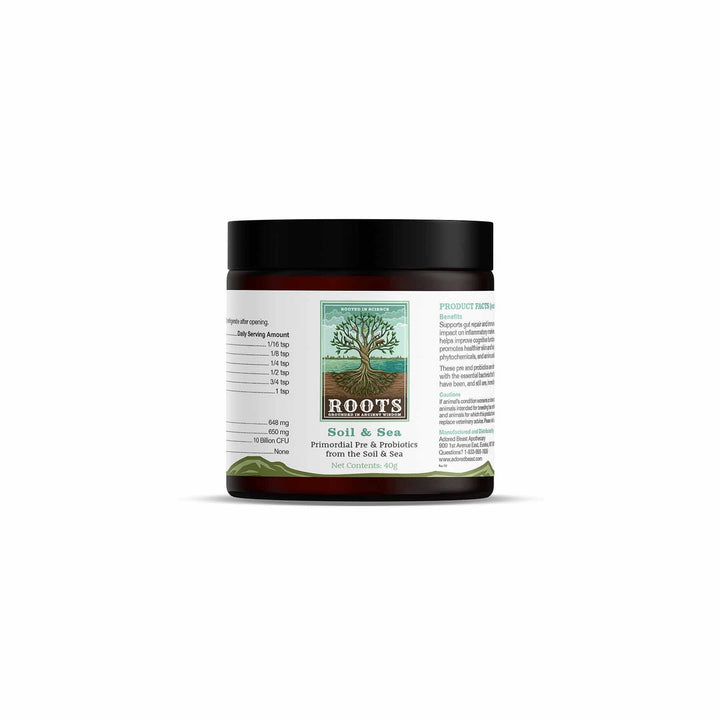
In Milka's probiotic rotation
Soil & Sea | Primordial Pre & Probiotics
Made by ROOTS, Adored Beast's sister brand, Soil & Sea is the soil-based probiotic I trust because it ticks every box on my list. Every species is named on the label, the count per serving is stated, it carries its own prebiotic, and there's nothing in the jar that isn't doing a job.
- Four named spore-forming species: Bacillus subtilis, pumilus, coagulans and licheniformis
- 10 billion CFU per half-teaspoon serving, with 648 mg prebiotic chlorella and 650 mg humic and fulvic acid
- No maltodextrin, flour, FOS or other non-functional fillers
- For dogs and cats, dosed by weight and mixed into food
If you're curious about the chlorella in that formula and what it does (and doesn't do), I wrote a whole piece on chlorella for dogs.
How do you start a soil-based probiotic for your dog?
Starting is the easy part. Starting in a way that tells you whether it's helping is where most of us go wrong, me included. Here's the order I'd follow:
- Loop in your vet first if there's an ongoing problem. Ruling out parasites and other causes comes before any supplement. If you'd like a vet who works with a holistic approach, our holistic vet directory is a good place to start.
- Write down a one-week baseline. Stool, gas, appetite, itching, energy. Without a "before," you can't see an "after."
- Change one thing at a time. If you're also switching food, let the new food settle before you add the probiotic, so you know what did what.
- Follow the label dose for your dog's weight, mixed into a meal.
- Give it real time. Adored Beast's guidance for its products is a minimum of six weeks before judging the result, because the body needs time to respond. A gut that took months to get here won't turn around in a weekend.
- Watch and note. If your dog's signs get worse or don't improve, stop and check in with your vet. That's straight from the label, and it's good advice for anything new.
- Rotate when the course is done. Moving through different probiotics over time gives the gut more variety than staying on one forever.
And if you've done all of this and your dog's gut still isn't right, the next question is usually whether something more is going on underneath. We put together a free guide on three conditions that often hide behind "my dog is still sick."
Please know this: your dog's body wants to heal. Your job isn't to find the perfect product on the first try. It's to give the gut the right support, in the right order, and to keep paying attention. You're doing exactly that by being here.
I'm rooting for you, and your dog, every step of the way.
Much love, Larry
I'm not a veterinarian, and this isn't medical advice. Every dog is unique, so I always recommend working alongside your vet, ideally a holistic or integrative vet, especially for anything ongoing or serious.
Sources
- Schauf S, Nakamura N, Castrillo C. Effect of Calsporin (Bacillus subtilis C-3102) addition to the diet on faecal quality and nutrient digestibility in healthy adult dogs. Journal of Applied Animal Nutrition, 2019. Link
- Félix AP, Netto MVT, Murakami FY, et al. Digestibility and fecal characteristics of dogs fed with Bacillus subtilis in diet. Ciência Rural, 2010. Link
- Bastos TS, de Lima DC, Souza CM, et al. Bacillus subtilis and Bacillus licheniformis reduce faecal protein catabolites concentration and odour in dogs. BMC Veterinary Research, 2020.
- Kahraman O, Gurbuz E, Inal F, et al. Effects of Bacillus subtilis C-3102 addition on nutrient digestibility, faecal characteristics, blood chemistry and faecal Lactobacilli spp., Enterococci spp., and Escherichia coli in healthy dogs. Italian Journal of Animal Science, 2023. Link
- Acuff HL, Aldrich CG. Evaluation of graded levels of Bacillus coagulans GBI-30, 6086 on apparent nutrient digestibility, stool quality, and intestinal health indicators in healthy adult dogs. Journal of Animal Science, 2021. Link
- Elshaghabee FMF, Rokana N, Gulhane RD, et al. Bacillus as potential probiotics: status, concerns, and future perspectives. Frontiers in Microbiology, 2017. Link
- Hakanen E, Lehtimäki J, Salmela E, et al. Urban environment predisposes dogs and their owners to allergic symptoms. Scientific Reports, 2018. Link
- Collier A. Chronic Enteropathies in Small Animals. MSD Veterinary Manual, professional version. Link
- Hall EJ. Antibiotic-responsive diarrhea in small animals. Veterinary Clinics of North America: Small Animal Practice, 2011. Link
- German AJ, Day MJ, Ruaux CG, et al. Comparison of direct and indirect tests for small intestinal bacterial overgrowth and antibiotic-responsive diarrhea in dogs. Journal of Veterinary Internal Medicine, 2003. Link
- Jergens AE. Practical GI function testing for veterinarians. dvm360, CVC proceedings. Link
- Rao SSC, Rehman A, Yu S, Martinez de Andino N. Brain fogginess, gas and bloating: a link between SIBO, probiotics and metabolic acidosis. Clinical and Translational Gastroenterology, 2018. Link
- EFSA Panel on Biological Hazards. Updated list of QPS-recommended biological agents for safety risk assessments carried out by EFSA. EFSA Journal, 2021. Link
- Weese JS, Martin H. Assessment of commercial probiotic bacterial contents and label accuracy. Canadian Veterinary Journal, 2011.
- Pilla R, Gaschen FP, Barr JW, et al. Effects of metronidazole on the fecal microbiome and metabolome in healthy dogs. Journal of Veterinary Internal Medicine, 2020. Link
- Lee JA. Probiotic rotation guidance, as recorded in PAWDEGA's yeast and allergy reference. Practitioner guidance, not a published study.