What naturally kills yeast in dogs? In a lab dish, plenty does. Oregano and thyme oils do. Acidic rinses do. But nothing you spray, dab, or spoon onto your dog will keep yeast away on its own, because the yeast behind itchy paws and smelly ears, Malassezia pachydermatis, is a normal resident of healthy dog skin. It only overgrows when something inside the body tips the balance.
The natural way to get yeast under control in dogs is a sequence, not a single remedy: starve it with a lower-sugar diet, weaken it gently with antifungal herbs, help the body clear it through digestion and liver support, then rebuild the gut so it stays in balance.
In this post
If you're reading this late at night with a dog licking his paws beside you, I know that feeling. You've tried the medicated shampoo. The ear drops. Maybe the antibiotics, twice. It clears up for a couple of weeks... and then that cheesy, corn-chip smell comes back.
So you start searching for something natural that will finally kill it. Here's what most pet parents are never told: the hunt for the thing that kills yeast is part of why it keeps coming back.
Why doesn't killing the yeast make it go away?
Because yeast was never the intruder. Malassezia lives on the skin and in the ears of healthy dogs, and veterinary dermatologists describe its shift from harmless resident to itchy overgrowth as one of the most frequent skin problems they see in dogs. The World Association for Veterinary Dermatology's consensus guidelines on Malassezia make the same point from the clinical side: the yeast tends to return unless the factors that allowed it to overgrow are found and corrected. It shows up especially often in dogs with allergies.
And those factors often start in the gut. In a 2022 study from the University of Zurich, allergic dogs had significantly less diverse gut bacteria than healthy dogs. A small 2023 pilot study in Japan gave 12 allergic dogs a single oral fecal transplant from healthy donors, and their itch and skin lesion scores dropped over the following eight weeks. It was a small study without a control group, but it points where holistic practitioners have pointed for years. The skin often reflects the gut.
Julie Anne Lee, DCH, the holistic practitioner who formulated the Yeasty Beast Protocol, puts it this way on our podcast: yeast gets more resilient the harder you attack it. Strong antifungals, medicated baths, and repeated antibiotics knock the numbers down, but they leave the gut depleted, and the yeast comes back stronger. Her goal is never to wipe yeast out. It's a gut that can hold it in balance.
What naturally kills yeast in dogs: vinegar, coconut oil, or oregano oil?
These are the home remedies for dog yeast that every search turns up, each one sold as a natural antifungal for dogs. Here's what the research actually shows.
Scroll sideways to see the full table.
| Remedy | What the evidence shows | Our take |
|---|---|---|
| Apple cider vinegar | No dog studies; acidic cleaners kill yeast in the lab | Surface only, diluted, never on raw skin |
| Coconut oil | No dog studies; this yeast is drawn to fats | Not a yeast tool on its own |
| Oregano and thyme oils | Strong lab results; one small dog trial | Formulated products only, never DIY drops |
| Tea tree oil | 337 dog poisonings from concentrated oil | Keep concentrated oil away from your dog |
| Probiotics and yogurt | Gut link is real; too much at once may backfire | Introduce slowly, one thing at a time |
Apple cider vinegar
No published study has tested kitchen apple cider vinegar for dog yeast. The closest evidence is a 2008 comparison of commercial dog ear cleaners, where antimicrobial activity was linked partly to low pH, and a cleaner built on acetic acid, the acid in vinegar, killed Malassezia in the lab. So acidity makes some sense as a surface tool. There is no evidence that adding vinegar to food or water does anything for skin yeast, and it stings on skin your dog has already scratched raw.
Coconut oil
We could not find a single canine study testing coconut oil for yeast in dogs. What we do know is that Malassezia belongs to a group of lipophilic yeasts, meaning they are drawn to fats. So smearing oil onto a greasy, yeasty paw is not the clear win the internet suggests. The compound people are really after is caprylic acid, one of coconut's medium-chain fatty acids, and in our view it does more good as a measured ingredient in a formulated product than as a spoonful from the jar.
Oregano, thyme, and other essential oils
This is where the lab evidence is strongest, and why oregano oil for dogs gets recommended so often. In a 2023 University of Pisa study, every Malassezia sample taken from dogs with ear infections was sensitive to oregano, thyme, and savory oils. A 2022 trial went further and tested a botanical oil spray on real dogs: 16 dogs with yeasty paws had the spray on one paw and a standard chlorhexidine and miconazole shampoo on the other for 14 days. Both paws improved; the researchers found no difference between them, and no side effects were reported. That trial used a formulated product, though, not drops from a health food store. Essential oils are concentrated, and dogs lick their paws.
Tea tree oil
A 2014 review of ASPCA poison control records found 443 cases of dogs and cats that came into contact with 100% tea tree oil over ten years, 337 of them dogs. Reported signs included drooling, lethargy, weakness, loss of coordination, and tremors. Concentrated tea tree oil does not belong in your dog's yeast routine.
Probiotics and yogurt
The gut connection is real, so this one feels logical. But Julie Anne Lee, DCH, warns about what she calls over-culturing: large amounts of probiotics, yogurt, or fermented foods at once can kill yeast too fast and set off a die-off reaction. It is also why the Yeasty Beast Protocol's own directions say not to combine it with other probiotics at the same time.
How do you get rid of yeast in dogs naturally, step by step?
This is the sequence we walk pet parents through every week. Each step is there because of what happens when it gets skipped.
- Starve it first. Spend two weeks on a lower-sugar, less processed diet before anything else. Raw or freeze-dried raw gives the best conditions. Hidden sugars count: heavily processed kibble, root vegetables, sweet chews, and fillers like inulin and maltodextrin. If you're not sure where your current food stands, start with whether kibble causes yeast in dogs and whether rice is bad for dogs with yeast.
- Support the liver from day one. Dying yeast creates extra work for the body's clearing systems, so liver support starts a few days before any antifungal herbs and runs the whole way through.
- Weaken it gently. Antifungal herbs such as pau d'arco, plus caprylic acid, apply steady pressure rather than a blast. Homeopathic support helps with the itching and burning while that happens.
- Digest what dies. Specific enzymes break down dying yeast so the body clears it, rather than leaving behind what Julie calls a yeast cemetery.
- Rebuild the gut lining. Yeast inflames the gut lining as it dies off. In Julie's experience, skipping this step is the most common reason signs return three to twelve months later. Our post on leaky gut in dogs explains why, and the Leaky Gut Protocol is the follow-on we recommend.
- Calm the surface without stripping it. In Julie's view, harsh antifungal shampoos damage the skin's own microbiome. A certified organic shampoo and cotton bedding, washed often, support the skin instead. Here's how to choose a shampoo for a dog with yeast.
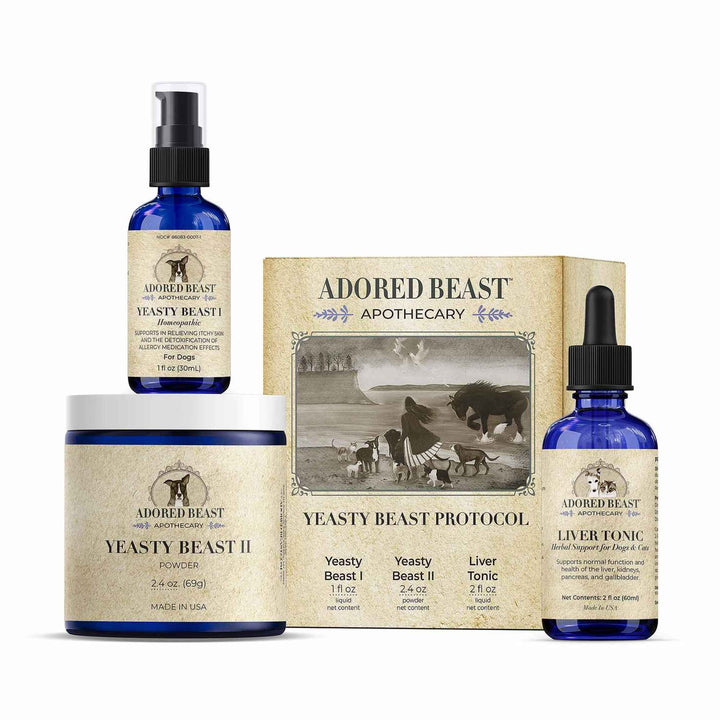
Steps two through four are the hardest to piece together on your own. Which herbs, which enzymes, in what order, and when to start each one. That's exactly what the Yeasty Beast Protocol puts in one box.
Where we start most yeasty dogs
Yeasty Beast Protocol
Formulated by Julie Anne Lee, DCH to work with the body rather than against it. It is designed to put gentle pressure on yeast while supporting the body as it clears it, which is exactly the order this whole post argues for.
- Three products, started in a set order a few days apart
- Liver Tonic with dandelion root and milk thistle, used throughout
- Yeasty Beast II pairs pau d'arco and caprylic acid with enzymes
- Designed to be followed by the Leaky Gut Protocol
Why does my dog look worse after starting a yeast protocol?
This is the moment most pet parents give up. Your dog seems better for a day or a few days, then suddenly itchier or smellier than before. Julie Anne Lee, DCH, calls this die-off, also known as a Herxheimer reaction. As yeast dies, it releases a surge of byproducts the body has to process, so a protocol that's working can look like it's failing. In her words, it is working, but working too well.
Her rule: back off, slow down, then bring it back up. Don't abandon the plan and don't rush back to antifungals. The Yeasty Beast Protocol's own directions say to pause Yeasty Beast I if things worsen during the first 14 days. Our full guide to yeast die-off in dogs walks through exactly what to watch for. And if your dog stops eating, starts vomiting, or seems truly unwell, call your vet.
How long does it take to get yeast under control naturally?
Let's be real for a second... longer than anyone wants. In our experience, some dogs show changes within a week. Others take a month. For dogs with years of medication history, Julie's cycling program runs roughly three months, and a second round is common. As she often reminds pet parents, yeast that took years to build up won't clear in a week.
The single most useful thing you can do is keep a journal from before you start. Write down when your dog itches, for how long, and where. An itching episode dropping from 15 minutes to 5 is real progress, and without notes you won't see it. Early signs often come before the skin clears: the smell fading, less licking you can hear at night, calmer-looking ears.
If you'd like the whole plan in one place, including how to tell yeast apart from other allergy signs, our free guide lays it out.
When should you see your vet about yeast?
Natural support works best alongside a good vet, not instead of one. A few moments where your vet matters most:
- Confirming it is yeast. A quick tape strip or swab looked at under a microscope is how vets count yeast on the skin. It is fast and gentle, and worth asking for before accepting a combined steroid, antibiotic, and antifungal drop by default.
- Darkening skin. The holistic practitioners we learn from point out that darkening skin can also be linked to thyroid issues, which make yeast harder to settle. Ask your vet whether a thyroid check makes sense.
- Open wounds, ear pain, or a dog who seems unwell. These need a vet's eyes first.
- Your dog is on Apoquel, Cytopoint, steroids, antibiotics, or antifungals. Never stop them cold turkey. Suppressed signs can rebound harder. Taper with your vet, more slowly than feels necessary, while you support the body.
For the bigger picture of why yeast keeps coming back, read our anchor post on yeast in dogs and how to support the gut at the root.
I'm not a veterinarian. I'm a pet parent who has spent years learning from the holistic practitioners who do this work every day, and I always recommend working alongside your vet, ideally a holistic or integrative one. You're not alone in this, so many pet parents go through it. I'm rooting for you, and your dog, every step of the way.
Sources
- Bond R, Morris DO, Guillot J, et al. Biology, diagnosis and treatment of Malassezia dermatitis in dogs and cats: Clinical Consensus Guidelines of the World Association for Veterinary Dermatology. Veterinary Dermatology, 2020. Link
- Guillot J, Bond R. Malassezia Yeasts in Veterinary Dermatology: An Updated Overview. Frontiers in Cellular and Infection Microbiology, 2020. Link
- Rostaher A, Morsy Y, Favrot C, et al. Comparison of the Gut Microbiome between Atopic and Healthy Dogs: Preliminary Data. Animals, 2022. Link
- Sugita K, Shima A, Takahashi K, et al. Pilot evaluation of a single oral fecal microbiota transplantation for canine atopic dermatitis. Scientific Reports, 2023. Link
- Swinney A, Fazakerley J, McEwan N, Nuttall T. Comparative in vitro antimicrobial efficacy of commercial ear cleaners. Veterinary Dermatology, 2008. Link
- In Vitro Antimicrobial Activity of Thymus vulgaris, Origanum vulgare, Satureja montana and Their Mixture against Clinical Isolates Responsible for Canine Otitis Externa. Veterinary Sciences, 2023. Link
- Hoes NPM, van den Broek J, Vroom MW. The efficacy of a novel topical spray composed of sodium benzoate, alcohol and botanical oils for the treatment of Malassezia dermatitis in dogs: a split body, randomised, blinded study. Veterinary Dermatology, 2022. Link
- Khan SA, McLean MK, Slater MR. Concentrated tea tree oil toxicosis in dogs and cats: 443 cases (2002 to 2012). Journal of the American Veterinary Medical Association, 2014. Link
- Julie Anne Lee, DCH, holistic practitioner and formulator of the Yeasty Beast, Leaky Gut, and Relief protocols. Interviews on the Next Level Pet Parent Podcast. Clinical observation and opinion, not peer-reviewed research. Link