Is rice bad for dogs with yeast? If your dog has yeasty, itchy skin, rice is not the ingredient I would build their daily diet around. Not because rice magically "turns into sugar and feeds the yeast," which is the line you will read on almost every blog. That mechanism is not how the main skin yeast in dogs actually works. The better-supported reasons to rethink a rice-heavy diet for an itchy dog are simpler and more honest: rice carries measurable arsenic over time, a rice and starch heavy homemade bowl is very often nutritionally incomplete, and neither of those things helps a dog whose skin is already struggling.
The short answer
For a dog with recurring yeast and skin issues, rice is a poor foundation for the diet, though mostly for reasons other than the sugar myth you have been told.
What's in this article
- Does rice cause yeast in dogs?
- So why does diet matter for yeasty, itchy skin?
- Is rice high in arsenic for dogs?
- Is homemade chicken, rice, sweet potato, and peas good for my dog's skin?
- What should I feed a dog with yeast and skin issues instead?
- Rice-based bowl vs fresh, meat-first bowl, side by side
- So, is rice bad for dogs with yeast?
- Sources
I am writing this because I got off the phone with my sister a few minutes ago. Her dog has hot spots. Red, angry, itchy patches that flare up and drive everyone in the house a little crazy. We are getting the dog started on the Yeasty Beast Protocol. And when I asked what she was feeding, she told me: home cooked chicken with rice, sweet potato, and peas.
I did not judge her for a second. Because I have been exactly there.
When Milka was a puppy, she had chronic gut issues and itchy hot spots, and I was doing everything I was told. I get why people cook this way. It feels wholesome. We hear fresh food is healthier. It is cheaper than a premium fresh diet. Rice, sweet potato, and peas are gentle, familiar, and easy to batch cook. So many loving pet parents feed like this. If that is you, you are not doing anything wrong. You are trying.
But here is what most pet parents are never told clearly.
Does rice cause yeast in dogs?
Not directly, and this matters. The yeast behind most canine skin and ear problems is called Malassezia. According to the World Association for Veterinary Dermatology's clinical consensus guidelines, Malassezia cannot make its own fatty acids, so it depends on an outside lipid source to grow. In plain terms, it feeds on the oils and lipids on your dog's skin, not on the sugar in their blood.
That is why the "rice becomes sugar and sugar feeds the yeast" explanation falls apart when you look closely. Skin yeast is a lipid eater. What actually lets it overgrow is an underlying trigger: allergies, a damaged skin barrier, a struggling immune system, antibiotics, or warm moist conditions in skin folds and ears.
So does that mean diet is off the hook? No. It means diet works through a different door than you have been told.
So why does diet matter for yeasty, itchy skin?
Because the real link runs through the gut. There is a growing body of research on what scientists call the gut-skin axis, the two way conversation between the gut microbiome and the skin.
A 2025 study published in the journal BMC Microbiology looked at dogs with allergic skin disease and found that these dogs had significantly lower gut microbial diversity than healthy dogs, and that supporting the gut microbiome with probiotics over 16 weeks improved their skin symptoms. A separate preliminary study comparing atopic and healthy dogs found the same pattern of reduced gut diversity in the itchy group.
Read that again, because it reframes everything. The diet question is not "does this food spike blood sugar and feed skin yeast." The real question is "does this food build a diverse, resilient gut that keeps the immune system calm and the skin barrier strong." A monotonous, high glycemic, nutritionally thin bowl does not do that job well. A fresh, varied, species appropriate diet does.
Is rice high in arsenic for dogs?
Yes, and this is the part almost nobody talks about. Rice absorbs arsenic from soil and water far more readily than most other crops, which is why arsenic in rice has been on the human food radar for years.
For dogs specifically, researchers at the University of Helsinki measured hair arsenic in Staffordshire bull terriers and published their findings in the Veterinary Record in 2020. Dogs that had eaten a rice based diet for at least a year had significantly higher arsenic levels than dogs eating no rice at all.
Now, I want to be honest with you, because that is the whole point of this blog. The researchers were careful to say the actual difference was fairly small, and their results do not show that rice based food is toxic or dangerous. So please do not panic if your dog ate rice yesterday. One detail stood out to me though: the dogs with the lowest arsenic levels of all were the ones eating raw diets.
Here is my takeaway as a pet parent, not a scientist. Arsenic is something that accumulates slowly with daily, year after year exposure. If rice is the base of every single bowl for the life of your dog, that is a lot of repetition of one ingredient that happens to concentrate a heavy metal. And if brown rice is your choice because it feels healthier, the arsenic actually sits in the outer bran layer, so brown rice tends to carry more, not less.
Is homemade chicken, rice, sweet potato, and peas good for my dog's skin?
This is the one I really want you to hear, because it is the biggest hidden problem in my sister's bowl, bigger than the yeast or the arsenic.
A landmark study out of UC Davis, published in the Journal of the American Veterinary Medical Association, analyzed 200 home prepared dog food recipes. Around 95 percent of them fell short on at least one essential nutrient, and more than 83 percent had multiple gaps. Some of the most common shortfalls were choline, vitamin D, zinc, and vitamin E.
Look at that list. Zinc and vitamin E are foundational for skin and coat health. Which means a homemade bowl that looks wholesome can quietly leave out the exact nutrients an itchy, inflamed dog needs most. The dog is full, but underfed where it counts. And because these recipes tend to share the same gaps, rotating between a few of them does not fix the problem.
None of this means home cooking is bad. It means home cooking without a complete and balanced recipe is a real risk, and most recipes floating around online, and even some in vet books or certified canine nutritionist books, are not balanced.
So here is the actual solution, not a vague warning. If you want to keep cooking for your dog, or you feed a DIY raw bowl, use recipes that are built to be complete and balanced so nothing essential is left out. The resource I point people to is The Forever Dog Life, a cookbook of more than 120 fresh whole food recipes co-written by veterinarian Dr. Karen Becker. It takes the guessing out of feeding this way. And if a fully premade fresh or raw diet fits your life better, that works too, because the balancing is already done for you.
What should I feed a dog with yeast and skin issues instead?
If you are wondering what to feed a dog with yeast, here is where I would start. This is the same thinking behind what we are doing for my sister.
- Take rice off the daily pedestal. It does not need to be the base of every bowl for the rest of your dog's life. Rotate your carbohydrate sources or lower them significantly, especially while the skin is flaring.
- Move toward fresh, meat first, and species appropriate. A varied, whole food diet that leans on muscle meat and organ rather than starch and fruit supports a more diverse gut, and that is the door that actually connects to calmer skin.
- Make sure the bowl is actually balanced. If you home cook or feed DIY raw, follow complete and balanced recipes, like the ones in The Forever Dog Life, so you are not missing zinc, vitamin E, and the other skin essentials.
- Support the gut directly. A quality canine probiotic helps rebuild the microbial diversity that itchy dogs are often missing.
- Address the yeast from the inside and the outside together, alongside your vet.
On that last point, this is exactly what the Yeasty Beast Protocol is built for. It is a three part approach that works to reduce yeast overgrowth while supporting the gut balance underneath it, rather than chasing the symptom on the surface and ignoring the root. Food sets the foundation. These are the tools that support the body while the foundation does its work.
Support for the yeast itself
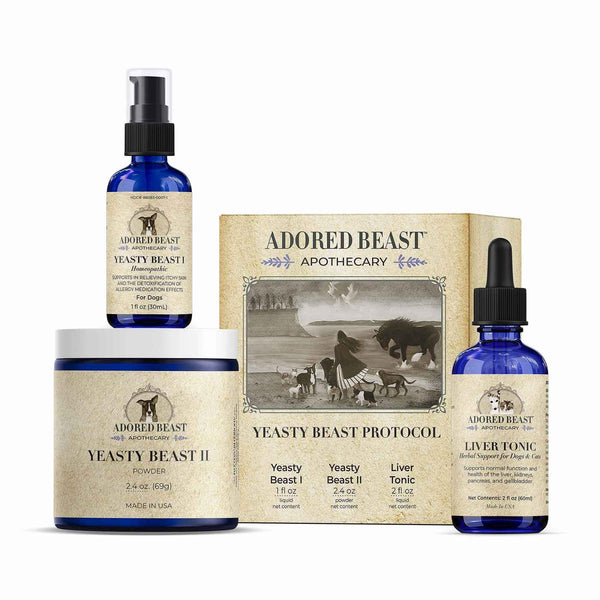
Yeasty Beast Protocol
A three part kit from Adored Beast, made with gentle herbs and homeopathic preparations, for dogs dealing with itchy paws, recurring hot spots, ear issues, and that dirty sock smell.
- Three products used in steps: Liver Tonic, Yeasty Beast I, and Yeasty Beast II
- Step one of the protocol is the diet change this whole article is about, lowering starches and sugars
- Free from maltodextrin, cellulose, saccharomyces, animal fat, flour, and other non functional ingredients
- Adored Beast advises against running it alongside other probiotics at the same time
If the arsenic piece worries you and you are in the United States, a gentle binder like The Exchange is something some pet parents use to support the body's ability to move heavy metals along. Support, never a magic eraser.
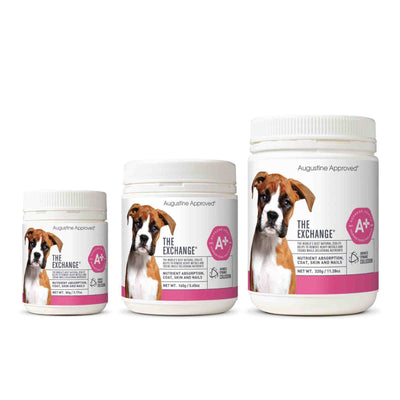
If the arsenic piece is what stuck with you
The Exchange, Zeolite
A Dynacol zeolite powder from Augustine Approved. Its honeycomb structure holds onto positively charged particles such as heavy metals and releases trace minerals like calcium, magnesium, and potassium in exchange. USA store, two sizes.
See The ExchangeRice-based bowl vs fresh, meat-first bowl, side by side
If you want the whole argument on one screen, here it is. Same dog, same itchy skin, two different foundations.
| What matters for a yeasty dog | Rice-based daily bowl | Fresh, varied, meat-first bowl |
|---|---|---|
| Does it feed skin yeast directly? | No. Malassezia cannot make its own fatty acids and feeds on the lipids on the skin, not on blood sugar. | No, for exactly the same reason. The sugar mechanism is a myth in both directions. |
| Arsenic exposure over years | Dogs eating a rice based diet for at least a year showed higher hair arsenic than dogs eating none. Brown rice tends to carry more than white, because the arsenic sits in the bran. | In that same study, the lowest arsenic levels of all were measured in the raw fed dogs. |
| Risk of nutrient gaps | High if home cooked from an unbalanced recipe. Of 200 home prepared recipes analyzed, around 95 percent fell short on at least one essential nutrient, with choline, vitamin D, zinc, and vitamin E among the most common gaps. | The same risk applies to a DIY raw bowl. It falls away when you follow a complete and balanced recipe, or feed a premade complete diet. |
| Gut diversity, the door that connects to skin | Monotonous and starch heavy. My read is that this does less to build the diverse gut that itchy dogs are often missing. | Varied and species appropriate, which is the kind of bowl a resilient gut is built on. |
| Where I would put it for a dog who is flaring | Off the daily pedestal. Rotate carbohydrate sources or lower them significantly. | The foundation of the bowl, with the yeast addressed alongside your vet. |
The first three rows come from the studies listed under Sources. The last two rows are my own read as a pet parent, not a study finding.
So, is rice bad for dogs with yeast?
Rice is not poison. Your dog is not doomed because they have eaten chicken and rice. Let's be real for a second: most of us started somewhere close to that bowl.
But if your dog has ongoing yeast and skin issues, rice is not the ingredient I would build the diet around. Not because of the sugar myth, but because of the arsenic that builds up over years, the nutritional gaps that starve the skin of what it needs, and the simple fact that a monotonous, high glycemic bowl does not build the resilient gut that keeps skin calm.
Your dog's body wants to heal. Your job is to hand it the right raw materials and get out of the way.
You are not alone in this. So many pet parents go through the exact same thing, usually while trying their absolute hardest. I am rooting for you and your dog, every step of the way.
Much Love, Larry
Free guide
The Dog Allergy & Yeast Relief Guide
You have the diet piece now. The next question is usually everything around it: what is driving the itch, what to look at first, and what order to work through it in. That is what this free guide covers. Drop your email below and we will send it over. If the form does not load for you, you can grab the guide here.
Sources
- Rosendahl S, Anturaniemi J, Hielm-Bjorkman A. "Hair arsenic level in rice-based diet-fed Staffordshire bull terriers." Veterinary Record, 2020;186:e15. https://doi.org/10.1136/vr.105493
- Bond R, et al. "Biology, diagnosis and treatment of Malassezia dermatitis in dogs and cats: WAVD Clinical Consensus Guidelines." Veterinary Dermatology, 2020;31:27-e4. https://doi.org/10.1111/vde.12809
- Stockman J, Fascetti AJ, Kass PH, Larsen JA. "Evaluation of recipes of home-prepared maintenance diets for dogs." Journal of the American Veterinary Medical Association, 2013;242(11):1500-1505. https://avmajournals.avma.org/view/journals/javma/242/11/javma.242.11.1500.xml
- Song H, Mun SH, Han DW, Kang JH, An JU, Hwang CY, Cho S. "Probiotics ameliorate atopic dermatitis by modulating the dysbiosis of the gut microbiota in dogs." BMC Microbiology, 2025;25(1):228. https://doi.org/10.1186/s12866-025-03924-6
- "Comparison of the Gut Microbiome between Atopic and Healthy Dogs (preliminary data)." 2022. https://www.ncbi.nlm.nih.gov/pmc/articles/PMC9495170/
Disclaimer: This blog may contain affiliate links, and PAWDEGA may earn a small commission at no extra cost to you if you purchase through them. It may also link to products on our website, and this content is for educational purposes, not a replacement for veterinary advice.