If your dog's ear infection keeps coming back, it is almost never a problem with the ear itself. Recurring ear infections are a downstream sign of something ongoing in the body, most often an allergic response, and the ear is where that dog happens to show it. Veterinary dermatology research puts allergy behind the chronic inflammation in up to 70% of dogs with long-running ear disease. The drops clear the organism living in the canal. They do nothing about the reason the canal became a good place for it to live, which is why the whole thing starts again a few weeks later.
In this article
- Why does my dog's ear infection keep coming back?
- What the drops are actually doing
- How do I know if it is yeast?
- Can food cause recurring ear infections?
- The sequence that actually holds
- How long before I see a change?
- What if my dog gets worse before better?
- When to go straight to your vet
- Yeasty Beast or Leaky Gut: which comes first?
- Sources
Let's be real for a second. If you are reading this, you have probably already done the responsible thing several times over. You went to the vet. You held your dog still and got the drops in twice a day for two weeks even though he hated every second of it. The ears looked pink and normal again and you exhaled. Then four weeks later, maybe six, you heard that sound at two in the morning. The head shake. The thump of an ear flapping against a skull.
And somewhere around the third or fourth round, you started to feel like the problem was you. Like you had missed something obvious, or not cleaned well enough, or picked the wrong food off the shelf.
You did not miss anything. You were handed a plan for the infection, and nobody gave you a plan for the reason.
Why does my dog's ear infection keep coming back?
Veterinary dermatology has a specific way of thinking about ear disease that most pet parents are never walked through, and once you see it, everything about the cycle makes sense.
Ear inflammation gets sorted into four categories. Primary causes are the things that create disease in a normal, healthy ear by changing the environment inside it. Secondary causes are the organisms, the yeast and bacteria, that move in once that environment has changed. Predisposing factors raise the risk, like a heavy floppy ear or a narrow canal. Perpetuating factors are the changes the inflammation itself causes, which then keep the whole thing going.
The Merck Veterinary Manual is explicit that primary causes alter the environment in the ear and allow a secondary infection to develop. Otitis externa is no longer viewed as an isolated disease of the ear canal at all. It is understood as a syndrome that usually reflects something happening in the skin and body more broadly.
Here is the part that matters for your dog. Almost every product handed to you at the appointment works on the secondary layer. The medicated drops address the organism. They are good at that. But if the primary cause is still running, the environment in that canal goes right back to being hospitable the moment the bottle runs out.
And in the majority of chronic cases, the primary cause has a name. Writing in Today's Veterinary Practice, the authors note that for up to 70% of dogs with chronic otitis externa, allergy is the factor driving the ongoing inflammation. A retrospective review of 100 dogs found allergic dermatitis was the most common primary cause identified, well ahead of grass awns or ear mites.
That same review found no primary factor could be identified at all in about a third of cases, which is worth saying out loud. This is genuinely difficult, and a vet who has not pinned it down yet is not a bad vet.
What the drops are actually doing
Most combination ear drops carry three things at once: a steroid to bring the inflammation down, an antibiotic for bacteria, and an antifungal for yeast. That combination is why the ear looks so much better so fast. It is also why the underlying picture stays invisible.
There is a real cost to running that cycle repeatedly. The same veterinary literature warns that when the primary cause is not addressed, you can end up with antimicrobial resistance, or with progressive changes in the ear canal that do not reverse, including mineralization of the cartilage. An ear that has been inflamed for years is a physically different ear.
There is also a gut cost. In a study of 22 dogs given metronidazole, gut microbial diversity dropped and an altered bacterial community persisted for four to six weeks after the course ended, though the dogs did eventually return to a composition close to where they started. Other antibiotics appear to take longer. Recovery is highly individual, which is why blanket reassurance in either direction is unhelpful.
None of this means the drops were wrong. An actively infected, painful ear needs addressing, and your vet was right to address it. It means the drops were step one of a plan that never got a step two.
How do I know if it is yeast?
Yeast lives on every healthy dog. It becomes a problem when the conditions change enough to let it overgrow, and the ear is one of the first places that shows.
Across the dogs we have supported, these are the signals that tend to cluster together. The more of them you recognize, the more likely yeast is part of your picture.
- A musty, cheesy, corn chip smell. Holistic vet Julie Anne Lee considers this the single most reliable signal.
- Dark brown or waxy discharge in the canal rather than clear fluid.
- Swollen, thickened ear canals. Inflammation lowers oxygen in the canal, which makes it a better environment for yeast.
- Damp, moist itchy patches rather than the dry presentation typical of a non-yeast allergy.
- Rust or brown staining on the paws from constant licking.
- Tear staining, and staining at the corners of the mouth.
- Irritation around the anus, or scooting, often put down to anal glands.
- Recurring hot spots or darkening skin.
Two honest qualifiers. Darkening skin can also come from hypothyroidism, which itself makes skin sensitivities worse, so thyroid testing is worth raising with your vet. And no signal list is conclusive on its own. Your vet can confirm yeast with a simple swab and a slide, and that is worth asking for rather than accepting a combined drop as the default answer.
I walked through what this looks like in practice in the video below.
Can food cause recurring ear infections?
Yes, and here is the statistic that should be far better known than it is.
In dogs with a cutaneous adverse food reaction, ear inflammation shows up in around 80% of cases. In roughly 24% of those dogs, the ear is the only clinical sign there is. No itchy belly. No chewed paws. No rash anyone would notice. Only an ear that keeps flaring.
That is exactly why a food driver gets missed for years. Nobody suspects the bowl, because the dog does not look like the picture of a food-reactive dog. He looks like a dog with bad ears.
The MSD Veterinary Manual is clear that an elimination diet trial followed by a controlled challenge is the only reliable way to establish a food reaction. Blood and saliva tests do not do it. And the trial has to run long enough. A systematic review found roughly 80% of dogs showed remission by five weeks, but reaching complete remission in more than 90% of dogs took at least eight weeks.
Read that again, because it is where most pet parents lose. If you run a diet trial for three weeks and conclude it did not work, you have not learned anything about your dog. You have only learned that three weeks is not eight.
What about high carbohydrate food?
You will read a lot online saying sugar and carbohydrate feed the yeast in your dog's ears. I want to be careful and accurate here, because that specific mechanism does not hold up for the organism usually involved in ears. Malassezia is lipophilic, meaning it favours skin lipids rather than dietary sugar.
But the broader point about processed, high carbohydrate food is well supported, and it works through inflammation and immune function rather than through feeding yeast directly. Researchers at the University of Helsinki sequenced skin tissue from atopic and healthy dogs before and after a diet change, comparing a heat-processed high carbohydrate kibble with a non-processed raw diet. They found altered pathways in keratinocyte proliferation and lipid metabolism, both central to a working skin barrier, and signs of enhanced innate immunity and reduced oxidative stress in the raw-fed dogs. The same research group found that when a puppy's mother ate raw, or raw was the puppy's first solid food, that puppy had a lower chance of allergies as an adult.
The fair caveat: in that same intervention, the diet change did not shift the severity of existing atopic dermatitis over the study window, and the sample was small. Diet is a lever, not a light switch.
What I will tell you from our side of it, clearly labelled as our experience rather than a study finding: when pet parents cut the carbohydrate load and move to fresh or raw whole food, the dogs we work with generally do noticeably better. Ears calm down. The smell fades. It is one of the most consistent patterns we see. That is observation across a lot of dogs, not a controlled trial, and you deserve to know which is which.
The sequence that actually holds
Here is what most content on this topic never gives you: an order. Not a shelf of options, a sequence, with a reason behind each stage.
- Get the active infection looked at. Ask for cytology so you know whether you are dealing with yeast, bacteria, or both. Follow your vet's plan for the acute flare. This step is not optional and nothing below replaces it.
- Start the diet work at the same time, not after. One novel protein the dog has genuinely never eaten, nothing else, for a full eight weeks. This is where a limited ingredient raw or freeze dried diet earns its place, because a short, readable ingredient list is what makes a trial interpretable at all. No flavoured chews, no table scraps, no flavoured medication if your vet can offer an alternative. One slip resets the clock.
- Reduce the yeast load, gently. If the signals above describe your dog, this is where a structured yeast program belongs, alongside the diet work rather than instead of it.
- Rebuild the gut lining afterwards. This is the stage almost everyone skips, and it is why results do not hold. Reducing yeast without repairing what it damaged leaves the door open.
- Reassess at three months, not three weeks. A condition that took two years to build is not going to unwind in a fortnight.
One practical note that sits alongside all five steps. Between flares, gentle routine cleaning helps keep wax and moisture from building up in a canal that is already prone to trouble. We use an organic ear cleanser with no synthetic additives for this, because a dog whose ears are already inflamed does not need fragrance and harsh chemicals added to the picture. To be clear about what this is and is not: cleaning is maintenance, not the answer to the recurrence question. It supports the work in steps two through four rather than replacing any of it. And during an active infection, ask your vet before cleaning anything, because a ruptured eardrum changes what is safe to put in there.
If you have read this far and recognized your dog in the yeast signals, this is the point where the honest question becomes what to actually start with.
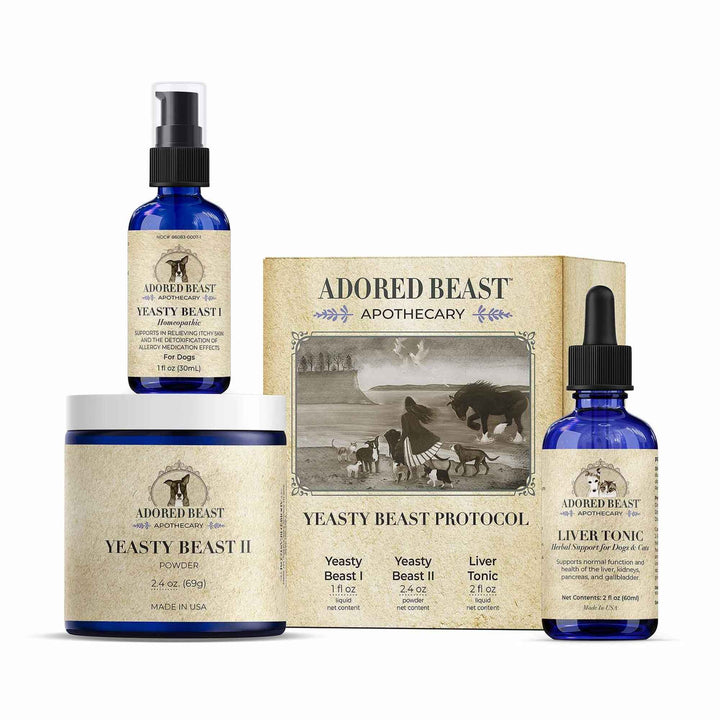
Where we start dogs with yeasty ears
Yeasty Beast Protocol
Not a single supplement, a staged three-part program built to reduce yeast slowly rather than all at once. The pacing is the point. Going too hard too fast is the most common reason pet parents abandon this work in week two, and this is sequenced to avoid that.
- Liver Tonic runs throughout, supporting the organs doing the processing
- Yeasty Beast I, a homeopathic preparation, phases in after three days
- Yeasty Beast II, an enzyme and probiotic blend with pau d'arco and caprylic acid
- Formulated by holistic vet Julie Anne Lee, for dogs only
One important note on ordering. If your dog shows the yeast signals, the yeast work comes first and the gut repair work follows it. Running them in the wrong order is a common and expensive mistake. If you are not sure which describes your dog, our team will talk it through with you before you buy anything.
How long before I see a change?
Honestly, longer than you want. Some dogs shift within a week. Others take a month before anything is visible, and dogs with years of history behind them work on a scale of months.
The research timelines line up with this. The elimination diet work needs eight weeks. In a study where dogs with atopic dermatitis were given a daily probiotic, clinical severity dropped significantly over sixteen weeks. That study also found that dogs with atopic dermatitis had significantly lower gut microbial diversity than healthy dogs at baseline, which is the gut and skin relationship showing up in the data.
Something worth knowing: improvement often shows up somewhere other than the ears first. More energy, deeper sleep, better stools, a calmer dog. Pet parents sometimes report those changes almost apologetically, as though they do not count because the ears have not changed yet. They count. The skin and ears are usually the last thing to catch up.
As Julie Anne Lee puts it, the turtle wins the race.
What if my dog gets worse before better?
This one catches almost everybody, so know about it in advance.
The pattern looks like this: improvement for roughly a day or a few days, then a decline. It is easy to read that as the program failing, and it is the moment most pet parents quit or head back for another round of drops.
More often it means things are moving too quickly rather than not working at all. The answer is to ease off and let the body catch up, then build back up, rather than abandoning the approach entirely. This is exactly the point to message us rather than guess, because the adjustment depends on your specific dog.
If you are working through the diet and gut side of this and want the whole framework in one place, including the yeast signal checklist and how the stages fit together, this is the free guide we put together for exactly that.
Form not loading? Grab the Allergy & Yeast Relief Guide here.
When to go straight to your vet
Nothing in this article replaces an examination. Book an appointment without delay if you see any of the following.
- A head tilt, loss of balance, or circling, which can point to the middle or inner ear
- Sudden severe pain, or a dog who cries when the ear is touched
- Blood or pus coming from the canal
- A swollen ear flap that feels like a cushion, which may be a haematoma
- Hearing loss, or an ear infection on one side only, which more often points to a foreign body or a mass
- Any dog on Apoquel, Cytopoint, steroids, antibiotics, or antifungals. Never stop these abruptly. Suppressed conditions rebound, and they rebound harder. Any reduction is a conversation with your vet.
Please keep in mind that I'm not a veterinarian, and this isn't medical advice. Every pet is unique, so I always recommend working alongside your vet, ideally a holistic or integrative vet, especially for anything ongoing or serious.
If you take one thing from this: your dog's ears are not the problem. They are the place the problem is showing. Once you work on the reason instead of the flare, the whole thing changes shape. It takes longer than anyone wants. It also stops being a cycle.
You are not alone in this, so many pet parents go through exactly this loop before anyone explains it to them.
Yeasty Beast or Leaky Gut: which one comes first?
This is the question we get asked more than any other, and getting the order wrong is what costs pet parents both time and money. Here is the short version, side by side.
Scroll sideways to see the full table.
| Yeasty Beast Protocol | Leaky Gut Protocol | |
|---|---|---|
| Start here if | Yeast signals present, smell, brown wax, staining | No yeast signals, or yeast stage already done |
| What it works on | Reducing the yeast load in stages | Rebuilding the gut lining underneath |
| Key difference | Paced to limit die-off reactions | Foundational repair, five products |
| Evidence status | Formulated by holistic vet Julie Anne Lee | Gut and skin link supported, kit not trialled |
| Sizing | One kit, for dogs only | Two sizes, by dog weight |
| Take a look | Yeasty Beast Protocol | Leaky Gut Protocol |
The one thing worth repeating: if the yeast signals describe your dog, the yeast stage runs first and the gut repair stage follows it. Doing the repair work while an overgrowth is still active tends to mean doing it twice. If you are genuinely unsure which describes your dog, message our team before you buy anything and we will look at it with you.
Much love, Larry
Sources
- Merck Veterinary Manual. Otitis Externa in Animals. merckvetmanual.com
- Paterson S. Diagnosis and medical treatment of otitis externa in the dog and cat. Journal of Small Animal Practice. PubMed
- Koch S. The Challenge of Chronic Otitis in Dogs: From Diagnosis to Treatment. Today's Veterinary Practice, 2022. todaysveterinarypractice.com
- Treating Otitis Externa in Dogs. Today's Veterinary Practice, 2022. todaysveterinarypractice.com
- Saridomichelakis MN et al. Aetiology of canine otitis externa: a retrospective study of 100 cases. Veterinary Dermatology, 2007.
- Cutaneous Adverse Food Reactions: What's New? Vet360. vet360.vetlink.co.za
- MSD Veterinary Manual. Cutaneous Food Allergy in Animals. msdvetmanual.com
- Olivry T, Mueller RS, Prelaud P. Critically appraised topic on adverse food reactions of companion animals: duration of elimination diets. BMC Veterinary Research. PMC
- Anturaniemi J et al. The Effect of Atopic Dermatitis and Diet on the Skin Transcriptome in Staffordshire Bull Terriers. Frontiers in Veterinary Science, 2020. PMC
- Probiotics ameliorate atopic dermatitis by modulating the dysbiosis of the gut microbiota in dogs. BMC Microbiology, 2025. BMC Microbiology
- Conserved signatures of the canine faecal microbiome are associated with metronidazole treatment and recovery. Scientific Reports, 2024. Nature
- Royal Canin Academy. Diagnosis and treatment of Malassezia dermatitis in dogs. academy.royalcanin.com