Yeast in dogs is an overgrowth of a fungus that is supposed to live in balance inside your dog's gut and on their skin. When the gut microbiome gets disrupted, that yeast overgrows and surfaces as itchy paws, recurring ear infections, a musty smell, and darkening skin. Here is what most pet parents are never told: trying to wipe yeast out quickly usually backfires. Yeast in dogs is not a skin problem, it is a gut problem that shows up on the skin, and killing it too fast is often the very thing that keeps it coming back.
On this page
- Is yeast in dogs a skin problem or a gut problem?
- What are the signs of yeast in dogs?
- Why does my dog's yeast keep coming back after medication?
- What causes yeast overgrowth in dogs in the first place?
- How do you get rid of yeast in dogs naturally?
- What is the difference between surface care and root-cause support?
- What happens after the yeast is gone?
- Which yeast starting point fits your dog?
- The one thing to remember
Is your dog constantly licking their paws, scratching, or dealing with ear infections that keep returning? Maybe they have tear stains, skin that is turning dark, or a cheesy, yeasty smell you cannot bathe away. Maybe your vet has called it allergies, or a skin condition, or said some dogs are prone to this.
What if all of those things are connected? What if they are not separate problems at all, but one root cause showing up in different places at once?
More often than not, that root cause traces back to yeast overgrowth inside the gut. And yeast is one of the most misunderstood, mismanaged issues we see at PAWDEGA. Let's change that.
This article is based on a full episode of the Next Level Pet Parent Podcast. You can watch the complete conversation here:
Is yeast in dogs a skin problem or a gut problem?
It is a gut problem that becomes visible on the skin.
Yeast is a normal resident of your dog's body. In a healthy dog, the gut microbiome keeps that yeast in check. Malassezia, the yeast most often behind these symptoms, lives quietly on the skin and causes no trouble at all until something compromises the skin barrier or the immune balance that regulates it. That is when it multiplies into what a vet may call yeast dermatitis.
The gut is the control center for that balance, which is why gut health sits at the center of every lasting yeast solution. Research increasingly points to a gut-skin axis in dogs, a two-way line of communication between the microbiome in the gut and what happens on the skin. In one study comparing dogs with allergic skin disease to healthy dogs, the allergic dogs had significantly lower gut microbial diversity. A separate 2025 study found that dogs with atopic dermatitis started with a less diverse gut microbiome, and that rebalancing it with probiotics improved their skin symptoms and shifted their gut flora back toward a healthier pattern.
Here is why that matters for you. When you only work on the skin, with shampoos and drops and wipes, you are working downstream of the actual problem. You can lower the yeast sitting on the surface, and your dog may feel better for a day. But you have not changed the internal environment that let the yeast overgrow in the first place. So it comes back.
What are the signs of yeast in dogs?
The signs of yeast in dogs show up in more places than most pet parents realize. Here is what to watch for:
- A distinct smell, often described as corn chips, moldy bread, or old cheese, that returns even after a bath
- Constant paw licking, with the fur between the toes staining a rusty brown
- Recurring ear infections, with dark, waxy buildup and swollen, thickened ear canals
- Itching and skin that is turning dark, thick, or leathery, often in the armpits, groin, and skin folds
- Tear staining, and staining at the corners of the mouth
- Scooting, which pet parents often blame on anal glands when yeast is the real driver
- Damp, sticky hot spots that feel different from a dry allergy flare
One honest note: darkening skin and itching can also point to other things, such as hypothyroidism, which can exist alongside yeast. This is why a proper look matters. Your vet can confirm yeast with a quick, noninvasive skin imprint or swab under the microscope. That is worth doing, because it tells you what you are actually working with instead of guessing.
Why does my dog's yeast keep coming back after medication?
Because the standard approach works on the surface and ignores the source, and because of one thing almost nobody explains: die-off.
This is the question we hear most. Why does my dog keep getting yeast infections no matter what I try? The cycle usually looks like this. Your dog is confirmed yeasty at the vet. They go on an antifungal, a medicated shampoo, and sometimes a steroid. The surface clears for a while. Then it returns, sometimes worse, so you go back and repeat, often with stronger medication each round.
There are two traps hidden in that cycle.
The first is that surface products never touch the internal cause. Antifungal shampoos lower the yeast on the skin, which calms the itch and the smell for a few days, but the warm, moist, sugar-fed conditions underneath are unchanged. As soon as you stop, the yeast returns. It is like mowing a lawn without pulling the roots.
The second trap is yeast die-off in dogs, and it is the piece that keeps pet parents stuck. When yeast is killed off very quickly, the mass of dying cells releases a surge of toxins into the body faster than your dog can clear them. This is a recognized reaction in both human and veterinary medicine, sometimes called a Herxheimer or die-off reaction. The result looks exactly like the yeast getting dramatically worse: more itching, more redness, more misery. So the pet parent panics, assumes the approach failed, and stops. Meanwhile the dog scratches enough to trigger a secondary bacterial infection, which earns a course of antibiotics, which further damages the gut microbiome, which feeds the next yeast flare. Round and round.
Understanding die-off changes everything. The goal is not to blast the yeast as hard and fast as possible. The goal is to reduce it at a pace your dog's body can actually keep up with.
What causes yeast overgrowth in dogs in the first place?
Yeast overgrowth in dogs is rarely one event. It is a slow accumulation of things that chip away at the gut microbiome until the balance finally tips. The most common contributors:
- Sugar and high-carbohydrate food. Yeast thrives on sugar. Many dry foods are 30 to 60 percent carbohydrate, and once carbohydrate is processed into kibble it behaves much like sugar in the body. The carbohydrate number is not printed on the bag, but you can estimate it: subtract the protein, fat, moisture, fiber, and ash percentages from 100.
- Rounds of antibiotics, which clear bad bacteria and good bacteria alike, leaving room for yeast to move in.
- Repeated drug exposure, including steroids and some flea, tick, and worm products that stress the gut.
- Environmental toxins. Floor cleaners, scented candles, and sprays add to a load your dog absorbs and licks off their paws and coat. When the toxin load outpaces the antioxidants coming in from food, the system gets overtaxed.
- Stress, which drives inflammation in the gut and reduces the beneficial microbes that keep yeast in line.
None of this is about blame. As one holistic practitioner puts it, we have collectively created a harder version of this problem than existed a generation ago. You are not failing your dog. You are working with a system that got tilted, and it can be tilted back.
How do you get rid of yeast in dogs naturally?
The natural, root-cause approach to yeast follows an order, and the order is what makes it work. This is how to get rid of yeast in dogs naturally without triggering a painful die-off:
- Starve it with diet first. Yeast's main fuel is sugar, so this is the single highest-impact change. Lower the carbohydrates and cut the sugar. Move toward fresh, whole, minimally processed food: raw, gently cooked, dehydrated, or freeze-dried. This alone weakens the yeast before you do anything else, which makes every later step gentler.
- Reduce it gently, not violently. Once the diet has done its quiet work, bring in targeted antifungal support at a measured pace. Slow and steady is the entire point. You are lowering the yeast at a speed your dog can clear.
- Digest the dead yeast so it does not flood the system. This is the step most plans skip. Specific digestive enzymes help break down dying yeast cells instead of letting them pile up and dump their toxins all at once. This is the built-in logic behind a well-designed protocol.
- Support the liver. Any die-off puts the load on the liver, so gentle liver support helps your dog process and clear what is being released.
- Repair the gut and rotate probiotics. Yeast damages the gut lining on its way through, so after the overgrowth is handled, the gut itself needs healing. Rotating probiotics over time teaches the gut to stay resilient against future overgrowth.
If your dog is currently on medication such as Apoquel or Cytopoint, this is important: never stop a prescribed drug cold turkey. Many of these work by suppressing symptoms, and pulling them abruptly can cause a rebound. Work with your vet to wean slowly while you build the body up underneath. The turtle wins the race here.
This ordered approach is exactly what the Yeasty Beast Protocol is built around.
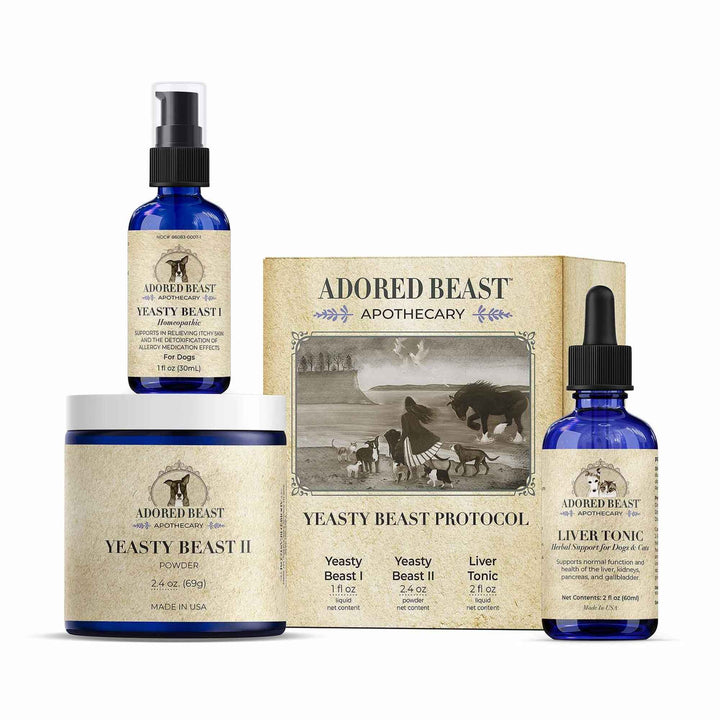
Where most pet parents start
Yeasty Beast Protocol
A three-part system designed to work with your dog's body rather than against it: weaken the yeast, reduce it while helping digest the dead cells, and support the liver through the process. It was developed by holistic animal homeopath Julie Anne Lee, DCH, over more than 25 years of clinical work, and it is one of the products our customers most often credit with finally breaking the cycle.
- Three products in one kit: Liver Tonic, Yeasty Beast I, Yeasty Beast II
- The enzyme step is built in, so dying yeast gets digested rather than dumped
- Ordered so the liver is supported before the antifungal step begins
- One kit, one size, with dosing by weight on every label
For surface comfort while the internal work begins, a gentle apple cider vinegar topical spray for yeasty skin can help ease the itch without stripping the skin's own protective microbiome the way harsh medicated shampoos can.
What if my dog is still eating kibble?
You can absolutely start this process on kibble. A full raw transition is ideal, but it is not the price of entry, and cost, convenience, and vet guidance are all real and valid reasons a dog is on kibble.
If you are staying with dry food, look for a less-processed, lower-grain option, ideally oven-baked, and add fresh food on top: blueberries, green beans, broccoli, and affordable organ meats like beef heart or kidney. Freeze-dried and dehydrated raw are excellent middle-ground steps. On more processed food the process can take longer and may need repeating more often, but it still works. Many pet parents start here, see the first improvements, and become curious about the next upgrade from there.
What is the difference between surface care and root-cause support?
Surface work and root-cause work are answering two different questions. Here is how they compare:
Scroll sideways to see the full table.
| Surface care | Root-cause support | |
|---|---|---|
| Question it answers | How do I make him comfortable today? | Why does this keep happening? |
| What it targets | Yeast sitting on the skin | The gut environment behind the overgrowth |
| Typical tools | Shampoos, drops, wipes, oral antifungals | Diet, gentle antifungals, enzymes, gut repair |
| Speed of change | Itch and smell calm within days | Gradual, over weeks and months |
| When you stop | Yeast returns, conditions unchanged | The result tends to hold |
| Where it leaves the gut | Untouched, antibiotics set it back | Repaired, gut healing is the final step |
Neither column is about attacking your vet. Testing at the vet is genuinely useful, and prescription antifungals have a place, though it is worth knowing that oral options like ketoconazole can burden the liver and usually require bloodwork monitoring. The point is that surface work and root-cause work are answering two different questions.
What happens after the yeast is gone?
The work is not quite finished, and this is where a lot of dogs quietly relapse.
Yeast is hard on the gut. On its way through, it inflames and can scar the gut lining, and you cannot see that from the outside. So your dog looks great, the itching is gone, and three to six months later new symptoms appear. It is easy to assume the yeast is back. Often it is not. It is reactivity and sensitivity coming from a gut wall that was left inflamed and never repaired.
That is why the sequence ends with gut repair, not with the antifungal step. After the overgrowth is handled, going in to soothe and rebuild the gut lining is what makes the result hold.
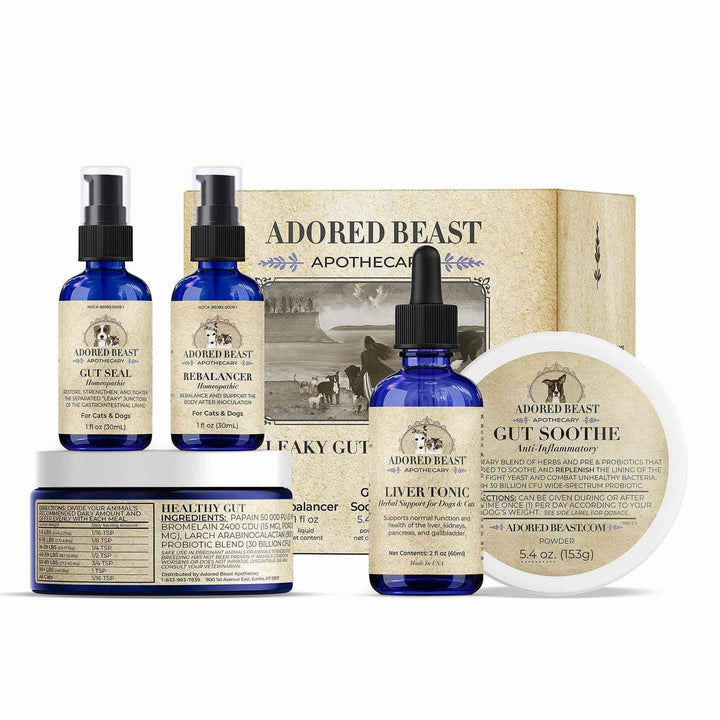
For the stage after the yeast
Leaky Gut Protocol
A structured gut-healing protocol for leaky gut in dogs, designed for exactly this stage. Five products that soothe and rebuild the gut lining after the overgrowth has been handled, so the result you worked for actually holds.
- Five products: Rebalancer, Liver Tonic, Gut Soothe, Healthy Gut, Gut Seal
- Two sizes on the product page, for dogs over and under 20 lbs
- Runs after the yeast work, not alongside it
Rotating a quality probiotic like Fido's Flora afterward helps keep the microbiome diverse and resilient so yeast has a much harder time taking hold again.
One more piece worth knowing about probiotics and yeast: Saccharomyces boulardii is a beneficial yeast, not a bacteria, and it behaves differently from a standard probiotic. In laboratory research, S. boulardii and a fatty acid it produces have been shown to block Candida from switching into its invasive form, from sticking to the gut wall, and from building the protective biofilm that makes it so stubborn. It is one reason timing and strain choice matter, and why loading a struggling dog with huge amounts of ordinary probiotics too early can actually push the yeast into a die-off you did not want yet.
Which yeast starting point fits your dog?
Three different starting points, for three genuinely different situations. All three are built on the same root-cause sequence, so you pick one and start there rather than combining them.
Scroll sideways to see the full table.
| Yeasty Beast Protocol | Yeasty Dog Support Bundle | |
|---|---|---|
| Best for | A first, focused go at the overgrowth | Dogs needing the skin handled too |
| What is in it | Liver Tonic, Yeasty Beast I and II | Yeasty Beast Protocol, spray, shampoo |
| Where it works | Internally | Internally and topically |
| Gut repair included | No, add Leaky Gut Protocol after | No, add Leaky Gut Protocol after |
| Sizes to choose | One kit, one size | One kit, one size |
| Where to look | View protocol | View bundle |
The third starting point is for the dogs who have been through the most:
Scroll sideways to see the full table.
| Allergy & Yeast Relief Protocol | |
|---|---|
| Best for | Long strugglers, heavy medication history |
| What is in it | Yeasty Beast, Fido's Flora, Leaky Gut, shampoo |
| Where it works | Inside and out, in two-week cycles |
| Gut repair included | Yes, the Leaky Gut Protocol is built in |
| Sizes to choose | Fido's Flora size and Leaky Gut size |
| Where to look | View protocol |
Not sure which one fits? Bark at us and our Pet Wellness Success Team will help you work it out for your dog specifically.
The one thing to remember
If your dog has yeast, chances are it has been building for a while. It did not appear overnight, and it will not resolve overnight either. The turtle wins the race. Slow and steady.
Work from the gut outward. Starve the yeast, reduce it gently, help the body clear it, then heal the gut underneath. Keep a simple journal of the licking, the smell, the ear redness, and the scooting, because a flare that drops from fifteen minutes of itching to five minutes is real, measurable progress that is easy to miss in the moment.
You are not powerless here, and you are not alone. So many pet parents have walked this exact road and come out the other side with a comfortable, calm, no-longer-itchy dog. Your dog's body wants to find its balance. Your job is to give it the room and the support to get there.
Much love,
Larry
Sources
- "Yeast Infections in Dogs," Vets4Pets Pet Health Advice (veterinary-reviewed), 2022. vets4pets.com
- Rostaher A. et al., "Comparison of the Gut Microbiome between Atopic and Healthy Dogs: Preliminary Data," Animals, 2022. pubmed.ncbi.nlm.nih.gov
- "Probiotics ameliorate atopic dermatitis by modulating the dysbiosis of the gut microbiota in dogs," BMC Microbiology, 2025. pmc.ncbi.nlm.nih.gov
- Krasowska A. et al., "The antagonistic effect of Saccharomyces boulardii on Candida albicans filamentation, adhesion and biofilm formation," FEMS Yeast Research, 2009. academic.oup.com
- Murzyn A. et al., "Capric Acid Secreted by S. boulardii Inhibits C. albicans Filamentous Growth, Adhesion and Biofilm Formation," PLOS One, 2010. journals.plos.org
- "What a Candida die-off is (Jarisch-Herxheimer reaction)," Healthline, reviewed 2019. healthline.com
Disclaimer: This blog may contain affiliate links, and PAWDEGA may earn a small commission at no extra cost to you if you purchase through them. It may also link to products on our website, and this content is for educational purposes, not a replacement for veterinary advice.