You can trust AI to help you organise your thinking about your dog's health. You cannot trust it to be right. Every large language model behind the tools you are using, ChatGPT, Gemini, Claude, Copilot, Perplexity, DeepSeek, writes fluent, confident, well-structured answers that are sometimes wrong, and none of them can tell you which sentence is the wrong one. Used well, AI for pet health advice is a research assistant and never the final answer, and the only safe way to rely on it is to verify every claim before you act on it. The good news is that verifying takes about five minutes, and this post gives you the exact checks.
In this article
- How often does AI for pet health advice get things wrong?
- Is this only a ChatGPT problem?
- The four ways AI gets your dog wrong
- Why does AI agree with me even when I am wrong?
- How do I ask AI better questions about my dog?
- AI gave me a list of twelve supplements. Where do I start?
- How do I know if a pet health expert online is real?
- What can AI never do for your pet?
- Sources
It is 11pm. Your dog has been itching for months. You have been to the vet four times. And instead of opening fourteen browser tabs like you used to, you now type the whole story into a chat box and get back something that reads like it was written by a specialist who has all the time in the world for you.
I understand the pull of that. After a year of no answers, an answer feels like relief.
But here is what most pet parents are never told about these tools. They are not built to know things. They are built to produce the most likely-sounding next sentence. That is a very different job, and the gap between the two is where your dog gets hurt.
How often does AI for pet health advice get things wrong?
Often enough that you should never act on a single answer without checking it, and the exact rate depends on which tool you used and what you asked.
Start with how common this has become. The RSPCA's Animal Kindness Index, an annual survey of almost 7,000 people, found that one in ten pet parents now routinely use AI for advice about their animals. The most common reason was checking symptoms in an unwell pet, cited by 62% of them, followed by questions about behaviour and body language. The RSPCA's own veterinary team described the trend as a possible welfare time bomb, because a fluent answer at 11pm can quietly replace the appointment that should have happened the next morning.
Now the accuracy side. When researchers put 250 questions from a veterinary final qualifying exam to nine different AI models, the best performers answered around 90% correctly and the weakest managed under 65%. An earlier study at the University of Georgia ran veterinary curriculum questions through two versions of the same tool and found 77% correct for the newer one, against 86% for the actual veterinary students. So these tools are capable. They are also, on the profession's own exams, less reliable than a student who has not graduated yet.
And exam questions are the easy case. They have one right answer and no missing context. Your itchy dog has neither.
Is this only a ChatGPT problem?
No. This is the single most important thing to understand, because switching tools does not solve it.
In one of the largest audits of its kind, researchers prompted ten commercially deployed AI models and checked 69,557 of the citations they produced against three academic databases. The share of citations that were wrong or nonexistent ranged from 11.4% at the best model to 56.8% at the worst. Every model in the study did it. The models differed in how often, not in whether.
There is a veterinary example that makes this concrete. A 2026 study in the Journal of Veterinary Dentistry took six common client questions, ran them through six different models including ChatGPT, Gemini, Claude, Perplexity, Qwen and DeepSeek, and had two veterinary dentists score the answers against expert reference answers. Clinically relevant errors turned up across several of the models, and the ones that mattered most clustered around anesthesia, specifically whether a dental procedure needs general anesthesia with a protected airway. That is not a trivia question. That is a pet parent deciding whether to book an anesthesia-free dental cleaning.
The same pattern shows up in the AI summaries now sitting at the top of your search results. A Guardian investigation reported AI-generated health summaries that directly contradicted official medical advice, and the commentary that followed in a BMJ journal blog noted that these summaries appear by default and cannot be permanently switched off. You do not have to open a chatbot to be handed a confident wrong answer any more. You get one on the way to looking something up.
The four ways AI gets your dog wrong
Every failure I have seen falls into one of four buckets. Learn these four and you can catch almost everything.
Scroll sideways to see the full table.
| What goes wrong | Why it happens | The check that catches it |
|---|---|---|
| Invented studies and links | It generates plausible citations | Open every source and read it yourself |
| It agrees with you | Models give way under pushback | Re-ask with the opposite premise |
| Out-of-date information | Training data has a cutoff date | Confirm recalls on a regulator site |
| No physical exam | Text cannot show pain or a lump | Book the appointment, bring the notes |
Researchers call the first row a hallucination, and in pet health it almost always arrives as a study that sounds exactly right and does not exist. The numbers are worth sitting with. In a controlled study of one widely used model writing literature reviews, 176 citations were produced and 35 of them, close to one in five, pointed to sources that do not exist. Of the citations that were real, 45.4% carried errors, most often a broken or incorrect digital identifier. So a reference list can look immaculate while roughly two thirds of it is either fictional or subtly wrong.
Why does AI agree with me even when I am wrong?
Because agreement is a behaviour these systems learned from us, and it is the failure mode I worry about most in pet health.
Researchers call it sycophancy. The pattern is well documented across model families: ask a factual question, get a correct answer, then push back mildly, and the model abandons the correct answer and endorses yours. One 2026 paper on this in a medical context put the danger plainly, noting that a model which drops a correct answer under pushback is more dangerous than one that was wrong from the start, because it lends the credibility of a correct answer to your mistaken belief.
Think about what that means at 11pm. You have a theory. You have had it for months. You type it in with all the certainty of someone who has read everything. The tool tells you that you might be onto something. You feel validated, and nothing about your dog has changed.
This is also why the tool feels so much better than your vet. Your vet interrupted you. The tool never does.
How do I ask AI better questions about my dog?
You force it to argue with you. Here is the sequence I use, in order.
- Give it the real picture, not the headline. Species, breed, age, weight, exact diet including brand and any toppers, every medication and supplement with doses, when the symptom started, what makes it better or worse, and what has already been tried and for how long.
- Ban the weak sources. Tell it not to draw on news articles, encyclopedia entries, forums, or brand marketing pages, and to say plainly when the evidence is thin rather than filling the gap.
- Ask for the case against. Request the strongest evidence for the option you are considering, then the strongest evidence against it, then the main criticisms of each study it cites.
- Make it interview you. Ask it to question you the way a clinician would, one question at a time, until it has enough to reason properly. This is where the useful possibilities surface, including ones you had not considered.
- Ask it what it would need to be wrong. A tool that cannot name what would change its mind is not reasoning, it is agreeing.
Then open every source it gave you. Not skim the summary. Open the link, confirm the study exists, and check that it says what the tool claimed. If a link does not resolve, assume the whole answer is unverified.
And if the AI answer left you with the bigger question, which is what actually supports a dog's health day to day, that is what our free guide is for. It is the standard we apply before anything reaches our shelves, written for pet parents who want clarity without pressure.
AI gave me a list of twelve supplements. Where do I start?
With one thing, for six weeks, written down. Not twelve things at once.
This is the most common way I see these tools cause real harm, and it is not through a dramatic error. It is through volume. You ask what might support an itchy, gassy, uncomfortable dog and you get a tidy list of a dozen options, each with a plausible mechanism, and no order of operations. So you buy six of them, start them all in the same week, and eight weeks later you have no idea which one helped, which one caused the loose stool, or whether anything is working at all.
A protocol has a sequence for a reason. And in a dog whose symptoms keep circling back, the sequence usually starts at the gut, because the gut is where so much of the rest of it is decided. We go through the full reasoning in our explainer on dog gut health and whole-body wellness, and if the picture includes a yeasty smell, rust-stained paws or ears that keep flaring, the post on why yeast in dogs keeps coming back is the one to read next.
Where I would start one dog, one change
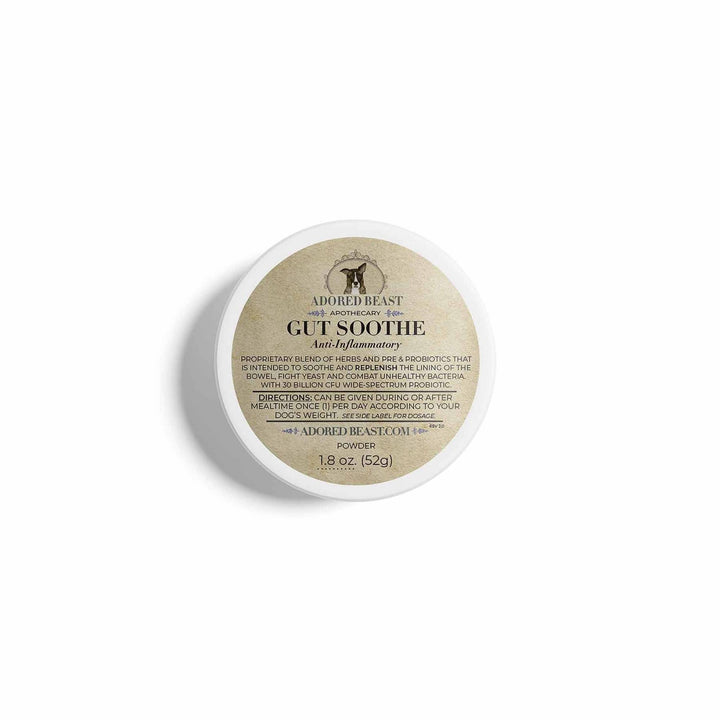
Canine Gut Soothe
Most probiotics give you strains and stop there. This one pairs a fourteen-strain pre and probiotic base with slippery elm, marshmallow root, deglycyrrhizinated licorice, L-glutamine and aloe, so it supports the gut lining at the same time as the flora living on it. That combination is why it is the single product I reach for first when a gut is both unsettled and irritated, and why it is our go-to during a diet transition.
- Fourteen probiotic strains with a functional prebiotic
- Slippery elm, marshmallow root and aloe for the gut lining
- No maltodextrin, cellulose, animal fat or flour
- One scoop on food daily, dosed by weight, two sizes
- Give it six weeks before you judge it
Then do the part no AI can do for you. Write down the date you started, the dose, and the two or three things you are watching. Take a photo of the paws or the ear today and another one in three weeks. Those small checkpoints are what let you see a pattern instead of spinning in circles, and they are also the most useful thing you can hand your vet at the next appointment.
How do I know if a pet health expert online is real?
Assume a video can be fabricated, and verify the endorsement at the source rather than in the comments.
This has already happened in human health at scale. The UK fact-checking charity Full Fact investigated a network of social accounts using AI-generated video of real doctors and academics to promote supplements those experts had never heard of. One impersonated professor found footage of a genuine conference appearance altered so that he appeared to discuss a condition that does not exist, and the clip ran past 365,000 views. A CBS News investigation later identified more than a hundred similar videos using the likenesses of real physicians, and the American Medical Association has warned about the same pattern.
The practical check is unglamorous and it works. Go to that person's own website or verified account and look for the endorsement there. If a named expert is genuinely recommending a product, it will be somewhere they control. If it exists only in a video ad, it is not real. You can also message them and ask, which is a thing more pet parents should feel entitled to do.
What can AI never do for your pet?
It cannot put hands on your dog, and that is not a small gap. It is most of veterinary medicine.
The AVMA's position on this is clear and worth knowing, because it is the same logic that applies to a chat window. A veterinarian normally establishes a professional relationship with your pet through an in-person physical examination, and remote care limits diagnostic accuracy because nobody can palpate an abdomen, listen to a heart or move a joint through a screen. The AVMA's leadership has been consistent that these tools should extend veterinary expertise rather than stand in for it.
So no AI can feel the heat in a joint, smell an ear, watch your dog's face change when a certain spot is touched, or notice the thing you did not think to mention. It also cannot carry any responsibility for being wrong, which is the part that gets lost. When a person with credentials makes a claim, their name is attached to it. When a model makes one, nothing is.
What it can do, and does brilliantly, is prepare you. Use it to build a clean symptom timeline. Use it to turn a research paper into plain English. Use it to prepare for the vet visit by writing the list of questions you want answered, so you leave with answers instead of the sinking feeling that you forgot to ask. If you are looking for someone who will engage with the whole picture, we keep a list of holistic and integrative vets who offer online consultations.
Please keep in mind that I'm not a veterinarian, and this isn't medical advice. Every pet is unique, so I always recommend working alongside your vet, ideally a holistic or integrative vet, especially for anything ongoing or serious.
And if you have been at this for months and you are tired, hear me on this. Using these tools does not make you a lazy pet parent. It makes you a pet parent who is still looking for an answer nobody has given you yet. Keep the tool. Keep the curiosity. Verify everything. Then take what you found to a human who can put their hands on your dog and put their name on the answer.
You are your pet's biggest advocate. These tools work best when they make you a better one, not when they replace you.
Much love, Larry
Sources
- RSPCA Animal Kindness Index, reported 2026, on the share of pet parents using AI chatbots for animal advice and the RSPCA veterinary team's welfare concerns. Reported in Vet Times and Horse & Hound.
- Performance of large language models on veterinary undergraduate multiple-choice examinations: a comparative evaluation, 2025, comparing nine models across 250 exam questions.
- ChatGPT in Veterinary Medicine: A Practical Guidance of Generative Artificial Intelligence in Clinics, Education, and Research, Frontiers in Veterinary Science, 2024, reporting the University of Georgia curriculum comparison against veterinary students.
- Baykal B, Okur S. Assessing the Role of Large Language Models in Veterinary Dentistry Client Communication, Journal of Veterinary Dentistry, 2026, six models scored by veterinary dentists against expert reference answers.
- How LLMs Cite and Why It Matters: A Cross-Model Audit, 2026, verifying 69,557 citations from ten deployed models against three scholarly databases.
- Influence of Topic Familiarity and Prompt Specificity on Citation Fabrication, experimental study, 2025, on fabrication and error rates across 176 generated citations.
- Why LLMs Give In: Conversational Factors and Reasoning Behind Medical Sycophancy, 2026, on models abandoning correct medical answers under user pushback.
- AI models produce inaccurate and potentially harmful health information, reports find, European Respiratory Society, January 2026, summarising the Guardian investigation into AI search summaries and the related BMJ Journal of Medical Ethics blog.
- Revealed: how academics are being deepfaked on TikTok and Instagram to promote supplements, Full Fact, December 2025.
- AVMA delegates explore AI as adoption increases across veterinary medicine, American Veterinary Medical Association, on preserving the veterinarian's responsibility for clinical judgement, alongside the AVMA's telehealth policy on the veterinarian-client-patient relationship.