Anal gland problems in dogs keep coming back because expressing the sacs empties them without changing the thing that filled them in the first place, which is stool that is too soft to press them empty on its own. The two sacs sit either side of the anus and release when a firm, bulky stool passes. Soft stool slides by without applying pressure. The sacs stay full, the ducts get inflamed, and a few months later you are booking the same appointment again.
Recurring anal gland problems in dogs are usually a stool consistency problem rather than a gland problem, which is why manual expression ends the episode without ending the pattern.
What this article covers
- Why do my dog's anal glands keep filling up?
- How often do anal gland problems in dogs come back?
- Why does expressing them every few weeks not fix it?
- Is soft stool really the root of it?
- Could this be allergies rather than a gland problem?
- What to do over the next 30 days
- When should you call your vet?
If you are reading this, you have probably already done the responsible thing more than once. You noticed the scooting. You booked the appointment. Someone emptied the sacs, your dog was comfortable for a while, and then the carpet dragging started again. Maybe your groomer now does it at every visit. Maybe you have been told this is normal for the breed.
You are not alone in this, and you have not missed something obvious. What has been missing is an explanation of the mechanism. Once you have that, the pattern makes sense, and so does the way out of it.
Why do my dog's anal glands keep filling up?
Anal sacs are scent glands. Each one has a narrow duct that opens next to the anus, and the fluid inside is squeezed out by muscular contraction as a bowel movement passes. That is the entire emptying mechanism. It is mechanical, and it depends on one thing: a stool firm enough and bulky enough to apply real pressure on the way out.
The Royal Veterinary College studied this in a population of 104,212 dogs under primary care in the UK and found anal sac disorders in 4.4% of them in a single year, which makes it one of the more common reasons a dog is seen at all. Smaller dogs carried more of it. Cavalier King Charles Spaniels had over three times the risk compared with crossbreeds, and flat-faced breeds such as the Shih Tzu had roughly 2.6 times the risk of long-skulled breeds like the Border Collie.
Breed and anatomy are real. They are also not the part you can do anything about. The part you can influence is what passes through the duct four hundred times a year.
How often do anal gland problems in dogs come back?
Often enough that recurrence is the expected outcome rather than bad luck. In a study of veterinarians in practice, the average relapse rate for anal sac impaction in dogs was 35.7%, and when impaction or inflammation came back it did so on average after four to five months.
A separate review of 190 dogs in a Swedish primary care practice found the same shape. Those 190 dogs produced 290 episodes between them, and around a third of the dogs had more than one episode.
Here is what I find most useful in those numbers. A third of dogs are in a loop, and the loop runs on a roughly four month clock. If your dog has been emptied three times in a year, that is not a coincidence and it is not a character flaw in your dog. It is a system doing exactly what the inputs tell it to do.
Why does expressing them every few weeks not fix it?
Because expression is relief, not repair. It removes the fluid that has built up. It does nothing to the stool that failed to remove it, so the sacs refill on the same schedule they emptied on.
There is a second issue, and it is the one most pet parents are never told. Routine manual expression is not neutral. The same veterinary research that recorded those relapse rates notes that expression performed as a matter of routine can irritate the sacs and the surrounding tissue, and that the irritation itself may drive more recurrence or push an impaction toward infection. Inflamed tissue narrows the duct. A narrower duct empties less well. The intervention starts feeding the problem it was meant to solve.
This is not a reason to stop working with your vet, and it is not a reason to skip an expression your dog genuinely needs right now. A full, painful sac needs emptying. It is a reason to stop accepting a standing appointment as the plan, and to ask a different question at the next visit: what is making the stool too soft to do this job by itself?
Is soft stool really the root of it?
For most recurring cases, yes. Chronically soft, pudding-textured, or inconsistent stool is the single most common reason the sacs are not emptying, and it is also the most fixable. Veterinary research into anal sac disease consistently lists stool quality, diet type, recent diet changes, body condition, and skin disease as the factors that set a dog up for it.
Stool quality is something you can assess yourself, tomorrow morning, for free.
Scroll sideways to see the full table.
| What you see | How it behaves | Effect on the sacs |
|---|---|---|
| Loose or pudding-like | No shape, leaves a smear | Too little pressure to empty |
| Soft but holding form | Squashes when picked up | Partial emptying at best |
| Formed and firm | Holds shape, picks up clean | Full pressure, sacs empty |
| Hard, dry pellets | Straining, small volume | Pressure with added irritation |
Aim for the third row. That is the target, and fiber is the lever that moves a dog toward it from either direction, which is the part that surprises people. The right fiber holds water in a loose stool to give it structure, and softens a dry one so it passes without strain.
The evidence here is good. In dogs with chronic gut inflammation, increasing dietary fiber improved stool scores in 28 of 32 dogs, with the median score moving from the loose end of the scale to a normal, formed one. In a trial of working dogs with long-running loose stool, a month of daily psyllium husk produced a good or very good response in 90% of them, increased stool bulk, and reduced how often they went from 3.5 to 2.9 times a day. Stool bulk is precisely the variable that decides whether a sac empties.
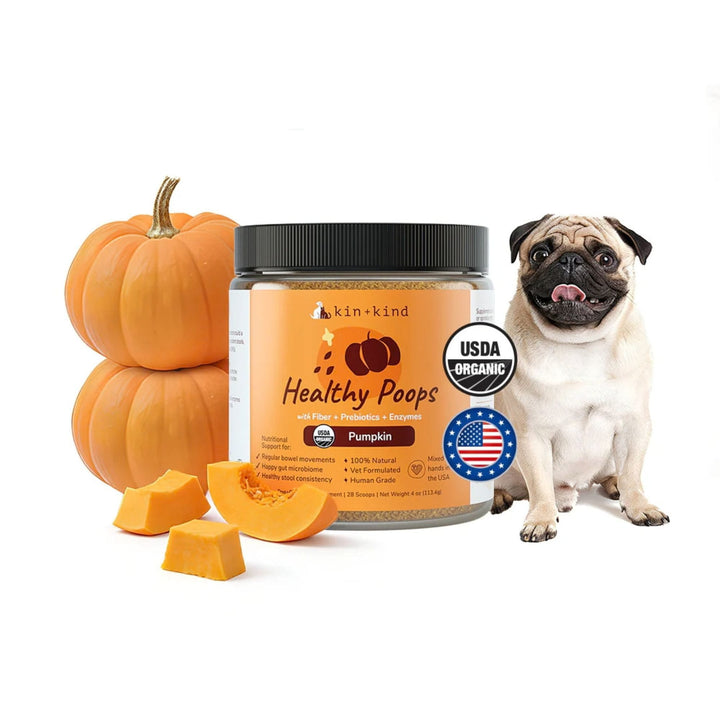
The one I reach for first
Organic Healthy Poops Supplement
A fiber supplement is not interchangeable with a probiotic here. This one is built around the specific job of changing stool structure, using organic pumpkin, flax seed and chicory root rather than a synthetic bulking agent, so you are adding food your dog's gut recognizes.
- Soluble and prebiotic fiber plus digestive enzymes, so it works on structure and on digestion
- USDA certified organic, with seven whole food ingredients and no fillers or synthetics
- Daily amount by weight: half a tablespoon under 25 lbs, 1 tbsp for 25 to 55 lbs, 1.5 tbsp for 56 to 90 lbs, 2 tbsp above 90 lbs
- Sprinkles onto raw, cooked or dry food, and suits dogs and cats from six weeks
Introduce it slowly and build up to the full daily amount over about a week. Going straight to a full serving on day one tends to cause gas, which then gets blamed on the supplement.
Could this be allergies rather than a gland problem?
For a meaningful share of dogs, the answer is yes, and it is the reason fiber alone sometimes gets you eighty percent of the way and no further.
In that study of 190 dogs, allergic skin disease was the most common concurrent condition, it appeared more often in the anal sacculitis group than in the wider practice population, and dogs who had it were significantly more likely to have the problem come back than dogs with any other condition alongside it. A smaller referral study found atopic dermatitis in 12 of 33 dogs, the most frequent comorbidity there too. The suspected mechanism is straightforward: allergic inflammation in the skin includes the skin around the anus, inflamed tissue narrows the duct, and a narrow duct does not empty.
So look at the rest of your dog. Itchy paws licked to a rust-brown stain. Recurring ear infections. A musty or corn-chip smell. Dark, thickened skin in the folds. If scooting sits inside that cluster, you are looking at one symptom of a whole-body inflammatory picture, not an isolated plumbing fault, and the gut is where that picture is usually driven from. Our guide to why yeast in dogs keeps coming back covers that pattern in detail, and how gut health drives whole-body wellness in dogs explains why the two keep showing up together.
What to do over the next 30 days
Two to four things in order, not a shelf of products at once. Here is the sequence I would run.
- Days 1 to 3, record what is actually happening. Note stool consistency against the table above at every pickup, plus scooting episodes and any licking. You cannot tell whether something worked without a baseline.
- Day 1, add fiber and build it up. Start at roughly a quarter of the daily amount for your dog's weight and work up over a week.
- Week 1, audit what is going in. High-carbohydrate food (common in kibble), daily chews, and table scraps all loosen stool. Cut the extras before you change the food itself, so you learn something from each change.
- Week 2, check body condition. Excess weight has been linked with anal sac disease, and you should be able to feel the ribs easily under light pressure.
- Weeks 2 to 4, support the gut itself. If stool has firmed but not settled, the gut lining and microbiome are the next layer, not more fiber. Six weeks is a realistic window for that kind of work.
- Day 30, compare against your notes. What you want to see is firmer stool first, then scooting fading, in that order. Stool leads, behavior follows.
One honest note on timelines, because I would rather tell you now than have you give up in week two. Stool can change within days. The gland pattern is judged against a four-month recurrence clock, so the real answer to whether this worked arrives in month three, not week one.
A fiber supplement is one way in. A rotation of whole foods is the more durable one, and most pet parents are adding fiber from a single source rather than rotating it. This free guide walks through the whole food fiber mistakes most dogs are stuck on, and what to add instead.
When should you call your vet?
Everything above is about the pattern between episodes. It is not a substitute for hands-on care for your dog, and some things need a same-week appointment rather than a supplement.
- Swelling, redness, or a firm lump beside the anus
- Blood, pus, or an open sore in that area
- Pain when the area is touched, or a sudden change in temperament
- Straining to pass stool, or crying out while going
- Any new swelling in an older dog, which needs a proper examination rather than an assumption
Worth knowing before you go: anal sac disorders are one of the better documented cases of veterinary research being thin on the ground. The authors of the largest study on it describe the condition as research-neglected, and note that the painkillers and antimicrobials being prescribed suggest these dogs are more uncomfortable than the casual "she needs her glands done" framing implies. Your dog's discomfort is real.
Two questions worth asking at the appointment. Does the stool consistency suggest an underlying gut issue we should look into? And is there a reason to run a diet trial for a food sensitivity before we settle into a standing expression schedule? Both are reasonable, evidence-based questions, and a good vet will be glad you asked them.
I am not a veterinarian, and this is not medical advice. I am a pet parent who spent a long stretch of Milka's early life watching soft stool undo everything else we were doing, and who learned to read what was in the yard as information rather than as a mess to pick up. Start there. Get the stool right, hold it for three months, and see what the glands do when the mechanism is finally allowed to work.
Much love, Larry
Sources
- O'Neill DG, et al. Non-neoplastic anal sac disorders in UK dogs: Epidemiology and management aspects of a research-neglected syndrome. Veterinary Record, 2021. bvajournals.onlinelibrary.wiley.com/doi/10.1002/vetr.203
- Corbee RJ, Woldring HH, van den Eijnde LM, Wouters EGH. A Cross-Sectional Study on Canine and Feline Anal Sac Disease. Animals, 2022;12(1):95. mdpi.com/2076-2615/12/1/95
- Hvitman-Graflund K, Sparks T, Varjonen K. A retrospective study of treatment, outcome, recurrence and concurrent diseases in 190 dogs with anal sacculitis. Veterinary Dermatology, 2023;34(6):576-585. pubmed.ncbi.nlm.nih.gov/37731183
- Lundberg A, et al. Local treatment for canine anal sacculitis: A retrospective study of 33 dogs. Veterinary Dermatology, 2022. pmc.ncbi.nlm.nih.gov/articles/PMC9545083
- Increased dietary fiber intake improves fecal and clinical activity scores in dogs with chronic enteropathy. Journal of the American Veterinary Medical Association, 2026. pubmed.ncbi.nlm.nih.gov/41962563
- Alves JC, Santos A, Jorge P, Pitaes A. The use of soluble fiber for the management of chronic idiopathic large-bowel diarrhea in police working dogs. BMC Veterinary Research, 2021;17:100. ncbi.nlm.nih.gov/pmc/articles/PMC7923632
- Anal Sac Disease in Dogs. VCA Animal Hospitals. vcahospitals.com/know-your-pet/anal-sac-disease-in-dogs