Calendula for dogs is a topical herb, better known as pot marigold, used to soothe irritated skin and support the body's own repair process. Its primary action is anti-inflammatory, and that effect is well documented. A 2025 study in Nature Communications identified the exact compounds responsible and the mechanism they work through, and a 2019 systematic review in Wound Repair and Regeneration found calendula extract helped the inflammation phase of wound healing resolve faster while increasing granulation tissue formation. Calendula officinalis is listed as non-toxic to dogs and cats by the ASPCA, and its most reliable use is topical, on irritated or healing skin, rather than as an internal remedy.
On this page
- What is calendula, and is it the same as marigold?
- Is calendula safe for dogs?
- What are the real benefits of calendula for dogs?
- Is calendula a natural antiseptic?
- Which form of calendula should you use?
- How to use calendula on dogs: the Wet or Dry Wound Rule
- Can dogs take calendula internally?
- What about calendula for joints and injuries?
- When should you skip calendula?
- What calendula cannot fix
- Spray or balm: which one does your dog need?
- Sources
One thing worth knowing up front, because it shapes how you should read anything written about this herb. The research on calendula comes from human trials, laboratory work, and animal wound models rather than from studies in dogs specifically. That is completely normal for botanicals, and it does not mean calendula will not help your dog. What it means is that the sensible approach is to lean on what the evidence supports well, which is calming inflammation and improving skin comfort, and stay measured about the claims that run further than the research does.
Because a few of them run a long way further.
So let's go through what calendula does, what it does not do, and how to use it in a way that respects your dog's skin.
What is calendula, and is it the same as marigold?
Yes and no. And this distinction matters far more than it sounds.
Calendula officinalis is commonly called pot marigold. It belongs to the Asteraceae family, alongside daisies, chrysanthemums, ragweed, and sunflowers. It is not the same plant as the ornamental marigolds most people grow in garden borders. Those are Tagetes species.
Here's why that matters for your dog.
The ASPCA lists Calendula officinalis as non-toxic to both dogs and cats. Pet Poison Helpline, meanwhile, notes that Tagetes species can cause mild gastrointestinal irritation when eaten, and that the plant's sap can irritate skin on contact.
Same common name. Different plant. Different answer.
If you have a dog who grazes in the garden, that is worth knowing before you plant anything.
Is calendula safe for dogs?
Topically, for most dogs, yes. Calendula also holds GRAS status with the FDA as a food seasoning, which tells you something useful about its baseline safety profile.
But here's what most pet parents are never told: calendula sits in the same botanical family as several of the environmental allergens your dog may already be reacting to.
A patch test study published in Contact Dermatitis in 2001 tested 443 consecutive patients. About 2% reacted to marigold, about 1.13% reacted to arnica, and roughly 4% reacted to the broader Compositae mix. The researchers concluded that allergy to this plant family contributes meaningfully to contact dermatitis, and that standard screening mixes miss some of these reactions entirely.
That was human patch testing, not dogs. But VCA Animal Hospitals flags the same principle for animals, advising caution in pets sensitive to ragweed, chrysanthemums, marigolds, or daisies. A 2025 review in Health Science Reports adds the mechanism: Asteraceae plants contain sesquiterpene lactones, a recognized risk factor for contact dermatitis, though most species in the family are weak to moderate sensitizers.
Now think about who is most likely to be reading an article about a soothing herb for itchy skin.
Usually, it is the pet parent of an allergy dog. Which is exactly the dog most worth testing carefully first.
The 48-hour patch test
- Apply a small amount to a coin-sized area of skin, ideally the inner thigh where the coat is thin.
- Wait 24 hours. Check for new redness, heat, or bumps.
- Apply once more and wait another 24 hours, since sensitization reactions are often delayed rather than immediate.
- If the skin looks calmer or unchanged, you are clear to use it on the affected area.
- If the skin looks angrier than before, stop. That is a sensitivity signal, not a detox reaction.
What are the real benefits of calendula for dogs?
It calms inflammation. And unusually for an herb, we now know fairly precisely how.
A 2025 study in Nature Communications identified C16-hydroxylated triterpenoids, particularly faradiol esters, as the main drivers of calendula's anti-inflammatory activity, working by modulating interleukin-6 release. The same research found something practical that no other article on this topic seems to mention: these compounds occur only in the flower tissue, and the outer ray florets, meaning the petals, contain roughly eight times more of them than the central disc. In the petals, faradiol myristate and palmitate measured 13.18 and 12.46 milligrams per gram of dry weight.
If you are ever making a calendula infusion at home, that is the detail that matters. The petals are where the activity lives.
A foundational 1994 study in Planta Medica put a number on that potency. Working through fractions of a flower extract, researchers found faradiol monoester was the most relevant compound because of how much of it is present, while unesterified faradiol was the most active of everything tested and matched indomethacin in the assay. That was a mouse inflammation model, not a dog, and I want to be clear about that. But it explains why this particular flower keeps showing up in topical formulations across centuries of use.
On wound recovery specifically, the 2019 systematic review mentioned above pooled 14 studies, seven in animals and seven in humans. The animal studies showed the inflammation phase resolving faster with more granulation tissue forming. The human results were genuinely mixed: a trial in burn patients found no benefit over controls, and of two trials in radiation-related skin damage, one favoured calendula while the other showed no advantage.
A 2021 randomized trial in Tissue Barriers gave the clearest single number. Across 40 patients with acute hand wounds, a 2% standardized calendula extract sped healing by 3.3% per day, and the effect appeared to come from shortening the inflammation phase.
A 2025 review in the journal Plants summed up the state of things fairly: calendula may work as a safe and accessible addition to wound care, but differences in formulation, dose, and study size mean better standardized trials are still needed.
That is the full picture: well-mapped anti-inflammatory activity with an identified mechanism, consistent signals in animal wound models, and human clinical results that are real but modest, and variable depending on how the extract was prepared. Preparation quality matters here more than it does with most supplements.
Is calendula a natural antiseptic?
Partly. And the nuance here matters far more than either of the usual answers.
Calendula does have measurable antimicrobial activity. A 2012 study in Complementary Therapies in Clinical Practice tested methanol and ethanol extracts of calendula petals against bacteria and fungi isolated from patients at Belfast City Hospital. The methanol extract outperformed the ethanol extract against most bacteria tested, and both extracts showed strong antifungal activity when measured against fluconazole. A 2017 study reported that calendula flower extracts reduced bacterial biofilm formation in isolates taken from infected eyes and contact lens cases. Separate research in the Brazilian Journal of Microbiology documented antifungal activity in calendula's essential oil.
That is a genuine body of work. Anyone telling you calendula does nothing against microbes has not read it.
Here is the part that usually gets skipped, though.
Almost all of that research is in vitro, meaning under controlled laboratory conditions, and it used concentrated methanol or high-percentage ethanol extracts. Those are not the same thing as a ready-to-use spray. Extraction method changes the chemistry substantially, and researchers have noted that conflicting antimicrobial results between studies likely come down to differences in dilution and how the extract was made. A strong alcohol tincture and a weak homemade tea are chemically different products wearing the same name.
This is why VCA Animal Hospitals describes calendula's antiseptic action as less reliable than its anti-inflammatory action. That is a fair reading of the clinical picture rather than a dismissal of the laboratory findings.
What that means for you, practically:
- Calendula supports a wound you have already cleaned. It is a valuable addition to good wound care, not a replacement for the cleaning itself.
- Alcohol-extracted tinctures and sprays are the preparations with antimicrobial data behind them. A gentle homemade infusion is a soothing rinse, which is a genuinely useful but different job.
- An already-infected wound needs veterinary attention. Heat, swelling, spreading redness, a bad smell, or discharge means the situation has moved past what any botanical should be handling alone.
That last point is not me hedging. It is the difference between using calendula well and using it as a delay.
Which form of calendula should you use?
This is where most pet parents go wrong, because three completely different products all say "calendula" on the label.
Scroll sideways to see the full table.
| Form on the label | What it actually is | Where it fits |
|---|---|---|
| Water infusion or tea | Flowers steeped in hot water. The weakest of the three. | A gentle rinse, to lift debris before you apply anything else |
| Herbal tincture or extract | Alcohol-extracted and concentrated. Chemically not a tea. | Weeping hot spots, raw licked patches, minor cuts and scrapes |
| Homeopathic Calendula 30C | A homeopathic potency, not an herbal extract at all. | By mouth, usually inside a combination formula |
The middle row is the one the research above was built on. Tinctures and extracts are the preparations those anti-inflammatory and antimicrobial studies used, not teas, and not homeopathic potencies.
That third row is the one nobody explains. A homeopathic Calendula 30C and a calendula tincture are not interchangeable products, and expecting one to behave like the other is how pet parents end up disappointed.
How to use calendula on dogs: the Wet or Dry Wound Rule
If you take one practical thing from this article, take this. It is the single most useful principle for using calendula for dog skin issues, and it is the one almost nobody states clearly.
Watery preparations go on wet skin. Fatty preparations go on dry skin.
A weeping hot spot, an oozing sore, or a raw patch your dog has licked open needs a water-based spray, rinse, or tincture. Sealing an actively draining area under an oily salve traps moisture and debris where you least want them. If a wound needs to drain, let it drain.
A dry, cracked paw pad or a closed, healing scab is the opposite situation. That is where a balm or oil earns its place.
Here is how I approach an irritated area on my dog, Milka:
- Clip the surrounding fur if the coat is trapping moisture against the skin.
- Rinse the area gently to lift away debris or discharge before applying anything. Cooled chamomile tea works well for this.
- Let the skin air dry completely. This step gets skipped constantly, and it matters.
- Apply a water-based topical if the area is weeping, or a balm if it is dry and closed.
- Keep her from licking it off for a few minutes so it has a chance to absorb.
- Photograph it daily. Skin changes slowly, and your memory is worse than you think. Photos tell you honestly whether you are moving in the right direction.
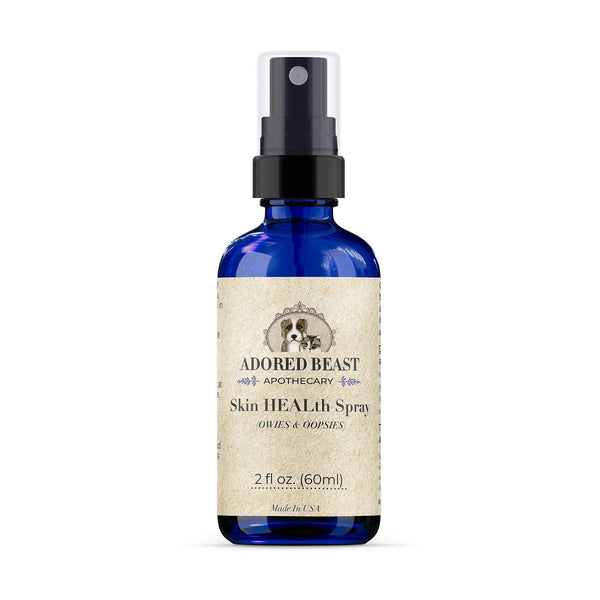
For weeping or open areas, Owies & Oopsies topical spray is what I keep in the cupboard. It is a witch hazel based spray built around herbal tinctures of calendula, hypericum, horsetail, hydrastis, and green tea.
That combination is not accidental, and the word "tinctures" on the label matters more than it looks. Tinctures are extracted preparations rather than water infusions, which is the preparation type most of the research above actually studied. Calendula and hypericum together are also a classic pairing in first aid herbalism, and the witch hazel base keeps it on the wet-wound side of the rule rather than working against it.
Worth noting from the label: safe use in pregnant animals, or animals intended for breeding, has not been established.
Can dogs take calendula internally?
Herbally, this is where the evidence thins out considerably.
Traditional herbal practice uses calendula tea and tincture internally for inflammation of the digestive and urinary tract, and it appears in plenty of holistic protocols. VCA mentions its occasional use for gastric ulcers. But I could not find canine trial data supporting any of it, and internal herbal use during pregnancy is traditionally avoided.
My position: use calendula topically, where the evidence actually is, and work with a holistic or integrative veterinarian before giving it internally.
What about calendula for joints and injuries?
Here is where the third row of that table becomes relevant, and where I want to be careful with you.
Jump for JOYnts is a homeopathic formulation, not an herbal extract. Its actives are Calendula Officinalis 30C, Ruta Graveolens 200C, Arnica Montana 1M, and Symphytum Officinale 1M. It was formulated by Julie Anne Lee, DCH, founder of Adored Beast Apothecary, around four remedies traditionally chosen for joints, tendons, ligaments, and muscle, and it contains no MSM, which some dogs are sensitive to.
Being straight with you: the trial evidence for homeopathy in animals is limited. Two systematic reviews from the Mathie group, one in the Veterinary Record in 2014 covering 18 placebo-controlled trials and one in BMC Veterinary Research in 2015 covering 20 trials with active comparators, found reliable evidence in only two trials across the entire body of work. That is the accurate state of the research, and you deserve to hear it from us rather than discover it later.
What I can tell you is what happened in our house. When Milka had her IVDD injury, Jump for JOYnts was part of what we used alongside bedrest and veterinary guidance during her recovery. I documented the whole thing, including what we gave and when, in Milka's natural IVDD recovery story. That is my experience with one dog, clearly labeled as exactly that. It is not a trial, and I am not presenting it as one.
Many pet parents reach for it for stiffness, for older dogs slowing down, and for support during recovery from strains and soft tissue injuries. It has a strong tolerability record, and it is gentle enough for long-term daily use.
When should you skip calendula?
- Your dog is sensitive to ragweed, chrysanthemums, daisies, or other Asteraceae plants. Patch test first, or skip it.
- The wound is deep, gaping, or clearly infected. That is a veterinary visit, not an herb.
- An abscess or wound still needs to drain. Do not seal it.
- Your dog is pregnant or intended for breeding. Safe use has not been established.
- The skin looks angrier after two applications. That is sensitivity, and continuing will make it worse.
- The itching keeps coming back in the same places. Which brings me to the most important point in this article.
What calendula cannot fix
Calendula soothes skin. It does not resolve the reason the skin is inflamed in the first place.
If your dog has recurring hot spots, chronically itchy paws, or irritation that clears up and returns every few weeks, a topical is managing a symptom while something upstream keeps producing it. In my experience, and in the experience of every holistic vet I have interviewed on our podcast, that upstream cause very often traces back to the gut.
The gut and the skin are in constant conversation. So are the gut and the immune system. A dog whose digestion is struggling often shows it on the outside first, and the itch and the ear infection are not always two separate problems. Sometimes they are one problem, whispering from different places. I went into this properly in our guide to dog gut health and whole-body wellness, and if recurring skin issues are your reality right now, start there rather than here.
If the itch keeps coming back
Start in the gut, not on the skin
A spray is the right answer for the patch in front of you today. It is the wrong answer for the fourth hot spot this year. Where a dog's skin keeps flaring in the same places, the gut is the first place I would look, and a canine-specific pre and probiotic is the least invasive place to start that work.
Fido's Flora is Adored Beast's canine-specific pre and probiotic, and it is the one our team reaches for most often with itchy, flaring dogs. Comes in multiple sizes, rated 4.9 out of 5 by more than 30 pet parents on pawdega.us. Subscribe and save 10% if you are committing to the six weeks these things actually take.
Shop Fido's FloraUse calendula for what it is genuinely good at: making your dog more comfortable while the real work happens underneath.
That comfort is not a small thing. Watching your dog finally stop scratching long enough to sleep through the night is worth a great deal. I remember it clearly with Milka.
Take the comfort. And then keep digging.
Much love, Larry
I'm not a veterinarian, and this is not medical advice. Every pet is unique, so I always recommend working alongside your vet, ideally a holistic or integrative vet, especially for anything ongoing or serious.
Spray or balm: which one does your dog need?
The Wet or Dry Wound Rule decides this for you, and both of these carry calendula and hypericum. The difference is the base they sit in.
| Skin HEALth Spray (Owies & Oopsies) | Organic Healing Balm for Nose & Paws | |
|---|---|---|
| Reach for it when | The area is weeping, oozing, raw, or freshly licked open | The area is dry, cracked, crusty, or a closed healing scab |
| Base | Witch hazel, water-based | Shea butter and carnauba wax, fat-based |
| Calendula form | Herbal tincture, with hypericum, horsetail, hydrastis, green tea | Organic calendula extract, with St. John's wort and rosemary |
| Typical spots | Hot spots, bug bites, scrapes, abrasions, nail bed irritation | Paw pads, nose, elbow pressure sores, chapped skin |
| Also worth knowing | Water-based, so a draining area can still drain | USDA Certified Organic, unscented, SPF 15 on the nose |
| Shop the spray | Shop the balm |
If you are unsure which side of the rule your dog's skin is on, look at whether the area is shiny and damp or dull and tight. Damp means spray. Tight means balm.
Sources
- "Biosynthesis and bioactivity of anti-inflammatory triterpenoids in Calendula officinalis." Nature Communications, 2025. https://www.nature.com/articles/s41467-025-62269-w
- Della Loggia R, Tubaro A, Sosa S, Becker H, Saar S, Isaac O. "The role of triterpenoids in the topical anti-inflammatory activity of Calendula officinalis flowers." Planta Medica, 1994; 60(6):516-520.
- Givol O, Kornhaber R, Visentin D, Cleary M, Haik J, Harats M. "A systematic review of Calendula officinalis extract for wound healing." Wound Repair and Regeneration, 2019; 27:548-561. https://onlinelibrary.wiley.com/doi/abs/10.1111/wrr.12737
- "Treatment of acute wounds in hand with Calendula officinalis L.: A randomized trial." Tissue Barriers, 2021. https://www.tandfonline.com/doi/full/10.1080/21688370.2021.1994822
- "An Update of Phytotherapeutic Advances of Marigold (Calendula officinalis L.) in Wound Healing." Plants, 2025; 14(22):3497. https://www.mdpi.com/2223-7747/14/22/3497
- Efstratiou E, Hussain AI, Nigam PS, Moore JE, Ayub MA, Rao JR. "Antimicrobial activity of Calendula officinalis petal extracts against fungi, as well as Gram-negative and Gram-positive clinical pathogens." Complementary Therapies in Clinical Practice, 2012; 18(3):173-176. https://pubmed.ncbi.nlm.nih.gov/22789794/
- El-Ganiny AM, Shaker GH, Aboelazm AA, El-Dash HA. "Prevention of bacterial biofilm formation on soft contact lenses using natural compounds." Journal of Ophthalmic Inflammation and Infection, 2017; 7(1):11. As summarised in the Drugs.com natural products monograph on calendula: https://www.drugs.com/npp/calendula.html
- Gazim ZC, Rezende CM, Fraga SR, Svidzinski TIE, Cortez DAG. "Antifungal activity of the essential oil from Calendula officinalis L. (Asteraceae) growing in Brazil." Brazilian Journal of Microbiology, 2008; 39(1):61-63.
- "Calendula." VCA Animal Hospitals, veterinary supplement monograph. https://vcahospitals.com/know-your-pet/calendula
- "Garden Marigold (Calendula officinalis)." ASPCA Animal Poison Control, Toxic and Non-Toxic Plants Database. https://www.aspca.org/pet-care/aspca-poison-control/toxic-and-non-toxic-plants/garden-marigold
- "Marigold." Pet Poison Helpline. https://www.petpoisonhelpline.com/poison/marigold/
- Reider N, Komericki P, Hausen BM, Fritsch P, Aberer W. "The seamy side of natural medicines: contact sensitization to arnica (Arnica montana L.) and marigold (Calendula officinalis L.)." Contact Dermatitis, 2001; 45(5):269-272. https://onlinelibrary.wiley.com/doi/10.1034/j.1600-0536.2001.450503.x
- Ključevšek et al. "Allergic Potential of Medicinal Plants From the Asteraceae Family." Health Science Reports, 2025. https://onlinelibrary.wiley.com/doi/10.1002/hsr2.70398
- "Calendula." Drugs and Lactation Database (LactMed), National Library of Medicine, 2021. https://www.ncbi.nlm.nih.gov/books/NBK501857/
- Mathie RT, Clausen J. "Veterinary homeopathy: systematic review of medical conditions studied by randomised placebo-controlled trials." Veterinary Record, 2014; 175:373-381. https://bvajournals.onlinelibrary.wiley.com/doi/abs/10.1136/vr.101767
- Mathie RT, Hacke D, Clausen J. "Veterinary homeopathy: systematic review of medical conditions studied by randomised trials controlled by other than placebo." BMC Veterinary Research, 2015; 11:236. https://link.springer.com/article/10.1186/s12917-015-0542-2
DISCLAIMER: Our content may include affiliate and/or sponsored links, which means your support helps move our mission forward. As content creators, we earn from qualifying purchases.