Red belted conk for dogs is a woody bracket mushroom, Fomitopsis pinicola, that appears in canine mushroom tinctures for its association with a calm inflammation response in the digestive tract, a steady histamine response, and broad immune support. It is almost never sold on its own for dogs. It shows up as one ingredient inside a blend, and here is the honest position on it: the traditional use goes back centuries, the laboratory and rodent research is real, and canine research on this specific mushroom does not exist yet.
Red belted conk is a supporting mushroom with promising laboratory evidence and no published dog trials, which is why it earns a place inside a blend rather than a bottle of its own.
On this page
- What is red belted conk, and why is it in your dog's blend?
- Red belted conk for dogs: what does it actually support?
- Why is the research thinner than the label suggests?
- Is red belted conk safe for dogs?
- On its own, or in a blend?
- How much does a dog need, and for how long?
- Which blend fits your dog?
You have probably turned a bottle over and read the ingredient panel. Turkey tail, reishi, chaga, lion's mane, all familiar. Then something you have never heard of: red belted conk. And the quiet question follows. Is this a real ingredient with a reason to be here, or is it padding the label?
Fair question. It is the right one to ask about every line on every panel, and it is the question I would rather answer properly than sell around.
What is red belted conk, and why is it in your dog's blend?
Red belted conk is a perennial shelf fungus that grows straight out of conifer trunks and fallen logs. Hard, woody, hoof-shaped, with a glossy orange to red band running behind a pale growing edge. Nothing like the soft mushrooms in your kitchen. You cannot chew it, and nobody eats it as food. It is prepared as an extract, which is the only way its compounds become available to a body at all.
In North American and East Asian herbal traditions it was used as a digestive tonic, an anti-inflammatory, and a fever remedy, and there are records of it being used to stop bleeding. It also carried practical uses that had nothing to do with health, like carrying fire embers between camps.
Why formulators reach for it: its reported affinity sits with the gut. Turkey tail and reishi cover immune modulation, lion's mane covers the nervous system, chaga brings the antioxidant load. Red belted conk is added for the inflammation response in the digestive tract and for histamine balance. It is a supporting player, chosen on purpose, and it is not the headline of any blend it appears in.
Red belted conk for dogs: what does it actually support?
Here is what the published research covers, and how much weight each line deserves. Every row below comes from work in cells, mice, or rats. None of it comes from dogs.
Scroll sideways to see the full table.
| What it has been studied for | Where that evidence comes from | How much weight to give it |
|---|---|---|
| Inflammation response | Cell studies and mouse models | Promising, unproven in dogs |
| Digestive comfort | Traditional use plus animal models | Reasonable, still unproven |
| Blood sugar and blood lipids | Rodent studies | Early, and a reason for care |
| Liver under alcohol stress | One mouse study, gut microbiome work | Mechanism only, not clinical |
| Antibacterial activity | Laboratory work on MRSA biofilms | Lab-level, no live-animal use |
| Tumour-related activity | Cell studies, three animal studies | Weak, and no dog trials exist |
A 2020 review of the antitumour work on this mushroom found pro-apoptotic, antioxidant and anti-inflammatory activity in cell studies, with only three animal studies published at that point, two of which reported slowed tumour growth. The authors called for better studies using properly identified specimens. That last phrase matters more than it looks, and it is the next section.
For contrast, look at what a properly researched mushroom looks like in dogs. In 2012, a University of Pennsylvania pilot gave a standardised turkey tail extract to 15 dogs with splenic hemangiosarcoma and reported a median survival of 199 days at the highest dose, longer than historical figures for the disease. Then a larger Penn follow-up of 101 dogs found no survival advantage for the extract alone, and female dogs on the extract alone did worse than those on chemotherapy. One landmark study, one honest correction, and that is still more canine evidence than any other medicinal mushroom has. Red belted conk has none of it.
Why is the research thinner than the label suggests?
This is the part that almost nobody writing about mushrooms for dogs mentions, and it changes how you should read every red belted conk claim online.
In 2019, US Forest Service and Canadian mycologists published genetic work in Mycologia splitting what everyone had been calling Fomitopsis pinicola into separate species. True F. pinicola turns out to be restricted to Eurasia. The red belted conks growing across North America are Fomitopsis mounceae in Canada, the Appalachians and the northern states, F. schrenkii in the west and southwest, and F. ochracea alongside them. They look near enough identical in the forest.
So: most of the published research on F. pinicola was done on Eurasian material. Most commercial extracts sold in the United States are wild-harvested from North American forests. The 2020 antitumour review was strict enough about this to exclude North American specimens from its analysis on the grounds that they were probably a different species. Labels have not caught up, and most still read Fomitopsis pinicola because that is the name the field used for a century.
Not every mycologist agrees with the split, and some argue the North American populations are regional variants of one species. That disagreement is worth knowing about rather than hiding.
What this means for you, plainly: a bottle in your hand is not proof of a research pedigree. Red belted conk belongs in a blend as one supporting ingredient among several with stronger backing. If a product leans its whole story on this one mushroom, that story is running ahead of the science.
Is red belted conk safe for dogs?
At the small amounts used in a formulated canine blend, it has a long record of gentle use and no reported pattern of harm. That said, there are four things I would want you to know before the bottle goes on your counter.
- It is emetic in large amounts. Herbalists have used it historically as a purgative at high doses. This is an argument for following a label, not for improvising.
- It has been associated with lowered blood sugar. If your dog is diabetic or on insulin, this belongs in a conversation with your vet before you start.
- Historical use includes stopping bleeding, and related extracts affected platelet aggregation in laboratory work. If your dog is on a blood thinner or has surgery scheduled, raise it first.
- Do not forage it. The whole point of the section above is that even specialists needed genetic sequencing to tell these species apart, and a woody conk off a log is not a supplement.
And the standing rule for anything with immune activity: if your dog is on an immune-suppressing medication or has an autoimmune condition a vet has identified, a mushroom blend is a discussion to have with that vet, ideally a holistic or integrative one, rather than a decision to make from a blog post. I am not a veterinarian. I am a pet parent who reads the research and then asks better questions at appointments.
On its own, or in a blend?
In a blend. I would say that even if we sold a single-mushroom version, which we do not.
Two reasons. First, the evidence base for this one mushroom cannot carry a whole routine on its own, while the mushrooms it is formulated alongside carry real weight. Second, the way these extracts are made matters as much as what goes in them. A woody polypore has to be extracted before anything inside it is available to a dog's body. Powdered mushroom stirred into food is largely indigestible fibre. A triple-extracted tincture pulls the water-soluble compounds, the alcohol-soluble compounds, and the mineral salts, which is why a dropper of liquid outperforms a scoop of powder. If you have been comparing forms, that is the whole answer.
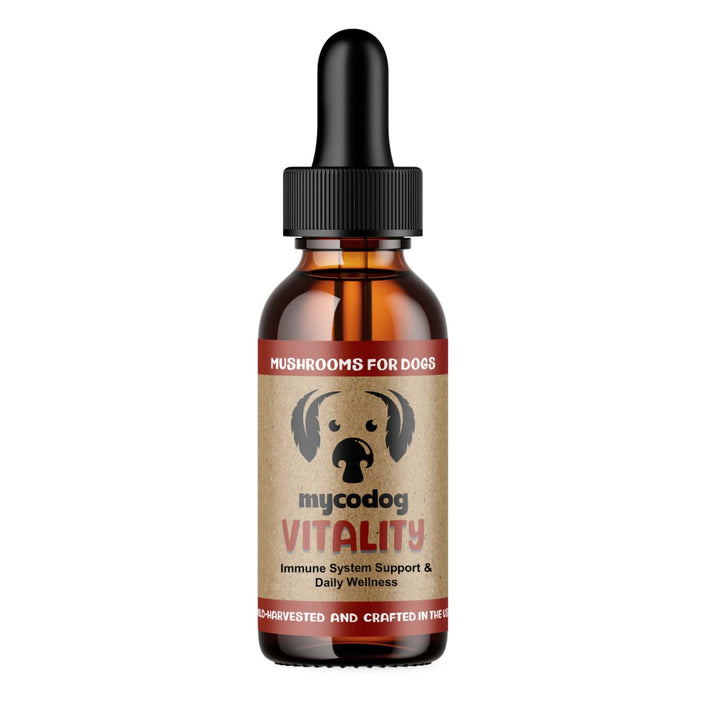
The blend we recommend most
VITALITY, Mushrooms for Immune Support
Red belted conk sits here alongside turkey tail, reishi, shiitake, maitake, chaga and artist conk, with astragalus root and ashwagandha. It is the blend I point pet parents to when nothing is wrong and the goal is a routine that compounds over years.
- Triple-extracted liquid, fruiting bodies only, no mycelium and no grain
- At least 350mg of mushroom extract per 1mL
- Wild-harvested in Pacific Northwest forests, not grown on rice or oats in a lab
- Third-party lab tested, no synthetics and no fillers
How much does a dog need, and for how long?
You will never dose red belted conk by itself. You dose the blend it lives in, and the label governs. For the tinctures we carry, the pattern is one dropper per 25 pounds of body weight once daily, given straight into the mouth or stirred through a meal, with roughly 60 servings in a 2 fl oz bottle.
Two things about timing that matter more than the number of drops:
- For a healthy dog, rotate. Run one blend until the bottle is finished, then move to a different one. Rotating through chaga, turkey tail and the blends across the year gives a wider spread of compounds than hammering the same tincture for a decade.
- When you are working on something specific, give it six weeks minimum. Herbalists work on the principle that a body needs about six weeks to move through a healing response. Two weeks and a shrug is not a fair test of anything.
Shake the bottle. The extract settles, and the mineral salts are part of what you paid for.
Which blend fits your dog?
Red belted conk appears in two of the tinctures we carry, and they are built for different dogs. This is the decision most pet parents are actually making when they land on this page.
Scroll sideways to see the full table.
| Question | VITALITY | DIGEST |
|---|---|---|
| Best suited to | A daily immune and longevity routine | A gut-first picture |
| Red belted conk sits with | Six other mushrooms, two adaptogens | Four other mushrooms, three adaptogens |
| The dog I picture | Healthy senior, nothing wrong yet | Loose stools, or gut stressors ahead |
| How it is usually run | Rotated through the year | Six weeks or more, then reassess |
| Start here | See VITALITY | See DIGEST |
If the honest answer is that your dog's digestion has never been settled, mushrooms are a support layer rather than the foundation. The foundation is the food, the gut lining, and what is being asked of that gut every day. We wrote about that here: why gut health sits under almost everything else.
And if you came here ready to be sold on an exotic mushroom, I would rather send you away with this instead. Red belted conk is a legitimate supporting ingredient with a real traditional record and early laboratory evidence. It is not a reason on its own to buy anything. The blend around it is.
Much love, Larry
Sources
- Haight J, Nakasone KK, Laursen GA, Redhead SA, Taylor DL, Glaeser JA. Fomitopsis mounceae and F. schrenkii, two new species from North America in the F. pinicola complex. Mycologia, 2019. US Forest Service
- Bishop KS. Characterisation of extracts and anti-cancer activities of Fomitopsis pinicola. Nutrients, 2020. PubMed Central
- The bioactive compounds, beneficial medicinal properties and biotechnological prospects of Fomitopsis. Frontiers in Cellular and Infection Microbiology, 2025. Frontiers
- The protective effect of Fomitopsis pinicola mycelia polysaccharides on acute alcoholic liver injury in mice. 2023. Authorea
- The dual role of the medicinal mushroom Fomitopsis pinicola in inhibiting biofilm and reducing antibiotic resistance of MRSA. Folia Microbiologica, 2025. PubMed Central
- Cheng et al. Properties and biological functions of polysaccharides and ethanolic extracts isolated from Fomitopsis pinicola, 2008, as reviewed in the 2025 Frontiers overview above.
- Brown DC, Reetz J. Single agent polysaccharopeptide delays metastases and improves survival in naturally occurring hemangiosarcoma. Evidence-Based Complementary and Alternative Medicine, 2012. PubMed
- Gedney A, Krick E, Martins R, Scavello H, Salah P. Evaluation of the safety and efficacy of Coriolus versicolor polysaccharopeptide alone or with doxorubicin for dogs with splenic hemangiosarcoma. University of Pennsylvania, Veterinary Cancer Society, 2020. VIN
This article is for information only. It is not veterinary advice, and it is not a substitute for care from a qualified professional. Every pet is unique, so work alongside your vet, ideally a holistic or integrative vet, for anything ongoing or serious.