Dog dementia gets worse at night because canine cognitive dysfunction disrupts the sleep-wake cycle itself, so an affected dog sleeps through the day and then paces, pants, vocalizes, or stares at walls once the house goes quiet. What helps is a combination, not one thing: ruling out the other reasons a senior dog is awake, a veterinary assessment, a predictable evening routine, and nutritional support with your vet's sign-off.
Here is the sentence I would want someone to tell me first, before anything else: nothing you can buy stops canine cognitive dysfunction, but the nights are the part of it that responds best to being worked on, and they are also the part quietly wrecking your own sleep.
What you will find here
- First: will any of this interfere with her medication?
- Why does dog dementia get worse at night?
- What else keeps a senior dog awake at night?
- What can your vet actually offer?
- The night routine that does the heavy lifting
- Does diet make a difference?
- What about mushrooms and other supplements?
- How long before you know if something is working?
- A word about your own sleep
- Sources
If you are reading this at 2am with a dog circling the kitchen behind you, I am sorry. This is one of the hardest stretches of pet parenting there is, and it is lonely in a way that is hard to explain to people whose dogs still sleep through the night.
You are also not doing it wrong. Let's go through what is actually happening, and what there is to work with.
First: will any of this interfere with her medication?
I am answering this before anything else, because if your dog is already on a veterinary plan it is the only question that matters until it is settled.
Nothing in this article is offered as a replacement for what your vet has put in place. Everything here is meant to run alongside it. But alongside is not the same as automatically compatible, and there are two places where that genuinely matters.
Selegiline, the one medication approved for canine cognitive dysfunction in the US, is a monoamine oxidase inhibitor. It has real interaction considerations with several other medications, including some used for night-time anxiety, and the Purina Institute's clinical guidance notes that combining selegiline with certain sedatives raises the risk of serotonin syndrome. If your dog is on selegiline, every addition goes past your vet first. No exceptions, and no reason to feel awkward about asking.
Second, any fat added to the diet is a real consideration for a dog with a history of pancreatitis, and any supplement is a consideration for a dog on multiple medications. Write down what you are thinking of adding and take the list to your appointment. A good vet will not be annoyed by that. Mine never has been.
Why does dog dementia get worse at night?
Because the disease attacks sleep directly, rather than the nights being the only time you happen to notice it.
Canine cognitive dysfunction shares its pathology with Alzheimer's disease in people: accumulation of beta-amyloid, phosphorylated tau protein, neuronal loss, and neuroinflammation. Veterinary behaviorists describe its signs using the acronym DISHAA, and sleep-wake cycle disruption is one of the six, sitting alongside disorientation, changed interactions, house soiling, activity changes and anxiety.
A polysomnography study recorded sleep in 28 senior dogs and found that those with higher dementia scores spent less time in both NREM and REM sleep, with electroencephalographic patterns reflecting shallower sleep in the more affected dogs. So this is measurable, not only a perception from the other end of the hallway.
And here is the part that explains why nights deserve so much of your attention. The relationship runs both ways. Clearance of beta-amyloid happens during sleep, and the research describes a loop in which amyloid burden disturbs sleep while poor sleep in turn promotes further amyloid deposition and impairs memory consolidation. Improving the nights is not cosmetic. It is working on one of the few levers that feeds back into the rest of it.
One more thing worth knowing, because it may take some weight off your shoulders. This is common, and it is badly under-recognised. Estimated prevalence rises steeply with age: around 8% of dogs aged 8 to 11, 19% at 11 to 13, 45% at 13 to 15, and 67% at 15 to 17. Yet in a cross-sectional survey of older companion dogs, while 14.2% met the criteria, only 1.9% had been formally identified by a veterinarian. A separate survey found 75% of dogs aged 7 and over showed at least one behavioral change consistent with cognitive decline, and only 12% of their pet parents had mentioned it at the clinic.
Most people assume it is normal aging and never raise it. You did.
What else keeps a senior dog awake at night?
This section matters more than anything else on this page, so please do not skip it.
Cognitive decline is common in old dogs. So is arthritis. So is kidney disease, hypertension, hearing and vision loss, and a dozen other things that produce a restless senior dog at 3am. Deciding it is dementia and stopping there is how a painful dog goes untreated for a year.
Scroll sideways to see the full table.
| What you are seeing at night | Could also be | Worth asking your vet |
|---|---|---|
| Cannot settle, shifts position constantly, pants | Pain, most often arthritis | A pain assessment, and whether a trial of pain relief is reasonable |
| Getting up to urinate, accidents indoors | Urinary infection, kidney disease, diabetes, Cushing's | Bloodwork and a urine sample before anything else |
| Bumping into things, stuck behind furniture | Vision loss | An eye examination, and whether a referral is warranted |
| Startling badly, sleeping through your arrival | Hearing loss, which looks a great deal like confusion | A hearing check, and whether hand signals would help at home |
| Restlessness that began suddenly, within days | Almost anything acute. Cognitive decline is gradual | An appointment this week, not at the next routine visit |
| Pacing plus labored breathing or coughing | Heart or respiratory disease | Chest imaging, and a discussion about cardiac screening |
The pattern that points toward cognitive decline rather than something else is a gradual accumulation of several DISHAA signs over months, not one change that appeared last Tuesday. A sudden change is a reason to be seen quickly.
What can your vet actually offer?
More than most pet parents realize, which is the other reason the 1.9% figure above is worth sitting with.
Selegiline (sold as Anipryl) is the one medication approved in the US for canine cognitive dysfunction. It does not work for every dog, and it does not stop the disease, but for a good number of dogs it noticeably improves alertness and eases several of the DISHAA signs.
If your dog goes onto it, ask about the liver. Selegiline is cleared almost entirely by the liver, with extensive first-pass metabolism and hepatic elimination, and in people on long-term use mild rises in liver enzymes have been reported in up to 40% of patients. Those are usually self-limiting, and the NIH LiverTox database rates selegiline as unlikely to cause clinically apparent liver injury, so this is not a reason for alarm. It is a reason to have baseline liver values on file before the first dose and a recheck a few months in, folded into the senior bloodwork you should be running anyway.
What I would not do is start a liver supplement off my own bat alongside it. Selegiline is processed through cytochrome P450 enzymes, several herbs commonly used for liver support act on that same system, and the Anipryl label itself notes that the MAO enzyme system is complex and incompletely understood. If liver support is warranted, that is a call your vet makes with your dog's numbers in front of them.
Sleep support for the nights specifically. The Purina Institute's clinical guidance describes a night-time approach that can get a dog sleeping through within days, which in turn makes the dog more alert during the day and begins to reset the cycle. Melatonin is commonly part of that conversation, and there are prescription options your vet may add. All of it is prescribing territory and interaction-sensitive, particularly alongside selegiline. This is a conversation, not a shopping list.
A formal assessment. Scales such as CADES and DISHAA let your vet score where your dog sits now and compare it at the next visit. That is worth more than it sounds, because on a slow decline your own memory of three months ago is not reliable. In one study of dogs aged 8 to 16, the rate of conversion from cognitively normal to mild impairment over 12 months was around 71%, so a baseline score today is genuinely useful information later.
Ask for the score to be recorded. Ask what it was. Write it down.
The night routine that does the heavy lifting
None of this costs anything, and in most households it changes more than any bottle does.
- Anchor the day, not only the night. A dog who sleeps all afternoon has nothing left to spend at 11pm. Daylight exposure, a gentle walk at the same time each day, and a food puzzle in the afternoon do more for the nights than anything you do after dark.
- Make the evening identical. Same order, same times, same last trip outside. Predictability is doing the work of memory for a dog who has less of it.
- Light the route. Low night lights along the path from the bed to the door and to the water bowl. A confused dog in a dark hallway is a frightened dog.
- Shrink the space. A smaller, enclosed sleeping area with familiar bedding gives fewer corners to get stuck behind. Baby gates across stairs are not optional once wandering starts.
- Soften the surfaces. Runners on slippery floors. A dog who has slipped once will pace anxiously rather than settle.
- Handle the waking calmly. Responding with energy teaches the night that something happens when she gets up. Quiet redirection back to bed, every time.
- Keep a simple log. Date, how many times she woke, roughly how long she was up. Three weeks of that tells you and your vet far more than an impression does.
That last one is the thing most people skip and later wish they had not. It is also how you find out whether any of the changes below are actually doing something.
Does diet make a difference?
This is, honestly, where the strongest evidence in the entire subject sits, and it surprises people.
The aging canine brain loses some of its ability to use glucose efficiently. Medium-chain triglycerides are converted by the liver into ketones, which cross the blood-brain barrier and give neurons an alternative fuel. That is the mechanism, and it has been tested properly in dogs.
In a prospective, double-blind, placebo-controlled study, 87 client-owned dogs showing signs of cognitive dysfunction were randomized into three groups of 29 and fed for 90 days. Dogs on a diet containing 6.5% MCT oil plus a brain protection blend improved significantly across all six categories of cognitive dysfunction signs. The control group improved in four of six. That is a real trial with a control arm, on ordinary pet dogs living at home, and it is stronger than the evidence behind anything else in this article.
One honest limitation, because it changes what you should expect. That study tested a complete therapeutic diet formulated at 6.5% MCT, not a spoonful of oil added on top of whatever your dog already eats. Adding MCT oil is a reasonable way to bring the same fuel into a diet you are otherwise happy with, and it is what many holistic vets suggest, but it is not the identical intervention, and I am not going to pretend it is. If your dog will eat a prescription cognitive diet and your vet recommends one, that is the version with the trial behind it.
A practical note either way: start at a quarter of the label amount and build up over a couple of weeks. MCT oil can loosen stools if you go in at full strength, and a dog with a pancreatitis history needs veterinary clearance before any added fat.
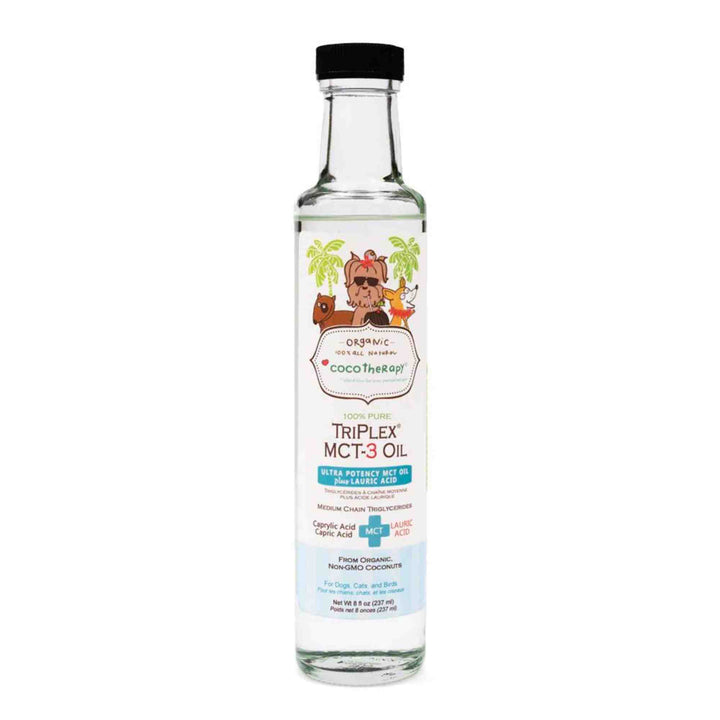
What I would add first, with your vet's sign-off
TriPlex MCT-3 Oil by CocoTherapy
I am recommending this one ahead of anything else on our shelves because the mechanism behind it has the best canine evidence of anything discussed on this page. It is a single-ingredient oil rather than a formula, which also makes it the easiest thing to run past your vet.
- 100% MCT oil from cold-pressed USDA-certified organic coconut oil
- Caprylic acid (C8) 7,000mg and capric acid (C10) 4,700mg, the two fractions the canine research is built on
- Lauric acid (C12) retained rather than stripped out
- Unbleached, unhydrogenated, human-grade, with no synthetics, fillers or additives
- Goes straight onto food, which matters with a senior who is fussy
- Start at a quarter of the label amount and build up over two weeks
We have written about the wider picture in our guide to MCT oil for dogs and what the brain research actually shows, including which fatty acid fractions the studies used and which claims run ahead of the evidence.
What about mushrooms and other supplements?
Here is the honest hierarchy, and I would rather give you that than a list.
No supplement stops or reverses canine cognitive dysfunction. Anybody telling you otherwise is selling ahead of what exists. What some of them may do is support normal brain function and calm alongside the rest of the plan, and for the nights specifically, calm is not a small thing.
The medicinal mushroom evidence is the most interesting and the most limited. MycoDog's Senior Dog Study enrolled 30 senior dogs showing signs of cognitive decline in a 12-week protocol using their Clarity formula, which combines lion's mane, reishi and cordyceps with bacopa monnieri and ashwagandha. They reported 81% of dogs stabilizing or improving on cognitive scoring, an average 39% reduction in cognitive dysfunction scores, activity-collar data showing calmer nights, and inflammation and brain-derived neurotrophic factor biomarkers moving favorably.
Some context on how much weight to give that. The study was run by Veterinary Health Research Centers, an independent research group, under veterinary supervision, and it used activity collars and bloodwork rather than owner questionnaires alone. It also ran on 30 dogs with no placebo arm, funded by the company that makes the formula, testing a five-ingredient blend rather than any one of its parts. It is the first formal work of its kind in this area, and it is encouraging, and it is not the MCT diet trial. I would rather give you both halves than let you find the second one later.
Where it earns a place is the calm. Reishi and ashwagandha are both used for stress modulation, and a dog who settles more easily in the evening is a dog whose nights are shorter, which loops back to the sleep and amyloid relationship above.
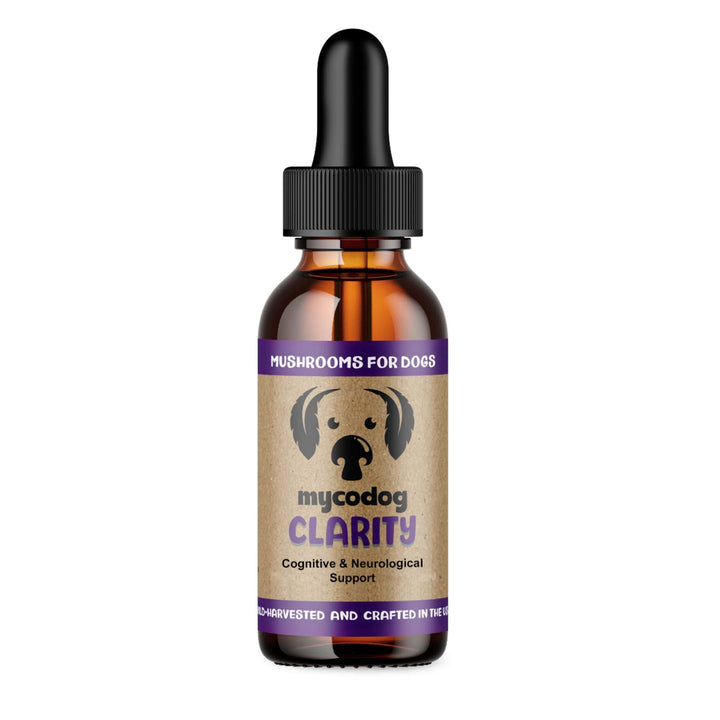
If the evenings are your hardest hour
CLARITY by MycoDog
This is the formula the Senior Dog Study used. It suits a different problem from the oil above: where MCT is about fuel for the aging brain, this one leans toward settling and engagement, which is what most pet parents describe wanting back first. Fruiting body only, no grain or mycelium, third-party lab tested.
Read the full ingredient listBoth go past your vet first if your dog is medicated. I know I have said that three times now. It is the thing I would most want said to me.
One more question comes up every time this subject does, so let's answer it here rather than leave you searching at 3am: what about CBD?
It belongs in this conversation, and it is worth being precise about what it is doing, because the answer depends entirely on what you are asking of it.
Ask whether hemp extract slows cognitive decline and the answer has two halves. The preclinical work is real: a peer-reviewed review of the neurological effects of phytocannabinoids concluded that cannabidiol can reverse cognitive deficits and neuronal death, reduce oxidative stress and neuroinflammation, assist the clearance of beta-amyloid plaques while reducing their production, and decrease tau aggregation. Those are exactly the mechanisms described earlier on this page.
The other half is the species. That work sits largely in laboratory models rather than in dogs, and no canine clinical trial has reported. Colorado State University is running the one that should answer it, 48 dogs across four arms including a placebo, double-blinded, over two years. So the mechanism is promising and the canine outcome is unproven, and anyone marketing hemp as reversing dog dementia is speaking well ahead of it.
Ask instead whether it helps a stressed, restless dog settle, and the picture changes completely. In a randomized, placebo-controlled, blinded study at the Waltham Petcare Science Institute, a single dose of broad-spectrum CBD produced significant improvements across multiple measures of canine stress, physiological ones including cortisol, heart rate and ear temperature, and behavioral ones including whining, trembling and panting. There is also a peer-reviewed placebo-controlled trial on canine anxiety from Cornell. On study design, that is stronger evidence than anything else discussed on this page apart from the MCT diet trial.
Which matters here, because anxiety and restlessness are exactly what is keeping your dog on her feet at 2am. One fair caveat: that study tested a single dose against short, sharp stressors like car travel, so applying it to chronic night-time restlessness is an extrapolation. It is a far shorter one than claiming an effect on cognition, and I would rather name it than quietly lean on it.
The practical note is about medication rather than about hemp itself. CBD is handled in dogs largely through cytochrome P450 enzymes, particularly CYP1A2, and it can change how those enzymes process other drugs. A mild rise in alkaline phosphatase is a common finding in canine CBD studies, and researchers describe it as an uninformative read on its own, which is why a full liver panel is the sensible way to look at it. None of that makes hemp a risky choice. It makes it a choice your vet should know about, which, on a page written for dogs often taking several medications, is worth stating plainly.
And keep the very first row of that rule-out table in mind. If the reason your dog cannot settle turns out to be arthritis rather than confusion, hemp extract moves from a reasonable option to a strong one.
How long before you know if something is working?
Longer than feels fair, and this is where most people give up too early.
The MCT diet study ran 90 days with assessments at day 30 and day 90. The Senior Dog Study ran 12 weeks. MycoDog's own guidance is a minimum of six weeks when working on something specific. So the fair test is measured in weeks and months, not days, and checking for a difference on day four will only tell you that day four was a bad night.
Change one thing at a time. Give it six to eight weeks. Use the log. Compare three weeks of entries against the three weeks before you started, rather than against your memory of how things were, which grief and exhaustion both distort.
And define what you are watching for in advance. Not "is she better," which is unanswerable, but "how many times is she up between midnight and 6am." That is a number. Numbers survive a bad week.
A word about your own sleep
Every clinical piece I read while writing this made the same point, and it is not sentimental. When a dog has cognitive decline, the pet parent is not sleeping either, and people who are not sleeping cannot make good decisions about their pet's care. Getting the nights under control is care for your dog and care for you, and you are permitted to count the second one.
You are also allowed to ask for help sooner than you think you should. If you want a professional who will work alongside your regular vet on the whole picture rather than one appointment at a time, we keep a list of the holistic vets we trust for online consultations.
And if you are wondering whether it is too late to start any of this: support is worth something at every stage. I will not turn that into a promise about outcomes, because nobody honest can. But a more comfortable night is worth having tonight, regardless of what the next year holds.
She does not need you to fix this. She needs you to make the dark less frightening. That, you can do.
Much love, Larry
Please keep in mind that I'm not a veterinarian, and this isn't medical advice. Every pet is unique, so I always recommend working alongside your vet, ideally a holistic or integrative vet, especially for anything ongoing or serious.
Sources
- Recent advances in diagnostic and therapeutic strategies for canine cognitive dysfunction. American Journal of Veterinary Research, 2025. Published ahead of print.
- Salvin HE, McGreevy PD, Sachdev PS, Valenzuela MJ. Under diagnosis of canine cognitive dysfunction: a cross-sectional survey of older companion dogs. The Veterinary Journal, 2010;184(3):277-281. pubmed.ncbi.nlm.nih.gov/20005753
- Updates on Cognitive Dysfunction Syndrome. Today's Veterinary Practice, 2024. todaysveterinarypractice.com
- Sleep and cognition in aging dogs: a polysomnographic study. Frontiers in Veterinary Science, 2023. frontiersin.org
- Pan Y, et al. Efficacy of a therapeutic diet on dogs with signs of cognitive dysfunction syndrome: a prospective double blinded placebo controlled clinical study. Frontiers in Nutrition, 2018. ncbi.nlm.nih.gov/pmc/PMC6299068
- Canine cognitive dysfunction syndrome: preserving quality of life for owners and senior dogs. Purina Institute. purinainstitute.com
- Selegiline. LiverTox: Clinical and Research Information on Drug-Induced Liver Injury, National Institute of Diabetes and Digestive and Kidney Diseases. ncbi.nlm.nih.gov/books/NBK548891
- ANIPRYL (selegiline hydrochloride tablets) label, Zoetis Inc. DailyMed, US National Library of Medicine. dailymed.nlm.nih.gov
- Comparison of clinical scales for the assessment of canine cognitive dysfunction. Frontiers in Veterinary Science, 2024. frontiersin.org
- MycoDog Senior Dog Study (conducted by Veterinary Health Research Centers, study director Joel Ehrenzweig, DVM, MRCVS). mycodog.com and Pet Age coverage
- Medium chain triglycerides (MCT) oil. VCA Animal Hospitals. vcahospitals.com
- TRAC Study: investigating the effect of trazodone, rapamycin and cannabidiol on cognitive dysfunction in dogs. Colorado State University. source.colostate.edu
- Maroon J, Bost J. Review of the neurological benefits of phytocannabinoids. Surgical Neurology International, 2018;9:91. Findings on cognition are drawn largely from preclinical models. pubmed.ncbi.nlm.nih.gov/29770251
- TRAC study protocol, including group sizes, blinding and imaging schedule. Colorado State University Veterinary Teaching Hospital. vetmedbiosci.colostate.edu
- A Q&A about CBD with Pet Poison Helpline. SafetyCall International. safetycall.com
- A single dose of cannabidiol positively influences measures of stress in dogs during separation and car travel. Frontiers in Veterinary Science, 2023 (Waltham Petcare Science Institute). frontiersin.org
- Safety of a single-dose and escalating-dose cannabidiol regimen in dogs: haematology, biochemistry and alkaline phosphatase findings. Frontiers in Veterinary Science, 2022. frontiersin.org