Marshmallow root for dogs is a mucilage herb, Althaea officinalis, used to calm irritated tissue in the digestive tract, the urinary tract and the throat. It works physically rather than chemically. The polysaccharides in the root swell in water into a slick gel that settles over an inflamed lining like a temporary film, which is why comfort often comes quickly and why it fades once the herb clears. The European Medicines Agency recognises the root for that narrow job: symptomatic relief of mild stomach discomfort, and irritation of the mouth and throat with dry cough.
Marshmallow root is comfort, not correction. It coats an irritated lining and buys the body time, and it does nothing about whatever irritated that lining in the first place.
In this article
- What is marshmallow root, and what does it do inside a dog?
- What is marshmallow root used for in dogs?
- Marshmallow root or slippery elm: which does my dog need?
- Is marshmallow root enough on its own?
- Can marshmallow root stop my dog's medication working?
- How do you give marshmallow root to a dog?
- Is marshmallow root for dogs safe?
- Sources
If you found this page late at night because your dog's stomach is off again, I have been exactly where you are. Milka, my French Bulldog, spent her first year with chronic diarrhea, vomiting, and hot spots. We did everything we were told. Countless vet visits. "Premium" kibble. Expensive meds. Nothing held.
What I did not understand back then is why an upset stomach kept coming back, or the difference between a herb that makes a lining feel better and a plan that changes why the lining is inflamed. Marshmallow root sits firmly in the first group, and it is genuinely good at that job. Here is what it does, what it does not do, and the one timing detail almost nobody mentions.
What is marshmallow root, and what does it do inside a dog?
Marshmallow root is the dried root of Althaea officinalis, a cultivated garden herb with no relationship to the white sugar confection that borrowed its name. Its characteristic constituents are mucilage polysaccharides, mainly rhamnogalacturonans and arabinogalactans, and European pharmacopoeia standards actually grade the root by how much it swells in water rather than by a chemical marker.
Herbalists call this a demulcent action. In plain terms: the gel sticks to an irritated mucous membrane and shields it from whatever keeps rubbing against it, whether that is stomach acid, digestive enzymes or the friction of a cough.
There may be a little more to it than a passive coating. In a 2010 cell-culture study published in the Journal of Ethnopharmacology, marshmallow polysaccharides adhered to human epithelial cells and were taken up by them, with changes in genes tied to cell adhesion, growth regulation and the extracellular matrix. That is laboratory work on human cells, not a dog in your kitchen, so I hold it loosely. It does suggest the mucilage interacts with the lining rather than sitting on top of it like plastic wrap.
What is marshmallow root used for in dogs?
The benefits claimed for marshmallow root in dogs all trace back to that same mechanism, applied to different membranes.
Scroll sideways to see the full table.
| Where it acts | What pet parents use it for | Strength of evidence |
|---|---|---|
| Stomach and gut lining | Loose stool, reflux, gut irritation | Recognised traditional use, plus cell studies |
| Throat and airway | Dry, hacking, irritated cough | Strongest area, animal and human studies |
| Bladder and urinary tract | Discomfort and straining when urinating | Traditional use only, no controlled data |
| Skin, applied topically | Irritated, itchy, reactive patches | Traditional use, limited human data |
Here is the part most articles skip. I could not find a single controlled trial of marshmallow root in dogs, and that is worth saying out loud rather than burying. The closest animal evidence is respiratory: in work published in the early 1990s and repeated in the 2000s, marshmallow extract and its isolated polysaccharide reduced mechanically induced cough in conscious cats, with an effect stronger than the non-opioid reference drug the researchers compared it against.
Cats are not dogs, and a fibre tickling an airway is not kennel cough. What that research supports is the mechanism, not a dose chart for your Labrador. Everything else riding on marshmallow root in the pet space is traditional use, human monographs and clinical experience, and anyone who tells you otherwise is selling something.
Marshmallow root or slippery elm: which does my dog need?
These two get compared constantly because they do the same thing by the same mechanism. Both are mucilage herbs. Both swell into a gel. The differences that actually matter are practical.
Scroll sideways to see the full table.
| Question | Marshmallow root | Slippery elm |
|---|---|---|
| What part is used | Root of a cultivated herb | Inner bark of a wild tree |
| Typical role | Gentler, suits longer daily runs | Go-to for sudden digestive upset |
| Texture in food | Mild, slightly sweet, slippery | Oatmeal-ish, thickens very fast |
| Sourcing pressure | Farmed widely, low pressure | On the United Plant Savers At-Risk list |
That last row deserves more than a cell. Slippery elm bark comes from Ulmus rubra, a North American tree that United Plant Savers lists as At-Risk because the herbal trade still leans on wild-harvested bark while Dutch elm disease and elm yellows thin the wild population. In its own species profile, the organisation names marshmallow as one of the alternatives herbalists suggest in its place. If you have been reaching for slippery elm by default, that is a real reason to look again. We go deeper on the bark itself in our guide to what the research on slippery elm for dogs actually shows.
In practice the question is rarely either or. Most well-built gut formulas use both, because the two mucilages hit slightly different points in the tract.
Is marshmallow root enough on its own?
Let's be real for a second. If your dog's stomach has been unsettled for months, a coating herb on its own will make the week better and the year identical.
The lining stays inflamed for reasons: a high-carb diet the gut is working overtime on, a microbiome flattened by a course of antibiotics, ongoing irritation that nobody has named yet. Mucilage buys that lining a rest. What rebuilds it is what sits underneath, which is food, flora and removing the thing causing the damage. This is why a sensitive stomach is not a personality trait and not something a dog grows out of. It is the first signal that something deeper needs support.
So when pet parents ask me whether to buy a jar of straight marshmallow root powder, my honest answer is usually no. I would rather they use it inside a formula that also repopulates the gut, because the herb holds the line while the probiotics and amino acids do the slower work.
What I reach for with Milka
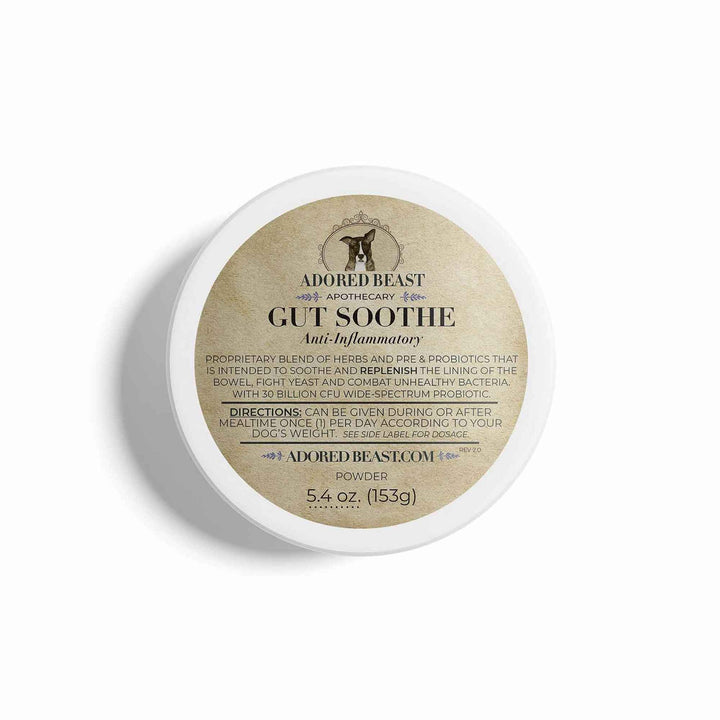
Canine Gut Soothe
This is marshmallow root doing the job I actually want it to do, sitting inside a formula that soothes and rebuilds at the same time rather than only quieting the surface.
- Marshmallow Root 4:1 and Slippery Elm Bark, the two mucilages together
- Deglycyrrhizinated licorice, N-acetyl glucosamine and L-glutamine for the lining
- A 14-strain probiotic blend at 30 billion CFU with larch prebiotic
- Two sizes, and no synthetics, fillers or grains in the jar
Give it a fair run. Herbalists work on roughly six weeks as the window in which the body responds to this kind of support, and that is the horizon I would hold you to before deciding it did or did not help. If the pattern is years old rather than weeks old, the gut lining itself is usually the conversation, and our guide to leaky gut in dogs and how to support the gut lining is the better starting point.
Can marshmallow root stop my dog's medication working?
Here is the detail most pet parents are never told, and it is the single most useful thing on this page.
Because mucilage forms a film across the lining, that film can slow the absorption of anything else crossing it at the same time. European regulators looked at this carefully. No study in humans or animals has ever confirmed the effect, so they deliberately left it out of the formal interactions section of the marshmallow root monograph. Then they put it in the warnings anyway, as a precaution, advising that the herb is not taken within half an hour to an hour of any other medicine. The older German Commission E monograph carries the same note.
Adored Beast, who formulate the gut products we carry, go slightly further and suggest giving a mucilage-containing product one to two hours after a medication, so the drug has time to absorb first.
The practical rule is easy to live with:
- Medication first, mucilage herb second, with an hour or two between them
- Never hold or stop a prescribed medication to make room for a herb
- Tell your vet the herb is in the routine, so timing sits in the notes
The same logic quietly applies to nutrients. A coating layer in every meal, every day, forever, with no reason behind it, is not a neutral choice. Use it with purpose and in blocks of time.
How do you give marshmallow root to a dog?
There is no established veterinary dosage for the loose herb in dogs, and any article handing you a confident teaspoon-per-pound chart has invented it. Product concentrations differ enormously, a 4:1 extract is not the same material as a raw powder, so the amount comes from the label in front of you and your vet, not from me. What I can give you is the method.
- Pick the form that fits your dog. Powder stirred into a wet or raw meal is the practical option for most dogs. Tinctures suit dogs who refuse powders. A cooled infusion works for a dog who is off food but still drinking.
- Use cool water, never boiling. This one trips up most people. Marshmallow root is prepared as a cold soak, around 30 minutes with regular stirring, and then strained and warmed afterwards if you want it warm. Boiling the root pulls out starch and produces a heavy, gluey preparation instead of a light mucilage.
- Start at the low end of the label for your dog's weight and hold there for several days before moving up.
- Space it away from medication and from any supplement you care about absorbing, using the hour or two rule above.
- Commit to a window, not a day. Six weeks for anything ongoing, and note what you see week by week.
- Watch stool, appetite and comfort. Firmer, more consistent stool and less gurgling are the early signals. More looseness usually means too much mucilage too fast.
Feed it with food rather than on an empty stomach, and mix it fresh at the meal. Mucilage keeps thickening in the bowl, and a dog who liked it at minute one can find it unappealing at minute ten.
Marshmallow root for dogs: is it safe, and when is it the wrong choice?
Marshmallow root is widely considered safe for dogs, and its safety record is one of the reasons it has stayed in use for centuries. Acute toxicity testing in mice put the lethal dose above a level no realistic supplement approaches, no meaningful interactions are documented, and reported adverse effects are scarce.
Scarce is not the same as studied, though, so a few honest limits:
- Pregnant and nursing dogs. Safety data is lacking, and the Gut Soothe label itself states that safe use in pregnant animals, or animals intended for breeding, has not been proven. Skip it unless your vet says otherwise.
- Dogs on daily medication. Fine alongside, with the spacing rule respected.
- Too much, too fast. Mucilage is gently laxative in quantity. If stool loosens after starting, reduce rather than abandon.
And the harder line, because it matters more than any of the above. A soothing herb is the wrong tool when the picture is not mild. Repeated vomiting, blood in stool or vomit, a painful or bloated belly, a dog who is flat and not eating, a puppy with diarrhea plus lethargy and vomiting, or any dog straining and unable to pass urine, are all vet visits, and the last one is an emergency. Reaching for a herb in those moments costs time the dog does not have.
I am not a vet, and this is not medical advice. Every dog is different, so work alongside your vet, ideally a holistic or integrative one, for anything ongoing or serious. What I can tell you from Milka, and from the thousands of pet parents we have walked through this, is that the dogs who turn a corner are rarely the ones who found a better soothing herb. They are the ones who worked out what was irritating the lining and changed it.
Much love, Larry
Sources
- Committee on Herbal Medicinal Products, European Medicines Agency. European Union herbal monograph on Althaea officinalis L., radix (EMA/HMPC/436679/2015), 2016. Read the monograph
- Committee on Herbal Medicinal Products, European Medicines Agency. Assessment report on Althaea officinalis L., radix. Read the assessment report
- Deters A, Zippel J, Hellenbrand N, Pappai D, Possemeyer C, Hensel A. Aqueous extracts and polysaccharides from marshmallow roots: cellular internalisation and stimulation of cell physiology of human epithelial cells in vitro. Journal of Ethnopharmacology, 2010;127(1):62-69.
- Nosal'ova G, Strapkova A, Kardosova A, Capek P, Zathurecky L, Bukovska E. Antitussive action of extracts and polysaccharides of marsh mallow (Althaea officinalis L., var. robusta). Pharmazie, 1992;47(3).
- Sutovska M, Nosalova G, Franova S, Kardosova A. The antitussive activity of polysaccharides from Althaea officinalis L., var. Robusta, Arctium lappa L., var. Herkules, and Prunus persica L., Batsch. Bratislavske Lekarske Listy, 2007;108:93-99.
- Shah SMA et al. Marsh Mallow (Althaea officinalis L.) and Its Potency in the Management of Cough. Complementary Medicine Research, 2020;27(3):174-183. View on PubMed
- Blumenthal M (ed). The Complete German Commission E Monographs: marshmallow root. American Botanical Council, 1998.
- United Plant Savers. Species At-Risk profile: Slippery Elm, Ulmus rubra. View the profile
- Adored Beast Apothecary. Canine Gut Soothe product information, including the manufacturer's guidance on spacing the product from medication.