Yes, dogs can eat cucumbers. Plain, raw cucumber is one of the safest fresh foods you can share with a dog. There is nothing in it that is toxic to dogs, it carries almost no calories, and most dogs love the crunch. Cucumber is a safe, very low-calorie, high-water snack for dogs, served plain and raw in small pieces, and kept inside the ten percent of daily calories that snacks are meant to occupy.
My French Bulldog Milka would take cucumber over almost anything in the fridge. She hears the knife on the board and she is already sitting. So this is a habit I am genuinely fond of, and I want to give you the useful version of the answer rather than the one every other page gives you.
Because here is what most pet parents are never told. Cucumber is about 95 percent water. That is what makes it such a guilt-free snack, and it is also the reason it is not doing the nutritional work you might be hoping it does.
In this article
What do cucumbers actually do for dogs?
Let's be real for a second. Cucumber is not a superfood. Per 100 grams, raw cucumber with the skin on carries around 15 calories, roughly 95 grams of water, under a gram of fibre, and small amounts of potassium and vitamin K, according to the USDA's own food composition data.
That composition gives cucumber three real jobs in a dog's day, and none of them is nutrition.
1. It is the cheapest calorie swap you will ever make. Half a cup of cucumber slices runs about 8 calories. One medium dog biscuit runs about 40. If your dog is carrying a little more weight than you would like, swapping a few biscuits a day for cucumber changes the maths without changing the ritual, and the ritual is usually the part neither of you wants to lose. This matters more than it sounds: when U.S. veterinary teams body-scored more than 800 dogs in a 2022 prevalence survey, 59 percent came in at a body condition score of 6 or above on the 9-point scale.
2. It brings a little water with it. Worth being honest about the scale here. A medium cucumber holds roughly 190 grams of water, and a healthy 20 kg dog needs somewhere near a litre a day in total, based on the 40 to 60 ml per kg figure used in veterinary practice. So a few slices are a pleasant extra on a hot afternoon. They are not a hydration plan, and they do not replace a full water bowl.
3. It gives them something to do. Cold, wet, crunchy, and it takes a few seconds of actual work. Frozen cucumber slices on a hot day are one of the easiest bits of enrichment in the house.
That is the whole honest list. It is a good list. It is not a reason to believe you have added meaningful greens to the bowl, which is the part I want to come back to further down.
How much cucumber can a dog eat?
The standard veterinary guidance is that snacks, chews and extras should stay inside 10 percent of your dog's total daily calories, with the other 90 percent coming from a complete diet. The Pet Nutrition Alliance's calorie tool states it plainly, and it is the number most veterinary nutrition resources work from.
Here is that rule turned into real numbers, using the standard resting energy formula multiplied by 1.6 for a neutered, moderately active adult dog.
Scroll sideways to see the full table.
| Dog weight | Daily snack budget | Sensible cucumber serving |
|---|---|---|
| 5 lb (2 kg) | about 20 calories | 2 to 3 thin slices, quartered |
| 10 lb (4.5 kg) | about 35 calories | 3 to 4 thin slices, quartered |
| 25 lb (11 kg) | about 70 calories | 5 to 6 slices, halved |
| 50 lb (23 kg) | about 115 calories | a small handful of slices |
| 75 lb (34 kg) | about 155 calories | up to a quarter cucumber |
Look at those two right-hand columns together and you will spot something useful. On calories alone, a 10 lb dog could technically eat most of a cucumber before touching the 10 percent ceiling. Nobody should do that. With cucumber, the limit that matters is not calories, it is volume and fibre in a gut that was not expecting either. Too much of any new plant food in one sitting is the usual cause of the loose stool that follows.
So I cap by portion, not by arithmetic. Start with one or two pieces, see what the next day's stool looks like, and build from there.
How do you serve cucumber to a dog safely?
- Wash it well. Cucumber skin holds whatever was sprayed on it, so give it a proper scrub under running water, or buy organic if that is available to you.
- Leave the skin on for most dogs. The skin carries most of the modest fibre cucumber has. Peel it only for a dog with a sensitive stomach, or one who has reacted to fibrous foods before.
- Slice thin, then cut the slices down. Whole rounds are the shape most likely to be inhaled by an enthusiastic dog. Quarters for small breeds, halves for medium, and never a whole cucumber left on the floor.
- Serve it plain. No salt, no oil, no dressing, no dips, and nothing that came out of a salad bowl with onion or garlic in it.
- Never pickled. Pickles carry high sodium, vinegar, and often garlic or onion in the brine. That is a different food with a different risk profile.
- Freeze a few slices in summer. They last longer, they are more interesting, and they are still about 15 calories per 100 grams.
- Watch the first few servings. A new food gets a 24-hour observation window in this house, every time.
If you are building a fresh-food routine from scratch and want a clear order of operations rather than a pile of ideas, this is the free guide I would start with.
When should you skip the cucumber?
Cucumber is low-risk, not no-risk. I would leave it out, or check with your vet first, in these situations:
- Dogs who gulp rather than chew. Size the pieces down further, or skip it. Choking and blockage risk comes from the piece size, not the vegetable.
- Small puppies. Tiny, thin pieces only, and not as a regular habit while their gut is still settling into their main diet.
- A dog on a prescribed therapeutic diet. Those diets are calculated. Adding anything to the bowl is a conversation with the vet who prescribed it.
- A dog in the middle of a digestive flare. Mid-flare is the worst possible time to introduce a new fibrous food. Wait until things are stable.
- Any dog who has had loose stool after cucumber before. Your dog already answered this question. Listen to the answer.
Please keep in mind that I'm not a veterinarian, and this isn't medical advice. Every pet is unique, so I always recommend working alongside your vet, ideally a holistic or integrative vet, especially for anything ongoing or serious.
Does cucumber count as fresh food in your dog's diet?
This is the question underneath the question, and it is the one almost nobody answers honestly.
Here's what the research tells us. A Purdue case-control study of Scottish Terriers, published in the Journal of the American Veterinary Medical Association in 2005, looked at vegetables in the bowl against the odds of developing bladder cancer. Dogs eating vegetables at least three times a week had markedly lower odds than dogs who were not. When the researchers broke it down by vegetable type, the strongest associations sat with green leafy vegetables and yellow-orange vegetables. Cruciferous vegetables did not reach statistical significance in that group.
It is one breed, one observational study, and an association rather than a result. I would not oversell it. But notice which categories carried the signal, and notice where cucumber sits. Cucumber is botanically a fruit, it is mostly water, and it is neither a dark leafy green nor a yellow-orange vegetable. Three slices a day is a lovely habit. It is not the "vegetables three times a week" the study was describing.
There is a second problem, and it applies to every vegetable you chop for your dog. Food science research on plant cell walls shows that nutrients sitting inside intact plant cells stay largely locked away from digestion until the cell wall is physically ruptured, and that reducing particle size is one of the most effective ways to release them. A thick slice swallowed whole by a dog who barely chews arrives at the other end looking a lot like it did going in. If you are feeding vegetables for the nutrition rather than the crunch, they need to be chopped fine, grated, or blended.
So here is how I hold both things at once. Milka gets cucumber because she loves it, because it is cold and crunchy, and because it costs her almost nothing in calories. She gets her actual greens from something built for the job.
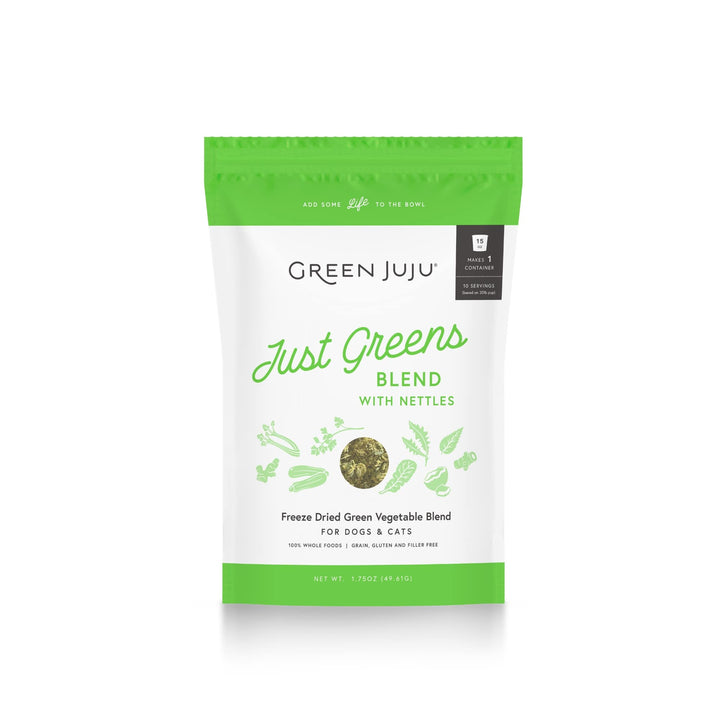
What goes in Milka's bowl
Green Juju Just Greens
An organic vegetable blend with nettles and bison bone broth, made to support skin, coat, digestion, joints and immunity. It is the answer to the part cucumber cannot do: real dark leafy greens, already broken down so your dog's gut can actually reach what is inside them.
- Organic vegetables, blended rather than chopped
- Nettles and bison bone broth in the same spoonful
- Goes on top of kibble, raw, or freeze-dried alike
- A spoon at breakfast, thirty seconds of work
If you would rather do it yourself, that is a completely legitimate answer too, and I have written up both sides of it: which fresh foods actually carry antioxidants for dogs, and our free fermented vegetable recipe for pet parents who want to go a step further with their greens. If your dog eats kibble and you are working out what is worth adding, this guide covers what to put on a kibble bowl.
Cucumber for dogs: the short version
- Safe? Yes, raw and plain, for the vast majority of dogs.
- How much? Inside the 10 percent snack allowance, and capped by portion rather than by calories.
- Skin on? Yes for most dogs, off for sensitive stomachs.
- Pickles? Never.
- Nutrition? Minimal. It is water, crunch, and a very low calorie count.
- Does it count as feeding fresh? Not really. Dark leafy and yellow-orange vegetables, chopped small or blended, are what the research points at.
Keep giving your dog the cucumber. Milka has earned hers. Take the ten seconds to cut it small, and if fresh plant food is the goal, put something greener alongside it.
Sources
- USDA FoodData Central. Cucumber, with peel, raw (FDC ID 168409). U.S. Department of Agriculture, Agricultural Research Service.
- American Kennel Club. Can Dogs Eat Cucumbers? AKC Expert Advice, Nutrition. akc.org
- Pet Nutrition Alliance. Calorie Calculator and feeding guidance. petnutritionalliance.org
- Raghavan M, Knapp DW, Bonney PL, Dawson MH, Glickman LT. Evaluation of the effect of dietary vegetable consumption on reducing risk of transitional cell carcinoma of the urinary bladder in Scottish Terriers. Journal of the American Veterinary Medical Association, 2005;227(1):94-100.
- Holland C, Ryden P, Edwards CH, Grundy MM-L. Plant Cell Walls: Impact on Nutrient Bioaccessibility and Digestibility. Foods, 2020;9(2):201. PMC7074226
- Association for Pet Obesity Prevention. 2022 U.S. Pet Obesity Prevalence Survey. petobesityprevention.org
- World Small Animal Veterinary Association 2018 Congress proceedings. Fluid Therapy: The Essentials (normal water balance in dogs and cats).