If your dog is still itchy after a diet change, the most likely reason is that food was never the main driver. Across the veterinary literature, food accounts for roughly 9 to 40 percent of itchy dogs, with a median closer to one in five. That leaves the majority of itchy dogs reacting to something else entirely, usually a stack of things at once: environment, skin barrier, gut, and genetics all pulling in the same direction.
Changing one ingredient rarely resolves an itch that has more than one cause, which is why the itch comes back a few weeks after the food change looked like it was working.
In this article
- Why the diet change did not work
- How long a diet trial actually needs to run
- Is your limited ingredient food really limited?
- Are allergy tests telling you anything useful?
- What your dog's environment has to do with itching
- The five loads stacking on an itchy dog
- What to actually do first
- How to rebuild microbial diversity
- Where Apoquel and Cytopoint fit
- How long before you see a change
I want to start where most pet parents in this situation are standing, because I have been there myself.
You did the research. You switched the food. Maybe you went further and paid for the prescription diet, or the hypoallergenic kibble, or the novel protein everyone in the Facebook group swore by. For two or three weeks it looked like it was working. Then the paw licking started again, then the head shaking, then the smell you cannot quite place. And you are back where you started, with less money and less confidence than when you began.
You are not alone, so many pet parents go through this. And it is almost never because you picked the wrong bag.
On the Next Level Pet Parent Podcast I sat down with Billy Hoekman, Vice President of Nutrition and Formulation at Green Juju, who has worked through this exact problem with his own French Bulldog, Huckleberry. The thing he said that stuck with me most was that pet parents tend to look at allergies too specifically. It is this food, or it is this one thing in the yard. Meanwhile everything in the body is connected, and the itch is usually the sum of several things rather than the product of one.
Prefer to watch or listen? Here's the full conversation:
Why didn't the diet change work?
Here is what the research tells us. When Thierry Olivry and Ralf Mueller reviewed 22 studies on food-driven skin reactions in dogs, the numbers landed in a wide but revealing range. Among dogs brought to a vet for any reason at all, food-driven skin reactions accounted for 1 to 2 percent. Among itchy dogs specifically, the range ran from 9 to 40 percent.
Read that second number carefully, because it cuts both ways. Food matters for a meaningful slice of itchy dogs, and it is nowhere near the whole story for most of them. If you change the food and nothing lasting happens, the most statistically likely explanation is that your dog is in the majority, not that you chose badly.
The second explanation is that the trial itself was never set up to give you an answer.
How long does a diet trial actually take?
This is where most home diet trials fall apart, and it has nothing to do with the food chosen.
The same research group pulled together the best available evidence on how long an elimination diet has to run before the result means anything. By five weeks, more than 80 percent of dogs with a food-driven reaction had cleared. By eight weeks, more than 90 percent had. Their conclusion was plain: run it for at least eight weeks.
Most pet parents give it two or three. I understand why. Watching your dog claw at himself while you wait is genuinely hard, and two weeks already feels like forever. But a three week trial cannot tell you anything reliable, which means the money and the effort produce no usable information either way.
The other thing that quietly breaks a trial is everything that is not the food. The dental chew. The training reward in your pocket. The flavored medication. The crumb the toddler drops. A trial is only a trial if it is total, and that is a household discipline problem more than a nutrition one.
Is your limited ingredient food as limited as the label says?
This one genuinely surprised me when I first read it.
Researchers at UC Davis bought 21 over-the-counter dog foods marketed as limited ingredient or single protein, and ran DNA testing on all of them. Every single one contained DNA from at least one mammal species that was not declared anywhere on the label. Cow, pig, sheep, goat, and bison all turned up in foods that were not supposed to contain them.
The researchers were careful about what this does and does not mean, and I want to be equally careful. The method they used detects very small quantities, nobody knows how much of a stray protein it takes to set off a reaction in a sensitive dog, and the study did not separate accidental cross-contamination from anything deliberate. So this is not proof that your dog's food caused the flare.
What it does mean is that a label reading "limited ingredient" is not by itself evidence of what is in the bag. If you are running a trial to get a real answer, the ingredient list needs to be short enough and the manufacturing clean enough that you can actually believe it.
Are allergy tests telling you anything useful?
A lot of pet parents arrive at our inbox holding a printout from a blood, saliva, or hair panel, with a long list of foods to avoid. I understand the appeal completely. It looks like an answer, and you have been searching for one for months.
The evidence on those panels is not kind. In one study, hair and saliva testing failed to separate allergic dogs from healthy ones. In another, serum and saliva assays returned positive results for dogs that had no clinical signs at all. And in the Finnish research on 168 dogs and their humans, blood IgE levels showed essentially no relationship with how symptomatic a dog actually was. The researchers set the blood values aside and used a validated symptom questionnaire instead, because the blood work was not tracking the dog in front of them.
The practical consequence is worth sitting with. If you have been avoiding fourteen ingredients based on a panel, you may have narrowed your dog's diet dramatically on the basis of information that does not hold up, while the actual driver went unaddressed.
What does your dog's environment have to do with itching?
This is the part almost nobody covers, and it is the part I find most useful.
A research group at the University of Helsinki studied 168 dogs alongside the people they live with, sampling skin and gut bacteria and mapping it against where and how each dog lived. Dogs in urban settings were significantly more likely to show allergic symptoms than dogs in rural ones. An urban style of life carried the same association: small household, no other animals in the home, apartment living. About one in five of the dogs studied had reported allergic symptoms.
The mechanism they point to is microbial. Urban living narrowed the range of organisms living on the skin of both the dogs and their humans, making everyone's skin communities look more alike and less varied. Separate work has found that dogs with allergic skin disease carry a less diverse mix of organisms on their skin than healthy dogs do.
Two honest caveats. These are observational studies, so they show association rather than proof of cause, and we cannot say from this data whether the narrowed skin community is a cause of the itch or a consequence of it. What we can say is that this pattern shows up repeatedly, in dogs specifically, not borrowed from human research.
Billy put the same idea in plainer language on the episode. His dog walks with him through the city and sleeps on the couch. Almost nobody listening has a dog living in the environment dogs evolved in. We took animals whose immune systems were built through constant contact with a messy world, moved them into clean houses, and then wondered why they react to everything.
What are the five loads stacking on an itchy dog?
This is the frame that changed how I look at the whole problem. Rather than hunting for the one culprit, look at what is stacking. Below is where the evidence currently sits on each layer, stated honestly, including where it is thin.
| Load | What it looks like at home | Where the evidence stands |
|---|---|---|
| Food | Itch that improves on a strict diet and returns on challenge | Strong. 9 to 40 percent of itchy dogs, confirmed only by an eight week elimination trial |
| Environment | Seasonal patterns, indoor living, lawn chemicals, paws licked after walks | Good observational evidence in dogs. Urban living and urban lifestyle both associated with higher allergy rates |
| Skin community | Recurring hot spots, ear issues, secondary infections | Moderate. Allergic dogs show lower skin microbial diversity, though cause and effect are unresolved |
| Gut | Loose stools or vomiting alongside the skin signs | Emerging. Early-life probiotic work in dogs is promising but small, and timing appears to matter |
| Genetics and early life | Breed predisposition, an allergic mother, signs appearing before age three | Strong association. Having an allergic mother significantly raised risk in the Finnish data |
Notice that not one of these layers is fixed by swapping a bag of food. That is the whole answer to why the diet change did not hold.
So what do you actually do first?
Order of operations matters more than the individual pieces. Here is the sequence I would follow.
- Run one real diet trial, once. Pick a genuinely single-protein food using a protein your dog has not eaten before, run it for eight full weeks, and let nothing else pass his lips. One properly run trial beats five half-run ones.
- Close the environmental gaps you control. Wipe paws and belly after every walk, especially in winter with ice melt on the pavement and in summer with lawn chemicals. Your dog grooms himself, so whatever is on the paws goes inside him.
- Widen microbial contact rather than narrowing it. Time on real ground, contact with other animals, and variety in the diet all push in the direction the research points.
- Support the gut deliberately. Diversity is the goal, not a single strain taken forever.
- Change one thing at a time. If you start four things at once and the itch improves, you have learned nothing about what to keep.
On step one, the practical problem is finding a food short enough to believe. This is the one we point pet parents toward when they are starting a trial properly.
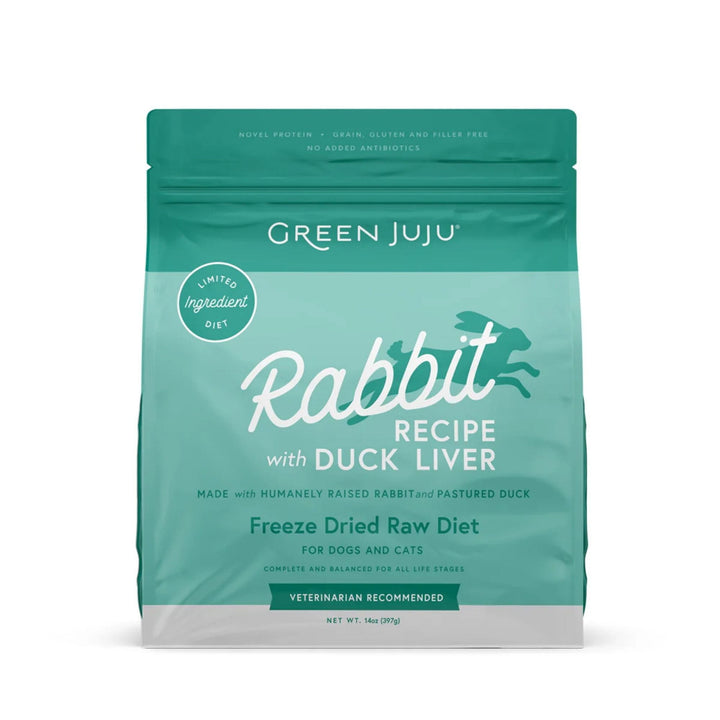
For the eight week trial
Green Juju Rabbit Recipe with Duck Liver
A novel protein most dogs have never eaten, on an ingredient list short enough to actually verify. Complete and balanced, so your dog can stay on it for the full eight weeks without nutritional compromise.
- Five ingredients: whole rabbit with bone, duck liver, organic dandelion greens, organic kelp, vitamin E
- 92 percent rabbit and duck, 8 percent plants
- No synthetic vitamins, grains, or fillers
- Freeze-dried, so no freezer space needed during the trial
If rabbit is already in your dog's history, the same range covers goat, turkey, lamb, and pork, and you can browse the full freeze-dried raw range to find a protein that is genuinely new to your dog.
How do you rebuild microbial diversity?
If the environmental research is pointing where it appears to point, the goal is not sterility. It is variety.
The honest state of the evidence here is mixed and worth stating properly. In one controlled study, puppies given a specific Lactobacillus strain from three weeks to six months showed lower allergen-specific antibodies, though their clinical scores did not differ significantly at the time. When the same dogs were reassessed three years after the probiotic stopped, they showed milder signs on allergen challenge than the comparison litter. That is a small, single-strain study in a research colony, and the timing was early life. It is a reason for interest, not a promise for an adult dog who is already itching.
Where I land after all of it: a broad, varied microbial input is a low-risk thing to add while you work through the bigger levers, and it is the one part of the picture most pet parents have never addressed at all.
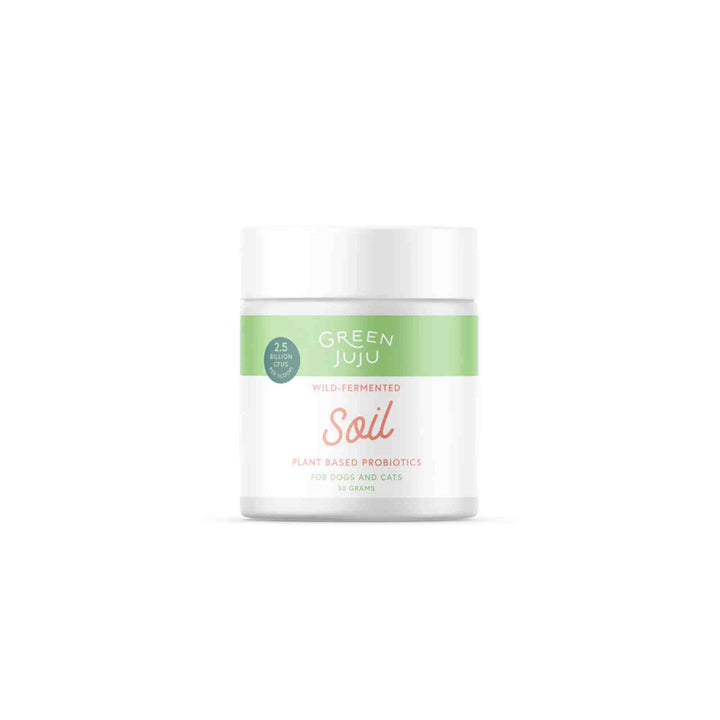
What we reach for on this one
Green Juju SOIL Wild-Fermented Plant-Based Probiotic
Most probiotics deliver a handful of strains. SOIL is built around breadth instead, which is the whole point when the concern is a narrowed microbial world rather than one missing organism. It carries no food proteins, so it does not compromise a diet trial that is already running.
- Over 500 soil-derived probiotic species
- Two ingredients only: the bacterial cultures and organic artichoke fiber as a prebiotic
- No synthetic vitamins, grains, or fillers
- Fed once daily by weight, so it fits any diet including kibble
Billy made a point on the episode that I think about often, because it applies to me as much as anyone. More is not better. He described himself as the person who decides that if a thing is good, a lot of it must be better, and then found that his own dog does poorly on heavy amounts of fermented food. Adding six products at once is not a protocol. It is noise, and it costs you the ability to tell what worked.
Where do Apoquel and Cytopoint fit into this?
I want to be careful here, because this is where a lot of natural pet content goes badly wrong and starts attacking vets. That is not my position and it is not PAWDEGA's.
The international veterinary consensus guidelines on canine atopic dermatitis are worth reading on this, because they arrive at a conclusion that sounds a lot like the one this article has been building toward. The committee states that managing this condition is multifaceted, that interventions need to be combined, and that the right plan varies between dogs and changes for the same dog over time. They also note that medications are the most effective tools for reducing ongoing itch and skin lesions, while only immunotherapy and proactive topical steroid use are likely to delay flares coming back.
Read that as it is written. Those medications do a real job, and that job is controlling signs. They are not aimed at the underlying stack, and the guidelines themselves do not claim they are.
Which means the useful question is not medication or nothing. It is whether you are using the relief you have bought as an opportunity to work on the underlying picture, or whether the medication has quietly become the entire plan. Your dog should not be uncomfortable while you work through this, and any change to prescribed medication belongs in a conversation with your vet, ideally a holistic or integrative one.
On the supportive side, the same guidelines list increased essential fatty acid intake among the first steps for chronic cases. Palmitoylethanolamide, usually shortened to PEA, is another one worth knowing about. In an eight week study across 39 clinics, 160 dogs with atopic dermatitis showed reduced owner-scored itch and improved lesion scores. That study was open-label with no placebo group, which is a real limitation, and the trials used a specific ultramicronized form, so results should not be assumed to transfer to every product on the shelf.
How long before you see a change?
This is the hardest part, and I would rather tell you the truth than something comfortable.
It is not days. A food trial needs eight weeks before it means anything. Rebuilding a gut and a skin barrier runs on a longer clock than that. Billy mentioned that the vets he trusts most tell pet parents that a problem two years in the making can take about that long to work through, and that matches what we have seen across hundreds of cases through PAWDEGA.
I will tell you our own version of this. Milka had gut issues, hot spots, and was throwing up in the middle of the night as a young dog. When Charly first told me a fresh food diet would cost roughly three times what we were paying, I told her she was out of her mind. We tried it anyway. Within about two weeks I could see the difference, and my whole framing shifted from expense to investment, mostly because the vet visits stopped.
Two weeks was our experience with one dog and one set of problems. It is not a promise, and I would be doing you a disservice if I framed it as one. What I can tell you is that the pet parents who get somewhere are the ones who change one thing at a time, give each change a fair run, and keep going after the first month when nothing dramatic has happened yet.
If you want the full picture in one place, including the yeast side of this and the mistakes that keep pet parents stuck, we put it into a free guide you can download below.
Free guide
The Dog Allergy & Yeast Relief Guide
Everything above in one place, plus the yeast side of the picture and the mistakes that keep pet parents circling the same loop for years.
- The root drivers behind allergy-like symptoms
- The common mistakes that stall progress
- Practical next steps in the order to take them
And if you are not sure where your dog sits in all of this, reach out to our team and we will help you think it through, or browse what we stock for allergy and skin support.
Please keep in mind that I'm not a veterinarian, and this isn't medical advice. Every pet is unique, so I always recommend working alongside your vet, ideally a holistic or integrative vet, especially for anything ongoing or serious.
Much Love, Larry
Sources
- Olivry T, Mueller RS. Critically appraised topic on adverse food reactions of companion animals (3): prevalence of cutaneous adverse food reactions in dogs and cats. BMC Veterinary Research, 2017. Link
- Olivry T, Mueller RS, Prélaud P. Critically appraised topic on adverse food reactions of companion animals (1): duration of elimination diets. BMC Veterinary Research, 2015. Link
- Fossati LA, Larsen JA, Villaverde C, Fascetti AJ. Determination of mammalian DNA in commercial canine diets with uncommon and limited ingredients. Veterinary Medicine and Science, 2019. Link
- Coyner K, Schick A. Hair and saliva test fails to identify allergies in dogs. Journal of Small Animal Practice, 2019.
- Lam AT, Johnson LN, Heinze CR. Assessment of the clinical accuracy of serum and saliva assays for identification of adverse food reaction in dogs without clinical signs of disease. JAVMA, 2019.
- Lehtimäki J, Sinkko H, Hielm-Björkman A, et al. Simultaneous allergic traits in dogs and their owners are associated with living environment, lifestyle and microbial exposures. Scientific Reports, 2020. Link
- Lehtimäki J, et al. Skin microbiota and allergic symptoms associate with exposure to environmental microbes. PNAS, 2018. Link
- Hoffmann AR, et al. The skin microbiome in healthy and allergic dogs. PLoS ONE, 2014. Link
- Olivry T, DeBoer DJ, Favrot C, et al. Treatment of canine atopic dermatitis: 2015 updated guidelines from the International Committee on Allergic Diseases of Animals (ICADA). BMC Veterinary Research, 2015. Link
- Marsella R. Evaluation of Lactobacillus rhamnosus strain GG for the prevention of atopic dermatitis in dogs. American Journal of Veterinary Research, 2009. Link
- Marsella R, et al. Early exposure to probiotics in a canine model of atopic dermatitis has long-term clinical and immunological effects. Veterinary Immunology and Immunopathology, 2012. Link
- Noli C, della Valle MF, Miolo A, et al. Efficacy of ultra-micronized palmitoylethanolamide in canine atopic dermatitis: an open-label multi-centre study. Veterinary Dermatology, 2015. Link