If you have found fleas on your dog, here is the order that works: comb, bathe, clear the environment, then support your dog's body from the inside. If you have found a tick, remove it with a tick tool, bag it, clean the bite site, and write down the date.
So when people ask me how to get rid of fleas on dogs naturally, my honest answer is that you do not do it on the dog. You do it in the room. Only about 5% of a flea population is actually on your dog. The other 95% is in your carpet, your bedding, and your yard as eggs, larvae, and pupae, according to Oklahoma State University Extension and veterinary parasitology reviews.
That single number reorganises everything. It is why combing and vacuuming outperform whatever you spray on your dog. It is why the natural approach gets called ineffective when what actually happened is that someone did one thing instead of four. And it is why panic, which is the most common first response, is the least useful one.
I want to walk you through what to do in the first 48 hours, for both fleas and ticks, in the order I would do it myself.
For this I spoke with Rita Hogan, a clinical canine herbalist with more than 20 years of experience, founder of the Ethos School of Canine Herbalism and author of The Herbal Dog. Her herbal protocols appear throughout this post, clearly marked, because I want you to know which parts come from her clinical practice and which parts come from published research. You can also watch our full conversation on the Next Level Pet Parent Podcast if you would rather hear it in her own words.
How Do I Get Rid of Fleas on My Dog Naturally?
Four steps, in this order. Do not skip to step four because it feels more productive.
1. Flea comb first, before anything else. This is the single most underrated tool in the whole conversation, and almost nobody does it anymore. Comb from the top of the head down the neck, along the back, under the belly, around the base of the tail, and down the legs. Have a bowl of soapy water next to you and dunk the comb after each pass. Soapy water kills what you catch. You are removing live adults and flea dirt in the same motion, and you get an honest count of what you are dealing with. Do this daily until you go several days finding nothing.
2. Bathe. A bath physically drowns and washes away adult fleas, which means it does real work rather than only deterring. A plant-based option like the Flea+Tick Lavender Shampoo lathers head to tail, sits for two minutes, then rinses out. Worth knowing: our own Herbal Flea & Tick Spot On product page says plainly that it will not clear an existing infestation and points you to the shampoo instead. That is the kind of honesty I want from a product page, and it tells you something important about the difference between deterring fleas and dealing with fleas you already have.
3. Clear the environment on the same day. Vacuum every room your dog uses, with attention to where they sleep, and empty the canister outside. Vacuuming is genuinely effective here, and a beater-bar vacuum works better because the vibration prompts adults to emerge from their cocoons where you can reach them. Wash your dog's bedding hot. If your dog sleeps on your bed, wash yours too. Food-grade diatomaceous earth can be worked into carpet and left before vacuuming, but only food grade, never pool or filter grade, and keep the dust out of your dog's face. PetMD notes that even food-grade powder can cause coughing or breathing difficulty if a pet inhales enough of it, and is candid that most vets do not widely recommend it.
4. Support the dog from the inside, and keep deterring. A dog under chronic stress, on a poor diet, or with existing skin issues is a more appealing host and reacts harder to the bites they do get. Once the acute phase is handled, an ongoing repellent layer like the Flea+Tick Lemongrass Repel Spray becomes the maintenance piece.
What we reach for at our house
The two products that map onto step two and step four above. Both are Kin+Kind, both plant based, both formulated to a vet-approved concentration.

Flea+Tick Lavender Shampoo for Dogs
The bath step. Lathers head to tail, sits for two minutes, rinses out. Peppermint, rosemary and cedarwood oils at vet-approved concentrations, with no chemical insecticides, sulfates or artificial fragrance. For dogs over 12 weeks, dogs only.
See the shampoo
Flea+Tick Lemongrass Repel Spray
The ongoing deterring layer once the acute phase is handled. Cedarwood, lemongrass and rosemary oils in a thicker formula that stays on the coat. Spray before parks, trails and long grass. Dogs and cats over 12 weeks.
See the repel sprayOn the essential oil question, the evidence is more interesting than either side admits. A 2026 review in Antibiotics found consistent laboratory activity for multiple oils across every flea life stage, with larvae the most vulnerable. The honest caveat is that most of that work is in a dish rather than on a living dog, and a review in the Journal of Veterinary Science notes that plant-derived flea products have generated reported adverse effects including lethargy and vomiting. So: real mechanism, thin canine field data, dilution and product quality matter enormously.
Do I Have a Few Fleas or an Actual Flea Infestation?
This is the question nobody answers, and it determines everything you do next. Here is how to tell.
| A few fleas | An infestation | |
|---|---|---|
| What you see | One to a handful on the comb, some flea dirt | Fleas visible on furniture, jumping on you |
| Your dog | Mildly itchy or unbothered | Scratching, biting, licking, damaging skin |
| Bathing | Weekly | Daily until it breaks |
| Environment | Regular vacuuming, wash bedding | Daily vacuuming, wash everything, carpet work |
| Realistic timeline | Days | Weeks |
| Emotional response required | Low | Also low, though harder |
What Are the Little Black Dots on My Dog's Skin?
That is flea dirt, and it is dried blood the flea has already digested. It is worth understanding what it signals: dirt means the fleas have been feeding on your dog for a while, not passing through. A flea that lands and leaves does not leave a deposit.
The Damp White Sheet Test
Lay a damp white sheet on the floor and stand your dog on it. Work your hands through the coat from head to tail, over the rump, along the neck and ears, and underneath. Then look at the sheet. Flea dirt rehydrates into small red or rust-coloured spots. For a small dog, a damp paper towel does the same job.
This takes two minutes and gives you an answer. No spots and no fleas on the comb means you are fine. Spots means it is time to run the full sequence.
How Long Does This Take to Work?
If your dog picked up a few fleas from a visiting dog and that dog is gone, a week of daily baths and daily combing usually closes it out. My own experience with Milka matches that. She has had fleas exactly once in her life, from a dog we were caring for. We spotted the black dots on her belly, moved fast with an essential oil shampoo and daily vacuuming, and it was over in about four days.
Looking back, we massively overdid it. We washed every item of clothing in the house. We showered her twice a day. What we did not do was use a flea comb, which was the one thing that would have told us how minor it actually was. We were reacting, not assessing.
A genuine infestation is a different timeline. Because flea development can stretch from about two weeks to six months depending on temperature and humidity, and because pupae can sit dormant and resist insecticide until conditions suit them, you should expect weeks and plan for the problem to appear to return once. That is not failure. That is a cohort hatching.
Can Fleas Give My Dog Tapeworm?
Only if your dog swallows an infected flea. According to the Companion Animal Parasite Council, the flea is a required intermediate host for Dipylidium caninum, so the dog has to ingest one during grooming for the tapeworm to establish. Not every flea carries it.
That distinction matters, because "fleas cause tapeworm" makes it sound automatic and it is not. Fleas raise the risk. Grooming closes the loop. It is another argument for combing, since every flea you take off is one your dog cannot swallow. If you are looking for internal parasite support alongside a flea situation, No More Worms is the herbal option we carry, and rice-grain segments near the tail are your cue to speak to your vet.
Free download
The Complete Flea + Tick Protection Guide
Everything above, plus the yard, the house and the season, in one place you can keep. Enter your email and we will send it straight over.
What If I Need to Use a Fast-Kill Product?
Let's be real for a second. Some of you are in an infestation right now, your dog is miserable, and you are going to use a conventional fast-kill product. I would rather give you good information than pretend that decision is not being made.
Rita's clinical approach is to prepare the body rather than absorb the hit unsupported. She uses milk thistle for the liver and skullcap for the nervous system, starting about a week before and continuing four to six weeks after. There are no canine trials on that specific sequence. It is her clinical protocol, and I am labelling it as such rather than dressing it up as research.
What I can point you to is our own material on the same question. How to detox your dog after flea and tick medication walks through the exit-route reasoning in detail, and Adored Beast's Liver Tonic is the tincture we reach for at our house. If you have not read the conversation on why any of this matters, flea and tick medication side effects in dogs covers what the labels do not.
If you are using a conventional product
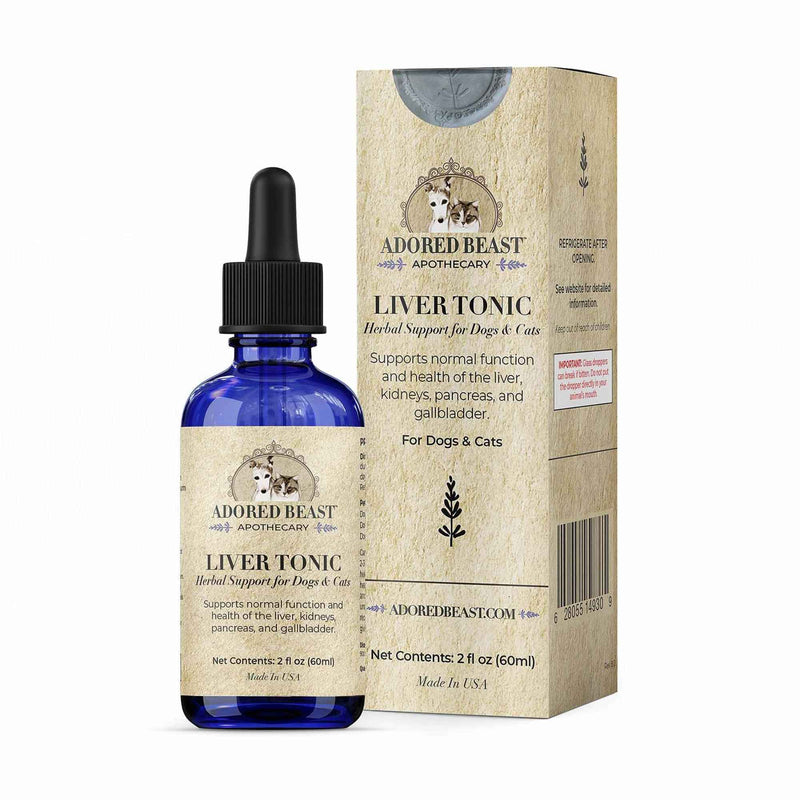
Liver Tonic by Adored Beast
A herbal combination of dandelion root, milk thistle, greater celandine and barberry that supports the liver, kidneys, gallbladder and pancreas. Adored Beast names flea and tick medication, antibiotics, steroids and NSAIDs among the exposures pet parents use it after. It is the milk thistle piece of what Rita describes, in a form you can measure by weight. Refrigerate after opening, and check with your vet if your dog is on medication.
See Liver TonicHow Do I Remove a Tick From My Dog Safely?
Six steps. Have the tools before you need them.
- Use a tick key or fine-tipped tweezers, not your fingers. A tick key is inexpensive and belongs in your dog's kit permanently.
- Grasp as close to the skin as you can get. This is what keeps the mouthparts from staying behind.
- Pull straight up with steady, even pressure. Do not twist, jerk, or squeeze the body.
- Do not crush it. Crushing pushes tick contents toward the bite.
- Bag it and label it with the date and where on the body you found it.
- Clean the bite site. A Colloidal SilverSol spray at 10 ppm is what we use, two to three sprays, and this is exactly the kind of silver Rita reaches for as a natural antiseptic after a bite.
Then check the rest of your dog. Finding several at once is common.
How Long Does a Tick Have to Be Attached to Pass Something On to My Dog?
This is the part most articles get wrong, and it is the most useful thing in this post.
You have probably read that a tick needs 24 to 48 hours attached before there is any risk. That is true for Lyme disease specifically, because Borrelia lives in the tick's midgut and has to migrate to the salivary glands before it can move into your dog.
It is not true across the board. The Companion Animal Parasite Council states that Ehrlichia and Rickettsia species, the latter being the Rocky Mountain spotted fever group, can transfer within roughly three to six hours of attachment, because those organisms are already sitting in the tick's salivary glands when it bites.
So a short attachment lowers your Lyme risk substantially and does far less for your ehrlichiosis or Rocky Mountain spotted fever risk. Given that Milka has been through Ehrlichia herself, this is the fact I most want you to carry out of this post. It is not a reason to panic. It is a reason to check your dog daily during tick season rather than weekly, and to take a short attachment seriously instead of dismissing it.
What Can I Give My Dog After a Tick Bite?
Two categories, and I want to be clear about which is which.
Supported by evidence: general immune support. A resilient dog handles an exposure better than a depleted one. Fresh food, lower stress, and something like Turkey Tail mushroom as an immune-supporting addition are all reasonable, ordinary things to do.
Rita's herbalist practice, no canine trials: homeopathic Ledum immediately after a bite, teasel, usnea, olive bud, sweet chestnut bud, and homeopathic nosodes given weekly through tick season. I am naming these accurately so you can research them yourself and speak to a holistic or integrative vet about them. I am not going to tell you a study supports them, because none does. We used Ledum with Milka. I cannot tell you what it did or did not do.
What a Positive Tick Test Actually Means
Here is what most pet parents are never told, and it cost us a real scare.
Milka tested positive for Ehrlichia. She cleared it. Her PCR came back negative. Later, at a routine heartworm check, the SNAP 4Dx came back positive for Ehrlichia again and the vet, who did not know her history, said she needed to go back on medication.
She did not. She still carries the antibodies.
Antibody tests and PCR tests answer different questions. An antibody test tells you the immune system met the organism at some point. Those antibodies persist after the body clears the infection, which is well documented. A PCR test looks for the organism's genetic material, which is what tells you whether something is active now. Veterinary Partner and Antech Diagnostics both state this plainly: a positive antibody result means exposure, not active disease, and the appropriate next step in a well dog is bloodwork and PCR where indicated, rather than automatic antibiotics.
If your dog screens positive and looks and acts completely normal, you are allowed to ask which test was run, what it measures, and what the bloodwork shows. That is not being difficult. That is being informed.
When to Go Straight to the Vet
Natural care handles the ordinary situations well. It is not the answer for everything, and knowing the line is part of doing this properly.
Go now if your dog is weak, collapsed, or cannot stand. Go now for a high fever, a sudden refusal to move, neurological changes, unexplained bruising or bleeding, or pale gums. Rocky Mountain spotted fever in particular can move quickly and become serious.
Doxycycline exists for a reason, and it works best when it is given early rather than months later. Having a relationship with a holistic or integrative vet, even a virtual one, means you have someone to call who will help you weigh the decision instead of making it in a panic at 9pm.
Which Natural Flea and Tick Product Does What
The three products above are not interchangeable, and the most common mistake I see is reaching for a deterrent when the situation calls for a bath. Here is the honest split.
| Flea+Tick Lavender Shampoo | Flea+Tick Lemongrass Repel Spray | Herbal Flea & Tick Spot-On | |
|---|---|---|---|
| Brand | Kin+Kind | Kin+Kind | Earth Animal |
| Reach for it when | Fleas are already on your dog and you are running the four-step sequence | The acute phase is handled and you want a layer before parks, trails and long grass | You want a set-and-forget monthly deterring layer between baths |
| Form and how often | Shampoo. Lather head to tail, leave two minutes, rinse. Use as needed during the acute phase | Spray onto the coat until slightly damp, before outdoor exposure | Topical tube applied to the skin between the shoulder blades, once a month |
| Active ingredients | Peppermint, rosemary and cedarwood oils | Cedarwood, lemongrass and rosemary oils | Cedarwood and peppermint oils in an almond oil base |
| Works on an existing infestation | Yes. This is the product the Spot-On page itself points you to for existing infestations | No. It is a deterrent, not a bath | No. The product page states plainly that it will not eliminate existing infestations |
| Dogs or cats | Dogs only, over 12 weeks | Dogs and cats, over 12 weeks | Dogs. There is a separate version for cats |
| Sizes | One size | One size | Small dog and puppies, medium dog, large dog |
Where to Go From Here
Everything above is what you do when something has already happened. The other half of this is what you do so it happens less, and that is a different plan: our layered approach to keeping fleas and ticks off your dog covers the full strategy across your yard, your home, and your dog.
If you want all of it in one place to keep for the season, our Complete Flea + Tick Protection Guide is free to download.
And if you take one thing from this: buy a flea comb and a tick key today, before you need them. They cost almost nothing, they tell you the truth about what you are dealing with, and having them in a drawer is the difference between assessing calmly and reacting at midnight.
You are not powerless here. You are your dog's biggest advocate.
With gratitude, Charly
Sources
- Flea Control. Oklahoma State University Extension, fact sheet. extension.okstate.edu
- Flea control: Does the environment really matter? dvm360, veterinary proceedings. dvm360.com
- Ticks: Transmission timelines. Companion Animal Parasite Council (CAPC) guidelines. capcvet.org
- Dipylidium caninum guideline. Companion Animal Parasite Council (CAPC). capcvet.org
- Dipylidium caninum life cycle. Centers for Disease Control and Prevention, DPDx. cdc.gov
- Prevention of tick-borne disease with time-sensitive interventions. Interview with Susan Little, DVM, PhD, DACVM (Parasitology). dvm360, 2025. dvm360.com
- The canine vector-borne disease timeline: how it works in practice. American Animal Hospital Association (AAHA), NEWStat. aaha.org
- Positive SNAP Tests for Ehrlichia and Anaplasma. Veterinary Partner, Veterinary Information Network (VIN). veterinarypartner.vin.com
- Ehrlichia spp.: exposure versus active disease. Antech Diagnostics clinical guidance, 2025. antechdiagnostics.com
- Can You Use Diatomaceous Earth for Fleas? PetMD, 2025. petmd.com
- Essential Oils for Flea and Tick Control in Companion Animals: A Critical Review of Efficacy, Safety, Resistance Mitigation and Integrated Pest Management. Antibiotics, 2026. mdpi.com
- Essential oil pharmaceuticals for killing ectoparasites on dogs. Journal of Veterinary Science. vetsci.org
Herbal and homeopathic protocols in this post (milk thistle and skullcap sequencing, Ledum, teasel, usnea, olive bud, sweet chestnut bud, nosodes) are attributed in-text to Rita Hogan's clinical practice and are labelled as such. No canine clinical trials support them, and the post states this plainly.
PAWDEGA is an Online Holistic Pet Wellness Store. This article is educational and is not veterinary advice. I am not a veterinarian. Every dog is different, so please work alongside your vet, ideally a holistic or integrative vet, especially for anything ongoing or serious, and before starting any new supplement or herb. PAWDEGA sells some of the products mentioned and linked in this post.