You cannot speed up how fast a flea and tick medication leaves your dog's body, and no supplement has been shown in a published canine study to do it. What you can do is support the systems the drug actually travels through on its way out. For the isoxazoline products, meaning Bravecto, NexGard, Simparica, and Credelio, that means the gut first and the liver second, across a window closer to 10 weeks than a few days. Here is the sentence I wish someone had handed me years ago: you are not flushing anything out of your dog, you are supporting a body that is already doing the work.
Let's be real for a second. If you found this page, you have most likely already given the chew. Your vet recommended it. You gave it. Your dog seems fine. And then you read something, or a friend said something, and now there is a quiet knot in your stomach.
I want to take that knot apart with facts instead of fear.
WHAT THIS ARTICLE COVERS
- How long does flea and tick medication stay in my dog's system?
- Where does the medication actually go, and how does it leave?
- My dog seems completely fine. Is there any point in doing anything?
- What does the FDA actually say about these medications?
- Was the Project Jake survey right about flea and tick side effects?
- The 10-week support window, step by step
- What about the liver specifically?
- What about the nervous system?
- What does Julie Anne Lee, DCH, do in clinical practice?
- Is it too late to detox my dog if I gave flea & tick medication months or years ago?
- Three things I would skip
- What this looks like with Milka
- The bottom line
- Three-day detox or 10-week support, side by side
- Sources
How long does flea and tick medication stay in my dog's system?
Longer than most pet parents expect, and this is the number that changes how you think about the whole thing.
These medications are not designed to be short-lived. Their entire selling point is that one dose keeps working for weeks. That works because the compound is built to persist.
| Measure | What is reported | Where it comes from |
|---|---|---|
| Elimination half-life, adult dogs (fluralaner) | 12.6 to 15.7 days | Bravecto product label (source 4) |
| Elimination half-life, puppies (fluralaner) | 5.0 to 8.5 days | Bravecto product label (source 4) |
| Half-lives needed to clear roughly 97 percent of a dose | About five | Standard pharmacokinetic arithmetic, not a study finding |
| Resulting clearance window at a 14-day half-life | Roughly 70 days, about 10 weeks | Arithmetic applied to the label half-life |
| Share of the dose leaving as unchanged parent compound in feces | Roughly 90 percent | EMA assessment report (source 2) |
| Share of the dose appearing unchanged in urine | Less than about 0.001 percent | EMA assessment report (source 2) |
Those figures come from a 2026 pharmacology review of the isoxazoline class. Bravecto's own product label puts the elimination half-life at 12.6 to 15.7 days in adult dogs and 5.0 to 8.5 days in puppies.
Here is what that means in practice, and this is straightforward arithmetic rather than a study finding. A half-life is the time it takes for half the remaining amount to leave. It takes roughly five half-lives for a body to clear about 97 percent of a dose. At a 14-day half-life, that is around 70 days. Ten weeks.
So when a website tells you to do a three-day detox after Bravecto, the timeline does not match the pharmacology. Your dog's body is working on this for over two months.
Where does the medication actually go, and how does it leave?
This is the part almost nobody explains correctly, and it is the whole reason the advice in this article looks the way it does.
The European Medicines Agency assessment report for Bravecto lays out the tissue picture clearly. After oral absorption, the highest concentrations turn up in fat, followed by the liver, kidney, and muscle. Then comes the detail that matters most: roughly 90 percent of the dose leaves the body as unchanged parent compound in the feces. Urine plays almost no role, with less than about 0.001 percent of the dose appearing there unchanged.
Read that again. Unchanged.
The 2026 isoxazoline review confirms the same pattern across the class. All four of these compounds leave mainly in feces as the original molecule, with metabolites contributing very little.
This flips the usual internet advice on its head. The standard story is "the liver detoxes it, so give liver support." But this drug is barely metabolized. It is not being broken down and neutralized in the way that word implies. It is being carried out, largely intact, through bile and into the stool.
There is one more wrinkle. Both the EMA report and the 2026 review note that fluralaner undergoes enterohepatic circulation, meaning some of what the bile sends into the gut gets reabsorbed and recirculated instead of leaving. That loop is part of why it lingers.
So the exit route is the gut. Which means gut function is not a nice extra here. It is the actual pathway.
My dog seems completely fine. Is there any point in doing anything?
Honest answer: for most dogs, the medication is used without a visible problem, and the body handles the clearance on its own. I am not going to pretend otherwise, and you should be skeptical of anyone who does.
But here is the thing. "Support the gut, support the liver, feed antioxidant-rich fresh food" is not a risky intervention you need strong evidence to justify. It is what a well-cared-for dog should be getting anyway. The medication is a reason to be intentional about it for a stretch, not a reason to panic.
There is also a practical case. A 2020 study in the Journal of Veterinary Internal Medicine gave healthy dogs metronidazole and found microbial richness dropped, key bacteria including Fusobacteria fell, and the disruption had not fully resolved four weeks after the drug stopped. A 2024 study in Scientific Reports followed 22 dogs through a seven-day course and found the altered community persisted for four to six weeks, and then every single dog recovered to a composition similar to where they started.
Both halves of that matter. Drug exposure can shift a dog's gut for weeks and months. And dogs recover.
To be precise, both of those are antibiotic studies, not isoxazoline studies. I am not going to tell you there is a trial showing Bravecto disrupts the canine microbiome, because there is not one. What exists is a broader literature, reviewed in The ISME Journal in 2023, showing that pesticide exposure in animal models can negatively affect gut microbiota, host physiology, and health. That is rodents and agricultural chemicals. It is a reasonable rationale. It is not proof, and I would rather tell you that than dress it up.
What does the FDA actually say about these medications?
In 2018, updated in 2019, the FDA issued a drug safety communication about the isoxazoline class. It stated that these products have been associated with neurologic adverse reactions including muscle tremors, ataxia, and seizures in some dogs and cats, and that seizures can occur in animals with no prior history.
The same fact sheet also states that the FDA considers the class safe and effective, and that most dogs and cats have not had neurologic reactions.
I report both halves, every time. If we only quoted the alarming sentence we would be doing the same thing we criticize.
Was the Project Jake survey right about flea and tick side effects?
There is one number you will see everywhere on this topic, and I want to handle it properly instead of repeating it or ignoring it.
Project Jake surveyed 2,751 respondents in August 2018, and the findings were published in Veterinary Medicine and Science in 2020 with W. Jean Dodds, DVM and Judy Morgan, DVM among the authors. It did something the FDA's database cannot: it asked pet parents who saw no reaction alongside those who did, and it looked at the three months before dosing as well as after.
Its most important finding is not the headline. The team compared their responses against the FDA and EMA adverse event databases and found reports of death, seizures, and neurological effects came in higher than the FDA figures. That is real support for something I keep coming back to: what reaches a regulator is a fraction of what happens in people's homes.
The number you will see quoted is that 66.6 percent of dogs were harmed. That is not what the paper says. It reports adverse events for 66.6 percent of respondents, alongside 36.1 percent with no apparent adverse event, and those two do not total 100, so the categories overlap. It counted respondents, not dogs. The adverse event category also spans everything from flatulence and reduced appetite to seizures.
It is also a voluntary survey, which means the pet parents most likely to answer are the ones with something to report. A larger sample makes a figure more precise. It does not make it less skewed.
So here is how I use it. As strong evidence that adverse events are under-reported, and as a reason to watch closely in the first 24 hours after a dose and again after the second and third, which is where the EMA data clustered the most serious events. Not as a two-in-three risk number.
How do you detox a dog after flea and tick medication? The 10-Week Support Window
This is the protocol I would follow, built around the clearance timeline rather than an arbitrary three-day reset. Four systems, in priority order.
- Gut, weeks 1 through 10. This is the exit route, so it gets first priority. Rotate probiotics rather than giving the same one every day. PAWDEGA's own guidance for Adored Beast probiotics is rotation for healthy pets, and the reasoning is diversity of strains. A practical rotation: Fido's Flora for the first jar, then Soil & Sea for the next. Fido's Flora includes fulvic and humic acid alongside canine-specific strains, which is why it is the one often reached for while a dog is on or coming off medication.
- Liver, weeks 1 through 10. Not because the liver is metabolizing much of this compound, but because it is producing the bile doing the carrying, and it is one of the higher-concentration tissues. Liver Tonic is a herbal tincture built on dandelion root, milk thistle, greater celandine, and barberry. Notice that three of those four are the exact herbs holistic practitioners have used for organ support for decades.
- Antioxidant and cellular support, ongoing. Fresh, whole food first. Real food does more here than any capsule. Phyto Synergy is pure marine phytoplankton and a source of superoxide dismutase, which is why it shows up in so many of these conversations.
- Observation, all 10 weeks. Keep a note on your phone. Energy, appetite, stool, willingness to jump on the couch, how quickly they get up. Subtle change is the only language your dog has. Write it down and you will actually notice it.
One thing to add: if you are ever in the position of giving one of these products again, the label itself says to give it with food, because absorption drops in a fasted dog. Fed versus fasted meaningfully changes how much gets absorbed. That is on the manufacturer's own paperwork and almost nobody mentions it.
START HERE: STEP ONE OF THE 10-WEEK WINDOW
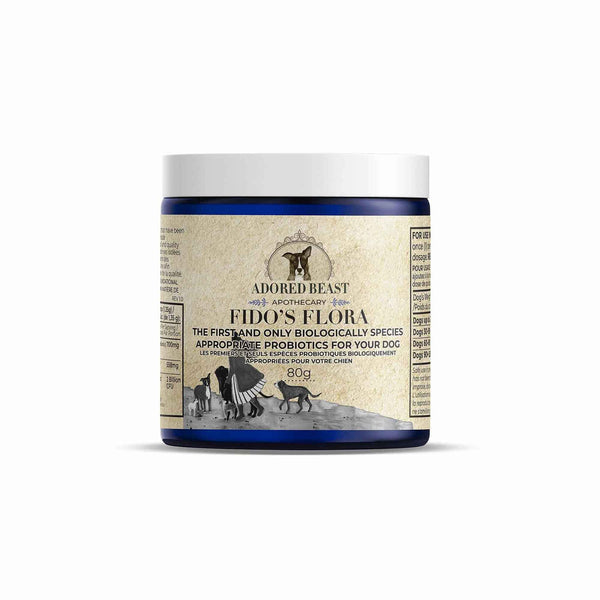
Fido's Flora
The gut is the exit route, so it is where the first jar goes. Fido's Flora is a canine-specific pre and probiotic that pairs species-specific strains with fulvic and humic acid, which is why it is the one we reach for while a dog is on or coming off medication. Rotate to Soil & Sea for the next jar to widen the range of strains.
Available in two sizes for dogs of any weight. Also available on subscription, which carries the 10% Adored Beast subscription discount.
See Fido's FloraWhat about the liver specifically?
There is one canine study I find genuinely interesting here, partly because of who was in it.
In 2025, researchers publishing in Veterinary Sciences gave six French Bulldogs a combined Ginkgo biloba and milk thistle seed extract at either 1 or 2 grams daily for 21 days. Antioxidant markers did not shift. But ALT, the most liver-specific enzyme on a standard panel, came down, and albumin went up. Both doses performed similarly, so the lower one looked as useful as the higher one.
Six dogs is a very small study. It was a combined extract, so you cannot separate the milk thistle from the ginkgo. Three weeks is short. All true, and worth saying once.
What makes it worth mentioning at all is that these were healthy dogs. Most milk thistle research looks at dogs who are already sick. This one suggests the marker movement can happen in a dog with nothing wrong, which is exactly the dog reading this page.
If you want the fuller picture on how I think about this, including why stacking multiple liver products at once backfired badly for us, I wrote about it in natural liver support for dogs, and the difference between detox and support.
IF YOUR FOCUS IS THE LIVER PANEL
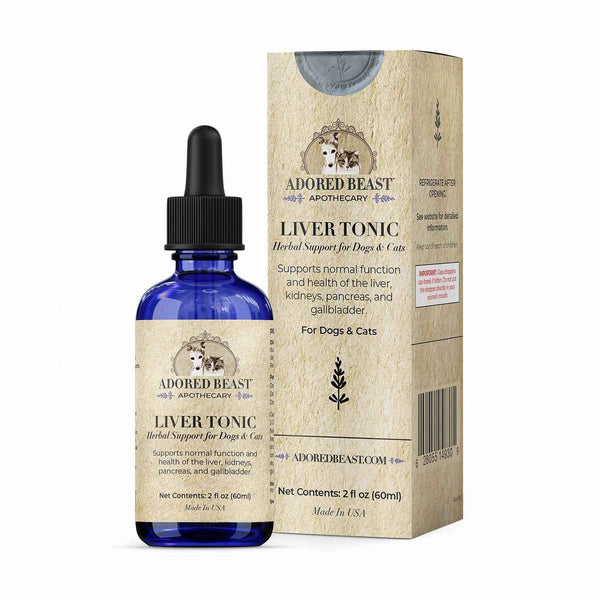
Liver Tonic
A different reader lands here: the one whose annual bloodwork came back with an elevated ALT and no symptoms at all. That was Milka. Liver Tonic is a herbal tincture of dandelion root, milk thistle, greater celandine, and barberry, and it is the one product we kept when we stripped everything else back.
One bottle, one dosage by weight, for dogs and cats. Also available on subscription, which carries the 10% Adored Beast subscription discount.
See Liver TonicWhat about the nervous system?
This is where the worry usually sits, because the FDA language is specifically about neurologic events.
I want to be careful here, and careful in both directions.
There is no supplement with evidence behind it for reducing a neurologic adverse event caused by one of these medications. Nobody has run that study. If someone tells you a supplement will blunt a reaction to a chew, they are ahead of the science, and I am not going to be that person.
What does have real canine evidence behind it is a different question, and it is one worth knowing about. MCT oil and CBD have both been tested in dogs with idiopathic epilepsy, and both showed a reduction in seizure frequency.
A 2020 multicenter randomized controlled trial in the Journal of Veterinary Internal Medicine gave 28 dogs with idiopathic epilepsy an MCT oil supplement alongside their existing antiseizure medication, in a crossover design against a control oil. Seizure frequency and seizure-day frequency were both significantly lower on the MCT oil. The detail that keeps me honest about it: two dogs became seizure-free, three more had a reduction of 50 percent or better, and eleven showed no change or got worse. It helps a subgroup, not every dog.
A 2019 randomized blinded trial from Colorado State University, published in the Journal of the American Veterinary Medical Association, added CBD oil to conventional antiseizure medication in dogs with intractable idiopathic epilepsy. The CBD group had a significant reduction in seizure frequency, a median drop of around 33 percent. The same honesty applies. The proportion of dogs reaching a 50 percent reduction was no different from placebo, two dogs developed ataxia and were withdrawn, and the CBD group's alkaline phosphatase rose, which is a liver marker worth watching.
So here is the accurate sentence. If your dog has epilepsy that your vet has already identified, MCT oil and CBD are real, studied add-ons to raise with that vet. If your dog had a one-off neurologic reaction to a flea and tick chew, that is a different situation, and neither has been studied in it. Do not read one across to the other, and do not use either as a reason to change or stop a medication your vet has prescribed.
What is reasonable for the dog this article is written for: supporting the cell in general. Antioxidant-rich fresh food, omega-3s, and keeping the gut in good shape, since gut and brain are in constant conversation. That is the honest ceiling on what I can tell you.
What is not reasonable: waiting and watching without acting if your dog is showing tremors, unsteadiness, or a seizure. That is a same-day call to your vet, not a supplement question. And report it, both to your vet and to the manufacturer, because the FDA monitoring system only sees what gets reported.
What does Julie Anne Lee, DCH, do in clinical practice?
We spoke with Julie Anne Lee, DCH, founder of Adored Beast, for a full conversation on this on the Next Level Pet Parent Podcast. You can watch the full episode with Julie Anne Lee, DCH, on supporting your dog after flea and tick medication if you want her reasoning in her own words. She has spent over two decades in holistic veterinary care and ran some of North America's longest-standing holistic clinics, and she has been building protocols for this specific situation since the late 1990s.
Her clinical approach, in her own framing, starts with homeopathy for an acute reaction, using Aconite and Arnica for the shock and trauma component, then Nux vomica and Phosphorus for chemical exposure, given across a range of potencies. For a dog with no visible reaction, she works through the systems rather than reaching for a single antidote: rebuild the microbiome with rotated probiotics, add fulvic and humic acid, support liver, pancreas, and kidneys with milk thistle, Berberis, and Chelidonium, and feed fresh food for antioxidant support.
Two things I want to be straight about, because this is her protocol and not a research finding.
The homeopathy piece does not have a strong evidence base. A 2015 meta-analysis of 15 randomized placebo-controlled veterinary homeopathy trials found a pooled odds ratio of 1.69, but nine of those 15 carried a high risk of bias and only two counted as reliable evidence. The authors, who are not hostile to homeopathy, described the evidence as very limited and the quality as too deficient for a firm conclusion. So: decades of clinical observation, not clinical proof. Both of those are real things, and you get to weigh them.
The probiotic rotation idea also has no canine trial testing rotation against a single product. It is a coherent rationale about strain diversity, and it is what we do, and it is not proven.
Her one line I keep coming back to, and this is the mindset shift more than the protocol: there is no antidote, so stop looking for one thing and support the whole system.
Is it too late to detox my dog if I gave flea & tick medication months or years ago?
No.
Nothing in the gut or liver work described here has an expiry date on it. The 2024 Scientific Reports study is the reassuring one: dogs whose microbiomes were disrupted returned to baseline. Bodies do this. Supporting the gut two years after a dose is still supporting the gut.
If it has been years of repeated doses and your dog is now dealing with skin issues, digestive trouble, or something you cannot pin down, that is a different conversation and it starts with your vet plus bloodwork, not with a supplement order. Our guide to dog gut health and why it drives whole-body wellness is the better starting point there.
Three things I would skip
Bathing your dog after an oral chew. Bathing is relevant for a topical product that is still sitting on the skin. If your dog swallowed a chew, it is in the bloodstream within hours. A bath does nothing.
Activated charcoal at home. It comes up constantly in detox articles. It binds things in the gut, which sounds perfect given the excretion route, but it also binds nutrients and medications indiscriminately and the timing matters. This belongs in a vet's hands, not in your kitchen.
Stacking five detox products at once. I learned this one the hard way. More is not better, and the liver does not respond well to being handed a pile of things to process at the same time.
FREE GUIDE
The Complete Flea + Tick Protection Guide
The question that comes next is always the same one: so what do I do about fleas and ticks now? This is the guide I wrote for that, covering how the different approaches actually work, what the trade-offs are, and how to build a plan you are comfortable with before the next season starts.
What this looks like with Milka
Milka is a 10-plus year old French Bulldog with a snout that is more white than black now. She came to us as a puppy with chronic gut issues, itchy hot spots, and vomiting, and everything changed when we moved her to fresh food.
At eight, her annual bloodwork flagged elevated ALT with no outward symptoms at all. Nothing you would notice on a walk. Our instinct was to do more, so we stacked several liver and detox products. Her next panel came back higher. We backed everything off to Liver Tonic alone and her values normalized.
That experience is why this article is structured around restraint rather than intensity. It is one dog, and it is our experience rather than data, but it shaped how I approach every one of these situations now.
It is also why I am such a believer in annual bloodwork. Milka had zero symptoms. Without the panel we would have known nothing.
The bottom line
If you have already given Bravecto, NexGard, Simparica, or Credelio, you have not done something irreversible, and you are not powerless.
The medication leaves largely unchanged through the gut over a period measured in weeks. Support that route. Rotate probiotics, support the liver gently, feed real food, and pay attention to the small stuff for about 10 weeks. Then get back to normal.
Do one thing from this page. Not all of it. Consistency beats intensity every time, and I say that as someone who tried intensity first and made it worse.
You made a decision for your dog with the information you had. That is what all of us are doing, every day.
Much love, Larry
Three-day detox or 10-week support, side by side
Almost every article on this topic sends you down one of two roads. Here is what each one is actually asking you to believe, and what it asks you to do.
| The three-day detox | The 10-week support window | |
|---|---|---|
| What it assumes | The drug is out within days and needs flushing | The drug persists for weeks and leaves largely unchanged through the gut |
| What the pharmacology shows | Three days does not match a 12.6 to 15.7 day half-life | About five half-lives, so roughly 70 days |
| Where the effort goes | A short intense push, usually several products at once | Gut first, liver second, fresh food and observation throughout |
| The main risk | Stacking products the liver then has to process, which is the mistake we made | It asks for consistency over a longer stretch than most pet parents expect |
| The honest appeal | It answers the urge to do something right now, and that urge is real | It matches how the drug actually leaves, and asks for patience instead of intensity |
Sources
- Fact Sheet for Pet Owners and Veterinarians about Potential Adverse Events Associated with Isoxazoline Flea and Tick Products. U.S. Food and Drug Administration, 2018, updated 2019. https://www.fda.gov/animal-veterinary/animal-health-literacy/fact-sheet-pet-owners-and-veterinarians-about-potential-adverse-events-associated-isoxazoline-flea
- CVMP Assessment Report for Bravecto (fluralaner). European Medicines Agency, Committee for Medicinal Products for Veterinary Use. https://medicines.health.europa.eu/veterinary
- Pharmacology and toxicology of veterinary isoxazolines: a review. Veterinary and Animal Science, 2026. https://www.sciencedirect.com/science/article/pii/S2211320726000151
- BRAVECTO 1-Month (fluralaner) Chews for Dogs, product label. Merck Animal Health / DailyMed. https://dailymed.nlm.nih.gov/dailymed/fda/fdaDrugXsl.cfm?setid=8fced6df-02cf-46b5-b794-c1512913e6d4
- Fecal elimination of fluralaner in different carnivore species after oral administration. Frontiers in Veterinary Science, 2024. https://www.frontiersin.org/journals/veterinary-science/articles/10.3389/fvets.2024.1279844/full
- Pilla R, et al. Effects of metronidazole on the fecal microbiome and metabolome in healthy dogs. Journal of Veterinary Internal Medicine, 2020;34(5):1853-1866. https://onlinelibrary.wiley.com/doi/full/10.1111/jvim.15871
- Conserved signatures of the canine faecal microbiome are associated with metronidazole treatment and recovery. Scientific Reports, 2024. https://www.nature.com/articles/s41598-024-51338-7
- Pesticide exposure and the microbiota-gut-brain axis. The ISME Journal, 2023;17(8):1153. https://academic.oup.com/ismej/article/17/8/1153/7505820
- Lertpatarakomol R, et al. Effects of Gingko biloba and Milk Thistle Extracts on Biomarkers of Antioxidants Status and Liver Function in Healthy Dogs. Veterinary Sciences, 2025;12(8):763. https://doi.org/10.3390/vetsci12080763
- Mathie RT, Clausen J. Veterinary homeopathy: meta-analysis of randomised placebo-controlled trials. Homeopathy, 2015;104(1):3-8. https://www.sciencedirect.com/science/article/abs/pii/S1475491614001039
- Schmitz S. Evidence-based use of biotics in the management of gastrointestinal disorders in dogs and cats. Veterinary Record, 2024. https://bvajournals.onlinelibrary.wiley.com/doi/abs/10.1002/vetr.4916
- Palmieri V, Dodds WJ, Morgan J, Carney E, Fritsche HA, Jeffrey J, Bullock R, Kimball JP. Survey of canine use and safety of isoxazoline parasiticides (Project Jake). Veterinary Medicine and Science, 2020;6(4):933-945. https://onlinelibrary.wiley.com/doi/full/10.1002/vms3.285
- Interview with Julie Anne Lee, DCH, founder of Adored Beast. Next Level Pet Parent Podcast, PAWDEGA. https://youtu.be/aTU4RP9UIWA (Primary source for the clinical protocol described in this article, presented as her practice experience.)
- A multicenter randomized controlled trial of medium-chain triglyceride dietary supplementation on epilepsy in dogs. Journal of Veterinary Internal Medicine, 2020. https://pubmed.ncbi.nlm.nih.gov/32293065/
- McGrath S, Bartner LR, Rao S, Packer RA, Gustafson DL. Randomized blinded controlled clinical trial to assess the effect of oral cannabidiol administration in addition to conventional antiepileptic treatment on seizure frequency in dogs with intractable idiopathic epilepsy. Journal of the American Veterinary Medical Association, 2019;254(11):1301-1308. https://pubmed.ncbi.nlm.nih.gov/31067185/
DISCLAIMER: Please note that this content is for informational purposes only and is not intended to be a substitute for professional veterinarian advice, diagnosis, or treatment. Our content may include affiliate and/or sponsored links which means your support helps move our mission forward. As content creators, we earn from qualifying purchases.