Ghee is safe for most dogs in small amounts, and it does two things worth caring about: it carries fat soluble vitamins into the body, and it supplies butyric acid, the short chain fat that the cells lining the gut use as fuel. What it does not do is put your dog's brain into ketosis. That job belongs to medium chain triglycerides, and those come from coconut, not from butterfat.
If you have read that ghee is a brain food for dogs, you have read something that skipped a step. Ghee supports the gut and helps carry fat soluble vitamins, while the ketones that fuel an aging brain come from medium chain triglycerides in coconut oil, not from ghee. Both of those are real. They are two different fats doing two different jobs.
On this page
Let's be real for a second. Fats are where holistic pet wellness gets sloppiest. A fat becomes popular, somebody attaches every benefit in the category to it, and three years later half the internet believes something the biochemistry never said. Ghee for dogs is having that moment right now.
So here is the honest version, with the research behind each piece, and a straight answer on where ghee belongs in your dog's bowl.
Ghee for dogs: is it actually good for them?
Can dogs eat ghee? Yes, for most healthy dogs, in small amounts, added slowly.
Ghee is butter with the water and milk solids taken out, leaving close to pure butterfat. Chemically it is a mix of long chain, medium chain and short chain fatty acids, and it carries sterols, phospholipids, carotenoids and fat soluble vitamins along with them, according to a 2026 review in Frontiers in Food Science and Technology. That same review names ghee as a meaningful dietary source of butyric acid, and notes it contains conjugated linoleic acid and sphingomyelin.
That fat soluble vitamin point matters more than it sounds. Vitamins A, D, E and K need dietary fat to be absorbed at all. A 2024 clinical review of the fat soluble vitamins describes their uptake as dependent on dietary lipids and bile driven micelle formation, and reports that co-ingesting fat can raise absorption of vitamin D and carotenoids substantially compared with low fat conditions.
Translated into a real bowl: if your dog eats a beautiful fresh diet full of leafy greens and organ meat, a little added fat helps them actually absorb what is in it. That is not a headline benefit. It is a quiet, structural one, and it is the reason a fat topper earns a place in a longevity focused routine.
Does ghee help a dog's brain?
Not through ketones, and this is the correction most articles never make.
Here is what the research tells us. As a dog ages, the brain becomes less efficient at using glucose for energy. Ketone bodies can cross the blood brain barrier and serve as an alternative fuel, which is why the ketone route has become such an active area in canine cognition. A double blind, placebo controlled study published in Frontiers in Nutrition reported that dietary medium chain triglycerides improved learning, memory and executive function in senior dogs, and concluded that ketone bodies may support brain function by acting as an energy source. A 2024 metabolomics study in Animals confirmed the mechanism from the other direction: feeding MCTs measurably raised circulating ketone bodies in both young adult and senior dogs.
Strong evidence. It is not evidence about ghee.
Medium chain triglycerides are the C8, C10 and C12 fats, and they are concentrated in coconut and palm kernel oil. Ghee is predominantly long chain butterfat with a much smaller medium chain fraction. Its signature short chain fat, butyric acid, is a four carbon fat that behaves nothing like C8 metabolically. Feeding ghee and expecting a ketone response is feeding the wrong molecule and hoping.
And here is what most pet parents are never told: this is exactly why the good ghee products for dogs are not pure ghee. They are blends. Pairing cultured ghee with virgin coconut oil covers both jobs in one spoon, the butterfat side bringing butyrate, CLA and the fat soluble vitamin carrier, the coconut side bringing the medium chain triglycerides that actually generate ketones.
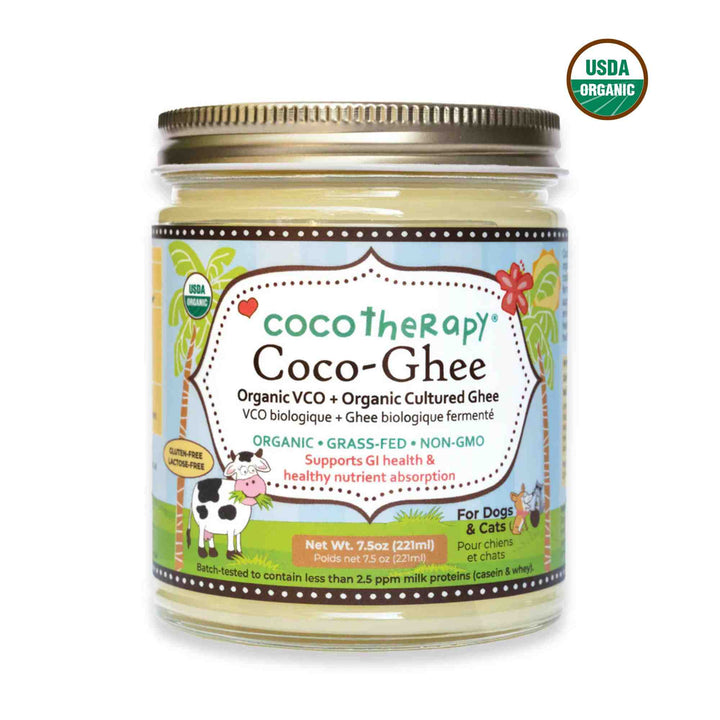
The one I feed Milka
Coco-Ghee
This is the blend I reach for rather than plain ghee, because plain ghee only does half of what pet parents think it does. Organic cultured ghee from grass fed cows, blended with organic virgin coconut oil, so one spoon covers the butterfat side and the medium chain side.
- Medium chain triglycerides, minimum 63 percent, per the product label
- Cultured ghee, made by churning fermented cream the traditional Ayurvedic way
- Grass fed milk, naturally carrying vitamins A, D and K plus CLA
- USDA Certified Organic, human grade, two ingredients and nothing else
What is butyrate, and does ghee actually deliver it?
Butyrate is the short chain fatty acid that colon cells run on. In dogs specifically, gut bacteria ferment carbohydrate and fibre into butyrate, and it is described in the veterinary literature as the preferred energy source of colonocytes. Research on dogs with chronic enteropathy has looked closely at faecal short chain fatty acid concentrations for exactly this reason, since these metabolites sit at the interface between the microbiome and the gut wall.
Now the nuance, because this is where honest gets useful.
Free butyrate eaten by mouth is largely absorbed high in the digestive tract, so most of it never reaches the colon where its main effects happen. That is well documented in the animal nutrition literature, and it is the reason commercial butyrate supplements are microencapsulated or delivered as tributyrin rather than as a bare salt.
Ghee's butyrate is not a bare salt. In butterfat, butyric acid arrives esterified onto a glycerol backbone, the tributyrate form, which is more stable through the stomach. Independent testing summaries note that this is the form naturally present in butter, and that preliminary animal work suggests it may act more favourably in the intestine than sodium butyrate. Preliminary is the operative word. Much of that work is in poultry, and I have not found a canine trial on dietary tributyrate.
So the fair claim is this: ghee is a real dietary source of butyric acid in a chemically sensible form, and the biggest driver of butyrate in your dog's colon is still a diverse, fermentable diet feeding a healthy microbiome. Ghee supports that picture. It does not replace it. If gut work is your actual goal, the fat is the accessory and the diet is the engine, which is why our gut health support range starts with the microbiome rather than with a topper.
Can a dairy sensitive dog have ghee?
Often yes, and this is one of ghee's genuinely useful properties.
Lactose and casein live in the milk solids, and clarifying butter removes those solids. Ghee therefore carries far lower levels of both than butter does. For a dog who reacts to dairy proteins, that difference is frequently the difference between a reaction and none.
Two honest caveats. First, trace amounts can remain, and how much depends on how thoroughly the ghee was clarified, so quality of manufacture is not a marketing detail here. Second, ghee is still a dairy derived product. If your vet has confirmed a milk protein allergy rather than a mild sensitivity, this is a conversation for them before it is an experiment in your kitchen.
How much ghee can I give my dog?
Small, and slower than you think. Fat is the most calorie dense thing in the bowl, and the most common mistake I see is a pet parent adding a generous spoon on day one and then blaming the ingredient for the loose stool that follows.
The daily amounts below are the feeding recommendations from the Coco-Ghee label, which is a ghee and coconut oil blend rather than plain ghee. Start at roughly a quarter of the target amount and build up over two to three weeks. Serve it with food rather than alone.
Scroll sideways to see the full table.
| Body weight | Daily amount |
|---|---|
| Cats, and dogs up to 10 lbs | 1/8 to 1/4 tsp |
| Dogs 11 to 25 lbs | 1/4 to 1/2 tsp |
| Dogs 26 to 40 lbs | 1/2 to 1 tsp |
| Dogs 41 to 60 lbs | 1 to 1 1/2 tsp |
| Dogs 61 to 80 lbs | 1 1/2 to 2 tsp |
| Dogs 81 lbs and over | 2 tsp |
Split the daily amount across two or three meals rather than giving it in one go. And count it. A teaspoon of this blend is around 40 kcal, which is real food for a small dog and needs to come out of their day rather than sit on top of it.
If you are building a whole routine rather than adding one topper, the guide below is the framework I wish I had when Milka was a puppy and I was buying things one panic at a time.
When should you skip ghee entirely?
There are three situations where I would not add it, and one widely repeated warning that deserves more nuance than it usually gets.
- A dog with a history of pancreatitis, or a known lipid disorder. Talk to your vet first, full stop. Do not run this experiment on your own.
- An overweight dog whose calories are already tight. A fat topper is the wrong first move. Fix the base diet, then revisit.
- A dog with a vet confirmed milk protein allergy rather than a mild dairy sensitivity, for the reasons in the section above.
Now the nuance. High fat food is widely named as a pancreatitis risk in dogs, and the dietary side of the evidence is real: a case control study in JAVMA found that eating unusual food items raised the odds of pancreatitis roughly fourfold, and an ACVN nutrition review reports still higher risk multiples for raiding the bin, along with elevated risk from table scraps and from obesity.
What that evidence describes is a sudden, large, unaccustomed fat load. A quarter teaspoon worked up slowly is not the same event as a plate of drippings. Worth knowing too: a 2026 narrative review from Michigan State revisited the link and found that recent work has largely failed to confirm a consistent, straightforward association between dietary fat content and the onset of pancreatitis, and that the older studies underpinning the standard advice have real methodological limits. The same review notes that fat restriction does not reliably keep every dog free of relapse.
I am not telling you fat is harmless. I am telling you the picture is less settled than the internet makes it sound, that the dose and the pace are what actually distinguish a food topper from a dietary insult, and that a dog with a pancreatic history is not the dog to be relaxed about.
Ghee or MCT oil: which one does your dog need?
This comes down to what you are actually solving.
If your dog is broadly well and you want a daily functional fat that supports the gut, carries fat soluble vitamins, and tastes good enough to make a supplement disappear into dinner, a ghee and coconut blend is the better fit. It is food first.
If your dog is nine, you watched them hesitate at the bottom of the stairs, and cognitive support is the specific goal, then the concentration matters and you want the fat the research was actually done on. A dedicated MCT oil delivers far more C8 and C10 per spoon than any butterfat blend can, and a straight virgin coconut oil for dogs sits between the two.
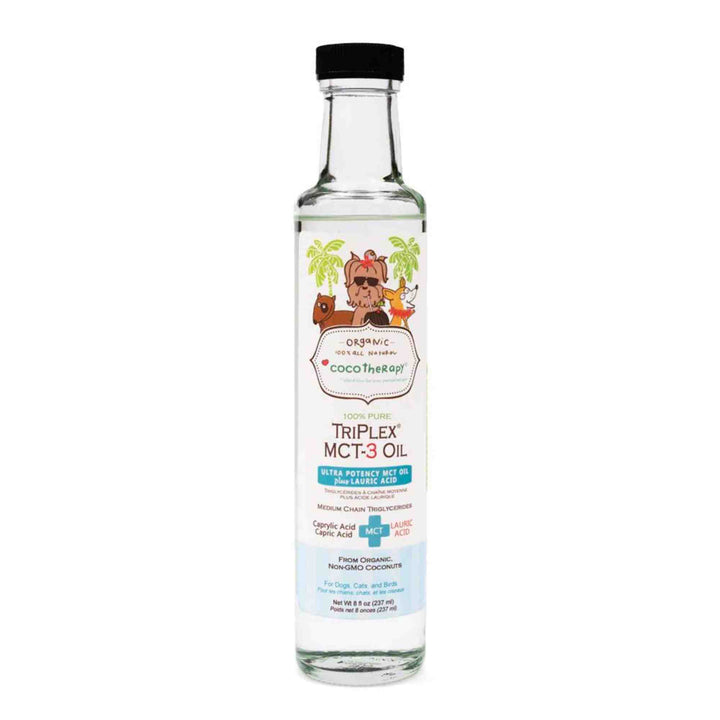
If the brain is the goal
TriPlex MCT-3 (Coconut) Oil
For the senior dog where cognitive support is the reason you are here. Medium chain triglycerides at 93 percent, with the C8 and C10 that the canine cognition research was built on, plus lauric acid that most refined MCT oils strip out.
See TriPlex MCT-3 OilScroll sideways to see the full table.
| Deciding on | Coco-Ghee | TriPlex MCT-3 Oil |
|---|---|---|
| Best for | Daily gut and vitamin support | Cognitive support, senior dogs |
| Fat profile | Butterfat plus coconut, 63% MCT min | Coconut MCT, 93% MCT |
| Ketone potential | Moderate, from the coconut half | High, the reason to pick it |
| Also brings | Butyric acid, CLA, vitamins A, D, K | Lauric acid, topical coat and paw use |
| Evidence status | Early for butyrate, strong for MCT | Controlled canine cognition trials |
| Have a look | Coco-Ghee | TriPlex MCT-3 Oil |
Plenty of pet parents end up using both, for different reasons, at different points in a dog's life. That is a reasonable outcome. What is not reasonable is buying ghee for a brain and never getting the thing you paid for.
If you have been feeding ghee and wondering whether it was doing anything, it probably was. Not the thing you were told, but something real, and something worth keeping. And if what you actually want is to support an aging mind, now you know which bottle to reach for.
This article is education, not veterinary advice. Every dog is different. Speak with your vet before adding a new fat to your dog's diet, particularly if your dog has any history of pancreatic or lipid problems.
Sources
- Understanding the techno-functionality of ghee as a cooking medium. Frontiers in Food Science and Technology, 2026. Link
- Efficacy of a Therapeutic Diet on Dogs With Signs of Cognitive Dysfunction Syndrome: A Prospective Double Blinded Placebo Controlled Clinical Study. Frontiers in Nutrition, 2018. Link
- Effects of Dietary Medium-Chain Triglyceride Supplementation on the Serum Metabolome of Young Adult and Senior Canines. Animals, 2024. Link
- Cultivating the colon: Probiotics and prebiotics. dvm360. Link
- Fecal short-chain fatty acid concentrations and dysbiosis in dogs with chronic enteropathy. Journal of Veterinary Internal Medicine, 2019. Link
- Implications of butyrate and its derivatives for gut health and animal production. Animal Nutrition, 2017. Link
- Butyrate Supplements for Gut Health. ConsumerLab, 2026. Link
- Fat-Soluble Vitamins A, D, E, and K: Review of the Literature and Points of Interest for the Clinician, 2024. Link
- Ghee vs butter: What are the differences? Medical News Today, 2023. Link
- Associations between dietary factors and pancreatitis in dogs. JAVMA, 2008. Link
- Controversies in the Nutritional Management of Pancreatitis. Today's Veterinary Practice, ACVN Nutrition Notes. Link
- High fat, high risk? Evaluating the strength of evidence linking dietary fat and pancreatitis in dogs. Narrative review, 2026. Link