Why is my dog licking their paws? In most cases, because the paws itch, not because your dog is bored. The front feet are one of the classic sites for allergic skin disease in dogs, and a paw that stays damp becomes a warm, low-oxygen pocket where the yeast and bacteria already living on the skin multiply. That is why the licking gets louder at night, and why it comes back a few weeks after every round of medication. The licking is the signal. The itch is the problem. And the thing driving the itch usually sits somewhere else entirely.
Here is the short version, and the one sentence worth carrying into your next vet appointment: paw licking in dogs is a symptom of itch, and that itch is usually driven by allergic skin disease with a secondary yeast or bacterial overgrowth sitting on top of it.
In this article
- Is it normal for a dog to lick their paws?
- Why is my dog licking their paws so much?
- What do rust brown paws actually mean?
- How do I know if it is yeast?
- Why does it always come back after the vet?
- Where do I actually start?
- What if there are no yeast signals at all?
- How long before anything changes?
- When should I go back to my vet?
Is it normal for a dog to lick their paws?
Some of it, yes. Dogs clean their feet after a walk. They lick when they settle. A few seconds of grooming and then they stop, and nothing about the paw looks different afterwards.
What is not normal is the version you are probably living with. The licking that goes on for minutes. The licking you can hear from the next room at 11pm. The licking that you can interrupt by calling their name, and that starts again the second you look away. The fur between the toes staining a colour it did not used to be.
That is not grooming. That is a dog trying to get relief from something, and doing the only thing available to them.
Why is my dog licking their paws so much?
There are six things worth ruling in or out. They are not equally likely, and the order matters, because the most common one is also the one most often missed.
| What is driving it | What it usually looks like | What tends to give it away |
|---|---|---|
| Allergic skin disease, environmental or food related | Both front feet, ears, armpits, belly. Often started before age three | Itch that responds to steroids and returns when they stop |
| Yeast overgrowth on top of that allergy | Damp, greasy, red skin between the toes, an odour, often the ears too | Smell, and the fact that ears and feet flare together |
| Bacterial overgrowth, usually alongside the yeast | Pustules, crusting, raw skin, sometimes a different smell entirely | Skin that got worse after antibacterial or antifungal washing |
| Parasites, including mites and fleas | Itch spread over the body, ear margins and the lower back involved | Ear margins and the dorso lumbar area, which allergy tends to spare |
| Pain or an injury | One paw only, sudden onset, sometimes limping or reluctance on stairs | It is one foot, not four. Check between the pads |
| Stress or habit | Licking tied to being left alone or to a change at home, skin looks normal | The skin underneath is genuinely unremarkable |
Notice where stress and habit sit on that list. They come last, and they belong last. They are real, and they are also the explanation most pet parents are handed first, which is how a dog spends two years licking while everyone assumes it is a nervous tic.
Here is the detail that changed how I look at this. When veterinary dermatologists work through whether an itchy dog has atopic dermatitis, they use a set of clinical criteria published by Favrot and colleagues in 2010, built from a study of 1,096 dogs. Two of the eight criteria are affected front feet and a history of chronic or recurring yeast. Not stress. Not boredom. Front feet and yeast, sitting side by side in the same checklist.
What do rust brown paws actually mean?
That colour is not dirt, and it does not wash out, which is usually the first thing pet parents try.
Saliva contains porphyrins, iron rich compounds that oxidise when they meet air. Dr. Jerry Klein, Chief Veterinary Officer at the American Kennel Club, describes porphyrin as the usual reason for pink, red, orange or brown staining on a dog's coat. When a dog licks the same spot for long enough, the fur there rusts.
So the stain is a timer, not a condition. It tells you the licking has been going on far longer than the few weeks you have been noticing it. In my experience it is also the single most useful thing to photograph before you change anything, because the fading of that stain is often the first visible proof that something is working.
How do I know if it is yeast?
Let's be real for a second. You cannot confirm yeast from a blog post, and anyone who tells you otherwise is selling you something. What you can do is count signals, and then take that count to your vet.
Malassezia is a yeast that lives on healthy dog skin in small numbers. It is not an invader. The problem starts when something else, most often an allergy, disrupts the skin surface and gives it the moisture and inflammation it needs to multiply. A 2024 review in The Veterinary Journal describes exactly this pattern: the yeast proliferates in the presence of an underlying disease, and allergic dermatitis is one of the most common underlying causes. The interdigital skin, the spaces between the toes, is named as one of the favoured sites, because the microclimate there suits it.
This is why yeast is almost never the whole story. It is a passenger that got loud.
Count how many of these are true for your dog right now:
- A musty, cheesy or corn chip smell, particularly from the feet or ears
- Skin between the toes that feels damp or greasy rather than dry and flaky
- Red or rust brown staining on the paws
- Recurring ear infections, or thickened, swollen ear canals
- Tear staining, or staining at the corners of the mouth
- Skin that has darkened, particularly in the folds and between the toes
- Hot spots that keep returning
- Scooting, or irritation around the anus, the vulva or the penis
Zero signals is a real answer, not a failure of observation. If nothing on that list is true, yeast is unlikely to be your dog's story, and you should skip ahead to what to do instead. One or more, and it is worth taking seriously.
Two honest caveats. Darkening skin can also come from hypothyroidism, which is worth raising with your vet because it makes skin problems worse on its own. And a swab that comes back clear does not close the case: a 2025 study looking at how consistently different people read the same skin cytology slides concluded that a negative result does not rule yeast out in a dog whose signs fit. If your vet is willing, a tape strip or a slide impression is a quick, non invasive way to look, and it is a fairer question than accepting a combined steroid, antibiotic and antifungal drop as the default.
If you want the full picture on what yeast is doing in the body and why it behaves the way it does, our anchor piece on yeast in dogs and why it keeps coming back goes much deeper than I can here.
Why does it always come back after the vet?
Four vet visits. Two rounds of antibiotics. A steroid shot. Prescription food that cost more than your own groceries. It clears for two weeks. Then it comes back, slightly worse.
If that is your story, you are not doing it wrong, and neither is your vet. Two things are happening.
First, the medication is doing what it was designed to do. Look at the FDA approved label for oclacitinib, the drug sold as Apoquel. Its stated indication is control of itch associated with allergic dermatitis and control of atopic dermatitis. Control. That is the manufacturer's own word, in a public regulatory document, and it is accurate. The same label notes that the drug modulates the immune system, that it may increase susceptibility to infection including demodicosis, and that dogs on it should be monitored. None of that makes it a bad choice in the moment. It does mean that when the control stops, the driver underneath is still there.
Second, each round leaves the gut a little further behind. This is the part that rarely gets mentioned in the exam room. In a 2020 study published in the Journal of Veterinary Internal Medicine, healthy dogs given a 14 day course of metronidazole showed a marked drop in microbial richness, and Fusobacteria had still not fully recovered four weeks after the last dose. A separate 2024 study following dogs for six months found an altered gut community persisting for four to six weeks before it settled back. Repeat that cycle three or four times over two years and the gut your dog's skin depends on has been reset repeatedly.
Why does the gut matter to a foot? Because of the gut skin axis, and this is where I want to be straight with you rather than sell you the tidy version. Several studies have found that dogs with atopic dermatitis carry a different, less diverse gut community than healthy dogs, and one 2023 pilot trial in Scientific Reports found that a single oral faecal transplant lowered median skin severity scores from 16.5 to 8 and itch scores from 3 to 1 over 56 days. That is a striking result. But a 2025 study in PLOS ONE comparing allergic and healthy West Highland White Terriers found no significant difference in their gut microbiomes at all. The research is genuinely split, the studies are small, and anyone quoting only the half that suits them is not being honest with you.
What I will say is what I have watched happen, with Milka and with thousands of PAWDEGA customers since: when the gut is supported properly instead of repeatedly knocked down, the skin gets a chance it did not have before.
Where do I actually start?
Not with five products. With a sequence.
- Start the journal today. Before you change a single thing, write down when the licking happens, how long it lasts, and which foot. Progress here is proportional, not binary. An episode dropping from fifteen minutes to five is a real win, and you will not notice it without a baseline. Julie Anne Lee, DCH, the holistic practitioner who formulated the protocols we carry, calls this the most useful tool a pet parent has, and I agree with her.
- Lower the sugar for two weeks before anything else. Yeast feeds on sugar, and heavily processed carbohydrate is effectively sugar by the time it is eaten. Two weeks on a less processed, lower carbohydrate diet weakens the yeast before you go anywhere near it, which makes everything that follows gentler. If you feed kibble and cannot change that right now, that is fine, it takes longer rather than not working. We wrote about the specifics in whether rice is feeding your dog's yeast.
- Change the shampoo before you add a product. Skin has its own microbiome, and antibacterial and antifungal washes damage it, which can leave a dog more vulnerable to staph than before. A certified organic shampoo is the baseline, not the upgrade. Here is how we choose a shampoo for a yeasty dog.
- Then work on the yeast, internally and topically at the same time. Topical alone keeps you rebathing a dog whose gut is still producing the problem.
- Then repair the gut lining. This step is not optional. Yeast inflames and scars the gut lining as it dies off, and skipping the repair is the single most common reason signs return three to twelve months later.
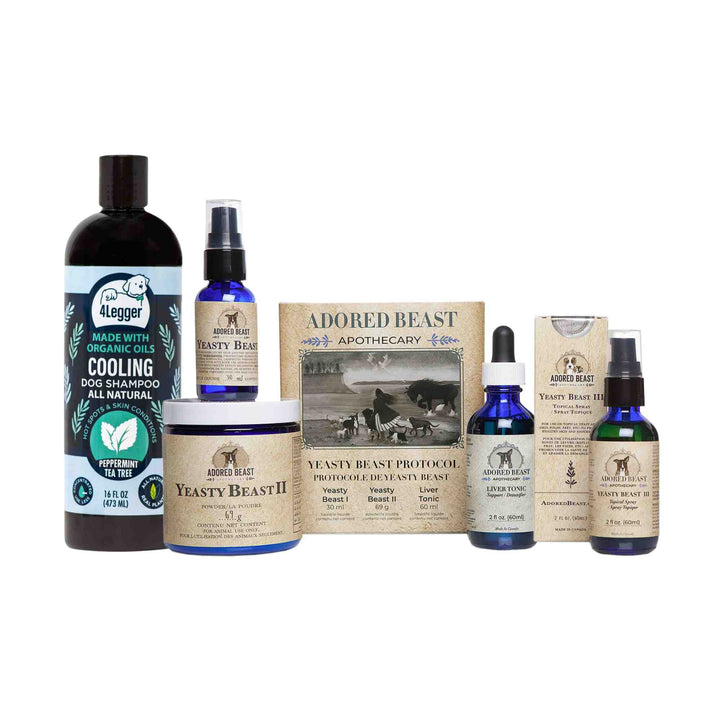
What I reach for at step four
Yeasty Dog Support Bundle
Most pet parents at this stage buy one thing, work on the outside of the dog, and wonder why the smell returns. This bundle exists because the inside and the outside need to happen together. It pairs the Yeasty Beast Protocol, which weakens the yeast with targeted herbs, digests what dies off with enzymes so it is not left to accumulate, and supports the liver throughout, with the two topical pieces that make the coat and skin liveable while that work happens.
- Formulated by holistic practitioner Julie Anne Lee, DCH
- Contains no conventional probiotics by design, because probiotic loading is itself a common trigger for a rough die off
- The shampoo is USDA certified organic, so it can be used as often as the skin needs
- Start it after the two week diet change, not before
One thing to expect, because nobody warns pet parents about it and it is the number one reason people quit while something is working. Dying yeast releases far more toxins than living yeast does, so a dog can improve for a day or two and then look worse. That is a die off reaction, not a failure. The response is to ease off and let the body catch up, never to go back to antifungals. We wrote a whole piece on why your dog can get worse before better, and it is worth reading before you start rather than in a panic on day three.
For dogs with years of signs behind them, multiple rounds of medication, or a protocol that has already been tried and did not hold, there is a cycling approach designed for exactly that situation. That is the Relief Protocol, explained here.
What if there are no yeast signals at all?
Then do not buy a yeast protocol. I would rather tell you that and lose the sale than watch you spend money on the wrong thing, which you have probably done enough of already.
A dog who licks their paws with no odor, no staining, no ear involvement and dry rather than damp skin is a different dog. So is the dog who has been through antibiotics or steroids and whose digestion has never been right since. In both cases the work is gut repair rather than yeast reduction, and the starting point is different. Our explainer on leaky gut in dogs and the signs to look for covers what that looks like, and if antibiotics are part of your dog's recent history, read the two questions to ask before the next course too.
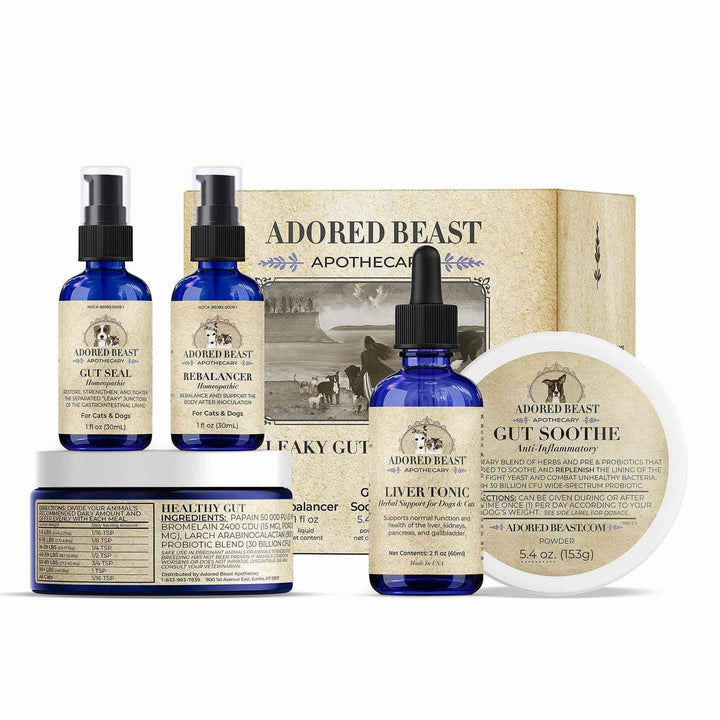
If you counted zero yeast signals
Leaky Gut Protocol
Five products, run in a set order, aimed at the gut lining rather than at the yeast. It is also the step that follows a yeast protocol, which is why so many dogs relapse without it. Choose the size that matches your dog's weight.
Read how the protocol worksHow long before anything changes?
Longer than you want, and that is the honest answer rather than the marketing one. If your dog has yeast, it has been building for a long time. It did not appear last week and it will not resolve in a week either.
What tends to shift first is not the skin. It is comfort, sleep and energy. Less audible licking at night. Calmer behavior. Reducing smell. Ears that look less angry. The paws are often last, because the skin is the outside of a process that starts on the inside. If your dog is brighter and more comfortable while the feet still look the same, that is progress, and your journal is what will let you see it.
And a small thing that costs nothing: swap synthetic bedding for cotton, and cover the couch with a cotton sheet you can wash often. Polyester and vinyl do not breathe, which creates exactly the dark, damp conditions that suit yeast.
When should I go back to my vet?
Sooner than you think, and with better questions rather than a position to defend. Ask for a tape strip or slide impression of the skin between the toes. Ask whether thyroid testing is worth doing. Ask what the plan is beyond controlling the itch, and what the wean looks like if your dog is on anything long term.
Please do not stop any medication suddenly on your own. Suppressed conditions rebound, and they rebound harder than they presented the first time. Anything ongoing comes off slowly, with your vet, while the body is being built up underneath.
I am not a veterinarian. I am a pet parent who spent years on this with my own dog and then built a business around what I learned. If you want someone with clinical training who works this way, we keep a list of holistic vets offering online consultations.
One last thing. If you are reading this at 11pm with your dog working away at their feet at the end of the bed, you are not failing them. You are the reason anyone is asking the right question at all.
Much love, Larry
Sources
- Favrot C, Steffan J, Seewald W, Picco F. A prospective study on the clinical features of chronic canine atopic dermatitis and its diagnosis. Veterinary Dermatology, 2010. PubMed record
- Bond R, Morris DO, Guillot J, et al. Malassezia dermatitis in dogs and cats. The Veterinary Journal, 2024. ScienceDirect
- Repeatability and reproducibility of microscopic examination of adhesive tape strip cytology slides for the diagnosis of Malassezia overgrowth and Malassezia dermatitis in dogs, 2025. PubMed Central
- Morris DO, et al. Malassezia pachydermatis carriage in dog owners. Emerging Infectious Diseases, US Centers for Disease Control and Prevention, 2005. CDC
- Klein J, American Kennel Club. Why is my dog's fur changing colour? AKC Expert Advice
- Apoquel (oclacitinib maleate) prescribing information, US Food and Drug Administration approved label, via DailyMed. DailyMed
- Pilla R, et al. Effects of metronidazole on the fecal microbiome and metabolome in healthy dogs. Journal of Veterinary Internal Medicine, 2020. PubMed Central
- Conserved signatures of the canine faecal microbiome associated with metronidazole and recovery. Scientific Reports, 2024. Nature
- Pilot evaluation of a single oral faecal microbiota transplantation for canine atopic dermatitis. Scientific Reports, 2023. Nature
- An insight into the gut microbiota of healthy and allergic West Highland White Terrier dogs. PLOS ONE, 2025. PLOS ONE
- Probiotics ameliorate atopic dermatitis by modulating the dysbiosis of the gut microbiota in dogs, 2025. PubMed Central
- Marsella R. Evaluation of Lactobacillus rhamnosus strain GG for the prevention of atopic dermatitis in dogs. American Journal of Veterinary Research, 2009. PubMed record
This article is for information only. Every animal is different, and nothing here is a substitute for veterinary care. Please work alongside your vet, ideally a holistic or integrative vet, for anything ongoing or serious.