MCT oil for dogs is a concentrated fat, usually drawn from coconut oil, that the liver converts into ketones. Those ketones give the aging brain an alternative fuel source when its ability to use glucose starts to decline. In canine studies, MCT has been associated with better cognitive performance in senior dogs and fewer seizures in a subset of dogs with epilepsy. The catch is dosage. Every study that produced a measurable result fed MCT at 5.5% to 9% of the dog's daily calories. Most dosing advice online lands at roughly half of that.
Here is the short version you can hold onto: MCT oil is one of the few nutritional tools for canine brain aging with real clinical evidence behind it, but the commonly repeated dose of a quarter teaspoon per ten pounds sits below the lowest amount ever shown to work in a dog.
In this article
- What is MCT oil for dogs, and how is it different from coconut oil?
- Does MCT oil actually help a dog's brain?
- How much MCT oil should I give my dog?
- Is your dog's MCT actually coming from a carrier oil?
- Can MCT oil help dogs with seizures?
- Is MCT oil safe for dogs?
- How do you start feeding MCT oil to a dog?
- What MCT oil will not do
- Does MCT oil improve skin and coat in dogs?
- What I give Milka
- Coconut oil or MCT oil: which one do you need?
- Sources
Milka is a senior now. Her snout has gone white, she still drags us out for walks in the forest, and brain support has moved to the very top of my list. So I went back through the actual research on this one rather than the blog posts about the research. What I found changed how I feed it.
What is MCT oil for dogs, and how is it different from coconut oil?
MCT stands for medium chain triglycerides. They are fats with six to twelve carbon atoms in the chain, which is short enough that they skip most of the normal fat digestion process and travel straight to the liver.
Here is where most articles blur something important.
Coconut oil and MCT oil are not the same product. Coconut oil contains medium chain fats, but the dominant one is lauric acid (C12), which behaves far more like a long chain fat. It travels the slower lymphatic route and is a weak ketone producer. Research in older adults comparing concentrated fatty acid preparations found that caprylic acid raised blood ketones while the ketone response to coconut oil and the other fractions was weak. That is human data, and I want to be honest about that, but the underlying biochemistry is the same one at work in your dog.
MCT oil vs coconut oil for dogs comes down almost entirely to the fatty acid profile, and you can see the difference clearly in the guaranteed analysis of two products from the same brand, both of which we carry:
| Fatty acid | Virgin Coconut Oil | TriPlex MCT-3 Oil |
|---|---|---|
| Caprylic acid (C8) | 12% | Roughly 53% of listed MCFAs |
| Capric acid (C10) | 7% | Roughly 36% of listed MCFAs |
| Lauric acid (C12) | 53% | Roughly 11% of listed MCFAs |
| Best suited to | Skin, coat, topical use | Ketone production, brain support |
Same coconut. Almost inverted fatty acid profile. If your goal is brain support, the fraction you want is C8 and C10, and coconut oil is mostly not that.
Does MCT oil actually help a dog's brain?
This is the part where the evidence on MCT oil for dogs and brain health is genuinely good, which is rarer than the internet suggests.
The aging canine brain becomes less efficient at using glucose. Ketones give it a second fuel line. That is the whole mechanism, and it is the reason researchers went looking here in the first place.
A 2010 study in the British Journal of Nutrition followed aged Beagles fed a diet supplemented with 5.5% MCT for eight months. The MCT group outperformed controls on most of the cognitive test protocols, and the gap widened on the harder tasks. Their blood beta-hydroxybutyrate, a ketone body, was significantly elevated.
A 2018 clinical study in Frontiers in Nutrition took it out of the colony and into real homes. Eighty-seven senior dogs showing signs of cognitive dysfunction were assigned to a control diet, a 6.5% MCT diet with a brain protection blend, or a 9% MCT version, and fed for 90 days. All six behavioral categories improved significantly in the 6.5% group. The control diet improved four. And here is the detail I want you to notice: the 9% diet only helped the dogs that would actually eat it.
More was not better. That comes up again in a minute.
The 2023 AAHA Senior Care Guidelines for Dogs and Cats list medium chain triglycerides among the dietary components recommended for cognitive dysfunction syndrome. When a mainstream veterinary body puts something in its guidelines, that is a meaningfully higher bar than a supplement company's product page.
Worth knowing how common this is. One review puts estimated prevalence of canine cognitive dysfunction at about 8% between eight and eleven years, 19% between eleven and thirteen, 45% between thirteen and fifteen, and 67% between fifteen and seventeen. Data from the Dog Aging Project, covering more than fifteen thousand dogs, found the odds rose 52% with each additional year of age. And in a survey of roughly 500 dogs aged eight and over, overall prevalence came in at 14.2% while only 1.9% had it recorded by their vet.
Most of these dogs are not being missed by bad vets. They are being missed because the early signs look like ordinary old age.
How much MCT oil should I give my dog?
Almost every MCT oil for dogs dosage chart online is built on guesswork rather than on the trials it points to. Here is the part nobody is doing.
Every canine trial dosed MCT as a percentage of the dog's daily energy: 5.5%, 6.5%, or 9%. Nobody converts that into a teaspoon. So we did the math ourselves.
The conversion below uses 8.3 kcal per gram for MCT, about 4.6 grams per teaspoon, which works out to roughly 38 calories per teaspoon, and estimates daily calories using the standard resting energy formula from the Merck Veterinary Manual with the commonly used maintenance factor for a neutered adult dog.
| Dog weight | Est. daily calories | 6.5% study dose | 9% study dose | Common online advice | That advice as a share of daily calories |
|---|---|---|---|---|---|
| 10 lb | 350 | 0.6 tsp | 0.8 tsp | 0.25 tsp | 2.8% |
| 20 lb | 585 | 1 tsp | 1.4 tsp | 0.5 tsp | 3.3% |
| 30 lb | 795 | 1.3 tsp | 1.9 tsp | 0.75 tsp | 3.6% |
| 50 lb | 1165 | 2 tsp | 2.7 tsp | 1.25 tsp | 4.1% |
| 70 lb | 1500 | 2.5 tsp | 3.5 tsp | 1.75 tsp | 4.5% |
PAWDEGA calculation based on published study percentages and standard canine energy estimates. Your dog's actual calorie needs will vary with age, activity, body condition, and neuter status, so use this as a starting frame with your vet, not a prescription.
Look at that last column. The quarter teaspoon per ten pounds that gets repeated everywhere lands somewhere around 3% to 5% of daily calories. Below the lowest dose that has ever produced a measurable cognitive result in a dog.
Now compare it to the label on the bottle. CocoTherapy's TriPlex MCT-3 calls for half a teaspoon per ten pounds of body weight, starting at a quarter of that amount and building slowly. Run that through the same math and it lands between roughly 5.5% and 9.6% of daily calories depending on the dog's size. Essentially the studied range.
The label was right. The internet advice was the outlier. I did not expect that going in.
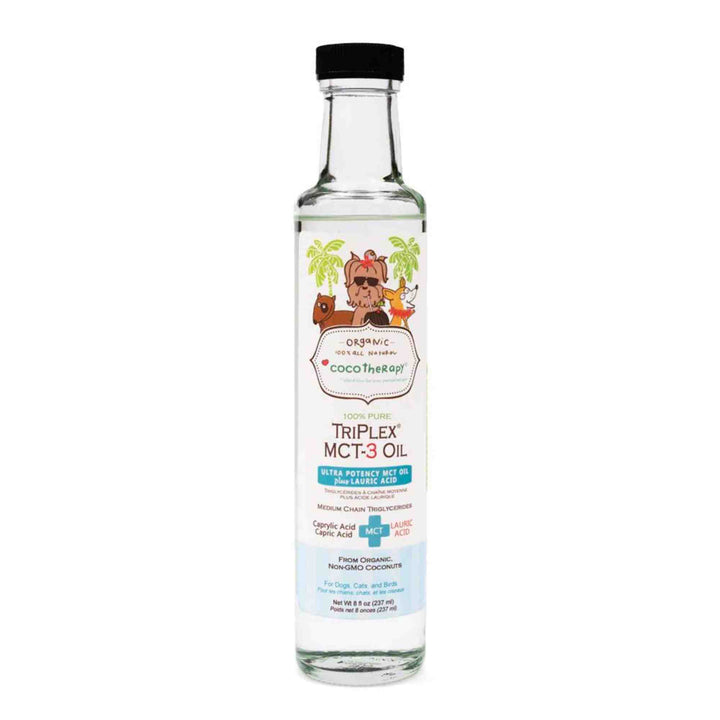
The one I feed Milka
CocoTherapy TriPlex MCT-3 Oil
The reason I use this one is the ratio. It is 93% medium chain triglycerides, weighted toward caprylic and capric acid, which is the fraction the brain research points toward, with only a small lauric portion.
- Cold pressed, USDA Certified Organic coconut, nothing else in the bottle
- Zero synthetics, zero fillers, zero additives
- Label dose of half a teaspoon per 10 lb lands inside the range used in the canine cognition trials
- Also suitable for cats and birds
$27.99
One caution, because this cuts both ways. That 2018 study found the 9% diet only worked in dogs who would eat it, and a 90 day safety study in Beagles found intake dropped at the 15% level, likely from palatability. There is a ceiling, and pushing past it costs you compliance and calories rather than buying you more benefit.
Is your dog's MCT actually coming from a carrier oil?
I need to say this part plainly, because I got caught by it myself.
Plenty of hemp tinctures, calming oils, and liquid supplements use MCT oil as their carrier. The label says MCT oil. You read it, you feel good, you assume that box is ticked.
Run the numbers, though. A typical tincture dose is around one millilitre, which is roughly a fifth of a teaspoon, and MCT is one ingredient in it rather than the whole thing. For a mid sized dog that is somewhere near 1% of daily calories at absolute best. The studies used 5.5% to 9%.
A carrier oil is a carrier oil. It is doing its job, delivering the actives it was formulated around. It is not a brain support dose of MCT, and no honest reading of the research says otherwise.
If brain support is your actual goal, MCT has to be fed as its own thing, at its own amount.
Can MCT oil help dogs with seizures?
There is real research here, and there is also a responder split that most articles quietly leave out.
A six month randomized, double blind, placebo controlled crossover trial published in the Journal of Veterinary Internal Medicine in 2020 gave 28 dogs with idiopathic epilepsy, all already on antiseizure medication, either MCT oil at 9% of metabolic energy or a control oil, three months on each. Seizure frequency and seizure day frequency were both significantly lower during the MCT phase.
But look at the individual dogs. Two became seizure free. Three had reductions of at least 50%. Twelve had smaller reductions. Eleven showed no change or got worse.
An earlier crossover trial in the British Journal of Nutrition found a similar pattern across 21 dogs: significantly lower seizure frequency overall, three dogs reaching seizure freedom, seven more halving their seizures, and six with no response at all.
So the honest framing is this. For some dogs with epilepsy, MCT appears to help meaningfully. For a substantial share, it does nothing. That is worth trying under veterinary supervision and worth tracking properly, and it is not a reason to change a single thing about prescribed medication without your vet.
Is MCT oil safe for dogs?
Broadly, yes, with real caveats.
A 90 day feeding study published in Food and Chemical Toxicology fed Beagles conventional food with 0%, 5%, 10%, and 15% added MCT, monitoring clinical observations, body weight, food intake, physical exams, bloodwork, and eye exams. No toxicological effects were found up to 15% of the diet. That is well above any dose you would use at home.
The genuine risks are more ordinary than the internet makes them sound:
- Loose stool and stomach upset. The most common issue by far, and almost always a dosing speed problem rather than a tolerance problem.
- Calories. MCT runs about 8.3 calories per gram, slightly under other fats but still dense. Roughly 38 calories per teaspoon. On a senior dog with a slowing metabolism, that adds up fast if you do not take it out of the food budget.
- Palatability. Some dogs push back at higher amounts, and the research reflects that.
Can MCT oil cause pancreatitis in dogs?
You will read constantly that MCT oil causes pancreatitis in dogs. The canine evidence does not support that as a blanket statement.
A 2023 study in PLOS One fed twelve healthy dogs meals varying in fat type, including a high MCT meal. Of all the markers measured, only serum triglycerides moved, and the MCT meal actually produced lower triglycerides than either long chain fat meal at two and three hours. The authors concluded that fat type had little acute effect on markers of exocrine pancreatic stimulation. An earlier study in the American Journal of Veterinary Research found neither dietary fat content nor added MCT oil significantly affected cPLI, cTLI, or gastrin in healthy dogs.
Read that carefully, because the caveat matters as much as the finding. Both studies used healthy dogs. Neither tells you what happens in a dog with a history of pancreatitis, and neither is a green light for a high fat supplement in a fat sensitive dog. If your dog has had pancreatitis, is a breed prone to high blood fats, or is on a low fat diet for a reason, this is a conversation with your vet before it is a purchase.
What I will say is that the confident claim that MCT oil causes pancreatitis in dogs is not something the canine research currently shows.
How do you start feeding MCT oil to a dog?
Slowly. That is genuinely most of it. Almost every bad experience I hear about is a dog who went from zero to a full spoonful in a day.
- Start at a quarter of the label amount for your dog's weight. Not the full dose. A quarter of it.
- Hold there for three to five days and watch the stool. Firm stool means you have room to move.
- Increase in small steps every three to five days until you reach the label amount for your dog's size.
- Split it across meals once you are at a meaningful amount. Two smaller servings sit better than one large one.
- Take the calories out of the food. Roughly 38 calories per teaspoon. Reduce the meal to match, especially in a senior dog.
- Give it time and track something specific. The cognition study ran 90 days. The Beagle study ran eight months. Pick two or three concrete things to watch, night waking, getting stuck behind furniture, recognizing people, responsiveness to their name, and write them down before you start, because gradual change is nearly impossible to judge from memory.
- Back off if the stool loosens. Drop to the last amount that worked and hold longer.
The single most useful thing on that list is number six. Brain change is slow and your memory of "how she was three months ago" is not reliable. Mine was not.
What MCT oil will not do
I would rather tell you this than have you feel let down in six weeks.
MCT oil is not a fix for canine cognitive dysfunction. Nothing currently is. In the studies, dogs improved on behavioral scores. They did not become young again.
The skin and coat claims you see attached to MCT oil are mostly borrowed from coconut oil and from human research, so I have given that its own section below rather than lumping it in here.
Does MCT oil improve skin and coat in dogs?
Possibly, and I want to be careful in both directions on this one.
There are no canine trials on MCT oil and coat quality that I could find. That means we have no numbers to point at. It does not mean nothing happens. Absence of a study is absence of a study, not proof that something does not work, and I think a lot of wellness writing gets that backwards in both directions.
Here is what we can reason from honestly.
MCT skips most of the normal fat digestion pathway. For a dog who struggles to absorb fat well, that matters, because coat condition is downstream of nutrient absorption. A dog who is not absorbing fats properly often shows it first in a dull, dry coat. Research is looking at MCTs in exactly this context: a 2023 study in Animals fed 18 dogs with chronic enteropathy a home-cooked diet with virgin coconut oil added, and the diet change reduced fecal fat excretion and improved clinical signs, though the coconut oil itself did not significantly shift the fecal microbiota. So the absorption angle has a real basis, even if nobody has run the coat study.
Coconut oil, which shares some of the same medium chain fatty acids, also has a long history as a topical emollient, and that use is reasonable. It holds moisture in the outer skin layers.
And plenty of pet parents do report a softer, glossier coat after a few weeks on MCT oil. That is an observed pattern rather than a controlled trial, and I will label it as exactly that. It is worth something. It is not worth a statistic.
One caution that matters more than the internet lets on. If your dog has active Malassezia yeast, go carefully with lipid-rich oils applied to the skin. That yeast is lipophilic, meaning it thrives in fatty environments, so slathering an oil onto an already yeasty patch can work against you. Feeding MCT is a different question from applying it topically, and the two get blurred together constantly.
Where the evidence for skin and coat is genuinely strong is omega-3s, which is a whole subject of its own and one I have written about separately in why omega-3s matter for your dog's brain, joints, and skin.
So my honest position: feed MCT oil for the brain, where the research is solid. If the coat improves too, that is a welcome bonus rather than the reason you bought it.
What else MCT oil will not do
MCT works best as one piece of something larger. In the 2018 study it was paired with a brain protection blend, not fed alone. For Milka, Potent-Sea algae oil covers the EPA and DHA side alongside her MCT.

If you are building the fuller brain stack
MYCODOG CLARITY
In the 2018 trial, MCT was not fed on its own. It sat alongside a brain protection blend. CLARITY is the piece we use on that side for Milka: a triple extracted blend of Lion's Mane, Reishi and Cordyceps with Bacopa Monnieri and Ashwagandha, formulated for cognitive and nervous system support.
$49.99
What I give Milka
She gets CocoTherapy TriPlex MCT-3 oil daily, stirred into her raw food, at the amount on the label for her size. We built up to it over about two weeks and she has never had a loose stool from it.
I chose that one for a specific reason. Its profile is roughly 53% caprylic and 36% capric acid of the listed medium chain fatty acids, with only a small lauric fraction, which is the ratio the brain research points toward. It is cold pressed, USDA certified organic, with nothing else in the bottle.
If you want to see the rest of what we use for aging brains, our brain and nervous system support range is where it all lives.
Let me be real for a second. I cannot know what Milka's brain would be doing without it. No pet parent gets a control group. What I can tell you is that this is one of the few things in the senior dog category where the research is solid enough that I feed it without second guessing, and that when I actually checked the numbers, I found I had been underdosing her for longer than I would like to admit.
If your dog is heading into their senior years and you have been feeling that low hum of worry about it, you are not alone. I feel it every time I look at that white snout. But you have more to work with here than you might think, and the research on this one is better than most.
I am not a veterinarian and this is not medical advice. Every dog is different, so please work alongside your vet, ideally a holistic or integrative one, especially for anything ongoing or serious.
Much Love, Larry
Coconut oil or MCT oil: which one do you need?
Both bottles come from the same coconut, and they are not interchangeable. If you only take one thing from this article, take this.
| TriPlex MCT-3 Oil | Virgin Coconut Oil | |
|---|---|---|
| Choose it for | Senior brain support, ketone production, fast energy | Skin, coat, topical use, dry paws |
| Dominant fatty acid | Caprylic acid (C8) | Lauric acid (C12) |
| Ketone production | Strong | Weak |
| Backed by the canine cognition trials | Yes | No |
| Shop MCT-3 Oil | Shop Coconut Oil |
Sources
- Pan Y, Larson B, Araujo JA, et al. Dietary supplementation with medium-chain TAG has long-lasting cognition-enhancing effects in aged dogs. British Journal of Nutrition, 2010. Link
- Pan Y, Landsberg G, Mougeot I, et al. Efficacy of a Therapeutic Diet on Dogs With Signs of Cognitive Dysfunction Syndrome (CDS): A Prospective Double Blinded Placebo Controlled Clinical Study. Frontiers in Nutrition, 2018. Link
- Dhaliwal R, Boynton E, Carrera-Justiz S, et al. 2023 AAHA Senior Care Guidelines for Dogs and Cats. Journal of the American Animal Hospital Association, 2023. Link
- Recent advances in diagnostic and therapeutic strategies for canine cognitive dysfunction. American Journal of Veterinary Research, 2025. Link
- Evaluation of cognitive function in the Dog Aging Project: associations with baseline canine characteristics. Scientific Reports, 2022. Link
- Berk BA, Law TH, Packer RMA, et al. A multicenter randomized controlled trial of medium-chain triglyceride dietary supplementation on epilepsy in dogs. Journal of Veterinary Internal Medicine, 2020. Link
- Law TH, Davies ESS, Pan Y, et al. A randomised trial of a medium-chain TAG diet as treatment for dogs with idiopathic epilepsy. British Journal of Nutrition, 2015. Link
- Matulka RA, Thompson DV, Burdock GA. Lack of toxicity by medium chain triglycerides (MCT) in canines during a 90-day feeding study. Food and Chemical Toxicology, 2009. Link
- Zhang Y, Kirk CA, Tolbert MK, et al. Impact of fatty acid composition on markers of exocrine pancreatic stimulation in dogs. PLOS One, 2023. Link
- James FE, Mansfield CS, Steiner JM, et al. Pancreatic response in healthy dogs fed diets of various fat compositions. American Journal of Veterinary Research, 2009. Link
- Norgren J, Sindi S, Sandebring-Matton A, et al. Ketosis After Intake of Coconut Oil and Caprylic Acid, With and Without Glucose: A Cross-Over Study in Healthy Older Adults. Frontiers in Nutrition, 2020. Link
- Ingle DL, Driedger A, Traul KA, Nakhasi DK. Dietary Energy Value of Medium-chain Triglycerides. Journal of Food Science, 1999. Link
- Nutritional Requirements of Small Animals. Merck Veterinary Manual, 2024. Link
- Vecchiato CG, Pinna C, Sung CH, et al. Fecal Microbiota, Bile Acids, Sterols, and Fatty Acids in Dogs with Chronic Enteropathy Fed a Home-Cooked Diet Supplemented with Coconut Oil. Animals, 2023. Link
- Product guaranteed analysis, CocoTherapy TriPlex MCT-3 Oil and Virgin Coconut Oil, as listed on PAWDEGA USA. MCT-3 Oil and Virgin Coconut Oil