If your dog's bloodwork came back with elevated liver enzymes, natural liver support for dogs means giving the liver gentle, targeted help, things like veterinarian-guided milk thistle or SAMe, alongside a fresh, whole food diet. It does not mean stacking multiple "detox" products at once. That distinction matters more than most pet parents realize.
Here's the sentence I wish someone had told me years ago: there's a real difference between supporting a dog's liver and detoxing it, and mixing up the two can make elevated liver enzymes worse, not better.
I learned this the hard way with my own dog, Milka. And I want to walk you through exactly what happened, what it taught us, and what actually helped, so you don't have to learn it the same way we did.
In this article
- What do elevated liver enzymes in a dog actually mean?
- What are the early signs of liver trouble beyond bloodwork?
- What's the difference between liver detox and liver support?
- Liver detox vs. liver support: a quick comparison
- Is liver detox bad for dogs?
- Can too many supplements hurt a dog's liver?
- What actually supports a dog's liver naturally?
- What does gentle liver support look like day to day?
- How do you know if your dog needs liver support?
- What helped Milka's liver values improve
- How long does it take for liver enzymes to improve?
What Do Elevated Liver Enzymes in a Dog Actually Mean?
When your vet runs bloodwork and flags something on the liver panel, they're usually looking at a few key markers:
- ALT (alanine transaminase): the most liver-specific of the group. When liver cells are stressed or injured, ALT tends to rise.
- AST (aspartate transaminase): can come from the liver, but also from muscle, the heart, and red blood cells, so it's less specific on its own.
- ALP (alkaline phosphatase): can rise from liver changes, certain medications, or general inflammation.
- GGT (gamma-glutamyl transferase): often linked to bile flow issues.
One elevated number, especially a mild one, doesn't automatically mean something is seriously wrong. It means your vet now has a thread worth watching over time. That was exactly our situation with Milka. Her ALT ticked up. Nothing else about her changed.
What Are the Early Signs of Liver Trouble Beyond Bloodwork?
Here's something worth sitting with: veterinary reference material on chronic hepatitis in dogs notes that in early stages, there may be minimal or no visible signs at all, and the disease is often only caught on routine wellness screening. When signs do show up, they tend to be nonspecific: vomiting, diarrhea, a drop in appetite, or increased drinking and urination.
That's part of why bloodwork matters so much. Milka had zero outward symptoms. Nothing you'd notice on a walk or at dinner time. If we hadn't been running annual panels, we simply wouldn't have known anything was shifting until it became something bigger.
What's the Difference Between Liver Detox and Liver Support for Dogs?
Here's what most pet parents are never told clearly: "detox" and "support" get used interchangeably online, but they are not the same action, and they don't belong in the same protocol at the same time.
When Milka's ALT came back elevated at eight years old, after years of "normal" bloodwork, our first instinct was to do more. We added liver support supplements. We added detox supplements. We were giving them daily. We were pros at this, we thought. Surely more support meant more improvement.
A few weeks later we retested her bloodwork thinking we'd see progress.
Her liver values were even higher.
We were stunned. Confused. A little panicked, honestly.
That's when we sat down with Julie Anne Lee, DCH, a holistic animal homeopath, and went through years of Milka's bloodwork with her. What she explained changed how we think about liver care completely: liver support supplements help an organ function well. Detox products are designed to actively push toxins out. Giving a dog too many detox products at once, especially one whose liver is already working overtime, can overwhelm the system rather than relieve it.
We backed off everything except a gentle Liver Tonic, and stopped the aggressive detox stacking entirely. Her ALT started coming back down.
Liver Detox vs. Liver Support: A Quick Comparison
| Liver Support | Liver Detox | |
|---|---|---|
| What it does | Helps the organ function well | Actively pushes toxins out |
| When it fits | Ongoing and consistent, for a liver under strain | Short, specific windows only |
| Typical trigger | Elevated ALT, AST, ALP or GGT, a pattern across several tests, or long-term medication processed through the liver | A known toxin exposure, or a course of medication that is hard on the liver |
| Pace | Gentle and steady over time | Active and time-limited |
| How many products | Start with one targeted supplement, not a stack of five | One at a time, with a clear reason for each one |
| What goes wrong | Adding more too soon, before it has had the few weeks it typically needs | Layering multiple detox products can overwhelm a liver already working overtime |
Is Liver Detox Bad for Dogs?
Not inherently, but it's easy to reach for it at the wrong moment. Detox protocols exist for a reason. They can be genuinely useful for short, specific windows, after a known toxin exposure, or after a course of medication that's hard on the liver. What tends to go wrong is using detox language as a default response to any abnormal lab result, and layering multiple detox products on top of each other without a clear reason for each one.
Can Too Many Supplements Hurt a Dog's Liver?
Yes, and it's more common than the wellness industry likes to admit. A veterinary toxicologist with the Pet Poison Helpline has flagged supplement overload, including from products marketed as natural and safe, as a genuine and growing source of liver stress in dogs, not just a theoretical risk. Even Chewy's own vet-reviewed guidance cautions pet parents to be skeptical of anything marketed heavily around the word "detox," calling much of that language hype rather than something backed by real evidence.
There's also nuance in how a supplement is meant to be used. Animal herbalists have pointed out that milk thistle, one of the most trusted liver herbs, was never meant to be given every single day indefinitely. It's a targeted remedy for a liver under abnormal stress, not a forever food additive.
More is not automatically better. That's the whole lesson, packaged into one sentence.
What Actually Supports a Dog's Liver Naturally?
A few ingredients have real evidence behind them, not just marketing claims.
Milk thistle (silymarin): A peer-reviewed study on silybin, the active compound in milk thistle, found measurable changes in liver function markers in dogs, supporting its role as a liver-protective ingredient rather than a trend. (1) Veterinary clinical references also note that milk thistle typically takes a few weeks to show its full effect, so consistency matters more than urgency here.
SAMe: A consensus statement from veterinary liver specialists at the American College of Veterinary Internal Medicine identifies SAMe as a key player in the liver's own detoxification pathway, becoming especially important when the liver is under strain. It's worth understanding what SAMe actually is: a lab-produced version of a molecule your dog's body already makes naturally, not a synthetic vitamin isolate. Veterinary guidance notes it's typically given on an empty stomach, about one to two hours before a meal, with gradual improvement often noticeable within days and full effects taking a few weeks.
At PAWDEGA, our own approach leans toward whole-food and herbal liver support rather than lab-synthesized compounds, which is why the Liver Tonic we use with Milka is built entirely from herbal tinctures like milk thistle and dandelion root rather than SAMe. That doesn't mean SAMe isn't real or effective, the veterinary evidence for it is genuine, it's a different philosophy of support entirely, and one worth discussing with your vet if you're weighing your options.
Diet: High-quality, easily digestible protein supports the liver's healing process, while poor-quality or contaminated ingredients can directly increase its workload, including a documented risk of liver toxicity from contaminated grains flagged by the FDA. Some vets also recommend reducing dietary fat for dogs with elevated liver values, though this depends on the individual case, so it's worth asking your vet whether that applies to your dog specifically rather than assuming it across the board. Either way, sourcing matters: clean, minimally processed, high-quality food reduces the liver's exposure to unnecessary toxins in the first place.
The through-line here is gentleness and consistency, not intensity. Your dog's liver isn't looking for a dramatic intervention. It's looking for steady, appropriate support over time.
What Does Gentle Liver Support Actually Look Like Day to Day?
- Start with one targeted supplement, not a stack of five.
- Give it consistently, at the same time each day, following your vet's guidance on timing and dosage.
- Focus on clean, high-quality, easily digestible ingredients rather than assuming fat needs to be cut. Avoid low-quality treats, rich table scraps, or anything with questionable sourcing, and skip the assumption that "low-fat" is automatically the right move. Ask your vet whether your dog's specific case calls for any fat or protein adjustment, since that depends on the diagnosis, not a blanket rule.
- Retest bloodwork on the schedule your vet recommends, typically every few months, rather than every couple of weeks.
- Resist the urge to "add more" if you don't see movement right away. Give it the few weeks it typically needs before reassessing.
- Keep a record of every test, even when everything "looks normal".
How Do You Know If Your Dog Needs Liver Support?
Watch for:
- Elevated ALT, AST, ALP, or GGT on routine bloodwork
- A pattern across multiple tests, not just one isolated number
- Your dog is on long-term medication that's processed through the liver
- Recent exposure to environmental toxins, certain medications, or flea and tick treatments
- Your vet has specifically recommended liver support as part of a broader plan
If you're seeing any of these, the first step is always a conversation with your veterinarian, not a shopping cart full of every liver product you can find. You can see the full range of options we've vetted in our natural detox and liver support collection, though the point of this article is that you almost certainly need fewer of them than you think.
What Helped Milka's Liver Values Improve
Once we stopped the aggressive detox stacking, we simplified. We gave Milka's body room to do what it's designed to do, with one gentle, consistent liver tonic rather than five competing products working against each other.
This is where Adored Beast's Liver Tonic has been part of our routine. It's formulated as an herbal tincture to support liver detoxification, histamine regulation, and overall organ function, gently, and without the aggressive multi-product approach that backfired on us. We're not saying it's a fix for every dog's bloodwork. We're saying it's an example of what gentle, targeted support actually looks like in practice.
The one product in this article
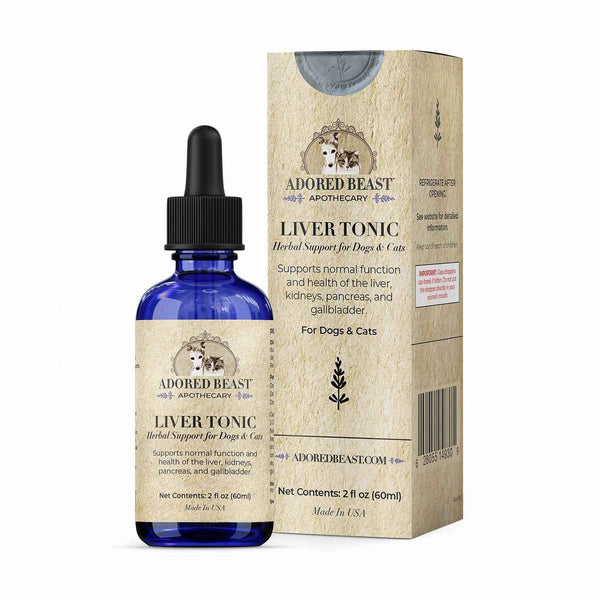
Adored Beast Apothecary
Liver Tonic
5.0 out of 5 from 21 reviews | One size, for dogs and cats
This is the tonic we kept when we took everything else away. It's a herbal tincture, not a synthetic isolate: dandelion root, milk thistle, greater celandine and barberry, formulated to support the liver, kidneys, gallbladder and pancreas together rather than pushing on one organ in isolation.
- Zero synthetics, zero fillers, zero additives
- Given twice daily by weight, 0.25ml up to 1.0ml, and it can go straight in food
- Often used after antibiotics, steroids, NSAIDs, or flea and tick meds
- Available on Subscribe & Save if you're supporting your dog long term
"her enzyme count went way down. The first time in about 5 years." Kathleen S., verified review
Always check with your veterinarian before starting anything new, especially if your dog is already on medication.
How Long Does It Take for Liver Enzymes to Improve Naturally?
Honestly? It varies. For us, it took several months of consistent monitoring, roughly every two to three months, to see Milka's ALT trend in the right direction. Some dogs may respond faster, some slower. The number you get from one blood draw matters less than the trend across several.
If there's one thing I hope you take from this, it's this: your dog's individual bloodwork history matters more than any single scary number. Trends over time tell a story that one test never can. That's also why we're such believers in annual bloodwork, even for dogs who seem perfectly healthy. It builds the baseline that makes moments like this one so much easier to navigate calmly instead of in a panic.
We go much deeper into Milka's full bloodwork journey, including the vet visits, the second and third opinions, and what we'd do differently, in our full podcast conversation on the Next Level Pet Parent Podcast. If you're navigating something similar with your own dog, it's worth the listen.
You know your dog better than any single lab report does. Trust that, ask questions, and give your dog's liver room to do its job, gently.
Much love, Larry