SIBO in dogs, or small intestinal bacterial overgrowth, is when bacteria multiply too heavily in the small intestine, where numbers are meant to stay low. The result is gas, loose or mucusy stool, and weight loss even when your dog eats well, because the gut cannot absorb nutrients properly. Here is the part most articles skip: SIBO overlaps so closely with recurring pancreatitis and EPI that dogs are often managed for the wrong one for months. If your dog keeps landing back in the same digestive loop, this is why, and this is where to look next.
The single most useful thing to know about SIBO in dogs is that it rarely travels alone, and chasing the symptom without confirming the cause is what keeps it coming back.
You've changed the food. You've added the supplements. You've followed every instruction. And your dog still cycles through the same soft stools and the same "let's try another round" visits. If that sounds familiar, you are not alone, and you are not doing it wrong. There is usually more to the picture than one tidy label.
What is SIBO in dogs?
The small intestine is where most digestion and nutrient absorption happens, and it is meant to stay relatively low in bacteria. When something slows that process down, food sits there longer than it should, and bacteria bloom in a place they were never meant to dominate.
Here is a detail that reframes the whole condition: the overgrowing bacteria are not always "bad" bacteria. They can be the same friendly flora we work so hard to build up, thriving in the wrong compartment and in the wrong numbers. That single idea comes from Julie Anne Lee, DCH, a holistic animal homeopath with decades in veterinary clinics and a probiotic formulator who joined me on the Next Level Pet Parent Podcast to talk through pancreatitis, EPI, and SIBO.
That episode explains why the standard "add more probiotics" reflex can sometimes make a SIBO dog worse. More on that below.
SIBO is closely linked to exocrine pancreatic insufficiency (EPI), inflammatory bowel disease, and anything that disrupts gut motility, according to VCA Animal Hospitals. That connection is the whole reason it hides so well.
Why do vets now call SIBO "antibiotic-responsive enteropathy"?
If your vet seems reluctant to say the word SIBO, there is a good reason. The veterinary field has largely moved away from SIBO as a standalone label. What used to be called idiopathic SIBO is now more accurately described as antibiotic-responsive enteropathy, a subtype of chronic enteropathy, as veterinary internist Albert Jergens and others have laid out.
Why the shift? The old definition rested on counting bacteria in fluid from the small intestine, and that count turned out to be unreliable. Experts could not even agree on what a "normal" number looked like. So the field regrouped around how a dog responds: food-responsive, antibiotic-responsive, or immunosuppressant-responsive. Reviews in dvm360 note that these overlapping terms, SIBO, antibiotic-responsive diarrhea, tylosin-responsive diarrhea, and dysbiosis, may all describe versions of the same underlying imbalance.
For you, the takeaway is practical: SIBO is not a clean, one-and-done answer. It is a pattern of gut imbalance, which is exactly why it needs a whole-picture approach rather than a single prescription.
What are the symptoms of SIBO in dogs?
The signs are frustratingly ordinary, which is part of the problem. The most common symptoms of SIBO in dogs include:
- Chronic or recurring loose, soft, or mucusy stool
- Gas, gurgling, and bloating
- Weight loss despite a normal or even increased appetite
- Signs of reflux or on-and-off abdominal discomfort
- A dull coat or a generally "not quite thriving" look
Here is the trap. These same signs show up in EPI and in chronic pancreatitis, and all three can feed into one another. Pancreatitis can lead to EPI through scarring, EPI can trigger SIBO, and SIBO can loop back and stress the pancreas. A dog can even have all three at once. I covered that tangle in depth in my post on recurring pancreatitis in dogs, and if your dog started there, it is worth the read.
The tell that points toward SIBO or EPI specifically is antibiotic-responsive diarrhea: the stool firms up on antibiotics, then relapses once the course ends. That relapse is not a failure. It is a clue.
How do vets confirm SIBO in dogs?
You cannot reliably tell SIBO apart from its lookalikes by symptoms alone, so the goal is to test, not guess. Here are the tools worth asking your vet about, roughly in order of how accessible they are:
- Serum folate and B12 (cobalamin). A high folate with a low B12 raises suspicion, because overgrown bacteria produce folate and consume B12. These markers lack sensitivity and are not definitive on their own, per an overview citing Gaschen and Merchant, but they are an easy, affordable place to start.
- cTLI test. This rules EPI in or out, which matters because EPI is managed very differently and often coexists.
- An antibiotic trial. Improvement on antibiotics supports antibiotic-responsive disease, though it does not pinpoint which one.
- Breath hydrogen test. Non-invasive, measuring hydrogen and methane, though few general clinics have the equipment.
- Duodenal fluid culture. The theoretical gold standard, but invasive and rarely done in practice.
Why does B12 matter beyond confirming the picture? Because cobalamin deficiency shows up in roughly 19 to 38 percent of dogs with chronic enteropathy and predicts worse outcomes, and a randomized trial published in the Journal of Veterinary Internal Medicine found oral B12 normalized levels about as well as injections in most affected dogs. If your dog is low, correcting it is not optional.
Free guide · No purchase needed
Not sure yet whether it is SIBO, EPI, or pancreatitis?
Then a product is not your next step, testing is. I put the whole thing into a free guide you can take to your appointment: Why Is My Dog Still Sick? The Truth About Pancreatitis, EPI & SIBO. It covers the exact tests to ask for, what the results mean in plain language, and how diet and probiotics differ depending on what your dog is actually dealing with, so nothing you are giving makes things worse.
Form not loading? Grab the guide here instead.
What is the best diet for a dog with SIBO?
This is where SIBO breaks the usual rules, and where a lot of well-meaning advice goes sideways. For general gut healing, we normally reach for fiber and vegetables to feed beneficial bacteria. For active SIBO, Julie's clinical approach is close to the opposite: a predominantly meat-based diet that digests quickly and does not leave fermentable residue sitting in the small intestine feeding the overgrowth.
Two things make or break this:
- It is short-term and vet-guided, not a lifestyle. This is an interim strategy of a few weeks while you retest folate and B12 to confirm you are actually moving the needle. A permanent all-meat diet is not the goal, and it is not balanced long-term.
- Nutrient absorption is already compromised, so easy-to-absorb nutrition matters. Julie leans on phytoplankton here because its nutrients can be taken up through the mucous membranes without much digestion.
A quick, honest caveat, because being straight with you is the whole point of this blog: the "never give a SIBO dog any fiber or prebiotics" rule you will see repeated online is more clinical reasoning than settled science. At least one canine study found that a fructooligosaccharide-supplemented diet, which is a prebiotic, actually improved stool quality in dogs with suspected SIBO, with benefits that built slowly and held while the diet continued, even as antibiotic benefits faded after withdrawal. So the sharper rule is not "prebiotics are forbidden forever." It is "during active overgrowth, avoid piling fermentable substrate into a gut that is already overrun, and confirm with testing rather than assuming."
Here is how the SIBO approach differs from the pancreatitis and EPI approach at a glance:
| Consideration | Active SIBO | Pancreatitis / EPI |
|---|---|---|
| Diet emphasis | Higher meat, low fermentable fiber, short-term | Gently cooked, hydration-forward, more supportive fiber |
| Fermentable prebiotics | Minimized during active overgrowth | Used to feed beneficial bacteria |
| Probiotic type | Soil or spore-based that stay intact to the large intestine | Diverse strains, rotated |
| Duration | Interim, retest to confirm | Longer-term, gradual |
Do probiotics help dogs with SIBO?
Yes, but which probiotic matters enormously, and this is the single biggest mistake I see. The instinct with any loose stool is to add a broad-spectrum probiotic. With active SIBO, common strains like Lactobacillus and Bifidobacterium can populate the small intestine and add to the very overgrowth you are trying to calm.
Julie's clinical workaround, developed over years of formulating, is to reach for soil-based and spore-based probiotics that stay protected through the small intestine and do their work in the large intestine, where you want them. Her Soil & Sea blend was built around a closed-cell chlorella chosen specifically because it does not open and feed bacteria in the small intestine. The logic of choosing a probiotic for where and how it survives transit is echoed in the research: a double-blinded, placebo-controlled study in Veterinary Record found the probiotic yeast Saccharomyces boulardii, which resists gastric acidity, improved stool consistency, frequency, and body condition in dogs with chronic enteropathy alongside standard care.
If you want a starting point that respects this logic rather than working against it, this is where I would begin.
Where most pet parents start
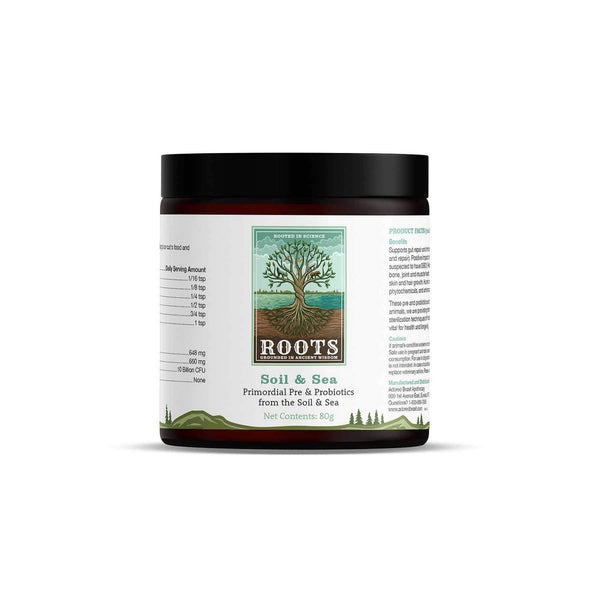
Soil & Sea | Primordial Pre & Probiotics
This is the probiotic that matches the reasoning above. Its four Bacillus species are spore-forming and soil-derived, so they stay intact through the small intestine and go to work in the large intestine. It uses chlorella rather than fructooligosaccharides, and the formula is free from maltodextrin, saccharomyces, and FOS, which is exactly what you want when you are avoiding fermentable substrate in an already overrun small intestine.
- Soil-based Bacillus subtilis, pumilus, coagulans, and licheniformis, 10 billion CFU per half teaspoon
- Chlorella plus ancient humic and fulvic acid, no FOS and no maltodextrin
- Zero synthetics, fillers, or additives, and suitable for dogs and cats
- Available in 40g and 80g
"My dog recently was diagnosed with EPI and SIBO. I started the Soil and Sea and within a couple days his stools became solid."
Andrea, verified review
How can you support a dog with SIBO beyond diet?
Diet and the right probiotics are the core, but a few supporting pieces are easy to miss and worth your attention:
- Organ support. The liver, pancreas, gallbladder, and kidneys all work overtime through a gut crisis and lean on each other. A supportive tincture like Liver Tonic acts as a multi-organ care rather than a liver-only product.
- The gut lining. Chronic overgrowth and inflammation can leave scarring and a leaky, irritated gut barrier behind, which is why the gut-lining focus of the Leaky Gut Protocol fits here.
- Antimicrobial herbs. Options like Pau D'Arco may help nudge the overgrowth back toward balance, and this is a conversation to have with a holistic or integrative vet.
- Stress and pain. This one surprises people. Low-lying, chronic stress and residual pain raise cortisol, and cortisol keeps the whole digestive system on edge. Keeping a simple journal of food, stressors, and household changes is one of the most underrated tools you have.
If the picture is already confirmed

SIBO Support Bundle for Dogs
Every supporting piece in the section above, assembled as one kit. This is the option for a dog with a confirmed picture, where you are covering the probiotic, the organ load, the gut lining, and the inflammation and discomfort side at the same time rather than adding them one at a time.
- Soil & Sea, EASE full-spectrum oil, Liver Tonic 60ml, Rebalancer 30ml, Gut Seal 30ml, Potent-Sea 60ml
- Choose your EASE strength and your Soil & Sea size
- Built around the same soil-based probiotic logic, so nothing in the kit works against the small intestine
Where this leaves you
My own French Bulldog, Milka, came to me as a puppy with relentless gut issues, itchy skin, and vomiting, and conventional care kept calling it "normal Frenchie problems." It was not normal. When we finally stopped chasing symptoms and looked at her gut as the root, everything changed, and she is a thriving senior now. That is the same shift SIBO asks of you: stop reacting to the label, and start understanding the system underneath it.
You are not powerless here, and you are not behind. You are your dog's best advocate, and now you know what to ask for. Test, don't guess. Go slow. Change one thing at a time so you can actually see what is working. And build the plan alongside a vet who will look at the whole picture with you.
If you want all of this in one place, I put together a free guide to pancreatitis, EPI, and SIBO that walks through the diagnostics to ask for and how to approach diet and support, step by step.
Which option fits your dog
Both routes follow the same reasoning. The difference is how much you are covering at once.
| Soil & Sea | SIBO Support Bundle | |
|---|---|---|
| Best for | Suspected SIBO, or swapping out a broad-spectrum probiotic that is not helping | A confirmed picture, or a dog who has been cycling for months |
| What it covers | The probiotic decision only | Probiotic, organ support, gut lining, inflammation and discomfort, omega-3 |
| Number of products | 1 | 6 |
| Options to choose | 40g or 80g | EASE strength, plus Soil & Sea size |
| Shop Soil & Sea | View the bundle |
Not sure which one your dog needs? Bark at us and our team will talk it through with you.
This article is educational and reflects a holistic perspective on canine gut health. It is not veterinary advice, and I am not a veterinarian. Every dog is different, so please work alongside your vet, ideally a holistic or integrative vet, for anything ongoing or serious.
Sources
- "Malabsorption and Bacterial Overgrowth in Dogs," VCA Animal Hospitals (veterinary reference). vcahospitals.com
- Jergens AE, "Antibiotic Responsive Enteropathy," Current Veterinary Therapy (via Veterian Key). veteriankey.com
- "Decoding chronic enteropathy in canine patients," dvm360, 2026. dvm360.com
- "Antibiotic-responsive diarrhea in dogs," dvm360. dvm360.com
- "Food therapy for dogs with SIBO and IBD," IVC Journal, 2026 (citing Gaschen and Merchant, 2011). ivcjournal.com
- Ruaux CG, Tetrick MA, Steiner JM, Williams DA, comparison of antibiotic therapy and an FOS-supplemented diet in suspected SIBO, Texas A&M Gastrointestinal Laboratory (via dvm360). dvm360.com
- D'Angelo S, et al, "Effect of Saccharomyces boulardii in dogs with chronic enteropathies," Veterinary Record, 2018 (double-blinded, placebo-controlled). pubmed.ncbi.nlm.nih.gov
- Chang C, et al, "Effect of oral or injectable supplementation with cobalamin in dogs with hypocobalaminemia," Journal of Veterinary Internal Medicine, 2022. onlinelibrary.wiley.com
- "Is Oral B12 Supplementation Effective for Dogs With Chronic Enteropathy?" Clinician's Brief, 2024. cliniciansbrief.com