Is peppermint oil safe for dogs?
It depends entirely on the concentration and the route. Undiluted peppermint essential oil applied to a dog's skin, licked off a coat, or swallowed is a real risk, and the warnings you have read about it are accurate. Peppermint oil at a low inclusion in a formulated, rinse-off shampoo is a different exposure, and the veterinary research that established the risk was built almost entirely on cases involving oil at full strength.
The short version: the danger in essential oils for dogs sits in the concentration and the route, not in the plant. Full-strength oil on skin is hazardous. A correctly diluted wash that goes on and comes straight off is not the same thing, and no credible source puts the two in the same category.
In this article
- What the toxicity warnings actually say
- Why the research is about full-strength oil
- The five exposure routes, ranked by risk
- What this means for peppermint dog shampoo
- Dogs that should skip peppermint entirely
- How to bathe an itchy dog safely
- If your dog swallows essential oil
- The label rule that works for any product
If you have searched this question, you have probably found two kinds of answers. One camp says peppermint is toxic, avoid it, full stop. The other camp sells essential oils and tells you to be a little careful when diffusing. Neither one explains why the same ingredient turns up in certified organic dog shampoos that holistic vets recommend.
That gap is where pet parents get stuck, so let me walk through what the evidence actually says.
What the toxicity warnings actually say
The warnings are real and they deserve respect. According to the MSD Veterinary Manual, essential oils are absorbed rapidly through the gut, the skin, the lungs and the mucous membranes, and systemic absorption should be assumed after any contact. The clinical picture can include vomiting, drooling, lethargy, wobbliness, tremors, low body temperature, seizures, rear-limb paralysis, skin irritation, and liver or kidney failure.
Two details in that same reference matter enormously and almost never make it into the articles that cite it.
The first is the principle that runs through the whole entry: the higher the concentration of the oil, the greater the risk. Concentrated oils should never be applied directly to a pet. The guidance for pet parents ends with the instruction to use diluted rather than concentrated oils. That is not a loophole someone invented to sell shampoo. It is the recommendation from the reference veterinarians use.
The second is species. Cats are markedly more vulnerable because they lack an enzyme, glucuronyl transferase, that handles phenolic compounds, and their grooming habit means anything on the coat ends up swallowed. Dogs do not share that enzyme deficiency. Dogs are still at risk, and nobody should read this as dogs being fine, but a great deal of the alarming case material in this field is feline.
It is also worth knowing which oils carry which specific risk. The MSD Veterinary Manual names birch tar, cassia bark, cinnamon, pennyroyal and tea tree as potentially damaging to the liver, and birch, cedar, eucalyptus, hyssop, pennyroyal, sage, wintergreen and wormwood as oils that can cause seizures. Peppermint appears on neither of those two lists. It is on the general caution list, and it should be, but the liver and seizure risks most often attributed to it in blog posts belong to other oils.
Why the research is about full-strength oil
Here is the part most pet parents are never told clearly. The single largest study in this field, published in the Journal of the American Veterinary Medical Association in 2014, reviewed 443 cases of tea tree oil poisoning in dogs and cats drawn from the ASPCA Animal Poison Control Center records over ten years. It covered 337 dogs and 106 cats. Signs appeared within two to twelve hours and could last up to three days, most commonly drooling, central nervous system depression, weakness, loss of coordination and tremors.
Every animal in that study had contact with 100 percent tea tree oil. Half of the cases were on the skin, a third were on the skin and by mouth, and the rest by mouth alone.
That study is the backbone of nearly every "essential oils are toxic to dogs" article on the internet, including the ones that go on to tell you a diluted shampoo is dangerous. The study does not say that, because it never looked at diluted products. What it establishes, powerfully, is that full-strength oil poured onto a dog causes serious harm within hours. That is a genuinely important thing to know, and it is not the same finding as the one it gets used to support.
There is honest evidence on the other side too, and I would rather you heard it from me. A 2012 study in the Journal of Veterinary Emergency and Critical Care looked at commercially formulated flea products containing essential oil blends, the kind that are diluted and sold on shelves. Of 44 animals, 92 percent showed one or more adverse effects, and the products had been used according to their label instructions in 77 percent of cases. Three animals died or were euthanised.
Two things about that study need saying. It was heavily weighted toward cats, 36 of the 44 animals, in the species that lacks the enzyme. And every product in it was a leave-on product, designed to stay on the coat and keep working. Neither of those describes a rinse-off wash. But it does prove the point that "diluted" is not a magic word, and that formulation and species have to be part of the decision.
The five exposure routes, ranked by risk
This is the table I wish had existed when I first started reading about this. Same plant, five completely different levels of risk.
| Exposure route | What the evidence shows | What to do |
|---|---|---|
| Undiluted oil on skin or coat | Highest documented risk. Every case in the 443-case study involved full-strength oil, with signs inside 2 to 12 hours. | Never. There is no dog and no situation where this is the right call. |
| Swallowed, licked or in food | Rapid absorption from the gut. Vomiting, drooling, wobbliness, and organ involvement at higher doses. | Never give orally. Store bottles where a dog cannot reach them. |
| Active diffuser, closed room | Nebulising diffusers throw microdroplets that settle on the coat, so it becomes a skin and oral exposure as well as a respiratory one. | Keep pets out of the room, ventilate afterwards, run it under 30 minutes. |
| Diluted leave-on product | Adverse effects documented even at label dose, mostly in cats. Designed to stay on the coat, so exposure continues for days. | Approach with real caution. Avoid in cats and in multi-pet homes with cats. |
| Formulated rinse-off wash | No published toxicosis series identifies this route. Low inclusion, short contact, rinsed away. Not studied directly, so this is reasoning from the dose principle rather than a trial. | Reasonable for most adult dogs. Check the exclusions below first. |
What this means for peppermint dog shampoo
A shampoo sits at the gentlest end of that table for three reasons. The oil is present at a small fraction of the bottle rather than as the bottle. It stays on the skin for minutes, not days. And it leaves with the water.
That is the whole argument, and I want to be straight with you about its limits. There is no published trial measuring absorption from a rinse-off dog shampoo, so this is an inference from the concentration principle that veterinary toxicology already accepts, not a study result. I would rather tell you that than pretend the evidence is stronger than it is.
What I can tell you is what to look for. A formula worth using names every ingredient, carries a certification that means something, and uses oils as a component of a wash rather than as the active event. The one we stock is certified organic to human food standards, which is a higher bar than the pet grooming category usually clears, and its ingredient list runs to seven items with nothing synthetic hiding in it.
On my own dogs, a cooling rinse is what I reach for when skin is hot, angry and being scratched raw, and it settles things down enough for everyone to sleep. That is my experience rather than a clinical finding, and I want it labelled as such.
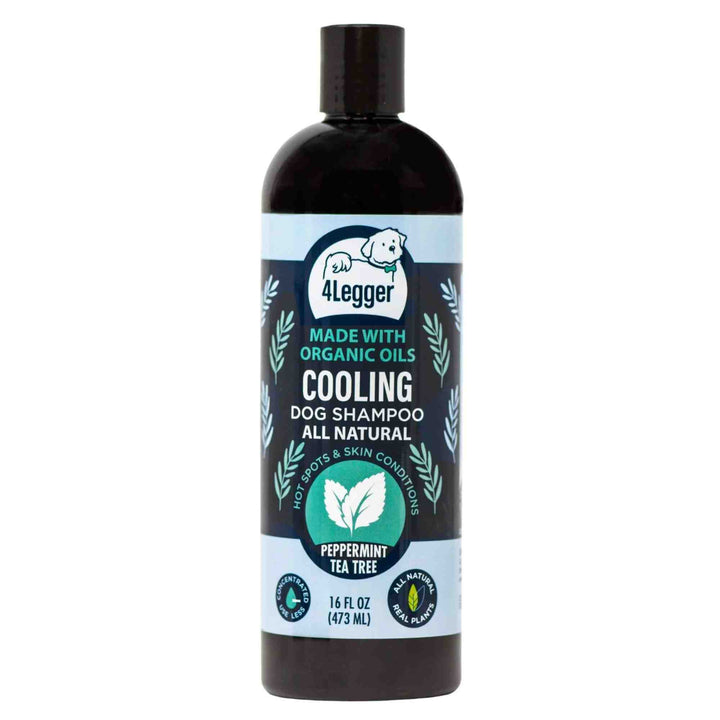
The one I use on hot, angry skin
Cooling Organic Peppermint Dog Shampoo
Most shampoos marketed for itchy skin get there with synthetic detergents and fragrance, which is a poor trade when the skin barrier is already inflamed. This one is certified organic to human food standards, so the ingredient list is short enough to read out loud and every oil in it is present as part of a rinse-off wash.
- Seven ingredients: organic aloe juice, saponified coconut, olive and jojoba oils, vegetable glycerin, and organic peppermint, tea tree, eucalyptus and rosemary
- No sulfates, synthetic detergents, added fragrance or synthetic preservatives
- Certified organic to human food standards, not the pet grooming standard
- Formulated to be rinsed out, which is the exposure route with no toxicosis series against it
Dogs that should skip peppermint entirely
A dose argument only holds if you know who the exceptions are. Choose a peppermint-free wash if any of these apply.
- Cats, and dogs who live with cats. The enzyme deficiency is the reason. If your cat grooms your dog, or shares bedding with a freshly bathed dog, that is a real exposure route.
- Puppies and very small dogs. Body weight is a documented risk factor for severity, and there is no reason to test a margin on a four-kilo dog.
- Dogs with a seizure history. Eucalyptus is named as a seizure-associated oil, and this formula contains it.
- Dogs with respiratory disease. Chronic bronchitis, collapsing trachea and airborne allergies all make inhaled aromatics a worse idea, and a bath is a warm, steamy, enclosed event.
- Dogs with known liver compromise. The liver clears these compounds, so a liver already under load has less room.
- Pregnant or nursing dogs. The data does not exist, which is reason enough to wait.
For those dogs, a gentle organic wash without peppermint, tea tree or eucalyptus is the better choice, and you can find the options in our grooming range.
How to bathe an itchy dog safely
The concentration argument only works if you follow the method that keeps the concentration low. Most of the mistakes I see come from pet parents doing more, not less.
- Soak the coat properly first. Soak the coat for 10-15 minutes. A genuinely wet coat spreads a small amount of shampoo further, which keeps the working concentration down. A damp coat makes people reach for more product.
- Use less than feels right. These formulas are thin and low-foaming by design. More water gives you more lather, more shampoo does not.
- Keep it off the face. Eyes, nose and mouth are the highest-permeability, highest-sensitivity tissue on a dog. Use a damp cloth with plain water for the head.
- Rinse until the water runs clear, then rinse again. Residue is what turns a rinse-off product into a leave-on one, and a dog will lick whatever is left.
- Bathe in a ventilated room. A sealed bathroom with hot water concentrates the aromatics in air your dog is breathing.
- Watch for the first hour. Drooling, wobbliness, unusual lethargy or vomiting after any topical product means rinse thoroughly with plain water and call your vet.
One more thing worth saying plainly. A cooling wash makes inflamed skin more comfortable. It does not answer why the skin is inflamed. If your dog is itchy every week and the bath is the only thing keeping a lid on it, the cause is somewhere else, usually the gut, the diet, or a yeast overgrowth that keeps feeding itself.
If your dog swallows essential oil
If your dog has licked or swallowed concentrated essential oil, or has had it applied to the skin at full strength, act now and read later.
- Do not make your dog vomit. This is the single most important line in this article. Oils carry an aspiration risk, and bringing them back up can put oil into the lungs, which is a separate and severe injury. The MSD Veterinary Manual is explicit that vomiting should not be induced.
- Call the ASPCA Animal Poison Control Center on (888) 426-4435, or your own veterinarian, or an emergency clinic. A fee may apply to the poison line.
- If it is on the skin or coat, wash it off with a mild soap and plenty of water while you are waiting for advice.
- Take the bottle with you. The oil, the concentration and the amount are the three things the clinic will ask for first.
The label rule that works for any product
If you take one thing from this article, take this. When you see an essential oil on a pet product label, you have not learned anything yet. You need three more answers before you know whether it matters.
- At what concentration? Near the top of the ingredient list is a very different product from near the bottom. Undiluted is a different product again.
- Does it stay on or come off? A rinse-off wash and a leave-on spot-on are not comparable, whatever the ingredient list says.
- Which animals are in the house? A formula that is reasonable for an adult dog can be genuinely unsafe for the cat who grooms him.
Apply those three questions and you will make better decisions than either camp on the internet, because you will be reading the product instead of reacting to the ingredient. That is the whole skill. You were not given the full picture, and now you have it.
If you are working through a stubborn skin problem and want a second pair of eyes, our Pet Wellness Success Team will talk it through with you. And if your dog's skin has been flaring for months rather than days, start with our allergy and yeast support range rather than another bottle of shampoo.
Much love, Larry
Sources
- Benson K. Toxicoses From Essential Oils in Animals. MSD Veterinary Manual, professional version, full review March 2025. Peer reviewed by Brutlag A, DVM, DABT, DABVT, University of Minnesota College of Veterinary Medicine.
- Khan SA, McLean MK, Slater MR. Concentrated tea tree oil toxicosis in dogs and cats: 443 cases (2002 to 2012). Journal of the American Veterinary Medical Association, 2014; 244(1): 95-99.
- Genovese AG, McLean MK, Khan SA. Adverse reactions from essential oil-containing natural flea products exempted from Environmental Protection Agency regulations in dogs and cats. Journal of Veterinary Emergency and Critical Care, 2012; 22(4): 470-475.
- Mitchell SC, DVM, DABVP. Are Essential Oils Safe for Dogs? PetMD, reviewed 2026.
- ASPCA Animal Poison Control Center, the case database underlying the 2012 and 2014 studies above. Emergency line (888) 426-4435.