Short answer: Rabbit is one of the most reliably hypoallergenic proteins available for dogs with food sensitivities, because most dogs have never eaten it before, so there is no history of reactivity to trigger. It is also leaner than beef, higher in protein than chicken, rich in Vitamin B12, and highly digestible. But a protein switch addresses the trigger, not the cause. For many dogs, a compromised gut lining is what is driving the sensitivity in the first place.
True food allergies affect an estimated 1 to 2% of dogs. What most pet parents are actually dealing with is a food sensitivity, and that is a far more addressable problem.
In this article
- Key takeaways
- Does my dog have a food allergy or a food sensitivity?
- Why are the most common dog food proteins the most common problem?
- Why is rabbit one of the most hypoallergenic proteins available?
- What is actually causing my dog's food sensitivities?
- How do I add rabbit to my dog's diet?
- The bigger picture
- What to explore at PAWDEGA
- Food allergy vs food sensitivity, side by side
- Sources
If your dog has been itchy, inflamed, or just not quite right for months and you've already tried switching foods, tried supplements, tried everything your vet suggested, I want to talk to you about something most pet parents never consider.
Rabbit.
Not as a novelty. Not as a trendy pet food ingredient. But as a genuinely strategic, hypoallergenic protein for dogs whose bodies have been quietly struggling with what they're eating.
When my dog, Milka, was at her worst; hot spots, digestive issues, itchy skin that wouldn't quit, I started learning about the connection between chronic sensitivities and the proteins dogs eat every single day. It changed how I thought about food entirely. And honestly? It's one of the things I wish someone had told me sooner.
If your dog is stuck in a cycle that nothing seems to break, this is worth reading.
Key Takeaways
- True food allergies are actually rare in dogs. What most pet parents are dealing with is a food sensitivity or intolerance which is a very different, and often more addressable, problem
- Food sensitivities don't involve a full immune response the way allergies do. They develop gradually and often show up as chronic itching, recurring ear infections, digestive upset, or poor coat condition
- The proteins in almost every mainstream dog food (chicken and beef) are the same ones most commonly linked to adverse food reactions, largely because dogs eat them every single day
- Rabbit is one of the most rarely used proteins in commercial dog food, making it one of the most reliably hypoallergenic options available
- Rabbit is not just gentle, it's nutritionally superior: leaner than beef, higher in protein per gram than chicken, rich in Vitamin B12, and highly digestible
- In Traditional Chinese Medicine, rabbit is classified as a "cooling" protein, which may help support dogs that run "hot", a trait commonly seen in dogs with chronic inflammation
- A protein switch alone addresses the symptom, not the root cause. For many dogs, leaky gut is what's driving food sensitivities in the first place and healing the gut is what allows them to eventually tolerate a wider range of foods again
First: Most Dogs Don't Have a "Food Allergy"
This is probably the most important thing in this whole post.
When pet parents say their dog has a "food allergy," what they usually mean is: my dog reacts to something they're eating. But that reaction doesn't always mean an allergy and the distinction matters.
A true food allergy involves the immune system mounting a specific IgE-mediated response to a food protein. It's relatively uncommon. Research estimates suggest true food allergies affect somewhere around 1 to 2% of all dogs.
What's far more common is food sensitivity or food intolerance.
Food sensitivities and intolerances don't involve the same kind of immune response. They develop gradually, often over months or years of repeated exposure to the same ingredients. The symptoms can look almost identical: itching, digestive upset, skin issues, recurring ear infections but the underlying mechanism is different.
Here's why this distinction matters so much: if it's a sensitivity rather than a true allergy, the gut often plays a major role in why it's happening at all. And that means there's a lot more you can do about it at the root cause level, not just by swapping proteins forever, but by actually healing what's driving the reaction in the first place.
More on that in a moment.
Why the Most Common Dog Food Proteins Are the Most Common Problem
Here's what most pet parents are never told:
The proteins most likely to cause adverse reactions in dogs are the exact same proteins found in almost every commercial dog food.
A peer-reviewed study published in BMC Veterinary Research analyzed data from hundreds of dogs with confirmed adverse food reactions. [1] The most commonly implicated proteins were beef, dairy, and chicken. Together they accounted for the majority of confirmed cases.
This isn't a coincidence. It's a pattern of overexposure.
When a dog eats the same protein every day for months or years, the gut, particularly if it's already compromised may start reacting to it. Partially digested food particles that pass through a permeable gut lining get flagged by the immune system as foreign invaders. Over time, what started as a tolerant relationship becomes a reactive one.
So when your dog is still scratching after you switched to the "sensitive skin" formula... and still dealing with ear infections even though you moved to "grain-free"... it's often because those formulas still contain the same proteins. The label changes, but the trigger stays the same.
This is where rabbit becomes genuinely useful, not just as a trendy ingredient, but as a strategic reset.
Why Rabbit Is One of the Most Hypoallergenic Proteins Available
Rabbit is considered a hypoallergenic protein choice for dogs for one very practical reason: most dogs have never eaten it before.
Food sensitivities develop through repeated exposure. A protein your dog has never been meaningfully exposed to is one their system has no history of reacting to. There's nothing to trigger. No pre-loaded reaction waiting to fire.
Rabbit appears in less than 1% of commercial dog food formulas. For most dogs who've been rotating through chicken, beef, or even salmon for years, rabbit is genuinely uncharted territory which makes it one of the cleanest starting points for giving the body a break.
Veterinary dermatology guidelines list rabbit alongside venison and kangaroo as among the most reliably novel protein options for elimination diet trials specifically because of how rarely dogs encounter it in standard commercial food.
But rabbit isn't just hypoallergenic. It's nutritionally impressive on its own terms.
It's leaner than beef, pork, or lamb. Rabbit meat contains less than 10% fat and is lower in saturated fat than almost any other animal protein. For dogs prone to inflammation, or with any history of digestive sensitivity, this matters.
It's higher in protein than chicken. Gram for gram, rabbit delivers more usable protein than chicken, turkey, or beef, while still being easy on the digestive system.
It's rich in Vitamin B12. B12 supports healthy nerve function, red blood cell production, and cellular energy. Particularly relevant for dogs dealing with chronic low-grade inflammation.
It's highly digestible. Many holistic vets recommend rabbit specifically for dogs with sensitive guts alongside skin or immune concerns, because the body can break it down and absorb it efficiently without adding digestive stress.
It's a "cooling" protein. In Traditional Chinese Medicine, foods are classified by their energetic effect on the body. Rabbit is a cooling protein. Dogs with chronic allergies and skin inflammation are often described as running energetically "hot." Cooling proteins may help bring some of that inflammatory energy back toward balance, a framework many integrative and holistic vets draw from in practice.
The Root Cause Conversation: It's Not Just the Protein
Here's where the real work lives.
Switching to rabbit may reduce your dog's reactivity. But if your dog has been in a chronic sensitivity cycle, the question worth asking is: why is their body reacting to proteins in the first place?
For many dogs, the answer is leaky gut, increased intestinal permeability.
The gut lining is meant to act as a selective barrier: letting fully digested nutrients through into the bloodstream, while keeping out undigested food particles, bacteria, and toxins. That barrier is maintained by tight junctions, protein structures that seal the spaces between intestinal cells.

| Healthy gut | Leaky gut | |
|---|---|---|
| Tight junctions | Intact, sealing the spaces between intestinal cells | Weakened or damaged, leaving gaps in the barrier |
| What crosses into the bloodstream | Fully digested nutrients only | Partially digested food particles, bacteria, and toxins as well |
| Immune response | No reason to flag food as a threat | Leaked particles get flagged as foreign invaders |
| Protein tolerance over time | A wide range of proteins stays tolerated | Proteins that were once fine start triggering reactions |
| Direction of travel | Stable | Self-compounding: more inflammation weakens the junctions further |
When those tight junctions become weakened or damaged, partially digested food particles leak through into the bloodstream. The immune system encounters those particles and flags them as threats. Over time, even proteins that were once tolerated start triggering a reaction. The gut gets more inflamed. The tight junctions weaken further. The cycle compounds on itself.
This is why some dogs seem to react to everything, even proteins they've never had before. It's not that they're allergic to all food. It's that their gut lining is compromised enough that almost any protein becomes a reactive trigger.
A protein switch like rabbit gives the body a break. But actually rebuilding the gut lining, resealing those tight junctions, restoring a healthy microbiome, reducing the systemic inflammation that's been running in the background; this is what can allow a dog to eventually tolerate a wider range of proteins again.
That's the difference between managing a sensitivity and actually addressing what's driving it.
For dogs in this situation, the Leaky Gut Protocol from Adored Beast Apothecary is one of the most targeted approaches we carry at PAWDEGA. It's a multi-step protocol that combines herbs, probiotics, and liver support specifically designed to support intestinal repair and help restore gut barrier function, working on the underlying permeability issue rather than just swapping out what's in the bowl.
And for dogs whose sensitivities are showing up alongside yeast overgrowth; itchy skin, recurring ear infections, a musty smell, paw licking that never really goes away, the Yeasty Beast Protocol is worth a closer look. Yeast overgrowth and gut permeability often go hand in hand. Addressing both together tends to produce better results than chasing either issue independently.
If your dog reacts to almost everything, start here instead

Adored Beast Leaky Gut Protocol
A new protein helps the dog who reacts to one or two things. It does much less for the dog who reacts to almost everything, because that dog's problem is the barrier, not the bowl. This is a five-product system built to support intestinal repair and gut barrier function at the root cause.
- Five products: Rebalancer, Liver Tonic, Healthy Gut, Gut Soothe, and Gut Seal
- Two days of Rebalancer first, then the remaining four together until finished
- Gut Soothe brings slippery elm bark, L-glutamine, marshmallow root, and a 30 billion CFU probiotic blend
- Free from maltodextrin, cellulose, animal fat, flour, and other non-functional fillers
- Dosed by weight, so choose the size band that matches your dog. For dogs only
If your dog is showing yeast symptoms as well, the usual order is to address the yeast first with the Yeasty Beast Protocol, then follow with this one.
How to Use Rabbit for Your Dog
You don't have to overhaul your dog's entire routine overnight to start benefiting from rabbit as a protein.
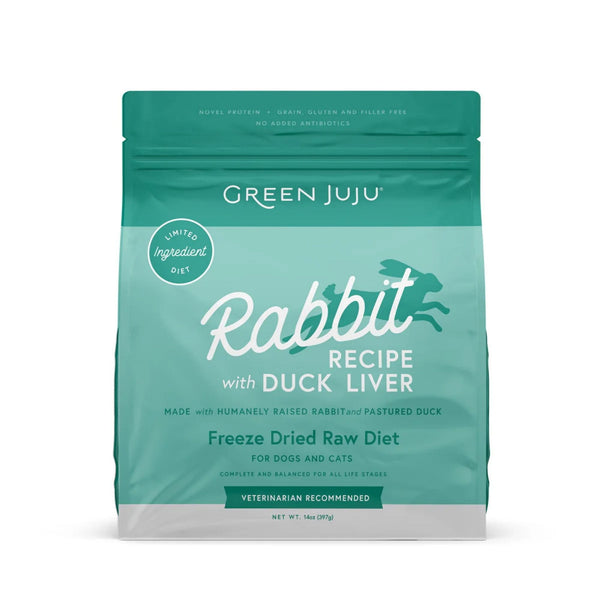
As a full meal base: If you're working through a suspected food sensitivity and want to reduce protein reactivity, rabbit-based freeze-dried raw is one of the cleanest ways to do it. A single-dominant protein with minimal additional ingredients gives you a more controlled picture of how your dog responds. The Green Juju Rabbit Recipe with Duck Liver Freeze-Dried Raw is what we carry at PAWDEGA. Freeze-dried raw preserves the nutrition without requiring you to handle raw meat, and rabbit is the featured protein.
As a meal topper or treat: If you're not ready to switch fully, adding rabbit as a topper or reward treat is a simple way to diversify your dog's protein exposure. Green Juju Rabbit Trainers, Whole Food Bites are real, whole-food ingredients with rabbit as the featured protein.
As a gut-supportive broth: For dogs with sensitive stomachs, bone broth is a gentle entry point. The Crude Carnivore Rabbit Bone Broth is slow-simmered and clean, adding hydration and gut-supportive collagen alongside a gentle dose of rabbit as the base protein.
| Format | Best for |
|---|---|
| Rabbit Recipe with Duck Liver, Freeze-Dried Raw | A full protein reset, or running a controlled elimination trial. Complete and balanced, so it can be the whole diet |
| Rabbit Trainers, Whole Food Bites | Diversifying protein exposure without changing the main meal yet. Whole rabbit including bone, for supplemental feeding |
| Rabbit Bone Broth, 16oz | The most sensitive stomachs, and adding moisture. Pasture-raised rabbit bones simmered a minimum of 36 hours |
A note on timelines: if you're switching proteins to observe a response, skin symptoms can take 8 to 12 weeks to fully shift. Digestive symptoms often improve sooner. Keep a simple log of what changed and when, it makes it much easier to connect what you're seeing to what you changed.
The Bigger Picture
Chronic food sensitivities are rarely just a food problem.
By the time a dog is in a cycle of itching, recurring ear infections, hot spots, and digestive upset, there's usually something deeper happening in the gut. The protein is often the trigger. But the gut's ability to handle proteins, the integrity of the gut lining, the health of the microbiome, this is just as important as what's in the bowl.
Rabbit addresses the surface trigger. Gut support addresses why that trigger exists at all.
Used together, these two strategies tend to produce better, more lasting results than either one alone.
If you want to go deeper on the root-cause connection between food sensitivities, gut health, and what's really driving your dog's symptoms, I'd really encourage you to explore our Allergies Playlist on YouTube. We've spent years interviewing holistic vets and nutrition experts on exactly this, and the conversations in there are some of the most practical, science-backed content we've put out.
🎥 A good place to start is this episode: https://youtu.be/-ehJ-6VbnvY
Your dog's body wants to get better. Sometimes it just needs a different starting point and the right support underneath it.
What to Explore at PAWDEGA
Green Juju Rabbit Recipe with Duck Liver, Freeze-Dried Raw A clean, single-dominant rabbit protein freeze-dried raw option for dogs whose sensitivity picture points toward a protein reset.
Green Juju Rabbit Trainers, Whole Food Bites Whole rabbit including bone, freeze-dried, for diversifying protein exposure as a treat or topper.
Crude Carnivore Rabbit Bone Broth, 16oz A gentle, gut-supportive way to introduce rabbit protein, particularly useful for dogs with sensitive digestive systems.
Adored Beast Leaky Gut Protocol A five-product protocol to support intestinal repair, gut barrier function, and the root-cause permeability that often drives food sensitivities. For dogs that react to many things, this is often where to start.
Adored Beast Yeasty Beast Protocol. For dogs whose sensitivities are showing up alongside yeast symptoms: chronic ear infections, itchy skin, paw licking, musty smell. Addresses both yeast overgrowth and gut imbalance together.
Food Allergy vs Food Sensitivity: How to Tell Which One You're Dealing With
This is the either/or that changes what you do next. Same symptoms, different mechanism, different plan.
| True food allergy | Food sensitivity or intolerance | |
|---|---|---|
| How common | Relatively uncommon, estimated around 1 to 2% of dogs | Far more common, and what most pet parents are actually seeing |
| Mechanism | A specific IgE-mediated immune response to a food protein | No full immune response of that kind. The gut usually plays a major role |
| How it develops | The immune system is already primed to that protein | Gradually, over months or years of repeated exposure to the same ingredients |
| What you see | Itching, digestive upset, skin issues, recurring ear infections | Almost identical: itching, digestive upset, skin issues, recurring ear infections |
| What tends to help | Strict, ongoing avoidance of the offending protein | A novel protein such as rabbit to reduce the trigger, alongside gut support to address why the reaction is happening |
| Room to improve | Limited. Avoidance is the main lever | More. Many dogs can eventually tolerate a wider range of proteins again |
Only your vet can confirm which one your dog has. But if the pattern in the right-hand column looks like your dog, there is more you can do than swap proteins forever.
Sources
- Mueller RS, Olivry T, Prélaud P. "Critically appraised topic on adverse food reactions of companion animals (2): common food allergen sources in dogs and cats." BMC Veterinary Research, 2016, volume 12, article 9. Reviewing the best available evidence, the authors identified beef, dairy products, chicken, and wheat as the food allergens most likely to contribute to cutaneous adverse food reactions in dogs. Read the paper