The supplements with real evidence behind them for an aging dog's brain work on four different jobs: omega-3 builds the structure of brain cells, MCT gives them an alternative fuel, medicinal mushrooms work on inflammation and signaling, and hemp extract works on the stress and discomfort that keep a senior dog awake. They are not four competing answers to one question. They are four layers, and a 2025 systematic review of 30 studies in dogs and cats ranks omega-3 at the top of the supplement list.
Here is the sentence I would want someone to tell me first: adding all four at once is the fastest way to learn nothing at all, so the order you build this in matters more than the shopping list.
What you will find here
Most articles about brain supplements for dogs read like a list of contestants, as though you are meant to pick a winner. That framing has always bothered me, because it is not how any of this works.
A brain ages on several fronts at once. Cell membranes change. Energy metabolism shifts. Low-grade inflammation builds. Sleep fragments. Discomfort accumulates. Asking which single supplement fixes that is like asking which single nutrient makes a diet good.
So here is the more useful question, and the one this article answers: which supplement does which job, how strong is the evidence for each, and in what order should you add them.
The four layers, side by side
Scroll sideways to see the full table.
| Layer | The job it does | Evidence in dogs | Where we would start |
|---|---|---|---|
|
Omega-3 Structural |
DHA is a building block of neuronal membranes | Strongest of the four. Named the leading supplement in a 2025 systematic review of 30 canine and feline trials | Potent-Sea algae oil |
|
MCT Fuel |
Ketones give aging neurons an alternative energy source | Strong, but for enriched diets rather than added oil. One 87-dog placebo-controlled trial | TriPlex MCT-3 oil |
|
Mushrooms Regulation |
Inflammation, neurotrophic signalling, calm | Early. One 30-dog manufacturer study with no placebo group | CLARITY |
|
Hemp Comfort |
Stress, restlessness, and the pain that disturbs sleep | Good for stress, none for cognition. Randomised, placebo-controlled, blinded canine work | CALM full-spectrum oil |
Notice that the evidence column does not rank the way the marketing does. That is the whole point of putting it in a table.
Layer one: omega-3, the structural layer
If you add one thing to an aging dog's bowl, add this one.
DHA is the dominant omega-3 in the brain and an integral part of neuronal membrane structure. It is not a passenger, it is construction material, and an aging brain that is short on it is short on something it cannot make well for itself.
A 2025 systematic review in GeroScience pooled 30 studies published between 2002 and 2023, 27 of them in dogs, looking at enriched diets and nutraceuticals for cognition in aging pets. Its conclusion on supplements was clear: omega-3 fatty acids showed cognitive benefits in aging pets, especially at higher doses, while plant antioxidants and vitamins E and C on their own were less effective. In one trial, DHA alone at roughly 26 mg per kilogram improved learning. In another, a combination delivering 67.5 mg per kilogram of DHA and 27 mg per kilogram of EPA improved learning and executive function, and memory decline was not seen in the supplemented group.
Two practical notes that matter more than the headline. The dose range across those trials ran from 7 to 94.5 mg per kilogram, and the benefits clustered at the higher end, so an omega-3 product that delivers a token amount is not doing this job. And source matters: dogs convert plant-based ALA from flaxseed into DHA and EPA poorly, so ALA is not a substitute. We have written about that in detail in our guide to the best omega 3 for dogs and why the source matters more than the supplement.
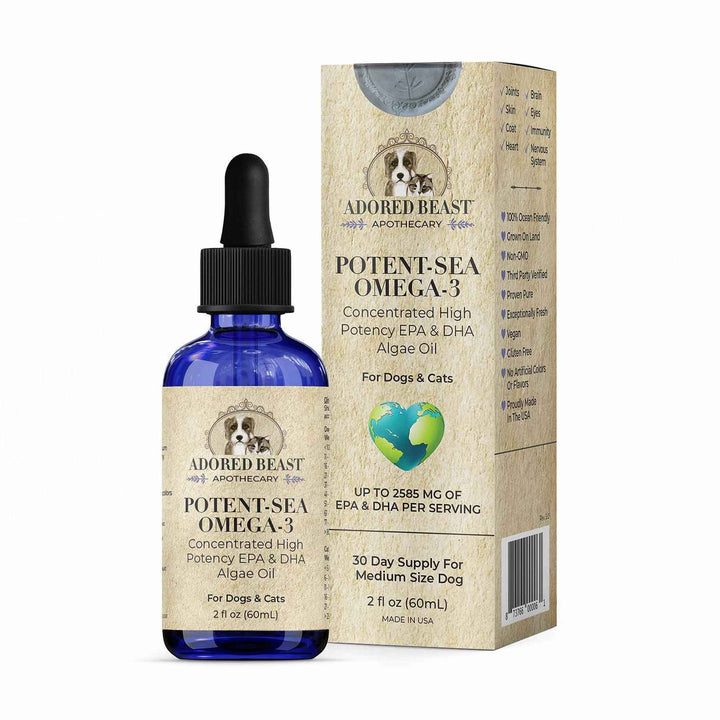
The layer to build first
Potent-Sea Omega-3 Oil by Adored Beast
This is the one I would start with, and it is the one with the best evidence of the four. It delivers EPA and DHA from marine algae, which is where fish get theirs in the first place, so you skip the food chain and the contamination that comes with it.
- EPA and DHA from the original marine source rather than from large fish
- Grown on land using triple-filtered ocean water, so heavy metals and radiation are not a concern
- Free from solvents and pesticides, with zero synthetics, fillers or additives
- Concentrated enough that a few drops covers a daily serving
- Suits dogs and cats, and refrigerate once opened
One thing to flag: it is preserved with rosemary extract, which can be contraindicated in epilepsy. If your dog has seizures, check with your vet before starting.
See the full label and dosing guideLayer two: MCT, the fuel layer
The aging brain loses some of its ability to use glucose efficiently. Medium-chain triglycerides are converted by the liver into ketones, which cross the blood-brain barrier and give neurons a second fuel to run on.
This has been tested properly. In a prospective, double-blind, placebo-controlled study, 87 client-owned dogs showing signs of cognitive dysfunction were randomized into three groups of 29 and fed for 90 days. Dogs on a diet containing 6.5% MCT oil with a brain protection blend improved significantly across all six categories of cognitive dysfunction signs. A separate trial found that a 5.5% MCT diet improved executive and visuospatial function.
And here is the honest limitation, because it changes what you should expect. Those trials tested complete diets formulated at 5.5% to 9% MCT, not a spoonful of oil poured on top. Adding MCT oil brings the same fuel into a diet you are otherwise happy with, and it is what many holistic vets suggest, but it is not the identical intervention. I would rather you know that than discover it later.
Start at a quarter of the label amount and build over a couple of weeks, because MCT loosens stools if you go in at full strength. A dog with a pancreatitis history needs veterinary clearance before any added fat. There is more on which fatty acid fractions the research actually used in our guide to MCT oil for dogs.
Layer three: mushrooms, the regulation layer
This is the layer I am most enthusiastic about personally and most careful about publicly, which is an uncomfortable combination to sit in but an honest one.
The mechanism story is good. Fungal beta-glucans are recognized by immune receptors and modulate rather than amplify; lion's mane is studied for its effect on nerve growth factors, reishi is the calming one, and cordyceps works on oxygen use and cellular energy.
The canine clinical evidence comes down to one study, and it is worth saying plainly that one is more than anybody else in this category has produced.
MycoDog's Senior Dog Study followed 30 senior dogs over 12 weeks on their Clarity formula. It was run by Veterinary Health Research Centers, an independent research group, with Joel Ehrenzweig, DVM, MRCVS, as study director, under veterinary supervision. It used the DISHAA cognitive framework alongside activity collars and bloodwork, so the outcomes are not resting on questionnaires alone. They reported 81% of dogs stabilizing or improving on cognitive scoring, an average 39% reduction in cognitive dysfunction scores, collar data showing calmer nights, and inflammation and neurotrophic biomarkers moving favorably.
Here is how I read it. It is a small study, it has no placebo arm, it was funded by the company that makes the formula, and it tested a five-ingredient blend rather than isolating any one part. None of that makes it worthless. It is how nutraceutical research almost always begins, and commissioning an outside research group to collect objective measures and then publishing the design openly is a great deal more than most of this market does. What it is not is proof of what any single mushroom does on its own, and the placebo question stays open until somebody funds that arm.
The brands worth being wary of are the ones making far bigger claims than that on no data at all.
Where I would place this layer: third, after the structure and the fuel are in, and first if what you are actually watching is night-time restlessness, because the calming side of this blend is the part that shows up soonest.
Layer four: hemp, the comfort layer
Hemp is the layer most often either oversold or dismissed, and both happen for the same reason: people test it against the wrong question.
Ask whether it slows cognitive decline and the answer is that nobody knows. Colorado State University is currently running a study on trazodone, rapamycin and cannabidiol in dogs with cognitive dysfunction, so that question is finally being examined properly. Until it reports, anyone marketing hemp as reversing dog dementia is well ahead of the evidence.
Ask instead whether it helps a stressed, restless dog settle, and the picture changes completely. In a randomized, placebo-controlled, blinded study at the Waltham Petcare Science Institute, a single dose of broad-spectrum CBD produced significant improvements across multiple measures of canine stress, physiological ones including cortisol, heart rate and ear temperature, alongside behavioral ones including whining, trembling and panting. On study design, that is stronger than the mushroom evidence above.
Which matters, because comfort is not a soft outcome in an aging dog. Clearance of beta-amyloid happens during sleep, and the research describes a loop where poor sleep worsens the underlying picture and the underlying picture worsens sleep. A dog who settles is a dog getting more of the thing that helps.
One caveat worth naming rather than hiding: that study used a single dose against short, sharp stressors, so applying it to chronic night-time restlessness is an extrapolation. It is a much shorter one than claiming an effect on cognition.
The practical note here is about medication, not about hemp. CBD is handled in dogs largely through cytochrome P450 enzymes, particularly CYP1A2, and it can change how those enzymes process other drugs. A mild rise in alkaline phosphatase is a common finding in canine studies, and researchers describe it as an uninformative read on its own, which is why a full liver panel is the sensible way to look at it. None of that makes hemp a risky choice. It makes it one your vet should know about.
If restlessness is the thing you have noticed
CALM Full-Spectrum Oil for Dogs
This serves a different need from the oil above. Where omega-3 is long, quiet, structural work, this one is aimed at stress, fear and nervous system tension, which is the target the canine research actually supports. It comes in more than one strength, so check the dosing guidance on the page against your dog's weight.
See CALM and its strengthsWhat does not work, and one thing that made it worse
A category is only worth trusting if someone in it will tell you what failed.
In the same 2025 systematic review, plant-derived antioxidants and vitamins E and C on their own were less effective for cognition, though they remain useful for stabilizing omega-3 fatty acids, which is a real job even if it is not the one they get marketed for.
More striking: alpha-lipoic acid tested alone at 2.7 and 11 mg per kilogram failed to show benefits, and at the lower dose it negatively affected learning after three years of supplementation. More is not automatically better, and neither is longer.
That finding is the best argument I know for building a stack deliberately rather than pouring in everything with a brain claim on the label.
How to build the stack without guessing
The layering idea is right. The execution is where most pet parents lose the thread.
- Write down what you are watching, as a number. Not "is he sharper," which is unanswerable. Something like how many times he is up between midnight and 6am, or how many stairs he manages before pausing.
- Add one layer. Omega-3 first unless something else is more urgent.
- Give it six to eight weeks. The MCT trial ran 90 days. The Senior Dog Study ran 12 weeks. Checking on day four tells you nothing except that day four was a bad day.
- Compare the number, not your memory. Three weeks of notes against the three weeks before you started. Memory is unreliable on a slow decline, and worry makes it worse.
- Then add the next layer. Same process. You will end up somewhere good and you will know how you got there.
- Take the list to your vet before you start, especially if your dog is on daily medication. Not for permission. For information you cannot get anywhere else.
Yes, this is slower than buying four bottles on a Sunday night. It is also the only version where you find out which layer was worth the money.
If you want the wider framework this fits inside, which supports go daily, which rotate, and which are not worth your money at all, that is what our free guide covers.
When to start
Earlier than feels necessary, which is the honest and slightly annoying answer.
The mushroom study found the strongest response in dogs with moderate signs rather than advanced ones. The human omega-3 literature points the same way, with benefits more likely in people with low baseline status or mild impairment than in advanced disease. Structural and metabolic support is doing its best work before there is much to repair.
So if your dog is eight or nine and nothing is wrong, that is not too early. That is the window.
And if you are further along than that, if the nights have already become hard, none of this is wasted either. We have written separately about what actually helps with dog dementia at night, including what to rule out first and what your vet can offer, because at that stage the supplements are one part of a much bigger plan.
If you want someone to look at the whole picture with you rather than one appointment at a time, we keep a list of the holistic vets we trust for online consultations.
Milka is eleven now. I am not doing anything dramatic for her, and I am not adding a new bottle every time I read something interesting. Four layers, added one at a time, most of them started before I had any reason to worry. That is the whole strategy, and it is available to anyone.
Much love, Larry
Please keep in mind that I'm not a veterinarian, and this isn't medical advice. Every pet is unique, so I always recommend working alongside your vet, ideally a holistic or integrative vet, especially for anything ongoing or serious.
Sources
- Enhancing cognitive functions in aged dogs and cats: a systematic review of enriched diets and nutraceuticals. GeroScience, 2025. link.springer.com
- Pan Y, et al. Efficacy of a therapeutic diet on dogs with signs of cognitive dysfunction syndrome: a prospective double blinded placebo controlled clinical study. Frontiers in Nutrition, 2018. ncbi.nlm.nih.gov/pmc/PMC6299068
- Weiser MJ, Butt CM, Mohajeri MH. Docosahexaenoic acid and cognition throughout the lifespan. Nutrients, 2016;8(2):99. doi.org/10.3390/NU8020099
- A single dose of cannabidiol positively influences measures of stress in dogs during separation and car travel. Frontiers in Veterinary Science, 2023 (Waltham Petcare Science Institute). frontiersin.org
- TRAC Study: investigating the effect of trazodone, rapamycin and cannabidiol on cognitive dysfunction in dogs. Colorado State University. source.colostate.edu
- Safety of a cannabidiol regimen in dogs: haematology, biochemistry and alkaline phosphatase findings. Frontiers in Veterinary Science, 2022. frontiersin.org
- A Q&A about CBD with Pet Poison Helpline. SafetyCall International. safetycall.com
- Sleep and cognition in aging dogs: a polysomnographic study. Frontiers in Veterinary Science, 2023. frontiersin.org
- Fungal beta-1,3-glucans: cell wall constituents that promote gut health through innate immune modulation. 2026. pmc.ncbi.nlm.nih.gov
- MycoDog Senior Dog Study (conducted by Veterinary Health Research Centers, study director Joel Ehrenzweig, DVM, MRCVS). mycodog.com and Pet Age coverage
- Mushroom nutraceuticals for cognitive dysfunction syndrome in pets. Parsemus Foundation, 2026. parsemus.org