You bought the device. You read the manual. And then you went looking for a real answer to a very simple question: how long do I actually point this at my dog, and how many times a week?
So you searched. One site said two minutes. The next said thirty. One said twice a day, another said twice a week. And now you are sitting on the floor next to your dog, holding a light, with less confidence than when you started.
You are not alone, so many pet parents go through this. And here is what most pet parents are never told: those numbers are not contradicting each other. They are answering different questions, with different devices, and nobody is showing you the one variable that decides all of it.
Let's fix that.
In this article
- The short answer
- Why every website gives you a different number
- How long each session should be
- How often per week, by goal
- Why more is not better
- How long before you see change, and when to taper
- What the research actually shows
- Where not to point it
- What this has looked like with Milka
- What light cannot do on its own
- Get the whole picture, free
- Frequently asked questions
- The bottom line
- Which support fits your dog
The short answer
For most dogs, most of the time:
- Session length: 2 to 10 minutes per body area, decided by how powerful your device is, not by how big your dog is.
- Frequency, first phase: 3 sessions per week for a chronic issue like arthritis. Daily or every other day for a fresh injury or a post-surgery site, for the first one to two weeks.
- Frequency, after that: taper down. Once or twice a week is a normal maintenance rhythm, and some dogs hold their gains on less.
- Give it 3 to 6 weeks of consistent use before you decide whether it is working.
That is the useful version. Now here is the part that actually lets you get it right for your device and your dog, because a two minute session on one panel and a two minute session on another are not the same thing at all.
Why every website gives you a different number
Red light therapy has a proper name in the research: photobiomodulation, often shortened to PBM. And in that research, nobody measures a session in minutes. They measure it in dose, written as joules per square centimetre (J/cm²).
Dose is not a time. Dose is time multiplied by power. The power figure is called irradiance, measured in milliwatts per square centimetre (mW/cm²), and it should be in your device's specifications.
dose (J/cm²) = irradiance (mW/cm²) × time (seconds) ÷ 1000
This is the whole reason the internet cannot agree with itself. A clinic-grade device and a small handheld unit can deliver the exact same dose, and one takes thirty seconds while the other takes ten minutes. The website telling you "twenty minutes" is not wrong. It is describing a weaker device than the website telling you "two minutes."
So the real question is never "how many minutes." It is "how many minutes on this device to reach the dose I am aiming for."
How long each session should be
Find your device's irradiance in the manual or on the product page, then read across. The table below shows the time needed to deliver two common target doses: around 6 J/cm², which sits in the range used for surface and soft tissue work, and around 12 J/cm², which sits inside the 10 to 20 J/cm² range used in canine joint studies.
| Your device's irradiance | Time to reach ~6 J/cm² | Time to reach ~12 J/cm² |
|---|---|---|
| 20 mW/cm² (low power handheld) | 5 minutes | 10 minutes |
| 50 mW/cm² (typical home pad or wand) | 2 minutes | 4 minutes |
| 100 mW/cm² (stronger home panel) | 1 minute | 2 minutes |
| 200 mW/cm² (high output panel) | 30 seconds | 1 minute |
Times are calculated from the dose formula above. They describe the dose arriving at the skin surface, per area, with the device held at the distance the manufacturer specifies.
Three adjustments that matter more than your dog's body weight:
- Coat density and colour. A thick double coat or dark pigment absorbs light at the surface, so less of it reaches the tissue underneath. Dense or dark coated dogs generally need longer at the same setting. Parting the coat with your fingers so the light reaches skin makes a real difference.
- Distance. Light intensity drops sharply as the device moves away from the body. The irradiance printed on the box assumes a specific distance. Double that distance and you are delivering far less than you think.
- Number of areas. Session time is per area. Two hips and a lower back is three areas. Your total time on the floor goes up, but the dose to each spot stays the same.
Body weight barely enters into it. A larger dog usually has larger areas to cover, which means more areas, not longer per area.
Pads and mats run on a different clock to handhelds
This trips up a lot of pet parents, and it explains another chunk of the conflicting advice online.
A pad or mat covers a broad area at once. You lay it over your dog, set it going, and the whole region gets covered in a single session. On the Next Level Pet Parent Podcast, Donna Woods of Photonic Health described this as roughly a ten minute session, and noted that five minutes is often enough on its own, with the extra time being partly because dogs settle into it and enjoy it.
A handheld works point by point. You hold it on one spot for something like ten to thirty seconds, then move to the next. Your total session can still land around ten minutes, but it is built from many short holds rather than one long exposure, and it needs you present for all of it. Neither approach is better. They are different tools, and a manual written for one will give you numbers that make no sense for the other.
| Pad or mat | Handheld | |
|---|---|---|
| How you use it | Lay it over the dog, one broad session | Hold on one point, then move to the next |
| Typical timing | Around 10 minutes total, often 5 is enough | 10 to 30 seconds per point, roughly 10 minutes total |
| Your involvement | Hands free once it is on | You hold it for the whole session |
| Best suited to | Broad areas, spine and hips, dogs who settle | Paws, small joints, one known sore spot |
| When you cannot pinpoint the pain | Better, it covers a wide area at once | Harder, you need to know where to aim |

Watch: pads and handhelds side by side
We show both formats on camera so you can see the difference before you choose.
How often per week, by goal
Frequency in the veterinary studies follows a clear shape: a heavier loading phase first, then a taper. Not the same dose forever.
| Situation | Loading phase | After that |
|---|---|---|
| Chronic arthritis, hip or elbow stiffness | 3 sessions per week for 3 to 6 weeks | 1 to 2 per week, or monthly top ups |
| Fresh soft tissue strain or sprain | Daily or every other day, 1 to 2 weeks | Stop, or drop to twice weekly |
| Post surgery site, once your vet clears it | Short daily sessions in the early days | Stop once the site has closed and settled |
| Surface skin irritation or a hot spot | Shorter sessions, more often, lower dose | Stop once the skin has calmed |
| General senior comfort and mobility | 2 to 3 per week for the first month | 1 to 2 per week ongoing |
Frequency patterns above reflect the schedules used in published canine studies. The randomised trial by Looney and colleagues in the Canadian Veterinary Journal (2018) ran regularly scheduled sessions to both elbows across six weeks. Alves and colleagues, writing in Animals (2023), used an explicitly tapering course: three sessions in week one, two in week two, one in week three, then a single session monthly at follow up.
You see the same shape outside the studies. Donna Woods of Photonic Health, who has worked with light therapy in animals since the mid 2000s, walked us through the schedule she used on her own senior terrier after a back injury: two to three sessions a day for the first five to seven days, down to once a day for the following week, then every other day for two weeks after that, and eventually once a week as ongoing maintenance once the dog was back to herself.
That is more frequent at the front end than the arthritis schedules above, because an acute back injury is a different situation to slow joint wear. But the direction of travel is identical: heavy early, then steadily less.
The pattern worth stealing: front load, then back off. Most pet parents do the opposite. They start gently, get impatient, and then escalate. Both the research and the practitioners go the other way round.
Why more is not better
This is the single most important thing on this page, and it is the thing the manuals leave out.
Photobiomodulation follows what researchers call a biphasic dose response. Huang and colleagues laid this out in Dose-Response in 2009: the natural assumption that a bigger dose of red or near infrared light must produce a bigger benefit is frequently not the case. Too little light does nothing. The right amount stimulates the cell. Past that point the effect flattens, and can turn inhibitory.
Which means a genuinely counterintuitive thing is true: if your dog is not responding, holding the light on him for twice as long is one of the least likely things to help, and one of the more likely things to work against you.
The same logic applies to buying decisions, and it is worth saying out loud because the marketing runs hard in the opposite direction. Donna Woods told us about a horse with months of persistent swelling whose person had bought a very high output device online and seen nothing from it. Swapping to a lower powered handheld overnight brought the swelling down noticeably. Her read was that the stronger unit was overshooting. More output is a specification, not a benefit.
Consistency is what compounds here, not intensity. Short regular sessions beat occasional long ones. If something is not working, the honest next step is to check your distance, your coat contact, and your device's actual output. Not to add minutes.
How long before you see change, and when to taper
Give it three to six weeks before you make a judgement. That is the window the canine trials used, and it is long enough for a real effect to show without being so long that you waste months on something that is not helping your dog.
And please, write things down. Not feelings. Observable things:
- How he rises from lying down, first thing in the morning
- Whether he takes the stairs or waits at the bottom
- How far into the walk before he slows
- Whether he settles at night or shifts position all evening
- Whether he offers to play
Three lines in your phone notes, twice a week. That is it. Memory is unreliable and love makes it worse, in both directions. Some pet parents talk themselves into progress that is not there, and plenty of others miss real progress that happened so gradually they stopped noticing.
When to taper: once you have a stretch of good weeks, start reducing frequency and watch what happens. If he holds, stay there. If stiffness creeps back, step up again. Your dog tells you the maintenance dose. You are not guessing forever, you are looking for the smallest amount that keeps him comfortable.
What the research actually shows
Let's be real for a second. You deserve the honest version of this, not the version that sells devices.
The encouraging part. In the Looney trial, twenty dogs with naturally occurring elbow osteoarthritis were randomly assigned to photobiomodulation or a sham light. Nine of the eleven dogs receiving real therapy reduced their non steroidal anti inflammatory medication. None of the nine sham dogs did. Lameness and pain scores improved more in the therapy group as well. That is a placebo controlled result in real dogs with a real problem, and it is meaningful.
The sobering part. Millis and Bergh published a systematic review in Animals in 2023, examining forty five studies of light therapy in dogs, cats and horses across four decades. Their conclusion was that there is no consensus on optimal protocols or on clinical efficacy, that study results conflict, and that much of the underlying literature carries a moderate to high risk of bias. They attributed the mess to the enormous variation in wavelength, laser class, dose, frequency and duration between studies.
Both of those things are true at once. There is genuine signal here, particularly for osteoarthritis pain in dogs, and the field has not yet nailed down the recipe.
Which is exactly why anyone handing you one confident number without asking about your device should make you suspicious. Including me. Everything above is a starting range grounded in published protocols, meant to be adjusted with your vet based on what your own dog does.
Where not to point it
Photobiomodulation has a reassuring safety record in animals, with no systemic adverse effects reported in the veterinary literature. The precautions that do exist are worth taking seriously.
Never into the eyes. Dogs will look straight at a light source. Reposition, cover, or work around the head.
Not over a known or suspected tumour. Speak to your vet first if there is any mass in the area.
Not over the abdomen of a pregnant dog, or over the thyroid, without veterinary direction.
Check for heat. Higher output devices can warm the skin. Put your hand where the light is going. If it is uncomfortable for you, it is uncomfortable for him.
Talk to your vet first if your dog has an existing health condition, is on prescription medication, has an implanted device, or is photosensitive.
One more, and it is the one people skip: watch your dog's face. If he keeps getting up and walking away, that is information. A session he tolerates is worth more than a session he endures, and a dog who dreads the light will not give you five good weeks of anything.
What this has looked like with Milka
Everything above is the general version. Here is my own, and I want to be clear that it is my experience as a pet parent, not evidence.
When my French Bulldog Milka had an IVDD injury, we worked through it holistically alongside our vet. Red light was part of that. We were running sessions with a back pad multiple times a day, around ten to fifteen minutes each, in the early stretch. Which, looking at the frequency table above, is exactly the loading phase shape. I did not know that at the time. I worked it out afterwards.
The moment that stays with me was a flight. Eleven hours, and Milka started shaking not long before we left. We gave her everything in our holistic kit and put the pad on her, and she settled. We flew. Mid flight she started shaking again, and in that seat, with her wedged under the row in front, Larry could not reach anything except the device. He put it on her. She calmed. He stopped it after fifteen or twenty minutes and she started shaking again. He put it back on. She calmed again.
I am not going to dress that up as data. One dog, no control, an enormously stressful situation, and plenty of other things going on. But I have been asked hundreds of times whether this stuff is worth having in the house, and my honest answer is that on that flight it was the only tool we could physically reach, and I do not want to think about that flight without it.
The devices we actually own
Both of ours are Photonic Health. We travel with them. Which format you want comes straight off the table further up this page, so pick the row that sounds like your dog rather than the one with the bigger number on the box.
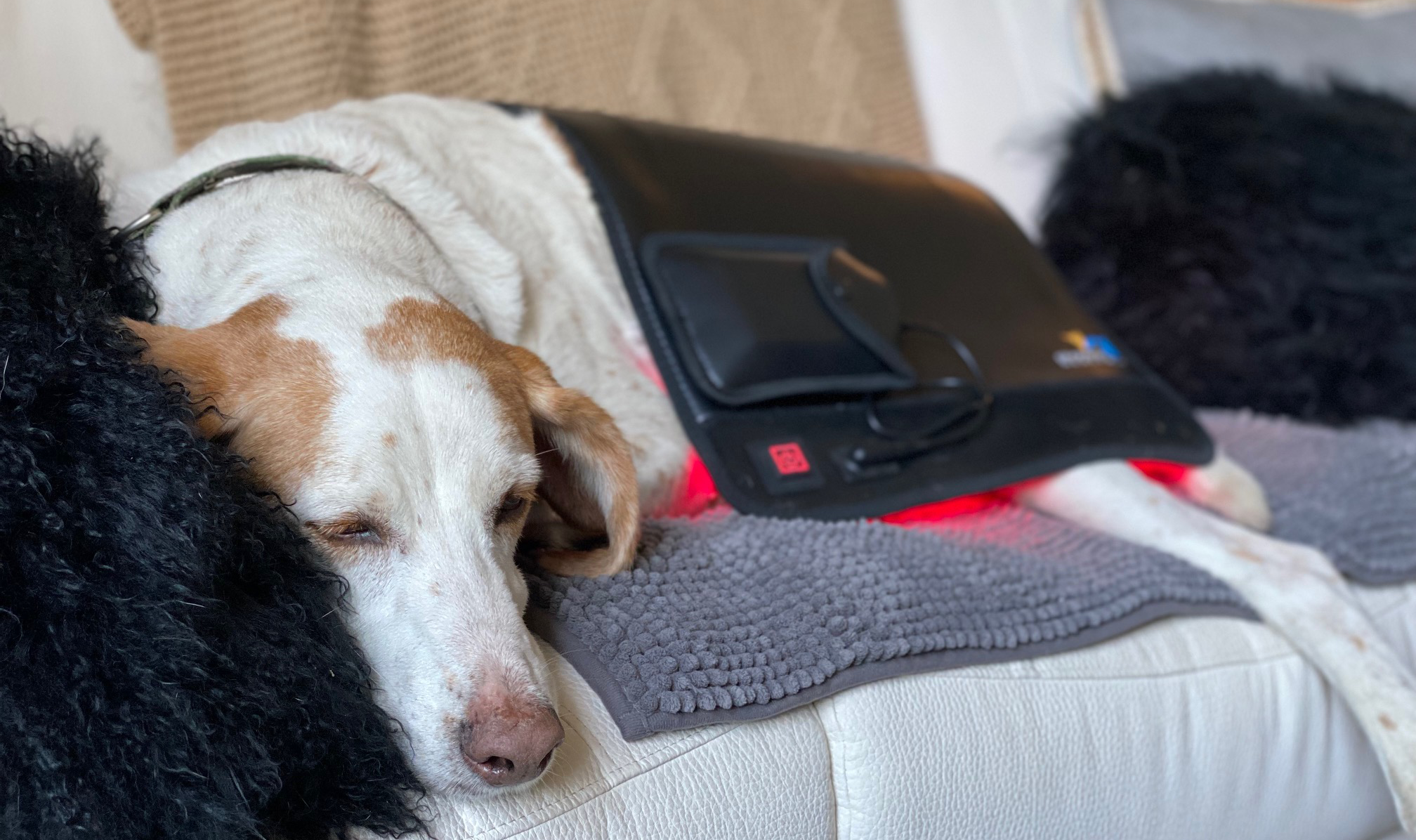
Essential Back Pad
Red and near infrared, with 10, 20 and 30 minute settings. You lay it over your dog and walk away. This is the one that was on Milka on that flight, and it is the right choice when you cannot pinpoint where the pain is, because it covers a wide area at once. Best for spines, hips and backs.
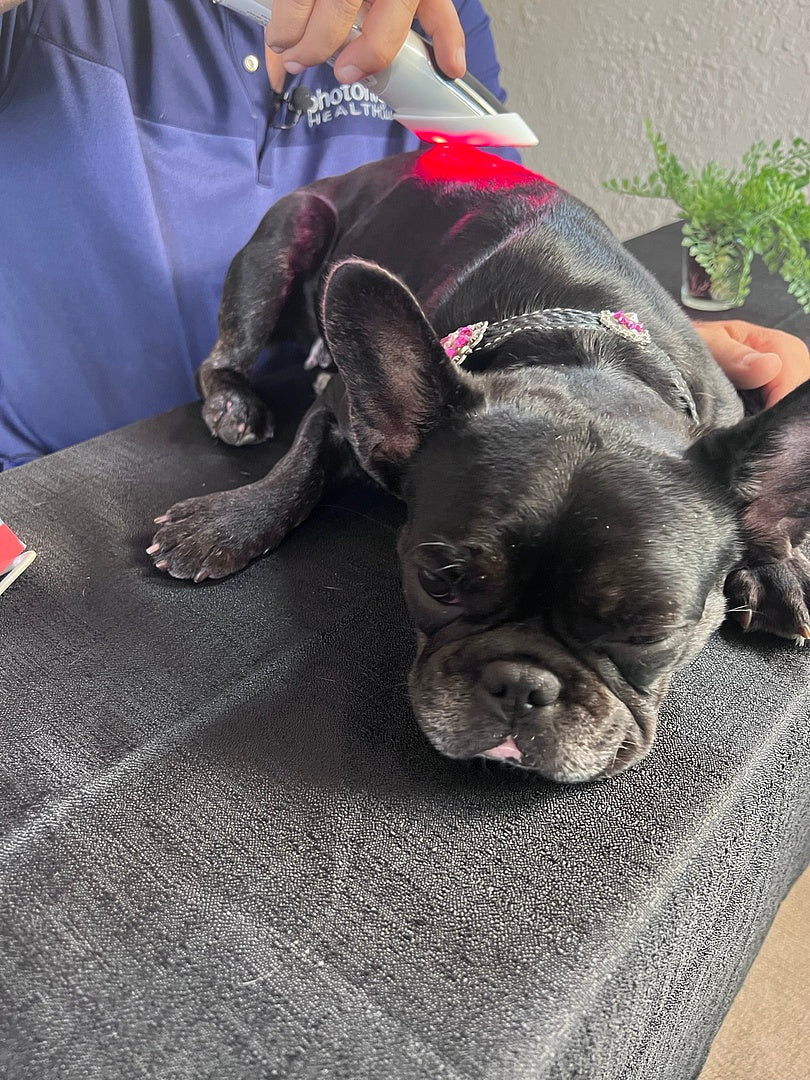
Illumi-Vet 3000
The handheld, for paws, small joints and one known sore spot. The reason I point people here rather than at a generic panel is the built-in timer, which sets duration from the energy dose in joules. That is the whole argument of this article built into the hardware, so you are not doing the arithmetic yourself every session.
Some links in this post are affiliate links. If you buy through them, PAWDEGA may earn a commission at no extra cost to you. We only recommend products we use ourselves.
If you want the longer conversation, including how to think about choosing a device, we went deep on it with Donna Woods on the Next Level Pet Parent Podcast episode on red light therapy.
If you are here because of IVDD specifically

A back injury is a different situation to slow joint wear, and it needs different support. We built this bundle out of what we actually used getting Milka through her IVDD injury holistically, alongside our vet. It adds first response homeopathy and stronger comfort support to the mobility base, which is exactly the shape of that heavier front loaded phase.
What light cannot do on its own
Here's the thing, though. Red light does not repair anything. Your dog's body does the repairing. The light is a signal to cells that are already doing the work.
Which means the result you get depends enormously on what those cells have to work with. A body carrying a heavy inflammatory load, running on poor raw materials, is a body you are asking to rebuild tissue with an empty toolbox. This is the part I got wrong for a long time with Milka. I kept looking for the one thing, when what her body needed was the whole picture supported at once.
If you are working on mobility and comfort, this is what we would put alongside your light sessions. Support from the inside, not a replacement for anything your vet has prescribed.
Our pick for stiff, slowing down and arthritic dogs

This is the whole inside-out picture in one order, built for dogs already dealing with arthritis, hip dysplasia, limping or an injury. It works on inflammation, pain, joint and connective tissue, and the gut that has to absorb all of it.
- Jump for JOYnts, four way mobility support for joints, ligaments, tendons and muscles
- Inflapotion, organic herbal support for inflammation and stiffness
- Potent-Sea Omega-3, algae based EPA and DHA, raw material for the repair work
- Coco-Gold, turmeric, ginger and black pepper in coconut oil
- EASE full spectrum oil, for aches and comfort
- Gut Soothe, because absorption decides how much of the rest lands
PAWDEGA suggests staying consistent for at least six weeks, which lines up almost exactly with the three to six week window for judging your light sessions. Run them together and you get one clean read on both.
Would rather start with one thing? Jump for JOYnts is where most pet parents begin. Or browse everything in Joint & Mobility Support.
Get the whole picture, free
If this article convinced you of one thing, I hope it is that a single modality is never the whole answer. The Holistic Pet Wellness Blueprint is our free guide to building the rest of the picture: diet, gut health, reducing the toxin load, and how the pieces support each other. It is the guide I wish someone had handed me when Milka was struggling.
Frequently asked questions
How often should you use red light therapy on a dog?
Three sessions per week is the usual starting rhythm for a chronic issue such as arthritis, run for three to six weeks and then tapered to once or twice weekly. For a fresh injury or a post surgery site, daily or every other day for the first one to two weeks is more typical before backing off. Published canine studies follow this shape consistently: heavier at the front, lighter over time.
How long should a red light therapy session be for a dog?
Roughly 30 seconds to 10 minutes per body area, decided by your device's power output rather than your dog's size. Work it out from the dose formula: dose in joules per square centimetre equals irradiance in milliwatts per square centimetre multiplied by seconds, divided by 1000. At 50 mW/cm², about 2 minutes delivers 6 J/cm². At 20 mW/cm², the same dose takes 5 minutes.
Can you use red light therapy on a dog every day?
Yes. Daily sessions are common for a fresh injury or a post surgery site in the first week or two. For a chronic issue such as arthritis, daily is usually unnecessary, and three sessions per week is the more typical loading rhythm. Going daily on a chronic case will not speed things up, because of the biphasic dose response.
Can you use too much red light therapy on a dog?
You can overshoot the useful dose. Photobiomodulation follows a biphasic dose response, described by Huang and colleagues in Dose-Response in 2009: too little light does nothing, the right amount stimulates the cell, and past that point the benefit flattens and can turn inhibitory. This is not a safety emergency, but longer sessions are not a free upgrade, and doubling the time is one of the least likely fixes if your dog is not responding.
How long does it take for red light therapy to work on dogs?
Allow three to six weeks of consistent sessions before judging whether it is helping. That is the window used in the canine trials. Some pet parents notice small changes within the first week or two, but a fair assessment needs the longer run. Keep written notes on observable things, such as how your dog rises in the morning and whether he takes the stairs, so you are comparing observations rather than impressions.
Does a dog's size change red light therapy session length?
Less than most pet parents expect. Dose is delivered per area of skin, so a larger dog usually means more areas to cover rather than longer per area. Coat density, coat colour and how far you hold the device from the body all affect the delivered dose considerably more than body weight does.
Do you need to shave your dog for red light therapy?
No, not for home use. Research studies sometimes clip the coat for blinding purposes. At home, parting the fur with your fingers so the light reaches skin is enough, and dense or dark coated dogs benefit from a little extra time at the same setting because more light is absorbed at the surface.
Is red light therapy safe for dogs, and where should you avoid it?
Photobiomodulation has a reassuring safety record in animals, with no systemic adverse effects reported in the veterinary literature. Avoid the eyes, since dogs will look directly at a light source. Speak to your vet before using it over a known or suspected tumour, over the abdomen of a pregnant dog, or over the thyroid, and before using it at all if your dog has an existing health condition, is on prescription medication, has an implanted device, or is photosensitive. Check the skin for heat on higher output devices.
Does red light therapy help dogs with arthritis?
The evidence is encouraging but not settled. In a randomised, blind, placebo-controlled trial published in the Canadian Veterinary Journal in 2018, nine of eleven dogs with elbow osteoarthritis receiving photobiomodulation reduced their non steroidal anti inflammatory medication, while none of the nine sham dogs did. A 2023 systematic review in Animals, however, examined forty five studies across dogs, cats and horses and found conflicting results with no consensus on optimal protocols. Both are true at once.
Can you use a human red light panel on a dog?
Speak to your vet before you do. The photobiology is similar across mammals, but human panels are designed for bare skin at a set distance, and a coated animal at an uncontrolled distance changes the delivered dose considerably. Eye exposure is also much harder to control with a dog than with yourself.
The bottom line
Find your device's irradiance. Use it to work out your minutes. Start with three sessions a week for a chronic issue, or daily for something fresh. Give it three to six weeks. Write down what you see. Then taper to the smallest amount that keeps your dog comfortable.
And hold the whole thing loosely. Light is one input. Your dog's body is doing the actual work, and what you feed it, how you move it, and what you take off its inflammatory load all decide how much it has left to give.
You are already doing more than most. The fact that you went looking for a real answer instead of accepting the first number you found tells me everything about the kind of pet parent you are. Your dog is lucky to have you.
Which support fits your dog
The frequency table near the top splits readers into three groups, and the inside-out support splits the same way. Find your row.
| If your dog is | Light session rhythm | Support from the inside |
|---|---|---|
| Healthy, and you are getting ahead of it | 1 to 2 per week, ongoing | Joint Support Bundle, Standard |
| Stiff, slowing down, arthritic, hip dysplasia | 3 per week for 3 to 6 weeks, then taper | Joint Support Bundle, Premium |
| Working through IVDD or a back injury | Daily or every other day early, then taper | IVDD Support Bundle |
Not sure which row you are in? That is a good reason to talk to your vet first, and our Pet Wellness Success Team is happy to help you think it through. Bark at us here.
I am not a veterinarian. I am a pet parent who has spent years researching this alongside holistic and integrative vets, and everything here is educational. Always work with your own veterinarian on your dog's care, particularly if there is an existing health condition or prescription medication involved. PAWDEGA is an Online Holistic Pet Wellness Store.
Sources: Looney AL, Huntingford JL, Blaeser LL, Mann S. A randomized blind placebo-controlled trial investigating the effects of photobiomodulation therapy (PBMT) on canine elbow osteoarthritis. Can Vet J. 2018;59(9):959-966. · Millis DL, Bergh A. A Systematic Literature Review of Complementary and Alternative Veterinary Medicine: Laser Therapy. Animals (Basel). 2023;13(4):667. · Huang YY, Chen ACH, Carroll JD, Hamblin MR. Biphasic dose response in low level light therapy. Dose Response. 2009;7(4):358-383. · Alves JC, Santos A, Jorge P, Carreira LM. A Preliminary Report on the Combined Effect of Intra-Articular Platelet-Rich Plasma Injections and Photobiomodulation in Canine Osteoarthritis. Animals (Basel). 2023;13(20):3247.