The Relief Protocol for dogs is a cycling program created by holistic practitioner Julie Anne Lee, DCH for dogs whose yeast and allergy signs have not held on a single protocol. You run the Yeasty Beast Protocol for two weeks, Fido's Flora with Liver Tonic for two weeks, the Leaky Gut Protocol for two weeks, then Fido's Flora with Liver Tonic again, and you repeat that loop for roughly three months, always ending on a Leaky Gut cycle. The order is the active ingredient here, because each interval leaves the body stronger before the yeast is worked on again.
The Relief Protocol is not a stronger dose of yeast support, it is the same products sequenced so the body is never asked to detoxify more than it can handle at once.
If you are reading this, you have probably already done a lot. Recurring ear infections. Paws licked rust brown. An itchy, restless dog and a smell you cannot place. The prescription food, the antibiotics, the steroid shot that worked beautifully for two weeks. Maybe a natural protocol too, which helped for a while, and then stopped. You are not missing effort. You are missing a layer.
ON THIS PAGE
- What is the Relief Protocol for dogs?
- Why did the Yeasty Beast Protocol stop working?
- What does yeast die-off look like?
- Does the diet have to change first?
- What are the cycles, week by week?
- Do I have to buy the full protocol to start?
- When should I switch a cycle early?
- Why does my dog slide back after the Leaky Gut cycle?
- How long does it take?
- What else is feeding this at home?
- What if my dog is on medication right now?
- Sources
What is the Relief Protocol for dogs?
It is a sequence, not a single product. Four Adored Beast formulas rotate through it: the Yeasty Beast Protocol, Fido's Flora, Liver Tonic, and the Leaky Gut Protocol. Liver Tonic already sits inside both kits, which is part of why the program is less of a shopping list than it first looks.
Julie Anne Lee designed it for one specific dog: the one who has been through everything and is still not well. She has seen more than fifty thousand animals across some of the longest-standing holistic veterinary clinics in North America, and she formulated all three of the protocols that make up the cycle. You can hear her walk through the whole thing in our podcast conversation on allergies and yeast that will not resolve, which is where most of the reasoning on this page comes from.
Here is the part most pet parents are never told. Yeast is not a skin problem that migrated inward. Research on canine atopic dermatitis has found lower gut microbial diversity in affected dogs compared with healthy ones, and a 2025 study in BMC Microbiology reported that sixteen weeks of daily probiotics significantly reduced clinical severity in twenty three dogs with the condition. Separate work has documented Malassezia yeast dysbiosis on allergic dog skin. The skin is where you see it. The gut is where it is organised.
Why did the Yeasty Beast Protocol stop working?
When a protocol does not hold, the reason almost always falls into one of five categories rather than being unique to your dog. Julie's clinical categories, in the order we see them most:
- A much larger yeast load than anyone realised. The dog was strong enough to mask it, so even a gentle approach produces a heavy die-off.
- Leaky gut sitting underneath the yeast. Two things happening at once while only one is being addressed. This is the most common pairing of all.
- Drug rebound. Medication withdrawn faster than the body could take over. Anything suppressed comes back, and it comes back harder.
- Immune dysregulation. In Julie's clinical view, often vaccine driven, where the immune system no longer knows how to return to balance on its own.
- A timing mismatch. The dog needs shorter cycles, or a longer run on one part of the program, than the standard schedule allows.
Point two deserves a note on honesty. Leaky gut is a real and measurable phenomenon in veterinary medicine, and increased intestinal permeability has been documented in dogs using sugar absorption and serum iohexol testing. It is also not something a single lab test confirms on its own: VCA Animal Hospitals describes it as a possible consequence of an underlying intestinal disease rather than a condition that can be proven or ruled out by itself. Which is genuinely fine for our purposes, because whether the yeast damaged the gut lining or the compromised lining let the yeast take hold, the work is the same.
What does yeast die-off look like?
This is the single most misread moment in the whole process, and the reason most pet parents quit while something is working.
When large numbers of yeast cells die quickly, they release a flood of toxic byproducts, and the liver and kidneys have to clear them. In human medicine this is documented as a Jarisch Herxheimer reaction, and a 2023 review in Toxicon describes exactly this pattern after antifungal medication for candida: the symptoms get worse before they get better, because of what is being released rather than what is growing. Julie's clinical framing is that dying yeast releases ten to fifteen times more toxins than living yeast.
"It is working, but working too well."
Julie Anne Lee, DCH, on why a dog looks worse on the right protocol
The pattern to recognize is specific: improvement for roughly twenty four hours to a few days, then a decline. That is not failure. It is the body being handed more than it can process at once. The wrong response is to abandon the protocol and go back for anti-fungals, because that restarts the loop at a lower baseline. The right response is to ease off, let the body catch up, and build back up.
Does the diet have to change first?
Yes, and this is the step pet parents skip most often. The Yeasty Beast label puts diet at step one for a reason: two weeks of lower sugar, less processed food before the herbs go in means the yeast is already weakened when you start, which makes the whole process gentler on your dog.
Yeast feeds on sugar, and the hidden sources matter more than the obvious ones. Heavily processed kibble carbohydrate behaves like sugar by the time it is eaten. So do root vegetables, beets and carrots in food and snacks, sugars used in fermenting, and prebiotic ingredients such as FOS, inulin and maltodextrin.
My honest recommendation is raw or freeze-dried raw, or something else minimally processed. Freeze-dried and dehydrated perform about as well as raw here, so choose whichever you will realistically keep up. The protocol still works on kibble. It may take longer, and it may need repeating more often.
And if a full switch is not on the table, a partial one still counts. A 2021 study of 4,022 dogs in the Journal of Veterinary Internal Medicine found that dogs whose puppyhood diet was more than twenty percent raw food, or less than eighty percent dry food, had a significantly lower prevalence of allergy and atopy related skin signs in adulthood. Worth reading carefully: it looked at puppyhood diet and adult signs, it is observational, and the authors say plainly that it suggests rather than proves a causal link. Other veterinary voices have pushed back on the raw feeding conclusions. What it does support is the direction of travel, which matches what we see every day at PAWDEGA.
So if you feed kibble and cannot change everything at once, replace a fifth of the bowl with fresh food. Choose a less processed or oven-baked option with less grain, and add green beans, broccoli, kale, or affordable organ meats like heart and kidney. That single change is often what finally lets a protocol hold.
What are the cycles, week by week?
Two week intervals, in this order, repeating until the products run out.
Scroll sideways to see the full table.
| Weeks | What you give | What the interval is for |
|---|---|---|
| 1 to 2 | Yeasty Beast Protocol | Reducing yeast, rebalancing the gut |
| 3 to 4 | Fido's Flora and Liver Tonic | Re-inoculating, gentle detox support |
| 5 to 6 | Leaky Gut Protocol | Rebuilding the gut lining |
| 7 to 8 | Fido's Flora and Liver Tonic | Strengthening before yeast round two |
| 9 onward | Repeat the loop | Always end on a Leaky Gut cycle |
Three details decide whether this works. Liver Tonic runs continuously through the whole program, because every organ involved is working overtime on both die-off and any residual drug load. The intervals do not overlap, and the Yeasty Beast label is explicit that the protocol is not given alongside other probiotics at the same time. And you always finish on a Leaky Gut cycle, never on a yeast cycle, because ending mid attack leaves the lining open.
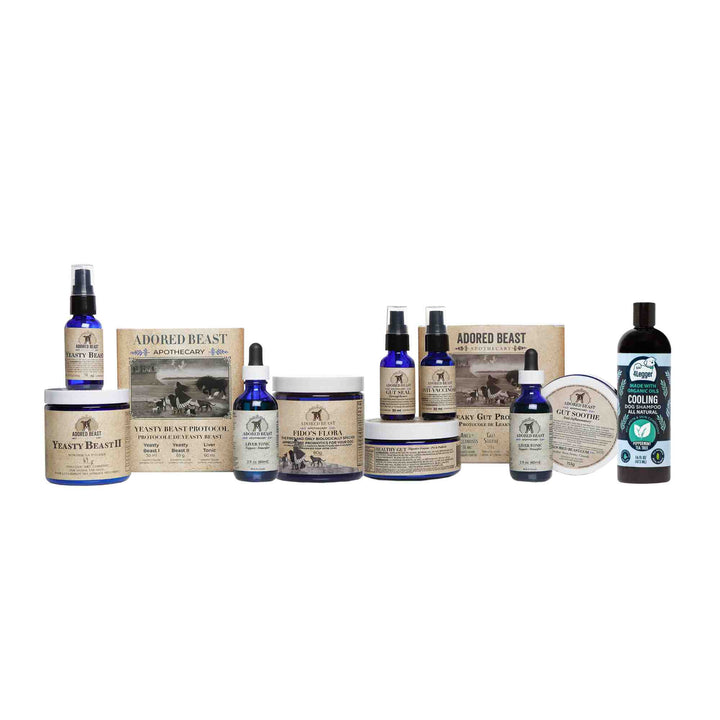
What our team sends the tried-everything dogs
Allergy & Yeast Relief Protocol
This is the Relief Protocol as one kit, so you are not ordering three things separately and then working out the order yourself. We stock it at PAWDEGA because the sequencing is the hard part, and getting it wrong is what sends dogs backwards.
- Yeasty Beast Protocol, Fido's Flora and the Leaky Gut Protocol in one place
- Liver Tonic included, so it can run continuously as Julie intends
- Adds a USDA certified organic cooling shampoo for the skin side
- Choose your Fido's Flora and Leaky Gut sizes by your dog's weight
Do I have to buy the full protocol to start?
No, and I want to be direct about this because it is the question we get most.
If your dog is showing yeast signs and has never run a protocol before, start with one round of the Yeasty Beast Protocol. Two weeks in, your dog will have told you a great deal. If the signs ease steadily, you carry on and follow it with the Leaky Gut Protocol, which always comes after a yeast round because that is what stops the signs returning three to twelve months later. That path is enough for a lot of dogs.
Add Fido's Flora and Liver Tonic when your dog shows you it is needed: the improve-then-decline pattern of a die-off, or progress that stalls part way. Fido's Flora is a canine specific pre and probiotic that helps balance the immune system, and its fulvic and humic acid content is what makes it the safety valve in this program rather than another probiotic on the pile. Julie is emphatic that this interval is the biggest single reason dogs get through the cycles at all.
The full sequence is the honest answer for one profile: a dog with years of history, a long medication record, or a protocol already run that did not hold. If that is your dog, the cost question deserves a straight answer too. The Relief Protocol uses the same products you would work through anyway for yeast and then for gut repair. It is a different order, not a longer list, and each protocol lasts a long time across the program.
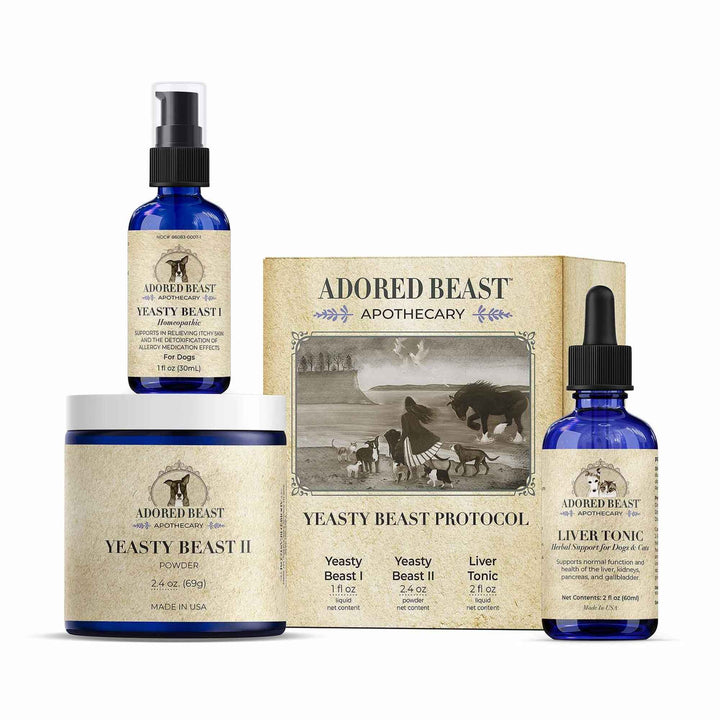
Starting smaller
Yeasty Beast Protocol
Cycle one of the Relief Protocol on its own. The sensible first step if your dog has yeast signs but no long history of medication behind them, and the two weeks tell you what to do next.
Start with one roundWhen should I switch a cycle early?
The two week schedule is a starting point, not a rule your dog has agreed to. Some dogs run on three or four day cycles, and that is a legitimate schedule rather than a sign something is wrong.
- Start the journal before day one. Record the time of day, how long the itching lasts, and where on the body. Without a baseline you will not see improvement, and you will stop while it is working.
- Watch for improve, then decline. Better for three days and worse on day four is information, not a setback.
- Move to the next cycle before the full flare, not after it. Do not wait out the remaining days of the two weeks.
- Track how long each cycle holds. That number is your dog's actual schedule.
- Always end the program on a Leaky Gut cycle, whatever length your cycles settle at.
Progress is proportional, not all or nothing. An itching episode dropping from fifteen minutes to five is a real win, and it is exactly the kind of change that is invisible without the journal. Early markers we hear about long before the skin clears: calmer behaviour, less audible licking at night, less scooting, ears visibly less inflamed, and the smell starting to fade.
Why does my dog slide back after the Leaky Gut cycle?
There is one pattern worth knowing by heart, because it points at something specific. The dog does very well on the Leaky Gut Protocol and goes backwards every time it comes off.
That points to Rebalancer, the homeopathic component inside the Leaky Gut kit, formerly called Anti-Vaccinosis. The clue is speed. Improvement inside twenty four hours to seven days is too fast to be gut support, digestive enzymes or Liver Tonic doing the work. In Julie's clinical experience roughly nine out of ten Relief Protocol dogs stay on Rebalancer for the full two weeks of every Leaky Gut cycle rather than the short initial course, and some need it once or twice daily for up to three months. Follow the kit instructions as your authority on dosing, and test it the way she does: give it for a week, stop, and watch.
What you are watching for is your dog's own first warning sign, well before a full hot spot. The inside of the ear flap reddening. Redness between the toes. Inflammation around the anus or the mouth. A slightly runny nose, sneezing, or reverse sneezing. Every dog has a personal first signal, and knowing yours is what stops a slide all the way back to the beginning.
How long does it take?
Around three months. Not one, and I would rather tell you that now than have you lose faith in week five.
At the end of the program, assess what is left rather than assuming you are finished. If your dog is seventy five to eighty five percent improved, Julie's recommendation is another full round, on the reasoning that a condition which took years to build is unlikely to fully resolve in twelve weeks. If the improvement is dramatic, the next step is rotating probiotics rather than staying on one: Fido's Flora, then The Wolf, then a soil or spore based option, each establishing a different set of colonies. For dogs with a lifelong yeast history, one Yeasty Beast round and one Leaky Gut round a year keeps things from building again unseen.
What else is feeding this at home?
Two things worth changing while the cycles run, both cheap.
Bedding first. Yeast favours dark, damp, low oxygen conditions, and synthetics, vinyl and polyester do not breathe. Cotton does, and in Julie's clinical observation the bacteria that develops on cotton works against yeast rather than for it. Cover the bed and the couch in cotton sheets, plain is fine if organic is not available, and wash them often. Most conventional beds also carry flame retardants, which is its own reason to put a barrier between your dog and the filling.
Then the household. Floor cleaner, laundry detergent, fabric softener, air fresheners, scented candles. Dogs lick floors and anything dropped on them, so what you clean with goes into the digestive system too. Your own creams and shampoos count as well, since your dog is licking your hands and face all day. No single product is the culprit. Cumulative exposure across a dozen of them is the point.
What if my dog is on medication right now?
Please do not stop anything cold turkey after reading this page. Work with your veterinarian and wean more slowly than feels necessary, while the body is being built up underneath. Suppressed conditions rebound, and they rebound worse than the original presentation.
It also helps to know what these medications are and are not doing. Apoquel and Cytopoint is documented as effective for controlling itch in allergic dogs, which is a real and valuable thing when a dog is raw from scratching, and it is a different thing from resolving the cause. VCA Animal Hospitals notes that oral antifungal courses for yeast dermatitis often run for months, that liver side effects mean routine blood monitoring, and that a relapse after a successful course usually calls for a higher dose. That is the loop the Relief Protocol is designed to step out of, gradually and with your vet in the loop.
Please keep in mind that I'm not a veterinarian, and this isn't medical advice. Every pet is unique, so I always recommend working alongside your vet, ideally a holistic or integrative vet, especially for anything ongoing or serious.
If there is no holistic or integrative vet near you, that is a common problem and not a dead end. We keep a list of holistic vets and pet health professionals who offer online consultations, so you can have someone look at your dog's full history and bloodwork wherever you live.
One last thing, from the pet parents we talk to at PAWDEGA every day. The ones who get there are rarely the ones who found a better product. They are the ones who understood the sequence, kept the journal, and did not panic on the day their dog looked worse. You are further along than you think.
Scroll sideways to see the full table.
| Which one | Yeasty Beast Protocol | Relief Protocol |
|---|---|---|
| Best for | First protocol, yeast signs now | Years of signs, long drug history |
| Difference | One cycle, two weeks | Four cycles on a loop |
| Evidence | Formulator protocol, gut-skin research | Same, plus clinical case experience |
| Go here | Yeasty Beast Protocol | Allergy & Yeast Relief Protocol |
Sources
- Song H, Mun SH, Han DW, et al. Probiotics ameliorate atopic dermatitis by modulating the dysbiosis of the gut microbiota in dogs. BMC Microbiology, 2025. Read the study
- Rostami Yasuj S, et al. Candida die-off: adverse effect and neutralization with phytotherapy approaches. Toxicon, 2023. Read the review
- Gonzalez LM, et al. Alterations in intestinal permeability, the role of the leaky gut in health and disease. Veterinary Clinics, 2017. Read the review
- Reisinger A, et al. Evaluation of intestinal barrier dysfunction with serum iohexol concentration in dogs. Animals, 2024. Read the study
- Leaky gut syndrome in dogs. VCA Animal Hospitals. Read the article
- Yeast dermatitis in dogs. VCA Animal Hospitals. Read the article
- Bensignor E. Critically appraised topic, benefits and risks of oclacitinib in allergic pruritus in dogs. Revue Vétérinaire Clinique, 2024. Read the review
- Hemida MBM, Salin S, Vuori KA, et al. Puppyhood diet as a factor in the development of owner reported allergy and atopy skin signs in adult dogs in Finland. Journal of Veterinary Internal Medicine, 2021. Read the study
- Meason-Smith C, Olivry T, Lawhon SD, Hoffmann AR. Malassezia species dysbiosis in natural and allergen induced atopic dermatitis in dogs. Medical Mycology, 2020.
- Tamamoto-Mochizuki C, et al. A comprehensive analysis of gut and skin microbiota in canine atopic dermatitis in Shiba Inu dogs. Microbiome, 2023. Read the study
- Julie Anne Lee, DCH RCSHom, on allergies and yeast that will not resolve. Next Level Pet Parent Podcast. Watch the episode