Separation anxiety in dogs is a panic response to being left alone, not a behaviour problem and not spite. It usually starts within the first 30 minutes after you walk out the door. The most useful change most pet parents can make is not swapping to a different calming product, it is moving the support earlier, so it is already working before your dog reads the first departure cue.
Calming support given as you pick up your keys is already late. The window that matters opens hours before you leave.
In this article
- What separation anxiety actually is, and what it is not
- Why most calming routines fail, and it is rarely the product
- The pre-departure protocol we use with Milka
- The layers that cost nothing, and did as much as the oil
- How much, and where the numbers come from
- The baseline layer: why the gut keeps coming up
- Lick mats: what the evidence actually shows
- No supplement replaces the training
- When to bring in a professional
- Questions pet parents ask us
- Sources
What separation anxiety actually is, and what it is not
There is a specific pattern behind the word. A dog with separation anxiety chews, vocalizes, paces or has an accident only in your absence, and it typically begins immediately or within about 30 minutes of you leaving. The distinguishing detail is not the mess. It is that the dog looks distressed rather than bored or playful, with pacing, whining, panting and restlessness alongside it.
Dogs in this pattern are usually very attached. They follow you room to room. Many start showing signs before you have gone anywhere at all, as soon as you begin the sequence of getting ready. Some go quiet and withdrawn instead of loud, which is why the quiet ones get missed for years.
That last point deserves emphasis. Research summarised by the RSPCA suggests that around eight in ten dogs find being left alone difficult, and roughly half of them show no obvious sign of it. So the absence of a destroyed doorframe is not evidence that your dog is fine.
Here is what most pet parents are never told clearly: this is common ground, not a failure of yours. Reviewing the veterinary behaviour literature, the Purina Institute notes that up to 70 percent of behavioural concerns in dogs trace back to some form of anxiety. You are not dealing with a badly raised dog. You are dealing with the most common emotional problem in the species.
What it is not: two things get confused with it constantly. Confinement distress, where the dog panics at a barrier rather than at your absence, can look identical and sometimes resolves when the crate comes out of the picture. And incomplete house training, especially in a young or newly adopted dog, gets read as anxiety when it is a training gap. A camera pointed at the room for one absence tells you more than a month of guessing.
Behaviour that appears suddenly in an adult dog also needs a medical look first. Pain, gut discomfort, thyroid changes and early cognitive change can all present as new anxiety. This is worth a conversation with your vet and, if it has been a while, a set of bloodwork before you assume the problem is emotional.
Why most calming routines fail, and it is rarely the product
Almost every article on this subject gives you a list of calming ingredients. Very few tell you when to give them. That omission is the reason so many pet parents conclude a product does not work.
Look at how the research is actually built. In a randomised, placebo-controlled, blinded study at the Waltham Petcare Science Institute, published in Frontiers in Veterinary Science, dogs were given a single oral dose of THC-free CBD at roughly 4 mg per kg of body weight and then put through a separation event or a car journey two hours later. Dogs on CBD were scored as significantly less sad by behaviourists, had lower cortisol, whined less, and were rated in a more relaxed emotional state than the placebo group.
Two hours. Not two minutes at the door. A follow-up study in the Journal of Animal Science used the same two-hour lead time across six months of daily dosing, and a separate blinded crossover of 54 dogs testing chews with CBD, L-tryptophan and alpha-casozepine also dosed two hours before the stress event. The lead time is not incidental to these designs. It is the design.
Now put that next to what your dog is doing. She is not reading your intention to leave at the front door. She is reading the shower, the shoes, the bag, the tone of your voice on a workday morning. By the time your hand is on the handle, her heart rate has already climbed. Support that arrives at that moment is chasing a stress response that started an hour ago.
Being honest about the evidence, because you deserve the whole picture: this is not settled science. The same six-month study found the effect appeared to fade over time, and the authors could not say whether that was the dogs habituating to the CBD or to the stress test itself. A separate tolerability study in healthy colony dogs at 2 and 4 mg per kg twice daily saw no improvement in anxiety-related behaviour at all, and the authors suggested behavioural change in already-calm dogs may need higher dosing. Most of this work was also done in kennelled research dogs, not in family pets at home with a real history. The mechanism is plausible and the trial designs are good. Certainty is not on offer yet.
So if you have a bottle in the cupboard you concluded was useless, it is worth asking whether it ever had a fair test. The answer for us was a full-spectrum hemp oil, dosed on the gums, hours ahead of the thing we knew was coming.
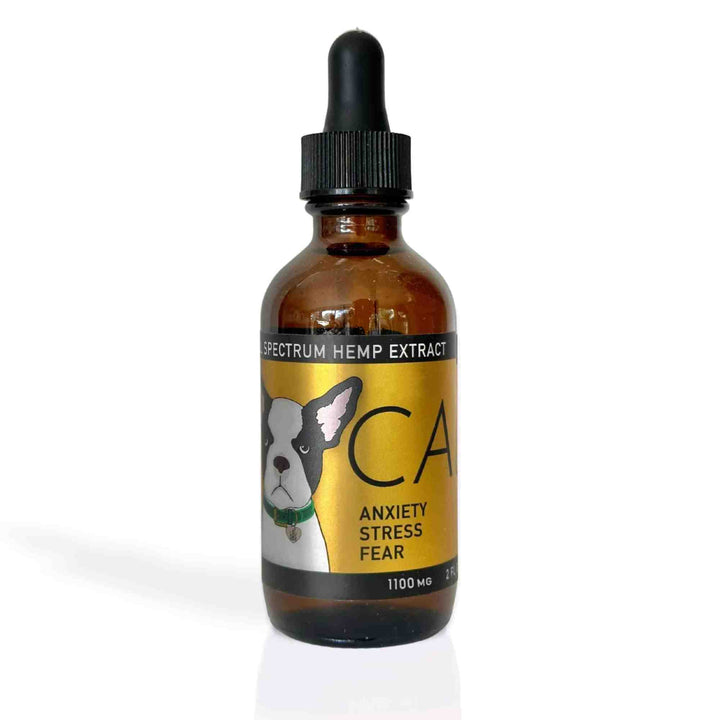
What I give Milka hours before we leave the house
CALM Hemp Oil For Dogs
There are a lot of calming products. I use this one because it is a liquid, which means I control the dose to the drop and can move it earlier or later without buying a different size. It goes on the gums, which is the most bioavailable way to give an oil, so I am not waiting on digestion to catch up with a deadline I already know about.
- Full-spectrum hemp extract, not an isolate or a distillate
- Two strengths, so you can work up without switching products
- Extra Strength carries at least 18 mg of hemp extract per 1 ml dropper
- Third-party lab tested, organically grown American hemp
- Also useful for the other predictable ones: fireworks, grooming, the vet
The pre-departure protocol we use with Milka
Milka has separation anxiety. She is a 25 lb French Bulldog, she is a senior now, and we still plan around it. She also has opinions about people in uniform, which means airport security and anyone official-looking gets barked at on principle. So we know our triggers, and that is the whole advantage: a predictable trigger can be prepared for.
This is what we do, and I want to be clear that it is our experience with our dog rather than a protocol from a study. When it works, the difference is not subtle. Things she would normally react to stop registering. She is not sedated and she is not a different dog, she is relaxed enough that the trigger passes her by.
| When | What we do | Why this timing |
|---|---|---|
| 3 hours before | First dose, on the gums | Well ahead of any departure cue she could pick up on. Nothing about our behaviour has changed yet |
| 1 hour before | Second dose, on the gums | Lands inside the two-hour lead time the research uses, and tops up the first dose rather than replacing it |
| 30 minutes before | A meal served on a frozen lick mat | Gives her something absorbing to be doing while we move around the house getting ready |
| The last 10 minutes | Nothing. No goodbye | An emotional farewell is a very loud cue. Keeping the exit boring is doing her a favour, even when it feels cold |
| On the way back in | Calm greeting, once she has settled | A big reunion raises the emotional stakes of the next departure |
The same shape works for a restaurant, a flight, a groomer, or any evening we know we will be out. What changes is the clock, not the sequence.
The part that took us longest to accept is that this is a planning routine, not a rescue routine. If we decide to go out an hour from now, we have already missed the useful window. Patience with the schedule is the thing that made the difference, more than anything we put in her mouth.
The layers that cost nothing, and did as much as the oil
I need to be straight with you about something, because I would hate for you to read the table above and buy one bottle expecting it to be the answer. We have tried so many things with Milka over the years. What actually works is not the oil on its own. It is the oil plus four other things, and two of those four are free.
A safe space, and the question nobody answers honestly
She needs one spot that is genuinely hers, with her bed and something that smells like us, where nothing stressful ever happens. That part is uncontroversial. What comes next is where the advice online splits in two, and most articles pick a side without telling you there is an argument.
One side says open the house up. Confinement distress is a real and separate thing, where the dog panics at a barrier rather than at your absence, and the veterinary behaviour literature notes that in some of those cases taking the crate out of the picture resolves the problem on its own. Behaviourists have also reported dogs who stopped being anxious once they were no longer shut in anywhere.
Milka is the other kind, and this is our experience rather than anything from a study. She does better confined. Her preference is our bedroom with the door shut, asleep on our bed, and that is where she is calmest when we go out.
Give her the run of the house instead and here is what she does. She goes to the front door and sits there, shaking, before we have even left. She tracks every sound and every movement on the other side of it. And she does not come off that post until we come back through that same door. Not the back door, not a window she can hear us at. That door.
Once we saw that clearly, the bedroom stopped looking like restriction and started looking like relief. Free range does not give her freedom, it gives her access to the worst place in the house. It lets her take up a post she cannot leave and hold a vigil for however many hours we are gone. The closed bedroom takes that job away from her. She is not shut in so much as let off duty.
Both of those things are true at the same time, for different dogs. There is no way to know from a blog post which kind yours is, including this one. So test it rather than deciding it. Film one short absence with her shut in the room she gravitates to, film another with the house open, and compare. The camera settles in two afternoons what you could otherwise argue about for a year.
This is the part I would want you to take from the whole article, more than any dose or product in it. Your dog is an individual and she is already telling you what she needs. Watch closely enough to see the specifics of how she does this, which room, which door, which sound, at which point in your leaving routine, and the answer for her tends to be sitting right there in the detail. Then your job is not to work out what should help. It is to replicate the conditions she has already shown you she prefers, and keep replicating them.
We spent a long time trying general solutions on a very specific problem. Watching her properly was worth more than any of them.
Pet wellness newsletter
Don't miss the next one
This is one post in a series on anxious dogs. The ones coming next go ingredient by ingredient through what is actually in a calming supplement, and cover what to do when you have worked at this for months and nothing has moved. If that sounds like your dog, it is worth being on the list.
- New posts when they publish, with the research behind them
- What we are learning with our own dogs, including the things that did not work
- First access to our free guides as they are released
One email at a time, no noise. Unsubscribe whenever you like. Prefer the full signup page? Join here instead.
Two conditions on that test. Let her tell you which space, rather than picking one for her, because the room she already chooses when she wants to settle is the room to start with. And if she has ever tried to escape, scratched at a door frame or damaged a window, do not run the confined version without a behaviour professional involved first. Escape attempts cause real injuries, and a closed door in that situation is a hazard rather than a comfort.
The other three layers
Less noise from outside. A dog alone in a quiet house is tracking every sound in the street, and each one is a small alarm with nobody there to tell her it is nothing. Closing the windows on the road side and leaving something steady and low playing gives her ears less to work with. This is part of why the smaller room works for Milka: fewer windows, fewer angles, less to monitor.
My own body, slowed right down. This is the one I did not expect and the one I would put first if I could only pick one. When I move fast, when I am rushing to leave the house, when my own shoulders are up around my ears, she reads all of it and it goes straight into her. Slower movements, a lower voice, no clattering around looking for keys. She is not responding to the fact that I am leaving so much as to the state I am in while I do it. On the mornings I manage myself well, move quite, slower movements, she is a different dog, and the oil has not changed at all.
Patience, measured in months. Not the patient tone of voice kind. The kind where you accept that this is now part of how your household runs, you stop expecting the week where it is suddenly fixed, and you keep going anyway. That acceptance was the turning point for us more than any product was.
None of those four is a thing I can sell you, which is rather the point. If you are choosing where to put your energy this week, the free layers are a better first move than a new bottle. Take the noise down, sort out her space, watch how you move on the way out the door. Then add the support to a foundation that is already doing some of the work.
How much, and where the numbers come from
Dosing hemp for a dog is genuinely confusing, partly because the labels and the studies do not measure the same thing. Rather than hand you one number, here are the three reference points we work from, so you can see the reasoning instead of taking it on faith.
| Reference point | Amount | What it is measuring |
|---|---|---|
| The CALM label, separation anxiety | 9 mg before the trigger, wait 15 to 20 minutes, repeat if still anxious | Full-spectrum hemp extract. This is where to start, whatever your dog weighs |
| The Waltham separation study | About 4 mg per kg of body weight, two hours ahead | THC-free CBD specifically, which is not the same measure as total hemp extract |
| Where Milka landed | 36 mg total, split across two doses, for a 25 lb dog | Two Extra Strength droppers at 18 mg each. Our own experience, arrived at gradually |
Two things to take from that table. First, please do not start where Milka is. Start at the label, watch, and work upward slowly if you need to. We did not begin at 36 mg, we arrived there over time with a dog we know well.
Second, be careful comparing your label to a study. A milligram of total hemp extract is not a milligram of CBD, so 36 mg of extract for an 11 kg dog is not the same as the 4 mg per kg of CBD used in the research, even though the arithmetic looks close. Anyone telling you those two numbers are interchangeable is guessing. If you want the wider picture on how hemp is studied in dogs, we went into it in more depth in our piece on CBD and dog allergies.
The baseline layer: why the gut keeps coming up
Everything above is situational. It handles a departure you can see coming. It does nothing about how anxious your dog is on an ordinary Tuesday with nothing happening, and that resting level is the part worth working on for the long term.
This is where the gut comes in, and I know how that sounds until you see the trial. In a blinded, placebo-controlled crossover study at the Purina Pet Care Center, 24 anxious Labrador Retrievers were supplemented with a probiotic strain of Bifidobacterium longum. On the probiotic, the dogs were less reactive with lower cortisol, calmer with lower mean heart rates, and showed higher heart rate variability, alongside a significant reduction in anxious behaviours like barking, jumping, spinning and pacing.
That is a bacterium in the digestive tract changing measurable stress physiology through the gut-brain axis. It is not a metaphor. Chronic gut inflammation is understood to be able to induce anxiety-like behaviour, which is one reason we keep coming back to digestion for concerns that look nothing like digestion. If that connection is new to you, our guide to dog gut health is the place to start.
The honest caveat is that probiotics are strain-specific. The strain in that study is not the strain in every product on a shelf, and it is not the strain in what we use. What the research supports is the mechanism, that supporting the gut can move anxious behaviour in dogs. It does not license the claim that any probiotic will do it.
One more signal worth checking: if your anxious dog also has inconsistent stools or itchy skin, that combination points at deeper gut involvement, and the gut layer moves up your list rather than being optional.

For the daily baseline, not the departure
The Wolf
This is the one we reach for when anxiety is the main concern rather than digestion. Ancestral wolf-specific strains with triple-extracted turkey tail as the prebiotic, given once daily on food. It is a slow layer, not a fast one: allow six weeks before you judge it, and longer if the anxiety has been there for years.
See The WolfLick mats: what the evidence actually shows
We feed Milka from a Lickimat and it helps her settle. I am putting that in writing because it is true. I am also going to tell you something the pages selling lick mats will not, which is that the research on food-based enrichment is weaker than the marketing suggests.
A pilot study published in Animals compared seven enrichment activities in dogs. Enrichment as a whole significantly increased relaxation behaviours and significantly reduced alert and stress behaviours, which is a real result. But the two food-based activities, a stuffed food toy and an interactive food toy, produced the least behavioural change of everything tested. Social play with another dog and access to a playhouse did considerably more.
You will find a great many articles asserting that licking releases endorphins and lowers cortisol in dogs as though it were established fact. When you follow those claims back, they mostly lead to other blog posts rather than to a study in dogs. It may well turn out to be right. It is not demonstrated yet.
So use the lick mat, and use it in the right job. In our house it is not the calming agent, it is the thing that occupies her hardest ten minutes while we get ready, and a way to make our leaving predict something good rather than something frightening. Give it before the difficult moment rather than during it, freeze it so it lasts, and take it away if she starts chewing the mat instead of licking it.
No supplement replaces the training
I would rather lose a sale than let you skip this part. Milka is a senior now and we are still training her every single day. Everything in this article makes being alone easier to sit through. None of it teaches your dog that being alone is survivable, and that lesson is the only thing that changes the underlying fear.
The approach with the strongest support is gradual desensitisation: constructing absences so short that your dog never actually panics, then extending them very slowly. The ASPCA's guidance describes going through your normal leaving routine and then sitting back down, repeating until it produces no reaction, then reaching the door, then stepping outside for seconds. It is tedious. It also works, which is more than can be said for waiting it out.
The most common mistake is moving too fast because progress feels slow. Stretching an absence past what your dog can handle provokes the panic again and sets you back. Watch for dilated pupils, panting, yawning, drooling, trembling and pacing, and if you see them, shorten the absence to a length where she can relax and rebuild from there. Expect most of the difficulty to sit in the first 40 minutes, which is where the anxious response tends to happen.
One thing not to do, under any circumstances: leaving her to cry it out. Ignoring, punishing or waiting out the distress does not resolve separation anxiety and can damage a dog's mental wellbeing. She is not being manipulative. She is frightened.
Held in the right order, it looks like this. Training is the foundation and does the actual work. The daily gut and nervous system layer lowers the baseline she starts every day from. The pre-departure dose gets you through the specific Tuesday you have to be somewhere. Skip the first and you are managing a symptom forever, which is exactly the cycle we would rather help you break.
When to bring in a professional
Some of this is beyond what any article, and beyond what we, can help with. Please get professional eyes on it if your dog is injuring herself trying to escape, if the distress is severe rather than uncomfortable, if it appeared suddenly in an adult dog, or if you have been working at it consistently for weeks with nothing moving.
Escape attempts are the one to take most seriously. They tend to be extreme, they concentrate around doors and windows, and they cause real injuries. That is not a training plan, that is a same-week phone call.
For severe cases, medication alongside a behaviour plan is a legitimate option and worth an open conversation with your vet. If you would like someone who will work through the natural side with you as well, we keep a list of holistic vets who consult online.
Please keep in mind that I'm not a veterinarian, and this isn't medical advice. Every pet is unique, so I always recommend working alongside your vet, ideally a holistic or integrative vet, especially for anything ongoing or serious.
Questions pet parents ask us
How long does it take to see a change?
Two different clocks. A situational dose is something you either see on the day or you do not, and if you see nothing at the label amount, work upward before you conclude it failed. The gut and nervous system layer is measured in weeks, with six weeks a fair minimum. The training is measured in months and depends on your dog, your history and how consistent you can be. Nobody can give you a real number for that last one, and anybody who does is selling something.
Can I use hemp oil alongside medication my vet prescribed?
That is a question for your vet, and it deserves a proper answer rather than reassurance from a website. Never stop or reduce something your vet prescribed on your own. Bring the actual product and its label to the appointment, because a specific conversation goes better than a general one.
Will another dog fix it?
Sometimes, and it is a large thing to gamble on a maybe. True separation anxiety is often about a specific person rather than about company in general, which is why plenty of dogs with a housemate still panic when their person leaves. Interestingly, in the enrichment study above, time with another dog was the single most effective activity tested, so companionship clearly matters. That is still a long way from a reason to take on a second dog.
Should I give it every day, or only before we go out?
Both patterns are used, and the label covers each. Situational suits a dog who is generally settled and struggles with known events. Daily suits a dog who is anxious most of the time. One point worth knowing from the six-month study: daily dosing was no more effective than a single dose given ahead of the event, and the effect appeared to weaken across the six months. That is an argument for using it deliberately rather than by habit.
My dog is quiet when I leave. Does that mean she is fine?
Not necessarily. Some dogs go still and withdrawn rather than loud, and around half of dogs who struggle with being alone show no obvious sign. Put a camera on one absence. It is free and it settles the question.
If you are starting one thing, start this one
| CALM Hemp Oil For Dogs | The Wolf | |
|---|---|---|
| Start here if | Your dog is mostly settled but falls apart around known events | Your dog is anxious most days, or also has loose stools or itchy skin |
| What it targets | The specific departure in front of you | The resting level she starts every day from |
| When you give it | Hours ahead of the trigger, on the gums | Once daily on food, indefinitely |
| Timeframe to judge it | The same day | Six weeks minimum |
| Evidence status | Placebo-controlled trials on CBD and canine stress, promising and mixed, mostly in research dogs | Strong evidence for the gut-brain mechanism in dogs, though for a different probiotic strain |
| View CALM | View The Wolf |
If you have been living around your dog's panic, planning your days around it, feeling like a bad pet parent for wanting to go out for dinner, I understand it more than you know. Milka is a senior now and we still plan around hers. It does get easier. It gets easier when the support is already working before she knows anything is about to happen, and it gets easier faster when you stop looking for the thing that works on dogs and start watching what works on yours.
Much love, Larry
Sources
- Landsberg G. On Your Best Behavior: Canine Separation Anxiety. Today's Veterinary Practice. todaysveterinarypractice.com
- Separation Anxiety in Dogs. VCA Animal Hospitals. vcahospitals.com
- Separation Anxiety. ASPCA. aspca.org
- Separation-Related Behaviour in Dogs. RSPCA. rspca.org.uk
- Morris EM, et al. A single dose of cannabidiol (CBD) positively influences measures of stress in dogs during separation and car travel. Frontiers in Veterinary Science, 2023. frontiersin.org
- Daily dosing of cannabidiol (CBD) demonstrates a positive effect on measures of stress in dogs during repeated exposure to car travel. Journal of Animal Science, 2024. academic.oup.com
- Treats containing cannabidiol, L-tryptophan and alpha-casozepine have a mild stress-reducing effect in dogs. ncbi.nlm.nih.gov
- Tolerability of 2 and 4 mg/kg Dosing Every 12 Hour of a Cannabidiol- and Cannabidiolic Acid-Rich Hemp Extract on Mixed-Breed Dogs. ncbi.nlm.nih.gov
- McGowan RTS, et al. Tapping into those gut feelings: Impact of BL999 (Bifidobacterium longum) on anxiety in dogs. ACVB Veterinary Behavior Symposium, 2018, summarised by the Purina Institute. purinainstitute.com
- Hunt RL, et al. Effects of Environmental Enrichment on Dog Behaviour: Pilot Study. Animals, 2022. ncbi.nlm.nih.gov
DISCLAIMER: Please note that this content is for informational purposes only and is not intended to be a substitute for professional veterinarian advice, diagnosis, or treatment. Our content may include affiliate and/or sponsored links which means your support helps move our mission forward. As content creators, we earn from qualifying purchases.