Recurring pancreatitis in dogs is often not pancreatitis on its own. When a dog keeps relapsing despite the right diet, the right supplements, and the right medication, there are frequently two overlapping conditions hiding underneath: exocrine pancreatic insufficiency (EPI) and small intestinal bacterial overgrowth (SIBO). All three can look almost identical, and each one can set off the others, which is why the cycle keeps repeating. Getting real clarity means testing for all three, addressing pain and stress, and matching the diet and probiotics to what your dog actually has.
Here is the piece most pet parents are never told: the reason recurring pancreatitis in dogs is so hard to break is that it is rarely one condition, it is often pancreatitis, EPI, and SIBO feeding into each other in a loop.
You changed the food. You added the supplements. You followed every recommendation your vet gave you. And your dog is still stuck in the same cycle of flare, recover, flare again.
You are not alone, and you are not doing something wrong.
On this page
- Why does my dog keep getting recurring pancreatitis?
- Pancreatitis vs EPI vs SIBO: how they differ
- Can a dog have all three at the same time?
- Can stress cause pancreatitis in dogs?
- The best diet for a dog with recurring pancreatitis
- Should I give probiotics if my dog has SIBO?
- How to support your dog day to day
- What tests should I ask my vet for?
- A simple journal you can copy
- Frequently asked questions
- The one thing I hope you take away
- Which support fits your dog?
- Sources
We recently spoke with Julie Anne Lee, DCH, a holistic animal homeopath with decades of experience who ran some of the largest holistic animal hospitals in the world. I've learned to look at this condition differently. The dogs who stay stuck are almost never dealing with one clean problem. They are dealing with a connected system that has been approached as a single broken part. Let me walk you through what actually tends to be going on.
Why does my dog keep getting recurring pancreatitis?
Pancreatitis happens when the digestive enzymes that are supposed to stay quiet inside the pancreas switch on too early, right there in the organ, and the pancreas begins to inflame and damage itself. Veterinary sources describe this same mechanism: enzymes that should only activate once they reach the small intestine activate in the wrong place.
That process is intensely painful. And here is what most pet parents are never told: the pain itself can be one of the reasons the condition keeps returning.
Follow the logic with me. Even after the obvious symptoms settle, a low, quiet level of pain can keep smoldering. Pain drives up cortisol. And cortisol is not a bystander here, corticosteroids are a documented trigger for pancreatitis in the veterinary literature, and specialists note that stress and disrupted routines can contribute to flare-ups. So a dog carrying residual, low-grade pain may be quietly keeping its own cortisol elevated, and that is a plausible way the fire never fully goes out. I think of it as a cortisol-pancreas loop, and it is why gentle, longer-term pain support deserves far more attention than it usually gets.
So when a dog looks recovered but keeps relapsing, the first questions worth asking are: is the pain truly gone, and is this even still pancreatitis at all?
What is the difference between pancreatitis, EPI, and SIBO in dogs?
This is where the fog usually lifts for pet parents. Three different conditions, overlapping symptoms, very different approaches. Here is how they compare.
| Pancreatitis | EPI | SIBO | |
|---|---|---|---|
| What is happening | Digestive enzymes switch on too early inside the pancreas, so the organ inflames and damages itself | Too little enzyme-producing tissue is left, so food is not properly broken down | Bacteria overgrow in the small intestine, often fed by undigested food sitting there |
| Test to ask for | cPL or lipase | cTLI | Cobalamin (B12) and folate, run together |
| What confirms it | A raised pancreas-specific marker on cPL or lipase | A low cTLI result, at or below roughly 5.5 mcg/L in dogs | Raised folate paired with low B12, the classic small-intestine signature |
| Who it shows up in | Often follows corticosteroids, stress, or a stack of stressors landing at once | Most often young dogs, with German Shepherds a large share of cases | Frequently seen alongside EPI, because of the undigested food |
| Diet approach | Fresh, gently cooked first. Hydration, bone broth, cooked mashed vegetables, then a slow transition toward raw once stable | The same cooked-first, well-hydrated approach as pancreatitis | Predominantly meat and low in fermentable fiber. Short term and vet-guided, not a forever diet |
| Probiotic approach | A diverse, rotating range, with functional prebiotics like larch arabinogalactan and turkey tail | The same diverse, rotating approach | Step away from Lactobacillus and Bifidobacterium, lean on soil and spore-based options instead |
A few specifics worth holding onto. A low cTLI result, at or below roughly 5.5 mcg/L in dogs, is what confirms EPI, per the Merck Veterinary Manual. EPI most often shows up in young dogs, and German Shepherds account for a large share of cases. And a raised folate paired with low B12 is the classic small-intestine signature that points toward SIBO. Low B12 is common in these gut conditions and is worth testing and correcting, because it has been linked to poorer outcomes in EPI.
Can a dog have pancreatitis, EPI, and SIBO at the same time?
Yes. And this is the part that changes everything.
Pancreatitis can lead to EPI by scarring and destroying the enzyme-producing tissue. EPI leaves undigested food sitting in the small intestine, which feeds a bacterial overgrowth, so it can lead to SIBO. Veterinary literature backs this direction of travel: chronic pancreatitis is a recognized cause of EPI, and SIBO is frequently seen alongside EPI because of that undigested food. What I want you to see is that it can also run the other way and become a loop, each condition quietly setting up the next.
So your dog can be managed faithfully for the first condition while a second, or a third, builds underneath, unnoticed. That is the domino effect. And it is why a single test at a single moment is rarely enough for a dog who keeps relapsing.
Can stress cause pancreatitis in dogs?
This one surprises a lot of pet parents, because we are so conditioned to look only at fat and food.
Stress is a real contributing factor, and it lines up with what veterinary specialists report about routine disruption and stress contributing to episodes. Dogs are far more sensitive to the emotional temperature of a household than we give them credit for. A dog who gets loose stool every time it goes to daycare is telling you something, and if that low-level stress stacks up, it can be the thing that finally tips the balance.
At our store, we have watched this play out for years. We see a spike in pancreatitis cases around summer, in dogs who are fed beautifully and cared for well. The common thread is often a stack of stressors landing at once: heat and overheating, a sudden jump in activity, boarding or daycare, and the vaccines and chemical flea and tick products that daycare tends to require. Each of these stresses the body on its own. When they land together on a pancreas that is already vulnerable, that cumulative load can be what tips it over.
None of this means you did anything wrong. It means the picture is bigger than the food bowl.
What is the best diet for a dog with recurring pancreatitis?
Diet is where these three conditions split apart the most, so this matters.
For pancreatitis and EPI, the approach many holistic vets favor is a fresh, gently cooked diet to start, rather than jumping straight to raw, because a struggling pancreas can find full raw too much of a workload at first. The emphasis is less on the obsessive low-fat message and more on hydration, bone broth, easily absorbed nutrition, and cooked, mashed vegetables that lighten the digestive load. Once the dog is stable, you transition slowly toward raw, cooking the food a little less each week and watching stool, energy, and appetite the whole way. My rule here: slow wins the race, and keep a journal.
SIBO flips the script. A SIBO diet is predominantly meat and low in the fermentable fiber that would otherwise feed the overgrowth, and it is a short-term, vet-guided strategy, not a forever diet. This is the opposite of what helps pancreatitis, which is exactly why guessing based on symptoms alone can send you in the wrong direction.
Should I give probiotics if my dog has SIBO?
Here is the nuance that catches so many well-meaning pet parents.
For pancreatitis and EPI, a diverse, rotating range of probiotics can support the gut, especially after courses of antibiotics or medication have knocked the microbiome around. Functional prebiotics like larch arabinogalactan & turkey tail are favored in holistic practice here, the kind of thing a dog would encounter in nature, rather than sugar-based prebiotics.
For SIBO, the standard advice can backfire. The concern is that common Lactobacillus and Bifidobacterium probiotics, and typical prebiotics, can feed the very overgrowth you are trying to calm in the small intestine. This is where the research is genuinely mixed and mostly done in humans: some studies show probiotics reducing overgrowth, others show certain strains and prebiotics making it worse. The approach that makes sense when SIBO is confirmed is to step away from Lactobacillus and Bifidobacterium during that phase and lean on soil and spore-based options instead, because they are built to stay intact until they reach the large intestine.
The practical takeaway is not "probiotics are bad." It is that the right probiotic depends entirely on which condition your dog actually has, which is why confirming it comes first.
How can I support my dog day to day?
Once you know what you are working with, here is where I focus, and where a few thoughtfully chosen tools can support the body's own healing.
- Take pain seriously, even when it looks gone. Longer-term, gentle pain support is central to breaking that cortisol loop. Options that holistic vets often reach for include homeopathy, CBD, and red light therapy for that quiet, residual discomfort.
- Lower the stress load. Keep a simple journal on your phone of food, daycare days, visitors, and changes at home. Patterns show up fast when you write them down.
- Support the organs that carry the load. The liver, pancreas, gallbladder, and kidneys all work overtime through these conditions and support each other. At PAWDEGA, Liver Tonic is one of our best sellers precisely because it is formulated to support all of those organs together, not the liver alone. If you want to go deeper on this, we unpack the difference between detox and true organ support in our guide to natural liver support for dogs.
- Address scarring, not only inflammation. Scarring is what can turn an acute problem into a chronic one. Our Leaky Gut Protocol includes Gut Seal, which is made to support healing rather than scarring.
- Match the microbiome support to the condition. If SIBO is confirmed, this is where a soil and sea-based option like Soil & Sea fits, and where our SIBO Support Bundle for Dogs brings the pieces together. If it is pancreatitis or EPI, a diverse, rotating probiotic approach is the better path.
Every one of these is a way to support what your dog's body is already trying to do. Your vet confirms the condition, the body does the healing, and you get to be the advocate who finally sees the whole picture.
If your vet has confirmed pancreatitis or EPI rather than SIBO, and you want one place to start rather than five, this is the kit I would reach for first.
Where I would start · Pancreatitis or EPI
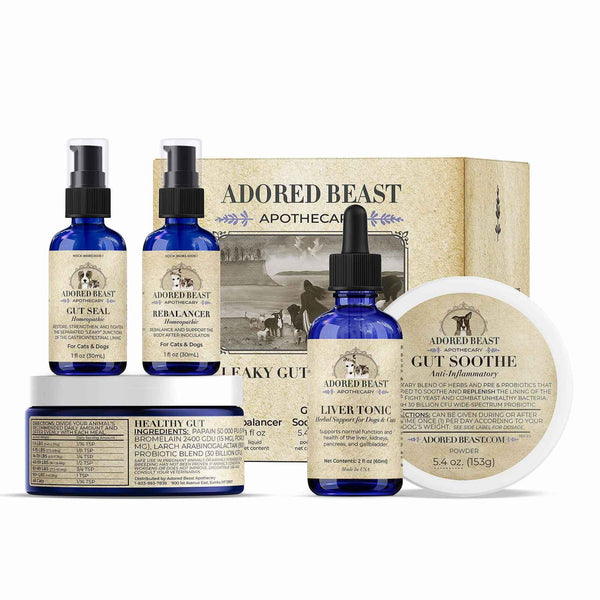
Leaky Gut Protocol
A five-product system built to support the gut lining, digestion, and the liver at the same time. It is the one I point pet parents toward when the pancreas has been inflamed for a while, because it works on the healing rather than the scarring.
- Gut Seal is included, which is made to support healing rather than scarring
- Healthy Gut adds digestive enzymes and larch arabinogalactan, the functional prebiotic favored for pancreatitis and EPI
- Liver Tonic supports the organs carrying the extra load
- Formulated for dogs, and often used after a course of antibiotics or medication
From $109.99 (dogs under 20 lbs) · $139.99 (dogs over 20 lbs)
21 reviews, 20 of them five-star · Free shipping over $150
Shop the Leaky Gut ProtocolIf SIBO has been confirmed instead, skip this one and see the side-by-side comparison below.
What tests should I ask my vet for?
If your dog keeps relapsing, the single most useful thing you can do is push for a fuller picture instead of assuming every flare is the same flare. Here is the ask list I would walk in with:
- A full blood panel, not a partial one. This looks at liver and kidney values too, which helps rule out other causes like a toxin.
- A cPL or lipase test. This is the pancreas-specific marker used to confirm pancreatitis.
- An abdominal ultrasound where available. It shows inflammation and rules out an obstruction or mass, often without repeated sedation.
- A cTLI test for EPI. A low result, at or below roughly 5.5 mcg/L in dogs, confirms exocrine pancreatic insufficiency.
- Cobalamin (B12) and folate together. A raised folate with low B12 points toward SIBO, and low B12 is worth correcting either way.
If the first round confirms pancreatitis and your dog later relapses, ask whether it is time to retest rather than assuming it is the same condition returning. That one question is often what breaks the cycle. This is also why annual bloodwork for dogs matters so much: a single result tells you far less than a trend you can compare against your own dog's baseline over time.
Free guide · No purchase needed
Not sure which of the three your dog has yet?
Then a product is not your next step, testing is. I put the whole thing into a free guide you can take to your appointment: Why Is My Dog Still Sick? The Truth About Pancreatitis, EPI and SIBO. It covers the exact tests to ask for and what the results mean in plain language, plus how diet and probiotics differ depending on what your dog is actually dealing with, so nothing you are giving makes things worse.
Get the free guideA simple journal you can copy
You do not need an app or a spreadsheet. A note on your phone is enough. The goal is to catch the patterns that a single vet visit never will. Track these each day, or at least on flare days and the two days before:
- Date
- Food: what they ate, including any new snacks, chews, or table scraps
- Stool: firm, soft, mucousy, or loose
- Appetite and energy: normal, up, or down
- Body signals: any stretching, hunching, gas, or reluctance to eat
- Stressors: daycare, boarding, visitors, travel, a vaccine or flea and tick application, heat, or a big jump in activity
After a few weeks you will start to see what lines up with the rough days. That record is one of the most powerful tools you can bring to your next vet appointment.
Frequently asked questions about recurring pancreatitis in dogs
Can a dog fully recover from recurring pancreatitis? Many dogs do very well once the full picture is understood and the right diet, gut, and pain support are in place. Because chronic inflammation can leave scarring, the aim is steady, long-term support rather than a single fix, and that is best mapped out with your vet.
How can I tell EPI or SIBO apart from pancreatitis at home? You cannot do it reliably, and that is the whole point. The signs overlap heavily, especially the diarrhea, which is why the blood tests above matter so much. Trust the testing over the symptoms.
Can I feed a raw diet if my dog has pancreatitis? Some dogs do beautifully on raw, but a pancreas that is actively struggling can find full raw too much at first. A gently cooked, well-hydrated diet is a common starting point, with a slow transition toward raw once the dog is stable. Work the pace out with your vet.
Are probiotics safe if my dog has SIBO? It depends on the type. Standard Lactobacillus and Bifidobacterium blends may feed an overgrowth in the small intestine, while soil and spore-based options are generally better tolerated when SIBO is confirmed. The research is still mixed, so match the probiotic to the condition rather than reaching for any blend.
Does stress really trigger pancreatitis in dogs? Stress is recognized as a contributing factor, and corticosteroids are a documented trigger. It is rarely the only cause, but for a dog that is already vulnerable, a stack of stressors landing at once can be enough to set off a flare.
The one thing I hope you take away
If your dog's pancreatitis keeps coming back, it may not be because you are failing. It may be because there is more going on than one condition, and no one has helped you connect the dots yet.
You do not need to change everything overnight. Start by asking your vet to look at the whole picture, pancreatitis, EPI, and SIBO together, rather than assuming every flare is the same flare. Slow down. Watch. Adjust one thing at a time.
Every dog is an individual, so always start slow and work alongside your veterinarian on any changes.
And if you want to go deeper, this post builds on a full Next Level Pet Parent Podcast episode on pancreatitis, EPI, and SIBO that is well worth your time.
Which support fits your dog: pancreatitis and EPI, or confirmed SIBO?
This is the fork in the road the whole post has been building toward. The same probiotic strategy that supports a dog with pancreatitis or EPI is the one to step away from when SIBO is confirmed. So the honest answer to "which should I buy" is that it depends entirely on what the testing showed. Here are the two paths side by side.
If it is pancreatitis or EPI
Leaky Gut Protocol
- Best for: a dog with confirmed pancreatitis or EPI, or one coming off antibiotics
- Probiotic style: diverse, multi-strain, with larch arabinogalactan
- Includes: Rebalancer, Liver Tonic, Healthy Gut, Gut Soothe, Gut Seal
- Sizes: dogs under 20 lbs, dogs over 20 lbs
- Not the one if SIBO has been confirmed
From $109.99
Shop Leaky Gut ProtocolIf SIBO is confirmed

SIBO Support Bundle for Dogs
- Best for: a dog with SIBO confirmed by B12 and folate testing
- Probiotic style: soil-based Bacillus strains, no Lactobacillus or Bifidobacterium
- Includes: Soil & Sea, EASE, Liver Tonic, Rebalancer, Gut Seal, Potent-Sea
- Options: Soil & Sea in 40g or 80g, EASE in Original or Extra Strength
- Not the one if the overgrowth has not been confirmed
From $268.94
Shop SIBO Support BundleStill waiting on results? Do not guess between these two. Download the free guide, get the testing done, then come back and pick the right path.
Sources
- Pancreatitis in Dogs. VCA Animal Hospitals. vcahospitals.com
- Pancreatitis in Dogs: Symptoms, Causes and Treatment. American Kennel Club, 2026. akc.org
- Exocrine Pancreatic Insufficiency in Dogs and Cats. Merck Veterinary Manual. merckvetmanual.com
- Malabsorption Syndromes in Small Animals. MSD Veterinary Manual. msdvetmanual.com
- Malabsorption and Bacterial Overgrowth in Dogs. VCA Animal Hospitals. vcahospitals.com
- Cobalamin in Veterinary Health and Disease. Today's Veterinary Practice, 2022. todaysveterinarypractice.com
- TLI, Folate & B12. Battlab / UK Veterinary Laboratory. battlab.com
- Serum cobalamin and folate as prognostic factors in canine exocrine pancreatic insufficiency: an observational cohort study of 299 dogs. PubMed, 2019. pubmed.ncbi.nlm.nih.gov
- Navigating Pancreatitis in Dogs During the Holiday Season. Oklahoma Veterinary Specialists, 2025. okvets.com
- A Comprehensive Review of the Usefulness of Prebiotics, Probiotics, and Postbiotics in the Diagnosis and Treatment of Small Intestine Bacterial Overgrowth. PMC / MDPI, 2025. ncbi.nlm.nih.gov
- FDA Conditionally Approves First Drug for Acute Onset of Pancreatitis in Dogs (fuzapladib / Panoquell-CA1). American Veterinary Medical Association, 2022. avma.org
This post grew out of a Next Level Pet Parent Podcast conversation with holistic vet Julie Anne Lee, DCH of Adored Beast Apothecary. Claims that go beyond the published research above (the cortisol-pancreas loop framing, the cooked-first diet approach, and the SIBO probiotic strategy) reflect holistic clinical practice and are written as approach and possibility, not as proven outcomes.
Disclaimer: This blog may contain affiliate links, and PAWDEGA may earn a small commission at no extra cost to you if you purchase through them. It may also link to products on our website, and this content is for educational purposes, not a replacement for veterinary advice.