On this page
- What is slippery elm and how does it work in a dog's gut?
- What does the research actually show?
- Why does every website give a different dosage?
- How long does slippery elm take to work?
- Why it needs to be given away from medications
- Is slippery elm safe for dogs?
- Where does it fit in a daily gut routine?
- Plain powder or a formulated blend?
- The bottom line
- Sources
Slippery elm for dogs is a mucilage-rich inner bark used to soothe an irritated digestive tract. Mixed with water it forms a slick gel that coats the lining of the gut, which is why holistic vets reach for it during bouts of diarrhea, vomiting, and acid reflux. Published dosing guidance ranges from roughly 100 mg to 400 mg of powder per 10 pounds of body weight, always given away from medications. Here is the part most articles leave out: the one study everyone cites as proof was not a study of plain slippery elm powder, and it had no control group.
So let me give you the honest version.
Slippery elm is one of the gentlest gut-soothing herbs available for dogs, and one of the most thinly evidenced, which means it earns a place in your cupboard alongside realistic expectations rather than a miracle story.
I know how badly you want something that works right now. When Milka was a puppy, my French Bulldog was a mess. Chronic diarrhea. Itchy hot spots. Vomiting in the middle of the night. I would have given almost anything to a dog who was suffering... and I would have believed almost any percentage on any website that promised relief.
That is exactly why I want to walk you through this one carefully.
What is slippery elm and how does it work in a dog's gut?
Slippery elm (Ulmus rubra) is a tree native to eastern North America. The part used is the inner bark, and its active component is mucilage, a complex polysaccharide that turns gel-like in water. Herbal monograph reviews of the species note the inner bark also contains tannins, starches, phytosterols, and minerals including calcium, iron, zinc, magnesium, and potassium.
The mechanism is physical, not pharmacological. Nothing is absorbed into the bloodstream to go to work systemically. The gel coats mucous membranes, forms a temporary barrier over irritated tissue, and holds water.
A clinical review of Ulmus rubra published in Clinical Advisor described that same fiber working in two directions: drawing water into dry stool in the colon, and adding bulk to loose, watery stool.
That dual action is why the same herb gets recommended for constipation and for diarrhea. It is not doing two clever things. It is doing one thing to two different problems.
What does the research on slippery elm for dogs actually show?
Start with what is solid, because it is more than most herbs can claim.
Elm bark is named in the FDA's over-the-counter monograph M022 as an approved demulcent active ingredient, listed alongside gelatin, glycerin, and pectin. That is federal regulatory recognition of the soothing action itself, and very few botanicals hold that status. It is not supplement marketing. It is in the monograph.
The mechanism is well described too. The NIH's LiverTox database attributes slippery elm's effects to its mucilages, working by stimulating mucus and coating irritated tissue through the throat, esophagus, and stomach.
The safety record is unusually clean. LiverTox also notes a Swedish national registry review of 778 spontaneously reported adverse reactions to complementary and alternative medicines, in which none were attributed to slippery elm.
On the human side, a 2010 pilot study by Hawrelak and Myers tested two multi-herb formulas in 31 people with IBS. The constipation formula, combining slippery elm bark with oat bran, lactulose, and licorice root, improved both bowel habit and symptoms. The formula built for diarrhea-predominant and alternating IBS improved several individual symptoms, although not bowel habit itself. Both arms were open-label and uncontrolled, which the authors state plainly.
And then there is the part no database captures. Decades of holistic and integrative veterinarians reaching for this herb, watching what happens in front of them, and continuing to reach for it. That is real clinical experience. It is not a randomized trial and should not be dressed up as one, but it is very far from nothing.
So why does that "93%" statistic keep coming up?
Here is what most pet parents are never told.
Search this topic and you will find one number repeated across dozens of sites. 93% of dogs with diarrhea responded within two days. Sometimes 82% of vomiting dogs. Usually described as "a 2013 study."
That study is real. I read it. It is McCullough, published in the Open Journal of Veterinary Medicine in 2013, covering 3,952 dogs and 2,248 cats across 197 veterinary practices in 48 states. The percentages are quoted accurately.
But it is not a study of the slippery elm in your cupboard.
- It tested a modified product, not plain bark. PEPPS is a magnesium-chelated, potency-enhanced elm mucilage engineered to behave like sucralfate. The paper states the elm concentration given was under 8% of the dose holistic vets recommend, at a formulation strength of 0.9%.
- There was no control group. The comparison point was each veterinarian's recollection of how quickly their previous cases usually resolved.
- It was layered on top of therapies that were already failing. No group received the elm product on its own.
- The participating veterinarians resold the product at a profit, which the author names openly as a self-selection bias.
- The author states the data has little predictive value for efficacy and calls for a randomized, blinded, placebo-controlled trial.
The fieldwork was funded by the company developing the compound, and the author holds a US patent on the saccharide composition.
I am not raising this to talk you out of slippery elm. I use it and I recommend it. I am raising it because if you quote that 93% to your vet and your vet reads the paper, you have spent credibility you did not need to spend. The soothing action stands perfectly well on its own without it.
Why is there no proper trial on plain slippery elm?
Because nobody can patent a tree.
Randomized controlled trials cost millions, and that money comes from whoever stands to own the result. No one owns Ulmus rubra. So the trials do not get funded, and the herb sits where most of traditional herbal medicine sits: long use, sound mechanism, thin formal literature.
Notice what actually happened with that 2013 study. The one person who did invest in research patented a modified version of the mucilage first, then studied that. Which is precisely why the only sizeable veterinary study on elm is not a study of the plain herb.
An absence of trials is not a failed trial. Memorial Sloan Kettering's monograph lists the diarrhea evidence as lacking, and that is fair, but lacking means unstudied, not disproven.
What that means for you in practice: use slippery elm for what it demonstrably does, which is coat and soothe irritated tissue. Do not ask it to resolve the reason the tissue became irritated in the first place.
Why does every website give a different slippery elm dosage for dogs?
Because there is no canine dose-finding study to anchor to. Every number you see traces back to herbal tradition and clinical experience rather than research.
Here is what published guidance says for plain slippery elm powder, which is the only fair comparison to make:
| Source | Amount per 10 lb | Frequency | Source type |
|---|---|---|---|
| Whole Dog Journal (Jean Hofve, DVM) | 1/4 tsp powder | Before meals | Veterinarian-authored |
| Dogs Naturally Magazine | 1/4 tsp powder | Not specified | Holistic pet health magazine |
| Starwest Botanicals | 400 mg, described as about 1/2 tsp | Not specified | Herb supplier |
| Adored Beast | 100 mg | 2 to 4 times daily | Supplement brand |
The teaspoons are the problem, not the herb
Look closely and most of that apparent disagreement is a measuring problem.
Starwest counts 1/2 teaspoon as 400 mg, which puts 1/4 teaspoon at roughly 200 mg. Whole Dog Journal's Dr. Hofve cautions that bulk slippery elm powder is very fluffy and should be packed down before measuring. So the same "1/4 teaspoon" can hold noticeably different weights depending on how loosely you scoop it.
Between that and the differences in dosing frequency, the real gap between these recommendations is far narrower than the numbers make it look. This is not five experts disagreeing about an herb. It is five people describing a soft, low-density powder using units that were never designed for it.
What you cannot compare to a scoop of powder
Two things get pulled into dosage comparisons online that do not belong there, and this trips up a lot of pet parents:
Prepared syrups and teas are diluted. Holistic Vet Blend recommends 1/2 to 1 teaspoon of prepared syrup for dogs under 25 pounds, every 8 to 12 hours. That syrup is made by simmering roughly a tablespoon of powder into a cup of water. A teaspoon of syrup is nowhere near a teaspoon of powder, and reading it as one will have you dosing far higher than you think.
Formulated blends are not slippery elm doses. Gut Soothe's label lists 220 mg of slippery elm bark plus 80 mg of a 4:1 slippery elm extract, which is why some retailer listings show a combined 540 mg figure for the same formula. But it sits alongside marshmallow root, deglycyrrhizinated licorice, L-glutamine, N-acetyl glucosamine, larch arabinogalactan, and a 14-strain probiotic blend at 30 billion CFU. Marshmallow root brings its own mucilage to the same job. The scoop size on a blend like that reflects the whole formula, and it is set at a daily supportive level rather than an acute one.
So when you compare products, compare like with like. Powder to powder. Blend to blend. A brand is not underdosing because its scoop looks small next to a tub of loose bark.
My honest read, and this is my opinion rather than a research finding: with plain powder, start at 1/4 teaspoon per 10 pounds, packed down, stirred into cold water until it thickens, and pay far more attention to your dog's stool than to the decimal point.
How long does slippery elm take to work in a dog?
Because the action is a physical coating, effects tend to arrive quickly and fade quickly.
The benchmark you will see everywhere is a response within two days or four doses. Remember where that came from. It was the threshold 85% of the veterinarians in that 2013 paper agreed would be faster than their usual experience, applied to a formulation that is not what is in your cupboard.
Practically speaking, mucilage does not stay in place. That is why the traditional approach uses several smaller doses across the day rather than one large one.
Why does slippery elm need to be given away from medications?
This is the detail most articles bury, and it is the one I most want you to hold onto.
Mucilage coats indiscriminately. It cannot tell the difference between an irritated gut wall and a tablet your vet prescribed. MedlinePlus, the NIH's consumer health database, flags this directly: mucilage can reduce how much of an oral medication the body absorbs, and it advises taking slippery elm at least one hour after any oral drug. A clinical review of Ulmus rubra puts the gap at two hours. Guidance published elsewhere stretches to three.
Adored Beast, whose Gut Soothe formula contains slippery elm, suggests giving it one to two hours after any pharmaceutical medication so the drug has time to absorb first.
The working rule: if your dog is on a medication that matters, and most of them do, put two hours between that medication and the slippery elm. Do not fold them into the same meal because it is easier.
Also worth naming honestly. The same coating action raises fair questions about nutrient absorption over long stretches of daily high-dose use. I have not found canine research either way. So I approach extended high-dose slippery elm as something with a purpose and an end date, not something to run indefinitely by default.
Is slippery elm safe for dogs?
By herbal standards it has a strong safety record, and it is widely considered one of the gentler herbs used in dogs. Allergic reactions are always possible with any botanical. Adored Beast's own label notes that safe use in pregnant animals, or animals intended for breeding, has not been established.
But the bigger safety question is not the herb. It is what a soothed dog can hide.
Slippery elm may reduce a visible symptom while the cause of it carries on underneath. A veterinarian quoted in Animal Wellness Magazine, Dr. DiGrazia-Weigand, recommends slippery elm for calming the gut in acute diarrhea, and cautions that diarrhea needs prompt veterinary attention if there is blood in it or if there are repeated uncontrollable bouts.
When to stop and call your vet
- Blood in the stool, either bright red or dark and tarry
- Vomiting continuing alongside the diarrhea
- Signs of dehydration, lethargy, or pain
- No improvement after a day of home support
- Diarrhea that clears and returns the moment you stop
- Any puppy, any senior, or any dog with an existing condition
Number five matters more than it looks. A symptom that comes back the second support stops is not a symptom asking for more slippery elm. It is a symptom telling you the root cause has not been addressed.
Free guide
Why Is My Dog Still Sick? The Truth About Pancreatitis, EPI & SIBO
If the diarrhea keeps coming back the moment you stop supporting it, the herb is not the question any more. This free guide walks through the digestive conditions that keep a dog cycling through flare after flare, and where to start looking.
Where does slippery elm fit in a daily gut routine?
For an acute flare, standalone slippery elm powder mixed into a slurry is the traditional tool, and it is inexpensive.
For ongoing support, I would rather see it as one component in a formula than as the whole plan. Gut Soothe is the one I keep in rotation, because the slippery elm in it is working with marshmallow root, deglycyrrhizinated licorice, L-glutamine, N-acetyl glucosamine, larch arabinogalactan, and a 14-strain probiotic blend rather than carrying the whole job alone. Marshmallow root is also the more sustainable half of that mucilage pairing, which matters for the reason above.
The blend I keep in rotation
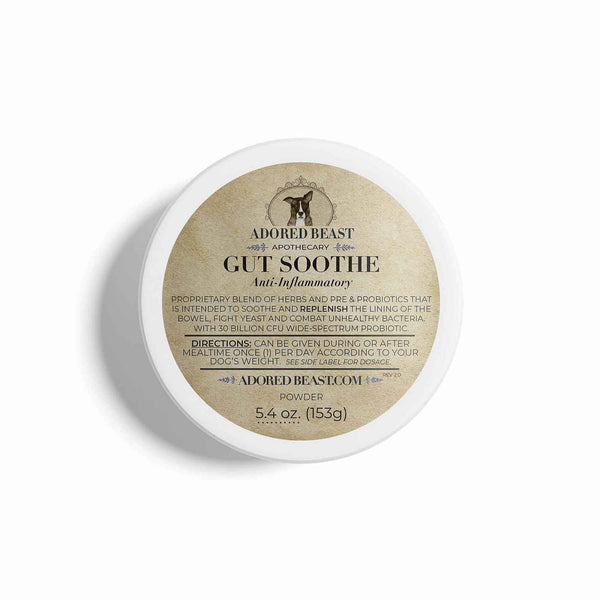
Canine Gut Soothe by Adored Beast
Slippery elm bark working alongside marshmallow root, deglycyrrhizinated licorice, L-glutamine, N-acetyl glucosamine, larch arabinogalactan and a 14-strain probiotic blend at 30 billion CFU. Two mucilages instead of one, plus the probiotic base, which is why this is the version I reach for day to day rather than a tub of loose bark.
- Formulated at a daily supportive level, not an acute demulcent level
- Give it one to two hours after any oral medication
- Two jar sizes, and a cat version below
Available as a one-time order or on subscription, and Adored Beast subscriptions carry a standing discount plus milestone rewards. Full details on the product page.
As covered earlier, a blend like this sits at a daily supportive level rather than an acute demulcent level. If your dog is in an active flare, that is a different conversation, and one worth having with your vet.
Cats get their own version, Feline Gut Soothe, formulated at lower amounts with hairballs in mind.
Reading this for a cat?
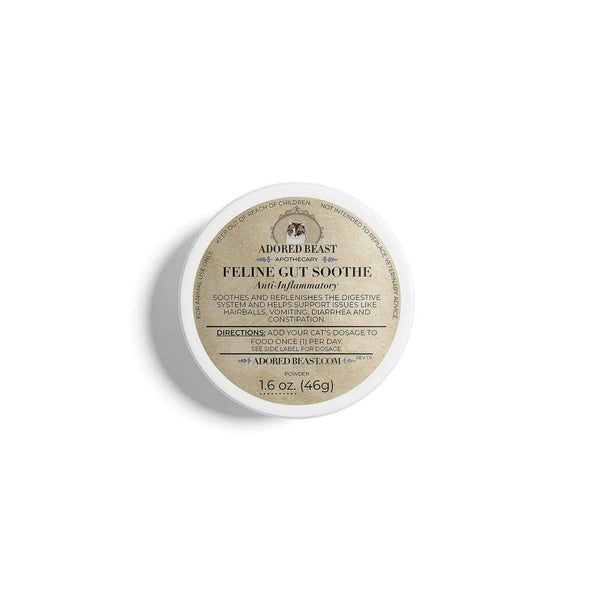
Feline Gut Soothe by Adored Beast
The same idea scaled for a cat, with slippery elm bark at a much lower amount, a 15 billion CFU probiotic base, and hairballs accounted for in the formulation. Cats are not small dogs, and the dosing here reflects that.
See Feline Gut SootheAnd if the flares keep coming back, the herb is not the answer to look for. That is a gut conversation, and I wrote a longer piece on dog gut health that covers where to start.
Plain powder or a formulated blend?
This is the choice most pet parents are actually making, so here it is side by side. It is not a question of which one is better. It is a question of which job you are doing.
| Plain slippery elm powder | A formulated blend (Gut Soothe) | |
|---|---|---|
| What it is for | An acute flare, where you want a coating action now | Ongoing daily support of the gut lining and microbiome |
| Dosing level | Acute demulcent level, several smaller doses across the day | Daily supportive level, once per day by weight |
| Mucilage source | Slippery elm alone | Slippery elm plus marshmallow root, the more sustainable half of the pairing |
| What else it does | Nothing else, and that is the point of it | Adds a 14-strain probiotic base, L-glutamine, DGL, N-acetyl glucosamine and larch |
| Measuring | Fluffy and easy to under-measure, so pack it down | Scoop reflects the whole formula, not the elm content |
| Medication spacing | Two hours either way | One to two hours after any oral medication |
| How long to run it | A purpose and an end date, not indefinitely | Suited to daily use, and to rotating with other probiotics |
The bottom line on slippery elm for dogs
Slippery elm may help soothe an irritated gut. That is a real claim, mechanistically sensible and supported by a long history of traditional use, and it is honestly the full extent of what the current evidence supports.
You do not need the 93% statistic to justify keeping it on hand.
You need to know what it does. How far apart to space it from medications. When it is buying you comfort instead of answers. And when to stop and pick up the phone.
That is not a smaller reason to use something. It is a far more durable one.
I am rooting for you, and your dog, every step of the way.
Much Love, Larry
Disclaimer: This blog may contain affiliate links, and PAWDEGA may earn a small commission at no extra cost to you if you purchase through them. It may also link to products on our website. This content is for educational purposes and is not a replacement for veterinary advice. I am not a veterinarian, so please work alongside your vet, ideally a holistic or integrative vet, for anything ongoing or serious.
SOURCES
- McCullough, R.W. "Expedited Management of Canine and Feline Vomiting and Diarrhea. Observational Study in 3952 Dogs and 2248 Cats Using Sucralfate-Like Potency-Enhanced Polyanionic Phyto-Saccharide, Elm Mucilage." Open Journal of Veterinary Medicine, Vol. 3, No. 3, 2013, pp. 228-234. DOI: 10.4236/ojvm.2013.33036. https://www.scirp.org/html/4-2280073_34284.htm
- Hawrelak, J.A. and Myers, S.P. "Effects of two natural medicine formulations on irritable bowel syndrome symptoms: a pilot study." Journal of Alternative and Complementary Medicine, Vol. 16, No. 10, 2010, pp. 1065-1071.
- "Slippery Elm." Memorial Sloan Kettering Cancer Center, Integrative Medicine herb monograph. https://www.mskcc.org/cancer-care/integrative-medicine/herbs/slippery-elm
- "Slippery elm: an effective anti-inflammatory agent." Clinical Advisor, clinical review of Ulmus rubra. https://www.clinicaladvisor.com/features/slippery-elm-an-effective-anti-inflammatory-agent/
- "Slippery Elm, Ulmus rubra." United Plant Savers At-Risk species profile. https://unitedplantsavers.org/slippery-elm-ulmus-rubra/
- "Slippery Elm (Ulmus rubra): Benefits, Safety, Uses." Herbal Reality herb monograph and sustainability guidance. https://www.herbalreality.com/herb/slippery-elm/
- Hofve, J., DVM. "Slippery Elm for Dogs: Safely Treat Irritation." Whole Dog Journal, 2024. https://www.whole-dog-journal.com/care/slippery-elm-for-dogs-safely-treat-irritation/
- "Slippery elm for dogs and cats." Animal Wellness Magazine, 2025, including veterinary comment from Dr. DiGrazia-Weigand. https://animalwellnessmagazine.com/slippery-elm-for-dogs-and-cats/
- "Using Slippery Elm for Dogs for Digestive Upset." Adored Beast Apothecary blog, dosing and medication-timing guidance. https://blog.adoredbeast.com/using-slippery-elm-for-dogs-for-digestive-upset/
- "Gut Soothe" product label and ingredient panel. Adored Beast Apothecary. https://adoredbeast.com/products/canine-gut-soothe
- "Slippery Elm for Dogs: Everything You Need To Know." Starwest Botanicals, dosing guidance. https://www.starwest-botanicals.com/blog/slippery-elm-for-dogs-everything-you-need-to-know-starwest-botanicals/
- "9 Times Slippery Elm Can Help Your Dog." Dogs Naturally Magazine. https://www.dogsnaturallymagazine.com/the-soothing-qualities-of-slippery-elm/
- "Slippery Elm for Dogs." Holistic Vet Blend, dosing and medication-separation guidance. https://holisticvetblend.com/blogs/news/slippery-elm-for-dogs
- "Slippery Elm." Gaia Herbs, statement on discontinuing use due to At-Risk status. https://www.gaiaherbs.com/blogs/herbs/slippery-elm
- "OTC Monograph M022: Oral Healthcare Products for Over-the-Counter Human Use," section M022.18 Demulcents, listing elm bark as an approved demulcent active ingredient. U.S. Food and Drug Administration, 2022. FDA OTC Monograph M022 (PDF)
- "Slippery Elm." LiverTox: Clinical and Research Information on Drug-Induced Liver Injury, National Institute of Diabetes and Digestive and Kidney Diseases, NCBI Bookshelf, 2024. https://www.ncbi.nlm.nih.gov/books/NBK599741/
- "Slippery Elm." MedlinePlus, U.S. National Library of Medicine, drug and supplement interaction guidance. https://medlineplus.gov/druginfo/natural/978.html