Turkey tail mushrooms for dogs are a food-grade fungal extract used to support immune function, and turkey tail is the most heavily studied medicinal mushroom in canine cancer research. Two trials have tested it in dogs. A small 2012 trial at the University of Pennsylvania found dogs with splenic hemangiosarcoma given a high dose of PSP, the active fraction, reached a median survival of 199 days after surgery, against 19 to 86 days historically reported for surgery alone. A larger 2022 trial did not repeat that finding.
Turkey tail may support a dog's immune system alongside veterinary care, the canine evidence is one encouraging small trial and one larger trial that did not confirm it, and nothing in that research supports using it in place of the plan your vet has given you.
What this article covers
- What turkey tail is, and what is actually in it
- Is it safe alongside my dog's veterinary plan?
- What the research on turkey tail mushrooms for dogs shows
- Does it do anything for a dog with no illness?
- Which form delivers the beta-glucans?
- How much turkey tail do you give a dog?
- What to watch, and what is not a fair test
- Five questions to ask your vet first
If you are reading this because of an appointment a few weeks ago, I want to be straight with you.
You have probably already found the Penn study. It is on every page selling mushrooms, including some of ours. What you have almost certainly not found is the follow-up trial, published ten years later, which looked at the same mushroom in the same cancer and came back with a different answer.
You deserve both. Not because the first one was wrong, but because you are the one making the decision, and everyone around you right now is trying to make you feel better rather than tell you what is known.
What is turkey tail, and what is actually in it?
Turkey tail (Trametes versicolor, previously called Coriolus versicolor) is a bracket fungus that grows in overlapping fans on dead hardwood, banded in the rings that give it its name. It is not a culinary mushroom. It is tough, woody, and used as an extract.
The compounds people are after are beta-glucans, a class of long-chain polysaccharide. Turkey tail is unusually rich in them: laboratory analysis using the Megazyme assay measured more than half of its dry weight as glucan, which puts it among the highest of any mushroom tested.
Two specific fractions carry almost all of the research history:
- PSK, also called polysaccharide-K or Krestin, isolated from one strain in Japan and used there as a prescription adjunct in oncology since the mid-1970s.
- PSP, polysaccharopeptide, isolated from a different strain and produced in China. This is the fraction used in both dog trials.
According to the National Cancer Institute's review of medicinal mushrooms, the immune effects are thought to come from these high-molecular-weight polysaccharides stimulating innate immune cells: monocytes, natural killer cells, and dendritic cells. Worth knowing, and rarely mentioned: Memorial Sloan Kettering's own monograph notes it is still unclear whether PSK, PSP, and other turkey tail extracts have comparable effects. They are related, not interchangeable.
Is turkey tail safe alongside my dog's veterinary plan?
This is the question that matters before any other one, so here is the honest version.
The human safety record is genuinely good. PSK has been given as an adjunct to thousands of people in Japan since the mid-1970s with few adverse events reported. A Cochrane systematic review of seven randomized trials covering 1,569 people found little to no difference in withdrawals due to adverse events, though it also concluded the certainty of that evidence was very low.
In dogs, no published study has tested high doses of turkey tail specifically for safety in dogs as the target species. That gap is real and you should know it exists.
Two things to raise with your vet directly. Medicinal mushrooms may interfere with immunosuppressant medications, so if your dog is on anything in that category, that conversation happens before the first dose. And products sold as turkey tail are not standardized between brands, which means "turkey tail" on two labels can mean two different things in the bottle.
Please keep in mind that I'm not a veterinarian, and this isn't medical advice. Every pet is unique, so I always recommend working alongside your vet, ideally a holistic or integrative vet, especially for anything ongoing or serious. If you do not have one, we keep a list of holistic vets who consult online.
What does the research on turkey tail mushrooms for dogs actually show?
Two canine trials. Both in splenic hemangiosarcoma, both after the spleen was surgically removed.
The 2012 pilot (Brown and Reetz, University of Pennsylvania). Fifteen dogs whose families had declined chemotherapy were randomized, double-blind, to one of three daily doses of a PSP product: 25, 50, or 100 mg per kg of body weight. In the highest dose group, the median time to development or progression of abdominal metastases was 112 days, compared with 30 days in the lowest dose group (p = 0.046). Median survival was longest in the high dose group at 199 days. The researchers described these as the longest survival times reported in canine hemangiosarcoma.
Two details that almost never travel with that headline. Fifteen dogs is a pilot, and the differences in overall survival between the three dose groups were not statistically significant. The trial was also funded by a grant from the company that makes the product being tested, which does not make the result wrong, but is something you are entitled to weigh.
The 2022 trial (Gedney and colleagues, Veterinary and Comparative Oncology). A larger prospective study asked the next question: does adding PSP to standard care help? It did not. Adding PSP to doxorubicin after surgery did not improve survival. There was no significant survival difference between groups for male dogs. And female dogs given PSP alone did significantly worse than females who received doxorubicin plus a placebo (p = 0.004). The strongest negative factors for survival were anemia (p < 0.001) and stage III disease.
Read that middle finding again, because it is the most useful sentence in this entire article. The dogs who did worse were not the dogs who added a mushroom. They were the dogs who used it instead of chemotherapy. That is the clearest evidence available that turkey tail belongs alongside a veterinary plan, never in place of one.
The human evidence is stronger than the canine evidence, which is an odd thing to say about a dog supplement, but it is the situation. A meta-analysis of 1,094 people with surgically resected colorectal cancer found PSK added to chemotherapy improved overall survival, at a pooled risk ratio corresponding to roughly a 29 percent lower risk of death (p = 0.006), with the same direction of effect for disease-free survival (p = 0.003). Against that, the Cochrane review found only low-certainty evidence of a small survival benefit at five years. And the FDA has not approved medicinal mushrooms for cancer or any other condition in the United States.
So: a real signal, an unconfirmed one in dogs, and a body of human work that is better but still argued over. That is the whole picture.
Does turkey tail do anything for a dog who is not ill?
Probably, though the dog research here is about beta-glucans generally rather than turkey tail specifically, and I would rather tell you that than blur it.
In a study of 30 puppies, oral beta-glucan at 4 mg per kg daily for 98 days produced protective antibody titers against rabies and canine parvovirus earlier than in the unsupplemented group, along with higher serum antibody levels. A separate study in growing dogs found beta-glucan supplementation raised fecal IgA and butyrate and shifted the microbiota, including higher Faecalibacterium and Blautia.
Neither used turkey tail. They used purified beta-glucans from other sources. What they establish is that a dog's immune system responds to this class of compound, which makes turkey tail plausible rather than proven for daily immune support.
For a healthy dog, this is also why rotation makes more sense than commitment to one mushroom. I alternate rather than run the same thing all year, and the usual partner for turkey tail is chaga, which carries a different antioxidant profile. If you would rather start with food than a bottle, our mushroom broth recipe is a gentle way in, and it sits well next to the antioxidant-rich foods worth adding to a bowl.
Which form of turkey tail actually delivers the beta-glucans?
This is where most money is wasted, and it has nothing to do with brand loyalty. It is about what is physically in the powder.
Beta-glucans sit inside a tough cell wall. Feeding dried, milled mushroom means most of them stay locked in that structure. Hot water extraction is what pulls them into solution and makes them available. Alcohol extraction pulls out a different group of compounds, the triterpenes, which is why dual and triple extraction exist at all.
The bigger problem is mycelium grown on grain. When a producer grows fungus on rice, oats, or sawdust, and mills the whole thing, the grain cannot be separated out. Analytical work by the developers of the standard beta-glucan assay found that in these products the grain starch remains intact and is by far the major glucan present, with beta-glucan content far lower than in the mushroom itself. The label says mushroom. The jar is mostly rice.
Scroll sideways to see the full table.
| What the label says | What you are buying | Beta-glucans available |
|---|---|---|
| Mycelium, mycelial biomass | Fungus grown on rice or oats, milled with the grain | Low, with starch as the main glucan |
| Fruiting body powder | Dried, milled mushroom, not extracted | Present, mostly locked in the cell wall |
| Hot water extract | Beta-glucans pulled into solution | High, this is the step that matters |
| Dual or triple extract | Water plus alcohol, sometimes glycerin | High, plus triterpenes |
| Proprietary blend | Unknown split between species and substrate | Not stated |
The number to ask any brand for is a batch beta-glucan figure measured by the Megazyme assay, not a "polysaccharides" figure, which can be largely grain starch and still be technically accurate. Be aware that most mushroom products sold for pets do not publish one, including some good ones. Asking is still the right move, and how a company answers tells you a great deal.
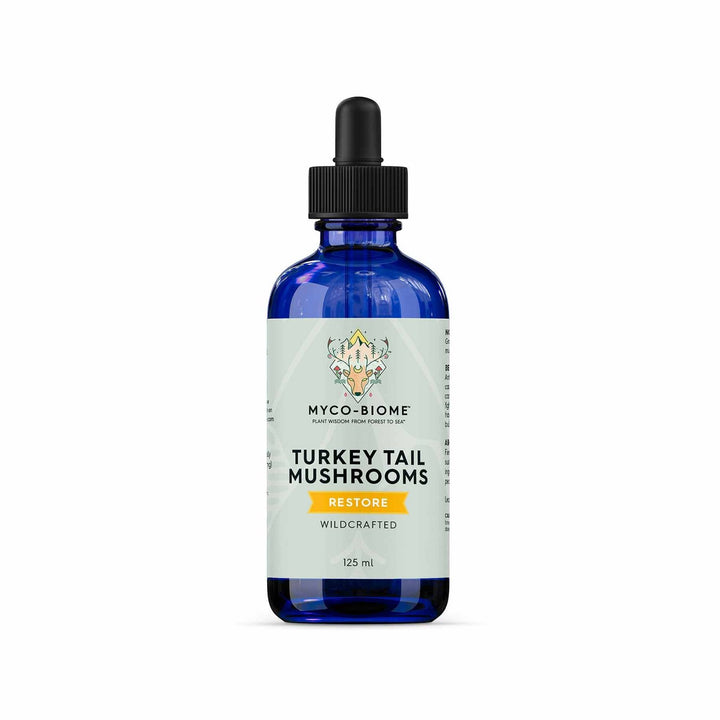
The one we chose to carry
Turkey Tail Mushrooms, Liquid Triple Extract
If you have read this far you already know why this is the form we carry rather than a powder or a capsule. The extraction step has actually been done, the mushroom is fruiting body with nothing grown on grain, and the label states a milligram figure per drop, which means the arithmetic in the next section is possible instead of guesswork. Most mushroom products sold for pets fail at least one of those three.
- Fruiting bodies only, no mycelium and no grain substrate
- Triple extracted: hot water first, then organic alcohol for the triterpenes, then glycerin
- Each batch tested to confirm no alcohol remains in the finished tincture
- Wild harvested in Maritime Canada and British Columbia, on trees in a forest rather than in a lab
- One drop is 10 mg, so you can work out the daily milligrams and take that number to your vet
- 125 ml bottle, and it can be set to arrive on a recurring schedule so a routine never breaks mid-course
How much turkey tail do you give a dog?
Follow the label on the product in your hand. Then do one piece of arithmetic, because it will change how you read that label.
The dose where the 2012 trial saw its effect was 100 mg per kg of body weight per day. For a 20 kg dog, roughly 44 pounds, that is about 2,000 mg of PSP daily.
Now look at a typical liquid extract sold for dogs. Many work out to around 10 mg per drop, dosed at a drop per pound of body weight. That same 44 pound dog lands near 440 mg a day, which is a fraction of the trial dose.
The label is not wrong. It is a general wellness dose, and it is not the dose that was studied in dogs with cancer. Those are two different things being sold in the same bottle, and almost nobody says so.
What to do with that: work out the milligrams your product delivers per day, write the number down, and take it to your vet along with the trial figure. Do not scale up on your own. Higher is not automatically better with an immune-active compound, and your vet is the one who knows what else is on board.
On duration, many holistic practitioners work in blocks of at least six weeks before judging anything. That is practice convention rather than trial data, and I would hold it loosely.
What should you watch, and what would not be a fair test?
You are going to want to know whether it is doing anything. Here is how to give yourself a real answer.
Watch appetite, energy on the same walk you always do, and stool consistency. Watch gum color, because anemia was the strongest negative factor for survival in the 2022 trial and it is something you can notice at home between appointments. And watch whichever bloodwork values your vet is already tracking, on their schedule, not a schedule you invent.
What is not a fair test: two weeks. Changing four things in the same week so nothing can be attributed. Judging by the tumor alone when comfort, appetite, and energy are the things you actually live with day to day.
Keep a dated log. One line a day. If you are the sort of person who already has a spreadsheet of bloodwork values, you know exactly why.
Five questions to ask your vet before you start
Write these down and take them in. Every one of them is designed so you can hand this over without any suggestion that you are going around your vet.
- Is there any reason turkey tail would interact with the specific medications my dog is on, particularly anything immunosuppressive?
- This product delivers this many milligrams a day. Is that a sensible amount for her weight?
- Would you rather she had it during chemotherapy weeks, or in the gaps between them?
- Which bloodwork values would you like to keep an eye on while she is on it?
- If you would rather she did not have it at all, tell me, and she will not.
That last question is the one that changes the conversation. It tells your vet you are a partner rather than a problem, and in my experience it is the reason those conversations go well.
You are allowed to ask what else. Doing everything your vet said is not the same thing as doing everything, and the fact that you are here reading about a bracket fungus says something true about you.
Her body is still doing the work. This is about supporting it, honestly, with your vet, and with your eyes open about what is known and what is not.
I'm rooting for you, and your dog, every step of the way.
Warmly,
Charly
Sources
- Brown DC, Reetz J. Single agent polysaccharopeptide delays metastases and improves survival in naturally occurring hemangiosarcoma. Evidence-Based Complementary and Alternative Medicine, 2012. Read the study
- Gedney A, Salah P, Mahoney JA, et al. Evaluation of the anti-tumour activity of Coriolus versicolor polysaccharopeptide alone or in combination with doxorubicin for canine splenic hemangiosarcoma. Veterinary and Comparative Oncology, 2022. Read the abstract
- Sakamoto J, Morita S, Oba K, et al. Efficacy of adjuvant immunochemotherapy with polysaccharide K for patients with curatively resected colorectal cancer: a meta-analysis of centrally randomized controlled clinical trials. Cancer Immunology, Immunotherapy, 2006. Read the abstract
- Pilkington K, Wieland LS, Teng L, et al. Coriolus (Trametes) versicolor mushroom to reduce adverse effects from chemotherapy or radiotherapy in people with colorectal cancer. Cochrane Database of Systematic Reviews. Read the Cochrane summary
- National Cancer Institute. Medicinal Mushrooms (PDQ), Health Professional Version. Read the NCI summary
- Memorial Sloan Kettering Cancer Center. Coriolus versicolor, integrative medicine herb monograph. Read the monograph
- McCleary BV, Draga A. Measurement of beta-glucan in mushrooms and mycelial products. Journal of AOAC International, 2016.
- Effects of orally administered beta-1,3/1,6-glucan on vaccination responses and immunological parameters in dogs. Food and Agricultural Immunology, 2017. Read the study
- Effects of yeast beta-1,3/1,6-glucans on nutrient digestibility, intestinal functionality, and immune and antioxidant variables in growing dogs. Read the study