The issue is coming from a much deeper level. So when you just take the mindset of addressing skin disease topically, it never works. It just suppresses the symptom for a very short period of time, and then they come back.
The medications that we hear the most about are actually Apoquel and Cytopoint. Those are all based to suppress the immune system.
I don’t know any animal that can have really good quality of life for long periods of time on immunosuppressive drugs. They are not long-term solutions. It’s just that simple.
If you allow this to keep happening and keep happening, and then you give more drugs and more drugs and more drugs, and all that stuff’s getting filtered into the bloodstream, the body finally goes, “Holy, we don’t know what to do.” So we’re just going to attack everything.
I feel personally that most of the diagnosed allergies are misdiagnosed. They’re not true allergies. They are either…
Oh.
Is your dog constantly scratching or dealing with frustrating allergies that never seem to go away?
Today, we’re uncovering natural solutions that go beyond the usual expensive vet visits and conventional medications that don’t seem to work.
Our holistic pet wellness expert will help you finally get to the root cause of the problem, so you and your pet can enjoy life. It’s free.
Welcome back to our podcast. Thank you for tuning in today, and thank you for being such a next level pet parent, taking your pet’s health into your own hands.
At PAWDEGA, we find that allergies and itchy skin are the number one wellness concern that pet parents struggle with and seek our support for.
So today, we are going to deep dive with a true holistic expert on the topic, Julie Anne Lee.
Julie Anne is a homeopath and the founder and formulator of one of our absolute favorite pet brands, Adored Beast Apothecary.
She is an absolute powerhouse in holistic pet care, and has been the owner and practitioner of some of the busiest and longstanding holistic veterinary hospitals in North America.
If you are tired of seeing your dog scratching and just want to find a natural solution that actually works, make sure to listen to this whole episode, as Julie shares lots and lots of tips with us that are very practical and very easy to implement.
Thank you so much for joining us today, Julie, to talk about natural solutions for pet allergies and itchy skin.
You’re very welcome. Big topic. Yes. Very, very big, important, super important topic.
Honestly, it’s one of the number one questions that we get at PAWDEGA, is how to naturally support dogs and cats with itchy skin and allergies.
So we’re super excited to be diving into that with you today and to get your expert opinion on natural solutions that actually work.
It’s a nice segue into the podcast too, because it was the first product that we launched, and that came from a place where I went to a vet conference in the U.S. And there was a really lovely veterinarian from the SPCA, talking about rescue and the SPCA and things like that.
And I was floored when she said the number one reason for deaths in dogs was cancer, but the number one reason for elected euthanasia was skin disease. And in that moment, I mean, I had been seeing tons and tons at my practice, but in that moment I just thought, something’s wrong.
There’s something very wrong. I could see why it would be for one reason, because animals, when they get skin disease, it is horrific. They’re always itchy. They’re suffering. They smell. People are spending a fortune and not getting anywhere, just a vicious circle trying everything.
So I understood why it was like, people like to do the nice, you know, dogs are walking around with cones on their heads. And, “Oh my gosh, I don’t put them up on the couch because they smell, they stink, oozing.”
It’s like, kind of life is that for anything. And also the hurt and the pain for the pet parents as well, to see your dog suffering like that. It’s also really heavy.
Thankfully, we haven’t had this experience with our own dog, but we have taken care of foster dogs before who have had really bad skin, and it’s so painful to watch.
All right, so let’s dive right in.
Can we just talk a little bit about the word “skin disease”? Because, honestly, when pet parents get in touch with us personally at PAWDEGA, they always mention allergies.
I don’t think anyone has ever messaged us about skin disease. I think it’s a term that a lot of veterinarians don’t really use. So at what point would you say does a dog have skin disease? Do you also include just itchy skin into that term, skin disease, as well?
I do. Anything for me, anything that the disease is expressing through the skin, whether that’s an allergy, whether that is something caused from their immune system, something that’s even like a chemical reaction to something, a reactivity.
And the reason I use skin disease is because I feel personally that most of the diagnosed allergies are misdiagnosed. They’re not true allergies.
They are either a sensitivity, a reactivity to food, or the body is reacting or sensitive. It’s not a full-blown allergy, but it looks like it is.
Like, “Don’t tell me my dog’s not allergic to beef, because every time I feed him beef, he blows out hot spots.” Well, that very well could be reactive, sensitive, or reactive to beef.
Not a full beef allergy, but it looks exactly the same. Or like I said, a secondary skin infection from environmental sensitivities.
So when I talk skin disease, I’m using skin disease as a blanket statement. Any kind of autoimmune, immune-mediated allergies, food sensitivities, and it manifests through the skin rather than arthritis, rather than heart disease, rather than inflammatory bowel disease in the ears or on the skin.
And that’s a term that a lot of holistic vets are using rather than an allergy, because more often than not, they’re not real allergies.
So coining the term an allergy, I think vets use that as a method or an easier way to communicate to pet parents, so that they kind of have an idea that if your dog keeps eating beef, he’s going to keep getting itchy. Yeah, right.
But for me it’s, why is it itchy? And in my practice, and I’m not joking, I mean 25 years of it, is animals that couldn’t eat anything. They couldn’t even eat the vet-prescribed allergy foods anymore, because nobody ever dug deep enough to deal with the real issue of what was going on.
And then eventually they just become sensitive or allergic or reactive to almost everything, because you’re really not addressing at the core level of why, why, why they’re having these skin symptoms.
Lots of pet parents feel really lost when it comes to understanding their dogs’ and cats’ allergies, and what is actually causing this to happen.
Can you help us get a clearer picture of why allergies and itchy skin are so common in pets, and what is going on right now?
Is there anything unique going on with our pets’ immune system or the environment that is causing their symptoms?
Before we start, I really want to make a strong statement that I feel like it’s important to empower people with that knowledge. But empowering people with that knowledge is not about guilt, right?
Yes, yes. I remember being in my hospital and people coming to me, and me explaining my philosophies on what’s going on, and talking to them about things that I’ve gone to conferences about, and putting two and two together.
And everything that I’m learning, and trying to just teach that to people. And a lot of people feel guilt when you really break it down to the possibilities of what might be contributing to allergies and skin disease.
People feel like they have caused it, and that’s not what this is about, in any way, shape, or form.
People that are watching this podcast right now are dedicated to their animals and love their animals, and there’s zero reason for any kind of feeling bad or feeling guilty.
Definitely.
I think that when we look at animals and we look at skin disease in general, even children with eczema, so let’s start with that, because we can break that down into things that are pretty easy for people to understand.
A lot of children get really bad eczema, and what they link it to sometimes is that the lungs are the last organ to actually mature in the fetus and in the infant.
And if the lungs aren’t fully matured, which you wouldn’t know when the child is born if they’re able to breathe and everything, but if they aren’t fully matured, your skin breathes in.
Your skin is the largest organ on any body, whether it’s a horse, a cow, a dog, a cat, a pig, a person, doesn’t matter.
So a big part of the research went into is that the detoxification that the lungs normally do can’t do, so the detox comes up through the skin.
Right. So there’s a link there.
So as a homeopath and someone that’s really dug into dermatology and really dug into skin disease because it’s such an issue and such a thing that they suffer with, one thing I can say is it’s not topical.
It’s not something that’s attacking the outside. There are things that can contribute from an external perspective, like environmental allergies, or putting stuff on your sofas, and soaps, and things like that.
But bathing can exacerbate the situation. The issue is coming from a much deeper level.
So when you just take the mindset of addressing skin disease topically, it never works. It just suppresses the symptom for a very short period of time, and then they come back.
So I feel like we just need to look at, you know, I always say that the Canada Food Guide is like 25 years too old.
But when you look at what doctors are telling us in the last maybe 5 to 10 years about our own health, it’s eat fresh fruits and vegetables.
When you’re going grocery shopping, go shop on the outside of the store. Fresh fruits and vegetables, and meats, and things like that.
A cell is a cell is a cell. So a cell in a dog, a cat, a person, a horse… what causes cell death, cell disease, or being unwell is the same thing that it causes with people.
So when we dig into looking at animals and what they’re fed, it’s a big one. It’s a massive, massive one.
We’re feeding dogs and cats processed food. It’s no different than you going and opening up a box of, I’m just going to use Kraft Dinner as an example, and just eating Kraft Dinner and nothing else, and taking a multivitamin and mineral.
It keeps you alive, but it doesn’t keep you thriving. It doesn’t do anything for cell oxidation, doesn’t do anything as prevention, doesn’t do anything for aging. It just keeps you alive.
So we feed our animals that. And even if they’re putting everything that it says on the bag in there, you just can’t negate the fact that it’s dead food, and nothing is going to thrive eating that.
So that’s a baseline. And then you add on lots of different things, like vaccinating too often. I’m not against vaccinations. I’m against over-vaccinations.
I’m against vaccinating puppies and kittens too young, which sets off the whole autoimmune response of vaccines, so that the body winds up attacking things that it shouldn’t attack because it already has an antibody.
So you look at that, then you look at all of the flea and tick medications that we’re putting on them.
And then you look at them going on antibiotics all the time because they start getting itchy and then they get secondary infections.
So it’s layers. Skin disease, layer after layer after layer after layer. So the body is trying to detoxify what’s going on, and what’s coming out on the skin.
It’s the least life-threatening organ. So it’s interesting, because the body is still quite vital when it’s trying to push out toxins through the skin.
But when we continue to try and suppress those symptoms that are coming out on the skin, what we actually, in fact, do is push it down into a deeper disease.
So whether that deeper disease comes from the side effect of a drug, like liver disease or kidney disease, allergies and skin disease is a manifestation of many, many, many things.
But also, they’re often born with it. When we look at causation, a puppy or a kitten can be born already set up to have skin disease because they’re born with a very, very weak gut microbiome.
So if the mother’s been fed processed food and doesn’t have any live food, or has been given a lot of drugs or antibiotics, their microbiome is really unhealthy.
Therefore, the puppy and the kitten, its microbiome will be unhealthy. And why that’s important is because the microbiome directly affects sometimes even up to 90% of our immune system, in your animal’s immune system.
And you think, okay, well, why is it immune system and skin disease? Well, for many reasons.
If the immune system is too high, which is called autoimmune, that means that the body has been debilitated for a length of time, that then it becomes overreactive.
And that’s when you see a lot of the allergies, because the body goes into a state of overreactivity.
Or if they have some kind of neuritis, seborrhea, or skin reactivity, which is very different than an allergy.
If they are reactive to certain proteins, and then they itch and they cause a lesion. If their immune system is too low, then they get secondary Staphylococcus skin infection bacteria that then causes it to spread.
So then you wind up with two different things.
So it’s important, it’s vital in skin disease that the gut is healthy in order to treat skin disease, in order to prevent skin disease. The gut is a major factor.
Yeah. And you already touched on the importance of looking at gut health when addressing the root cause of allergy-like symptoms, or symptoms of skin disease.
So let’s dig a little bit deeper into that, because gut health is really the foundation of health, just in general.
So for anyone who might be new to this topic of gut health, can you break down how the gut directly impacts things like skin health and reduction of allergy symptoms, or a flare-up of allergy symptoms?
So I don’t know if people have heard about leaky gut syndrome. Leaky gut syndrome is a term that was titled that or named that, because that’s exactly what happens.
You could refer to leaky gut as gut trauma, to dysbiosis too. There’s different words that mean very similar. Fragile mucosal lining, gut junctions.
There’s all kinds of different ways of approaching that. But I think for people to understand, what happens is that your gut should be this very fine-tuned system that communicates to your entire body.
To the skin cells, to the brain cells, to the kidney cells. It is the conductor of the symphony of every system of the body.
So it is the largest detoxification process, and the first detoxification. So if you ask someone, “So what organs of your body detox?” most people will say the liver and the kidneys.
It isn’t. It’s the gut. Well, it’s actually the skin first, and then the gut.
So when the gut is supposed to be able to process bacteria, pathogens, viruses, and contain them, calm them down, and remove them out of the body, while breaking down food and producing nutrients in microscopic amounts that then go through the mucosal lining, or the junctions of the gut, into the bloodstream, and metabolize everything and feeds us.
When the gut becomes traumatized through antibiotics, the overuse of drugs, stress, processed food, there’s a million different things that happen where the friendly bacteria becomes eliminated.
And then pathogenic bacteria just get out of hand, and yeast, and all those things that should be contained and regulated by friendly bacteria.
That’s bacteria that metabolizes our food, breaks down, converts a carrot into a vitamin, short-chain fatty acids, all of that stuff.
But when it becomes imbalanced, if you think of a cheesecloth and you think how it strains things and tiny, tiny little things, that’s what it’s supposed to be like.
But when the gut becomes inflamed, when there’s an imbalance of the microbiome, then it stretches, because it becomes stiff and it stretches open.
So then everything goes into the bloodstream in macro amounts.
So let’s say, to begin with, the first thing that does happen that you can’t see in an animal or a person is we become deficient in our nutrients, because our nutrients aren’t being metabolized in a form that is bioavailable to function with and thrive with.
So it goes through in macro amounts, along with all the pathogenic bacteria, all the drugs, all the things that should be contained in the gut and passed out of the body in feces. It goes into the bloodstream.
And then the body goes, “Holy man, what is going on? This is not supposed to be up here.”
And in that moment, if your dog is eating beef on a regular basis, or rice on a regular basis, or whatever on a regular basis, and that macro is going through, slipping through undigested, the body is going to start having a sensitivity or a reactivity to that protein.
Because it’s what it’s supposed to do, because that thing’s not supposed to be in the bloodstream.
But if you don’t address it, if you just go, “Okay, your dog is sensitive to beef. Let’s put them on turkey,” then the same thing is going to wind up happening with the turkey.
If you don’t wind up slowing down and healing the gut lining, that’s one basic thing.
What’s really bad is that if you allow this to keep happening and keep happening, and then you give more drugs and more drugs and more drugs, and all that stuff’s getting filtered into the bloodstream, the body finally goes, “Holy, we don’t know what to do.” So we’re just going to attack everything in our healthy cells.
Including our adrenal glands, including our kidney cells, including our skin cells.
And then it becomes hyperactive or overreactive, which is autoimmune disease.
When the body goes into an autoimmune state, veterinarians have to give, or do give, immunosuppressive drugs like Apoquel, or prednisone, or Benadryl, for blah blah, blah blah blah.
What that does is it says to the body, “Whoa, you do not have to react. In fact, we’re going to take your immune system, we’re going to shove it right down into the garbage can.”
We’re going to suppress that immune system right down. But then what happens is the dog’s itching or the cat’s itching, it has no recourse and nothing to fight against bacteria.
Then because it’s immune suppressed, then they have to give it antibiotics.
Then the antibiotics destroy all the natural flora in the gut. It can’t differentiate between friendly or bad, wipes out the gut, and the whole thing just keeps going.
So I’m not suggesting that you never go on Apoquel, you never go on prednisone, you never go on antibiotics. That’s not what I’m suggesting.
I’m suggesting that you deal with it if it’s really, really bad, but you also deal with the core issue of what’s going on.
You don’t pretend that it’s not there, because it really is there.
Because then what happens when they come off of Apoquel, or they come off of a steroid, this is what happens.
Here’s the body. The body’s in a really, really, really high state. So it’s over here.
And the prednisone and the immunosuppressive drug knocks it right back like this. Knocks it right down and holds it there.
Well, the disease isn’t going away. It’s just being pushed down.
As soon as you take that drug off, as a rebound effect, it’s just like if you push on someone and then let go of them, it comes back, like an elastic, and then it flies back in.
It comes back with a vengeance. It can be triple what it was.
So we get a lot of this rebound and rebound effect with skin disease, allergies, things like that in people and in animals when the core issue isn’t addressed.
But if the core issue is being addressed at the same time, then when it comes back up, it’s not going to have that same rebound effect.
Because with that rebound effect, the reason it’s rebounding is because the core issue hasn’t been looked at.
But if it heals, it’s not going to rebound nearly as bad if the healing process has already happened.
So there’s a, it’s hard. It’s really hard.
And this isn’t anything against veterinarians, because in their toolbox and how they are being trained, if the animal or the body’s in an autoimmune state, you give them an immunosuppressive drug.
And that’s not necessarily wrong. It’s just not looking at the whole picture. It’s looking at one thing.
And that’s what’s so awful about skin disease. It’s just, you’re in this constant, constant circle.
So when you address leaky gut, or gut trauma, the process and the idea is to heal the gut lining, and then re-inoculate the gut with friendly bacteria and proper species-specific bacteria that will then be prolific in the gut and grow this great microbiome in the gut, and reduce the immune system’s overreaction on its own.
Because it does have that function. The body, and proper probiotics, have an immunomodulatory effect.
Which means that if the immune system goes up, it brings it down. If it goes down, it brings it back up.
So aside from itchy skin and allergy-like symptoms, what are other common skin symptoms that a pet might have?
Yeast. You might go and the vet does a swab on the ear and it comes back that the animal has yeast.
Hot spots, interdigital cysts between their toes, even anal glands. Anal glands are a strong skin symptom, food reactivity symptom.
Constant itching, shedding, over-shedding, dry skin. There’s lots of different skin symptoms that can happen.
So you definitely brought up the frustration already of this vicious cycle starting.
And we hear this a lot from our customers, pet parents who are just really frustrated because they keep going back to the vet, and they keep going through all these rounds of medications, and they don’t really see any lasting results.
Or like what you mentioned already, they stop the medication and then it comes back even worse than before it started.
So it’s just a vicious cycle. And the medications that we hear the most about are actually Apoquel and Cytopoint, as well as medicated shampoo for yeast and things like that.
So what are your thoughts on these medications, and are they a long-term solution or not?
Well no, they’re definitely not a long-term solution.
Anything that’s immunosuppressive drugs, other than the topical yeast and the internal yeast medications, which is very different.
But the medications for, like I said, Apoquel and Cytopoint, things like that, those are all based to suppress the immune system.
So you’re going to get the rebound effect. You’re going to get all of that stuff.
But like I said, if your animal’s really, really bad, you can’t leave them like that.
And I think that long-term solution, they’re not. They are not long-term solutions. It’s just that simple.
I don’t know any animal that can have really good quality of life for long periods of time on immunosuppressive drugs.
It’s really hard on them. Some are worse on the liver, some are worse on the kidney, some of them are really bad on the joints.
They are going to create something much deeper, a deeper disease.
But I find and I see a lot of times people going, “Oh, I’m just taking my animal off this drug and I’m going to go the holistic route.” You just can’t do that.
Because you’re going to get that rebound effect and your animals are going to suffer, and it’s going to not feel well, and it’s going to take a really long time.
I’m a big believer, really big believer, in doing both. Integrating the conventional with holistic, and then slowly weaning them off the immunosuppressive drugs.
I did it with thousands of patients where they were on drugs when they came to see me.
We worked on everything. We did homeopathy. We changed their diets. We worked on their gut health. We did everything.
And then we slowly weaned them off.
As soon as we saw the animals were accepting the supplements and foods and probiotics and herbs and nutraceuticals and stuff, as soon as we saw that things were moving in the right direction, we eliminated for a short period of time what we knew that they were sensitive to.
Because it gives the body a chance to not be in a hyperreactive mode.
But that’s when you do an elimination diet, because you’re working on other stuff.
You’re not just eliminating it, thinking that it’s going to go away because you’ve eliminated something.
So I’m a big believer in integrating and then slowly weaning them off the immunosuppressive drugs.
Very, very slow. Just kind of like bringing the drug down, continuing to work on the gut, bringing the drug down, working on the food, bringing the drug down.
Just doing it in very, very small steps so that they don’t rebound.
They don’t “detox.” That’s a really irritating word for me. I’ve seen way too many animals go through torture, and people say, “They’re going through a detox.”
You don’t need to do that. You don’t need to detox something, especially an animal that can’t say, “Oh yeah, just detox me. I get it.”
They don’t know that. They just feel really sick and gross.
So, I don’t think it’s a long-term solution.
Do I think it’s the worst thing in the world if your animals are really bad? No, I don’t.
I just feel like you have to integrate all of it if you’re going to try and get down to the core reason.
And as far as yeast goes, my personal experience with yeast is that you don’t want to eradicate yeast.
And that’s the problem. When they give a drug that tries to eradicate yeast, you again destroy so many of the valuable, healthy yeast and healthy bacteria that fight yeast.
So your gut should have all kinds of stuff in it. It should have yeast. It should have pathogenic bacteria. It should have all of that stuff.
But the healthy bacteria keeps it at bay.
And I always say that if we walk around the world sterilizing everything, it has to be sterile, and we can’t have this and we can’t have that, we knock everything out of balance.
And also, our gut becomes lazy. We don’t continue to educate this friendly bacteria and grow more and more and more to get healthier and healthier.
We just eradicate everything and then get dependent on the drugs.
And then finally, what always happens with all diseases and all viruses and everything, they become smarter and stronger than the drugs.
So it’s definitely not a long-term solution, whether it’s going to eventually destroy their kidneys or their liver.
But the other thing too is it doesn’t keep them without the skin disease. It just keeps coming back and coming back stronger. It doesn’t address the root cause.
And then heaven forbid something happens, like your dog has an injury, or your cat, something happens and something gets sick.
They have to come off of the immunosuppressive drug for other drugs. They can have some massive bacterial infection or viral infection, or Lyme disease, or anything like that where you want to boost the immune system.
And you also have an immunosuppressive drug on board. Enough of that.
And not only are they sick from something else, but then their skin gets bad.
So no matter how you look at it, it’s not a long-term solution.
Unless let’s say you’ve got a 12-year-old, 13, 15-year-old, very geriatric animal.
And for whatever reason, it all of a sudden gets a really bad allergy or a really bad skin disease.
And you know this animal is not going to be around forever. You’re not going to take forever to try another approach.
Probably then you want to do both. That’s called integrative medicine.
So you can give a drug to ease their suffering, and then you can give loads of other stuff to protect the liver, protect the kidneys, protect their guts, and to give them the best quality of life.
So every age, when you’re looking at something, you don’t want to do it with puppies because it screws up their immune system forever.
And it’s a very long time, and it’s something they don’t want to stay on.
Before we start talking about natural solutions that work for allergy-like symptoms and skin disease, I do want to ask you really quickly about hypoallergenic food.
Is that a long-term solution? Is that a good idea?
And also, I want to ask you about allergy and food sensitivity tests. Do they actually work, or are they a waste of money?
Right. So there’s not one cookie-cutter thing for everything.
So again, if something is really bad, you don’t have the ability, you don’t have a nutritionist, or a store like yours, or someone that you can reach out to to help you with a diet, then in the moment you do what you have to do to alleviate the suffering.
And then you start reaching out. You reach out to a nutritionist, you reach out to holistic vets, you reach out to people like you.
You go on your podcast, you educate yourself, and then you start to put the solutions into place.
So no, that allergy food, your animal’s not going to thrive on that food, because in my opinion it’s one thing down from just the regular food.
Like it’s even more processed. It goes through even more of an altered state. It’s even less real food.
But sometimes in the moment you don’t have a choice. You really don’t have a choice. So you do what you need to do for the moment.
But don’t do what you need to do for the moment thinking that’s the solution, because it isn’t.
As far as diet, there’s a lot of different diets. And depending how bad your animal is, I do recommend reaching out to a nutritionist.
What I did across the board, obviously, is that if I knew my animal was sensitive to beef, I would remove beef from their diet.
I would find the most novel protein I could possibly imagine, whether that’s ostrich or emu, or something that you’re pretty sure that you’ve never fed them, and give them low starch.
Because there’s always usually a yeast component. Starchy, sugary foods in general create inflammation, and you don’t want inflammation.
You want to decrease inflammation as much as you possibly can with any disease, not just allergies or skin disease.
So leafy green vegetables and minimal ones, like maybe just kale, and you could do some blueberries, and another green that they don’t think that they’ve had often.
And clearly vitamins and minerals and putting different things in like that.
But something very basic, minimum, minimum, minimum, and reaching out to either a holistic vet or a nutritionist to help you sort out a diet.
But if you know that your animal’s allergic to something or sensitive, take that out of their system for three months, along with putting in anti-inflammatory vegetables like greens.
So you do that for a while, and then I would never leave them on longer than three months.
Then I would change it right away again, because your gut is not going to heal in three months.
So what you want to do is reduce the risk of being sensitive to that protein as well. So you’re going to rotate them.
And some people would say to me, “Can’t I just keep them on one protein for three months?” Well, you can, without a problem.
I’ve never had a problem with having a dog, so long as it’s balanced, or a cat, on one protein for three months.
So that’s what I would recommend.
But like I said, if the animal needs to go on something intense like a food from the vet to begin with, that’s fine, so long as you’re immediately, right away, searching for an alternative to that.
And then obviously keeping the food either raw or lightly cooked, or maybe even a freeze-dried diet.
The more whole nutrition, the more antioxidants will be in that food.
And an antioxidant is what fights oxidative stress. Inflammation, allergies, food sensitivities all create huge amounts of oxidative stress.
So to reduce that, just reducing inflammation in the body will help the gut heal, will help that animal feel better.
It’s the first thing that you really need to do, is incorporate real food.
And like you said, dehydrated or freeze-dried food. If you’re really freaked out about raw food, or if your animal is on an immunosuppressive drug, you have to be more careful because they are more sensitive to pathogenic bacteria.
So you can just cook. You can just do cooked food for a while as you’re weaning them off.
Yeah, it’s still a hundred times better than processed food.
Hey, pet parents. Quick pause. I want to share something that’s made a huge difference in our dog’s life.
Our sponsor, Adored Beast, creates some of the highest quality, all-natural pet supplements and probiotics out there.
They’ve revolutionized pet health by creating the world’s first species-specific probiotics.
So whether you have a dog, a cat, or even a horse, they’ve got you covered with formulas tailored to your pet’s unique needs.
From supporting immunity and easing allergies to helping with joints, skin issues, and digestion, Adored Beast helps you proactively manage your pet’s health and cut down on future vet bills with effective natural supplements backed by science.
We have been using Adored Beast for over six years now with our French Bulldog, Milka. She’s nine years old now, and she’s still as healthy and active as ever.
The Adored Beast probiotics, the Jump for JOYnts, and the Liver Tonic have been essential in keeping Milka free of the typical health issues we often see in older dogs.
Honestly, our vet bills are almost non-existent, and we do credit a lot of that to Adored Beast, and using these effective natural products all throughout Milka’s life.
If you’re ready to support your pet’s health naturally, head over to PAWDEGA to get 10% off your next Adored Beast order with the discount code PAWDEGA, plus free shipping on qualified orders within the USA.
Again, just visit PAWDEGA and use the code PAWDEGA for 10% off. Terms and conditions apply.
All right, let’s jump back into today’s episode.
What are your thoughts on the allergy and food sensitivity tests for pets? Do they actually work, or are they a waste of money?
It really depends. I know there’s some newer ones out that I think are a little more accurate.
Jean Dodds has a saliva test, Dr. Jean Dodds. I still put a lot of weight into that one more than anything else, because it’s saliva.
So at least it gives you a baseline of what’s going on. And if it comes back that there’s reactivity to everything, that’s your answer of a leaky gut.
That just means that everything’s being filtered into the bloodstream and into the body’s system where it shouldn’t be.
But at least you can look at what’s the least reactive, so you can choose the vegetables, or you can choose the proteins that are the least reactive.
Yeah. I like hers the best. I still think that she’s brilliant, and I really support her tests.
Okay. I’ll have a look into that. I actually wasn’t aware of her having one.
We did just do the comprehensive test with the Innovative Pet Lab. It shows you if your dog has leaky gut, or if your cat has leaky gut, and it gives you a really comprehensive review about the stage of the gut health.
So that is a really good option. It won’t show what your pet might be allergic to, but it will show if the allergy-like symptoms are related to a gut imbalance or not.
So yeah, I would say it depends. Everybody has… for me, I would always say at my clinic, I’m a bit of a diagnostic nerd.
The more things I have in my hand that I can look at to create a scenario for an animal, the better, if it’s not invasive.
I don’t believe in turning something into a lab rat. I don’t believe in doing tests that are invasive or cause things to get even worse.
But if cost is an issue and you’re looking at different things, I can honestly say that any kind of skin or allergy symptoms, I’ve never seen a negative effect by working on the gut.
And really working on a leaky gut or gut trauma philosophy.
And knowing which ones are highly reactive can be very, very, very good when you’re doing an elimination diet to get the inflammation down as fast.
And the cool thing about her tests is that they’re done at home. The animal’s not stressed. You don’t have to go to the clinic.
And then you mail them into Dr. Dodds, and she sends you out a really comprehensive review.
So it’s really nice and lovely that way, that the animal doesn’t have to go through any kind of stress.
Yeah, the results. Awesome.
I think with the allergy and food sensitivity tests that are out there, it’s a really great way to do the elimination diet by staying away from the proteins that the animal is sensitive to.
But I think what should really be clear is that it’s not necessarily a long-term solution.
So when you do these tests, you should definitely be working with protocols.
I think the animals should definitely be on supportive supplements and food all the time.
Nothing is just taking what they’re sensitive to out. It’s not going to fix anything.
Yeah, okay.
It just doesn’t mean… you know, the amount of people that can eat this and can’t eat that, and can’t eat that, and the older they get, the more allergic they get to everything.
Right. Yeah. It’s not the solution to the problem. It’s a short-term solution to bring inflammation down while you’re working on everything else.
Yeah.
So let’s start talking about natural solutions. What would you recommend a pet parent does?
Let’s say a pet has itchy skin. Let’s stick to dogs right now, but a lot of that information is going to be similar for cats as well.
So if a dog has chronic itchy skin and other allergy-like symptoms, what would you recommend for that pet parent to do?
Well, I would do a test, and then I would start automatically working with the diet and automatically working with the gut.
And what I did want to say before too, what’s really important, is that there’s some animals that have environmental allergies.
They don’t have food allergies. They’re allergic to leaf mold, they’re allergic to dust mites, they’re allergic to, or sensitive to, all of that.
So here’s where it comes into what I talked about at the very beginning, the other podcast, about learning about how something that you just wouldn’t think would be causing an issue, like a scented candle, like Febreze, or like fabric softeners.
Like cream that you’re even putting on your own body and then hugging your dog, your perfume.
Anything with hormone disruptors in it is cancer bait, skin disease, and environmental allergies beyond imaginable.
And the reason it affects animals so fast is because they have a shorter life.
What it’s doing to that animal in a couple of years is going to do to you being exposed to it for many years.
So the faster that you get less exposed to it as a human being, the better as well.
So paying attention to what you’re cleaning your floors with.
The other study that was done was, when it comes to yeast and pathogenic bacteria, they breed like crazy on synthetics.
They love synthetics because it doesn’t breathe.
So when there’s a lot of oxygen, oxygen has the ability to fight pathogenic bacteria and yeast.
So you want to try and cover your couches or your rugs, if you can, for a while.
Because the focus is bringing their dog’s cortisol level, which is caused from stress from being itchy, bringing all the inflammation and the cortisol down, just calming everything down.
And an easy way to do that is by paying attention to what you’re cleaning, what you’re bathing your animal with, what you’re putting on your couches.
All of that stuff is really, really important.
You don’t think it is, but it actually is.
Not bathing them very often. We think, “Oh, they stink,” or they have this or they had that, and then we use shampoos, and ketoconazole, and all these shampoos.
Try not to bathe them at all. And if you do have to, we have something on our website, and I think you might even have it, where you bathe them with just clear water or chamomile tea.
And then you put a probiotic and yogurt mask on their body.
So what it does is it decreases the smell right away, but it soothes their skin, and it actually creates the microbiome to flourish on the skin.
Which we didn’t talk about, because the skin has the same kind of microbiome on it as you do in the gut.
Wash them with soap, we are destroying all the natural protection that the animal has to environmental chemicals, to pathogenic bacteria.
And it’s going to make them itchier. And then they’re going to get secondary infection because they have no protection on their skin.
So you can do lots and lots and lots that doesn’t cost very much money at all, that you can start right away.
And then like I said, then we work with the gut. Right diet, and then we work with the gut.
So it’s easy for me to say.
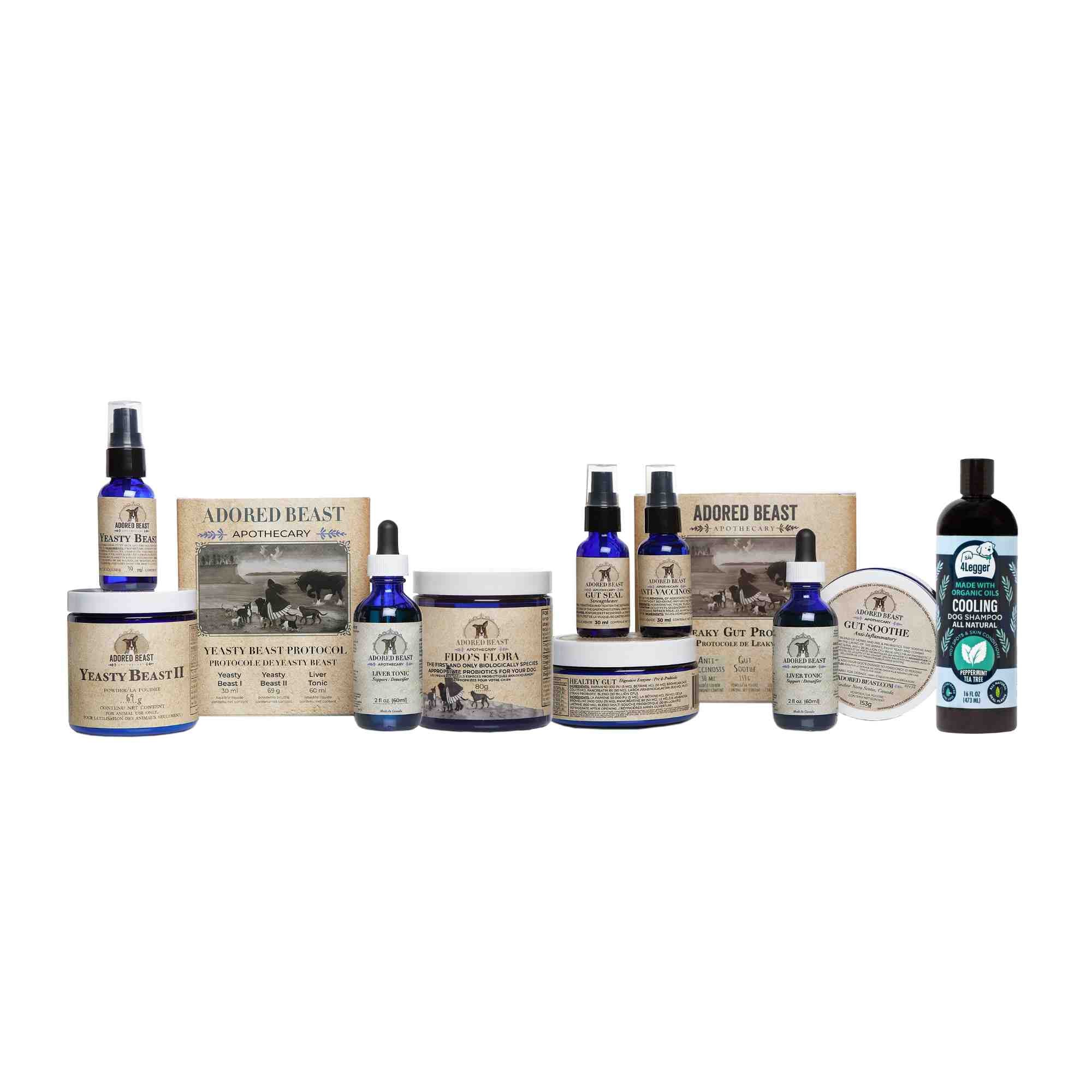
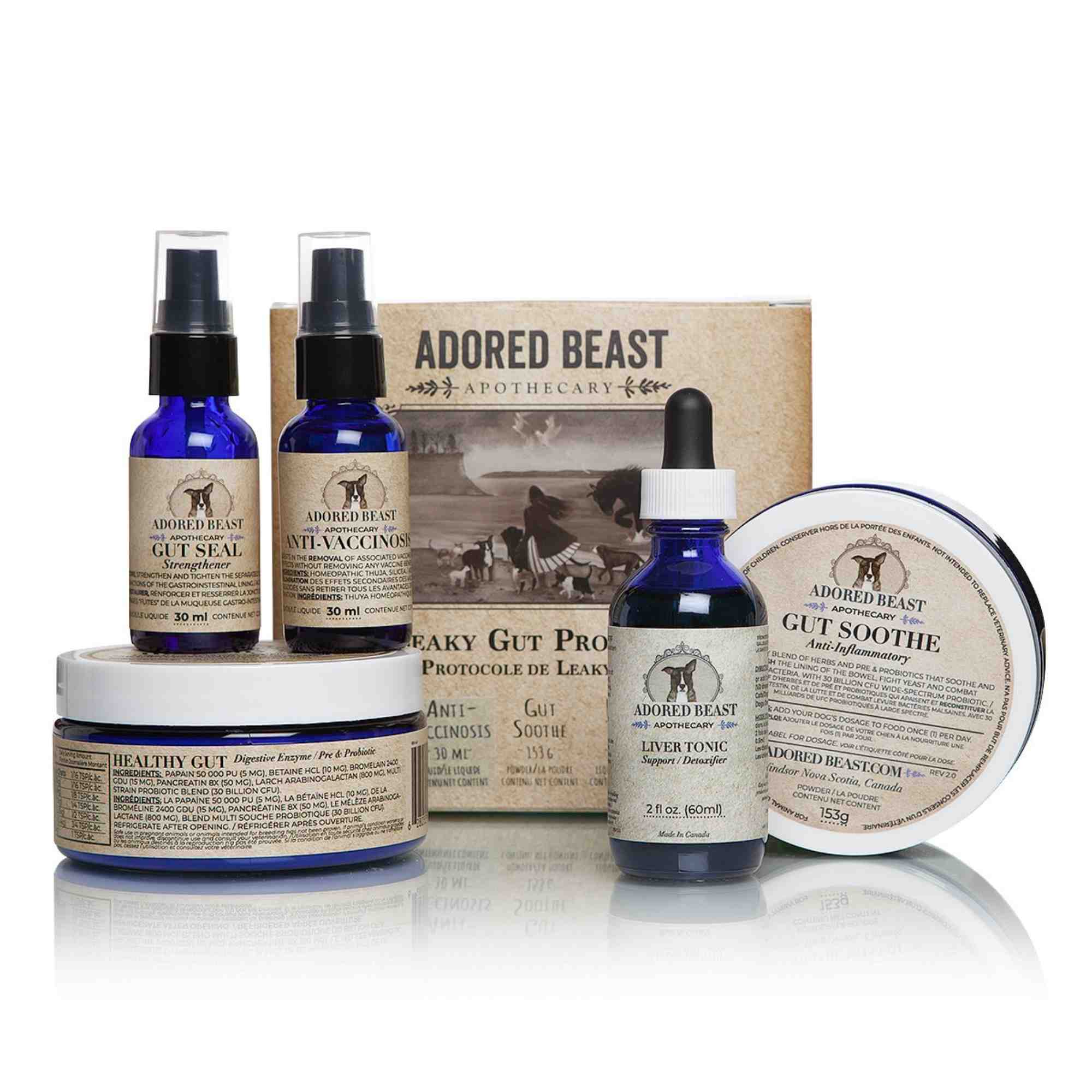
And it’s one of the reasons that I created the Leaky Gut protocol, because I wanted to give pet parents a solution that was super easy to do, but very complicated, right?
It’s complicated. What the Leaky Gut protocol does is very complicated, and it’s going to take way too long for me to talk about it on this.
But in a box, what we’ve done is put things together.
I think in total, if you were to buy every herb, every individual probiotic, every individual nutraceutical or homeopathic, I think you would have to go and purchase like 72 different things.
And that is overwhelming, and then you’re sourcing the right stuff and all that.
So we put the protocol together in order to make it super easy for people.
And it just basically, in a nutshell, addresses helping to heal the gut lining, so that it literally eliminates or stops the reactivity in the body.
To break the food down in micro amounts so that the animal’s getting nutrition right away before the gut even heals.
Antioxidants, and then probiotics, all kinds of herbs to soothe the gut.
That would be my suggestion right away, is just to do that.
Whether you have the… why spend the extra money to find out whether your animal has leaky gut or not.
Chances are they do. If they have any kind of skin symptoms at all, it’s highly, highly, it’s a very big chance that they have leaky gut.
So you just mentioned the Leaky Gut protocol, and honestly, we offer it in our store, and we have helped so many animals with allergy-like symptoms.
Before a pet parent goes out and they purchase this kit, I think at our store we usually ask a couple of questions before they go in that direction.
Because if your dog, or if a dog has certain symptoms, they should actually hold off on doing the Leaky Gut protocol.
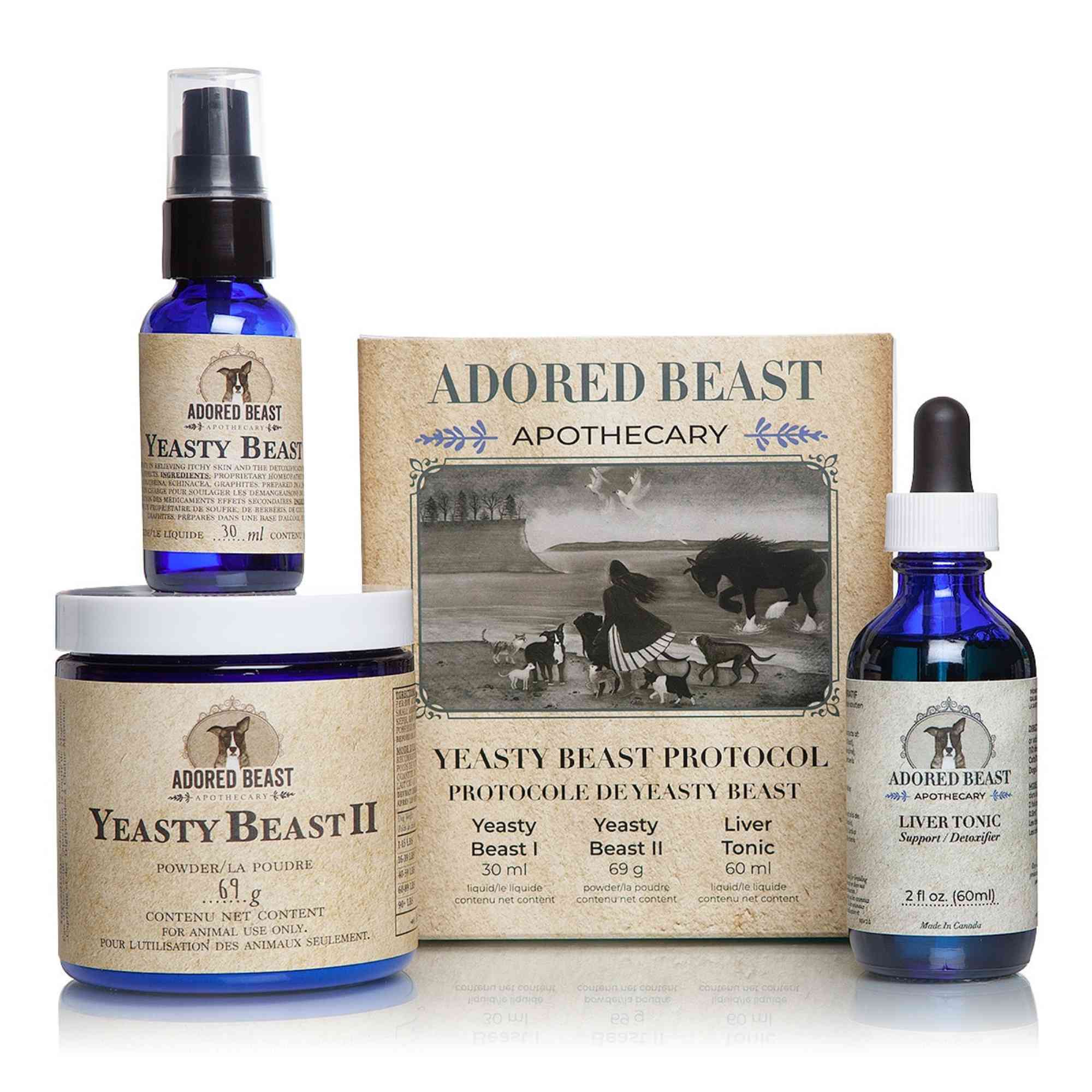
And they should probably be doing the Yeasty Beast protocol if they have symptoms of yeast, such as ear infections, yeasty-smelling paws, or red-brown paws. Is that correct? Would you say that?
Yeah. Or, you know, I always have this thing that is called the Relief protocol.
So it really depends on how sick they are and how long they’ve had it.
So if your dog has been dealing with Apoquel, Cytopoint, immune suppressive drugs for a long time, more than likely it’s got all of it.
And more than likely, if you have the stinky ears, or they’ve done a culture and they found yeast in the ears, or they’ve got interdigital cysts, or it smells yeasty, or they’ve got hot spots, chances are they’ve got yeast.
So after working with these protocols for a really long time, it was easy for me to do it at my practice when I was one-on-one with the animals.
But what I found is, and it sounds expensive to begin with, but it really isn’t, because you’re going to use the same amount anyways.
Because a lot of times what you would do is you would do the Yeasty Beast protocol first.
And because this trashes the gut lining, it just destroys the gut lining, then you would follow it with the Leaky Gut protocol.
Right. So you would try and remove the yeast to a healthy balance, then you help to fix the gut because that gut has been trashed by the yeast.
But sometimes when that happens, what’s a very important thing for people to remember is that there’s something called a yeast die-off.
And yeast produces about 36 different toxins, and acetone being one of them, which is what nail polish is, that burning, itching, destroying the skin cells.
But when they die, they even produce more, because their skeletal system kind of lands in the body.
And if you kill them too quickly, you will actually get something called a die-off or Herx reaction.
And then it looks like the yeast is worse. So you take them back to the vet, and then they go on more ketoconazole and secondary bacteria antibiotics.
Because then they have bacterial infections, when really that’s not what’s happening. The yeast is dying too quickly.
So some people might think that’s a good thing, but it’s not if you’re the animal. It’s very, very hard on them.
So the Yeasty Beast protocol was designed that it didn’t do that. It didn’t kill them in a very maintained, controlled way, so that they don’t get a yeast die-off.
Saying that, if this animal has been very suppressed by a lot of drugs, and they have tons of yeast, sometimes they’ll get a die-off. Even a small amount dying will set them into a reaction.
So now what I say is to rotate. So you start to address the yeast, then you stop, then you start to help alleviate the trauma in the gut.
Then you stop that, and then you put them on the Leaky Gut protocol.
Then you put them back on the Yeasty Beast protocol.
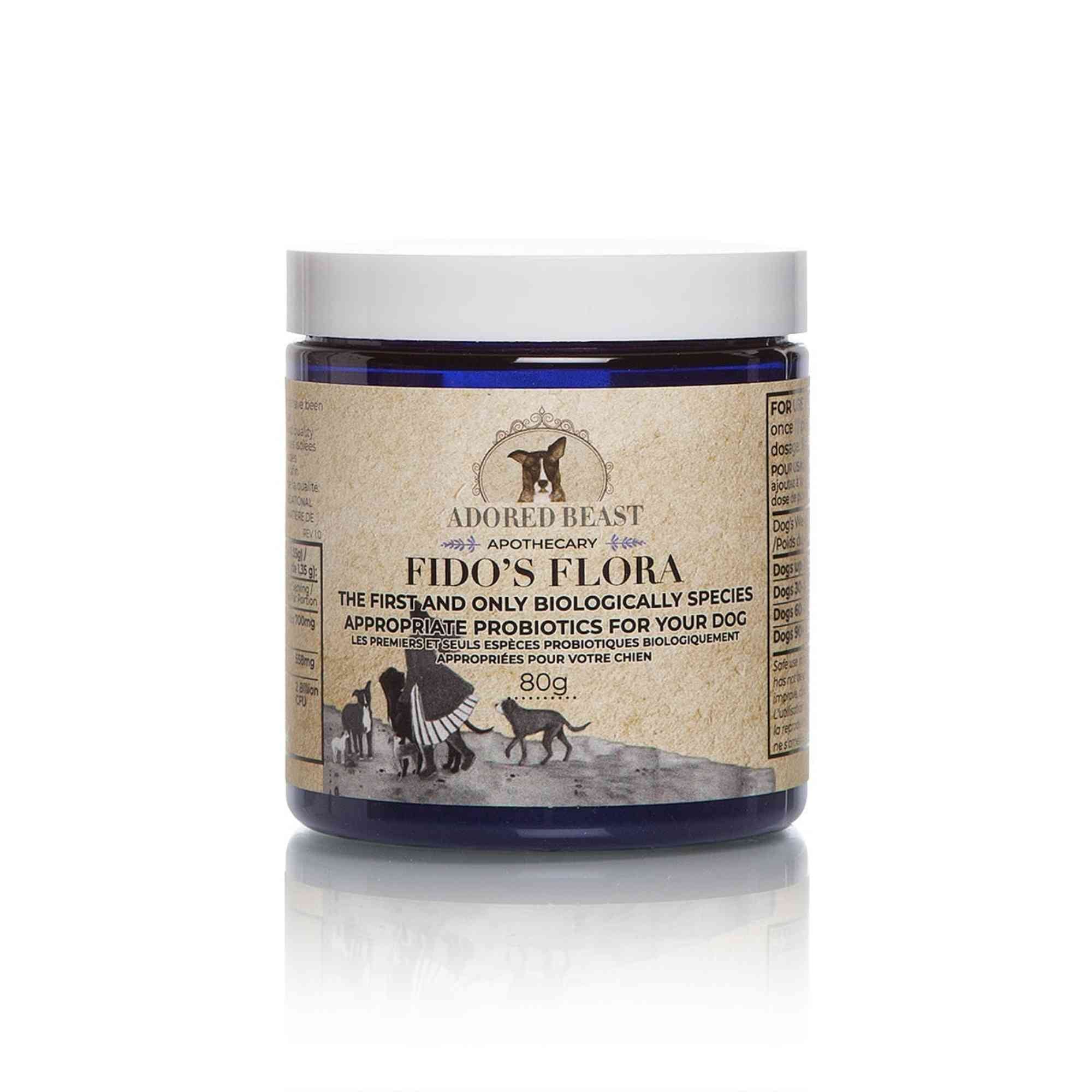
And then one thing that I will do too is put Fido’s Flora in the middle, right?
Which gives them a completely different probiotic strain than any other company out there has, which is a dog-specific strain.
Along with Full Vigor and humic acid, which detoxifies the blood in almost like a regulation therapy.
So for those of you people that are listening that are just at your wit’s end, and your animal has been suffering for a really long time, and you’re in this skin disease merry-go-round because it’s horrible.
To start off, when they’re that bad, with the Relief protocol is sometimes better.
Saying that, they should be on Liver Tonic throughout the whole thing.
Because what’s happening is that, first of all, the drugs are horrible on their livers.
So you want to support their liver, keep their liver healthier.
But when these toxins go into the bloodstream, the liver gets really overtaxed. And then it tries to push out the toxins through the skin because it can’t handle all the toxins that are in the blood.
So you stay on liver support, whether it’s our liver support through Liver Tonic, or you go and you purchase another liver support.
It’s vital that your animal is on liver support the entire time that you’re trying to do this skin disease. It’s vital. Really important.
So I feel like animals that are very sick, it’s the easiest, and it doesn’t wind up costing more money.
Because you’re going to go on those things later anyways, right?
If you go on the Yeasty Beast protocol and then go on the Leaky Gut protocol, then you’re going to wind up doing the different probiotics to rotate.
So you’re going to do them anyway. So it’s just going to be longer. Your products are just going to last a much longer time.
I mean, honestly, to be completely honest, yes, if you purchase the Relief protocol all at one time, yes, it’s going to cost a couple hundred dollars.
But to be completely honest, you will likely be saving so much money.
Oh, you’re going to have a healthier animal that’s going to require less vet visits.
I mean, you see it all the time. Our customers thank us so much because we have created this kit for them.
Like bundling all your products together, and they can just click it all in one button, you know?
Yeah. Maybe we should mention what that’s called. It’s called, at PAWDEGA, the Allergy and Yeast Relief Bundle.
And it is exactly what you just mentioned.
It’s Leaky Gut protocol, Yeasty Beast protocol, and Fido’s Flora.
And then we even have the option to add the Phyto Synergy in that as well, right?
Yeah, because that is also a very important aspect that you mentioned, antioxidants.
Yeah. And so you will likely be saving so much money, and you will likely be having a healthier animal.
We see it all the time. Most of the people that do this, they will eventually see the improvements, and then they will have less vet visits.
Yeah. I mean, so it’s…
I think the most important thing to mention, and actually something else that I wanted to mention, is I just want to make clear that the natural solutions that we’ve just talked about, like the Yeasty Beast protocol and the Leaky Gut protocol, they’re not medications.
Because a lot of pet parents use that word a lot, even when they speak to us. So these are not medications.
These are natural solutions that can help to address the root cause of the allergy symptoms that you’re seeing.
The results take time.
Exactly. Because a lot of the time we see, especially with this protocol, it’s designed to last several weeks, months.
And you may not see the results in one day, one week, two weeks. It takes time.
So I think that is something that we should say about almost all natural products, right? They generally take time.
They don’t suppress. Exactly. They work at the core issue.
But what I do want to say too is the amount of money that you spend with a dog or a cat that has these kind of issues is astronomical.
And you don’t have to, like I said before, you don’t have to wait till they’re off the drugs.
If you’re at a point where you’ve had to put them on this again, and it was so much worse this time, and you’re concerned, you can start this while they’re on the drugs.
So that hopefully by the time they’re being weaned off the drugs, they’re coming off the drugs, they’re not going to have that rebound effect.
Like, why wait till you’re off the drugs, and then they’re really, really, really bad again?
Let’s try and slowly reduce this so that when they come off the drugs, they’re not as bad.
They still might be worse, but not as bad as if you just take them off and then expect a natural solution to happen like that, because it’s not going to.
So why not start earlier?
Saying that, you’re probably then still going to have to go through more of the protocols again.
But at the end of the day, you do save money.
I owned five veterinary hospitals, so I know the cost of chronic disease, of any kind of chronic disease.
But I did want to mention one thing too, is that I’ve had a lot of conventional vets reach out to me and say, “We’re so happy that you have this.”
Because first of all, they’re so busy they can’t handle it.
The veterinary industry right now is not a happy place. They’re tired. They’re overbooked.
They can’t take the amount of people that have animals.
Animals are waiting weeks and weeks and weeks to get in unless it’s an emergency, and even then they have to go to the emergency clinic.
So I’ve actually had conventional vets reach out to me and say, “This has been a godsend to us,” because you’re not telling them just go off their drugs.
It’s something that is helping us, because we don’t have a solution. They don’t have a long-term solution.
And we can’t get these animals in fast enough. So it’s a win-win situation, really, for everybody, considering the state that the veterinary industry is in right now.
Yeah. It’s nice to hear that, especially with something like this.
With the real emergencies that you’re not going to use holistic medicine for, like hit by cars and broken legs and traumas and stitches and rentals, and things that are going to happen and are happening, they can address in a timely manner.
And so from a financial perspective and a stress perspective, there’s no downside. Zero downside to doing this.
A lot of pet parents are confused whether or not they should start with the Yeasty Beast protocol, or whether or not their dog needs the Yeasty Beast protocol or not.
What kind of advice do you have for pet parents that are not sure?
Well, if they don’t have a diagnosis for yeast, like if they haven’t done a swab, or they are really stinky, like that real stinky yeast smell.
If you’re smelling that smell, or you’ve had a swab, I would start with the Yeasty Beast protocol.
And I probably would do, if they’ve had it for a while, like I said, I would start it, and immediately two weeks later, I would do the Relief protocol.
Yeah. But if you don’t know, you’ll find out soon enough.
Because if you do the Leaky Gut protocol, what can happen sometimes is that it ramps their immune system up so much, it makes them so healthy so fast, that then it starts to address the yeast.
It’s like, “Get out of here. The big guns are coming in now.”
So then you could start to see more hot spots, then be a bit itchier.
If that happens, you need to get on the Yeasty Beast protocol right away, and you just need to do the Relief protocol right away.
That will give you your answer, because if it’s just leaky gut, they will heal quite quickly.
Not as fast as with drugs, no. But you’ll see a difference fairly quickly.
If they’re really, really, really sick, I can’t see how they wouldn’t have some type of yeast.
Okay. So I think the combination of all three is really important.
Some pet parents may be a little bit hesitant to fully commit to natural options and natural solutions to address their pets’ allergy symptoms.
So what advice do you have for them to feel confident about making the switch?
First, one of the first things would be, again, that they don’t feel guilty about it.
Guilt and fear would keep us stuck in most of the things that we know we have to do anyway, but we don’t do it.
So I would say, make a list. Look at that list and try and decipher on that list what is causing this merry-go-round to keep going.
Are you vaccinating too much? Can you do a titer?
A titer is something where you take a little bit of blood and it comes back and says your dog is adequately vaccinated, and then you’re not revaccinating them, because that can exacerbate all diseases, not just skin disease.
Am I good with just incorporating some real food?
Can I go and do a test with Dr. Jean Dodds, who’s a board-certified veterinary immunologist and hormone expert, and a conventional veterinarian, so you’re not scared to work with her?
She’s one of the biggest veterinary specialists in the world.
So look at what you’re scared of, put it to the side.
So let’s say raw food, I’m just going to say it, because that is often what happens. People are scared to do raw food.
So if you’re scared to do raw food, then don’t throw holistic medicine out the window.
It doesn’t live in the raw food realm, that if you don’t do raw food, you can’t help your dog, because that’s just not true.
Find a good cooked food. Try to find your balance and then add to it.
So start incorporating real food.
Don’t vaccinate for a couple of years.
Try to reduce the stuff inside your house that’s going to benefit you as well as your dog.
So that’s not getting too holistic. You’re really just looking at what is comfortable for you.
Like I’m saying, I’m not telling you not to do drugs. You can do your drugs and still incorporate all of these great things.
You don’t have to jump the fence over to the holistic side.
You can stay with the conventional side, but start to incorporate stuff at the same time.
And scientific. So if they’re scared and they want to be really on that science level, natural food, real whole food, is a whole science, research-backed mode of health for every species across the board.
It doesn’t matter what species that is. So that’s not even holistic. That’s just a fact. And it’s just real food.
And gut health is probably one of the biggest science-researched anything right now.
So just those two things, and reducing the amount of insult.
So not as many vaccines, not as much Advantage and topical bug stuff.
Just start a little bit.
But for me, it would just be, don’t negate what your vet’s doing.
Start with a fresh food diet, and addressing probiotics and vitamins. Antioxidants, Phyto Synergy.
So you don’t have to go crazy.
Yeah. And I think just to add to that, one of the most important things is to just start with something.
Start small, start wherever you feel comfortable, and then add on that.
Because we have this conversation almost on a daily basis, that pet parents come to PAWDEGA because skin disease is such a big topic.
We talk about all of the things that we’ve mentioned today.
So we start with nutrition. We start with the Allergy and Yeast Relief Bundle that includes the Leaky Gut protocol and the Yeasty Beast protocol.
And a lot of pet parents will say, “Look, I don’t feel comfortable with fresh food right now, but I’ll start with the Yeasty Beast protocol and the Leaky Gut protocol.”
And a lot of times what happens is that they see such amazing improvements with that, they get curious and they say, “Okay, now let me look at that fresh food, and let me see what I can achieve with that.”
So it’s really just about taking that first step wherever you feel comfortable, and then building up on that.
And I’m really glad you said that, because one thing that I always… in fact, every single new client that came in left with a journal.
And it was like a gift that we gave to them.
So write down the pros and cons of everything. Write down what you’re most afraid of, what you’re most comfortable with.
And like you said, just start, and then make a list. Like, what’s on my list?
Stopping itching. But not just that. Think back. What was your dog like before its skin disease?
Make it more social. Was it more active? Was it drinking less water? Was it more engaged?
Was it less reactive to strangers, less reactive to dogs?
Write all of that stuff down, because it’s really interesting where people will go, “His skin’s about the same, but you know what? He is playing with dogs again.”
He’s jumping. He’s running up the stairs again.
So things can change that aren’t necessarily the skin first.
The skin can come later, but that shows overall health and vitality, quality of life interactions.
That’s important, because then you know what might happen. You might look at this one change and go, “Holy, I just changed that one thing, and this is happening.”
If I change this one other thing, then his ears might get better, his skin might start showing improvement.
It gives you some confidence.
Yes. Yeah, absolutely.
And just having a journal in general helps so much as well.
Like where we note down the symptoms that we see on a daily basis.
And sometimes because we see our dogs every day, small changes might just go unnoticed, but it’s all the time.
Yeah, all the time clients would come in and I’d take real detailed notes.
So my consults, some consults were an hour and a half, sometimes two hours.
And then I would see them in a month, and I’d go through the changes, and then I’d be like, “Oh, what about this? What about this? What about this?”
Like, “Oh my gosh. God, he was even doing that.”
Yeah. “I’m so glad you wrote that down because I didn’t remember that.”
“You know, he’s sleeping with my two-year-old daughter again.” It’s really interesting.
Yeah, I think the pet journal is definitely really, really great advice.
So if you’re listening, please, it doesn’t have to be a physical book.
Me personally, I don’t have a book. I like to write it in a WhatsApp group, or in my notes on my phone, just so I can remember.
“Oh, this is what we did today.”
And then when we have that appointment and we need to reflect back, we can say, “This happened on this day, and this happened that day.”
Yeah. It helps with that as well, in case anything happens.
Yeah. Absolutely. It’s a very important part of their healing.
Definitely. And environmental allergies.
I was just going to say, what park is the parks you go to, right?
It’s like, “Oh, this is so weird. Every Wednesday they come in, and Thursday morning, they’re here. Thursday morning, red all the time.”
While the dog walker takes them to this particular park.
Okay. And maybe there’s some water, or a type of tree, or a type of leaf mold.
You can easily then go, “Oh okay. Well, he can’t go to the park anymore. Let’s find a different park for him to go to.”
Or daycare visits as well. Noting that always.
Yeah. Always. “It’s here after daycare.”
Well, is he really liking daycare?
The stress level can… yeah. Cortisol goes up. Inflammation goes up. Itching goes up.
But they don’t want them to be bored, right?
It’s one thing, like if you really do have an animal with skin stuff and you want to make a difference, it’s that thing at the very beginning of the podcast.
Being aware.
It sounds like it’s a big pain in the butt to do this journal, but you know what it does?
It actually makes you more aware. It grounds you, brings you back to what’s actually happening today.
Yeah. And while we’re at that, also showing some gratitude for whatever our dog is going through right now, always finding something to be grateful for, that has helped me in our journey for sure.
Yeah. No, for sure.
Even to be able to sit down and go, “This is amazing. I’m grateful that there’s even these podcasts,” right?
Because when people were coming to me 25 years ago, there was nothing.
They had no recourse. They had nothing to support them through this journey.
So being grateful, and even grateful that I had the money that I went and spent at the vet.
Just get rid of the guilt and go, yeah, we’re just in a different space now.
Well, thank you so, so, so much, truly, for sharing this wealth of knowledge with us today.
It has really been so amazing to listen to all of the different ways that we can help our pets, and understand pet allergies and allergy-like symptoms, and then go from there.
Build our natural repertoire and start with doing something that we feel comfortable with, and then building up on that.
So thank you so much.
You’re very welcome. Thank you for having me.
Can you just let our listeners know where they can find you if they want to connect with you?
AdoredBeast.com, or Adored Beast Apothecary. And we have a YouTube station, Adored Beast Apothecary.
Awesome. And thank you everyone for listening.
If you are ready to get started, definitely do check out the Allergy and Yeast Relief Bundle on PAWDEGA, and make sure to tag both PAWDEGA and Adored Beast in your before and after pictures.
If you check any of them out, we have pictures all over our walls and where they’re packing, and it’s just like, it’s great.
It’s amazing. Those pictures aren’t for… they’re really inspiration for us going, right?
Absolutely. They’re real stories.
It’s really a testament to the products that you’ve created, and all of the stories that you work with, and helping you to get these products out to the animals that need them the most.
Because a lot of, like you mentioned earlier, people feel like they reached the end of the road, and then they discover these products, and their lives have just been absolutely transformed.
So again, thank you.
We’re so proud to stock Adored Beast in both of our stores, in our international store and our U.S. store.
Thank you.
Well, yeah, I always say that if it wasn’t for you guys, you know, we would be able to be helping, but not nearly at the level that I want to…