Algae oil for dogs is a marine omega-3 supplement that delivers EPA and DHA from microalgae, the organisms at the bottom of the ocean food chain where the omega-3 in fish oil came from in the first place. For most dogs it is a sound daily source of both fatty acids, without the heavy metals, the smell, or the rancidity risk that travels with a fish-derived oil. The part almost nobody explains is the dosing. Omega-3 is measured in milligrams of combined EPA and DHA per kilo of body weight, never in teaspoons, and most algae oils carry far more DHA than EPA.
If you are reading this, nothing is probably wrong. Your dog is well. You feed thoughtfully, you read labels, and you would rather be told a product is unnecessary than be sold it. So let's do this properly: what algae oil is, where it genuinely beats fish oil, where it does not, how much your dog actually needs, and how to tell a serious bottle from a pretty one.
On this page
- Where do EPA and DHA actually come from?
- Is algae oil for dogs better than fish oil?
- Why does the EPA and DHA split matter?
- How much algae oil should I give my dog?
- What should I look for on the label?
- Is algae oil for dogs safe, and can you give too much?
- How long does it take to see a difference?
- Can my dog get enough omega-3 from food?
Where do EPA and DHA actually come from?
Fish do not manufacture omega-3. They accumulate it. Marine microalgae are the primary producers of EPA and DHA in the ocean, and fish build up those fats by eating algae, or by eating smaller creatures that ate algae. Everything else in the chain is storage.
What changed is that large-scale fermentation now makes it possible to grow those microalgae in tanks and take the oil directly, skipping the marine food chain altogether. The research group behind the canine feeding trial on this ingredient described that as the whole point of developing it: a source of long-chain omega-3 without the environmental contaminant load, and without pulling more fish out of the sea.
Here is what many pet parents are never told clearly. Plant based omega 3 for dogs, the kind in flax, chia and hemp, is a different molecule. It is ALA, and it has to be converted in the body before it becomes EPA or DHA. Work published in the Journal of the American Veterinary Medical Association on how dogs metabolise dietary omega-3 concluded that marine sources are what modify inflammatory and immune responses in dogs, because canine conversion from the plant precursor is limited. So a bag that boasts about omega-3 from flaxseed is telling you very little about the EPA and DHA your dog is actually absorbing.
Is algae oil for dogs better than fish oil?
Better at some things. Not automatically better at everything. Here is the honest version.
Where algae oil genuinely wins. It is grown in closed fermentation rather than harvested from the ocean, which is why it was developed as a long-chain omega-3 source free of contaminants like heavy metals and PCBs. It also sidesteps the freshness problem that quietly undermines a lot of fish oil. When researchers tested 171 omega-3 supplements from 49 brands sold in Canada, half of them exceeded voluntary industry limits on at least one measure of oxidation, and around four in ten exceeded the recommended total oxidation value. Those were products for people, not pets, but it is the same fat chemistry and much the same supply chain. And for a dog who reacts to fish, algae removes the fish protein entirely.
Where fish oil still leads. Almost all of the canine clinical research was done with fish oil, not algae oil. The joint trials, the skin trials, the dosing ranges your vet works from, all of it sits on fish-derived studies. Algae oil is newer to the bowl, so the evidence base behind it is thinner and shorter.
It is not empty, though. A 2019 safety and bioavailability study in beagles fed an algal oil containing both EPA and DHA showed the fats were genuinely absorbed, with plasma concentrations of both rising. A 2025 feeding study added algal powder or algal oil at one percent of the diet for 28 days and found serum DHA rose higher than in the group given an equivalent amount of fish oil, alongside improved coat condition and no adverse liver markers. Short study, one breed, so hold it lightly. It is a real signal, not a finished case.
Why does the EPA and DHA split matter?
This is the detail the comparison articles skip, and it is the one that decides whether your bottle is doing anything.
Veterinary dosing is written in milligrams of combined EPA and DHA. Not millilitres, not teaspoons, not "total omega-3". Meanwhile, the published safety work on algal oil from Schizochytrium describes an oil running roughly 40 to 45 percent DHA and up to about 10 percent EPA. That is a DHA-dominant oil, and many algae products on the shelf are more lopsided still. Some are DHA only.
So swapping fish oil for algae oil drop for drop does not hand your dog the same thing. The total number can match while the EPA share quietly collapses. DHA is structural, doing its work in brain, eye and nerve tissue. EPA is the one carrying most of the inflammation-related research in dogs. A senior dog you are supporting for joint comfort is a different conversation from a puppy you are supporting for brain development, and the ratio is where that conversation lives.
Rule to carry into any shop: if the label does not state EPA and DHA separately, in milligrams, per millilitre, you cannot dose the product. Put it down.
How much algae oil should I give my dog?
Algae oil dosage for dogs works in milligrams of EPA plus DHA per day. Use the label to convert that figure into millilitres of your specific bottle. Two dogs of the same weight can need wildly different volumes, because concentration varies enormously between products.
The clearest published anchor comes from Colorado State University's Veterinary Teaching Hospital, which publishes a maximum daily omega-3 dose for dogs with osteoarthritis, written for veterinarians: 310 mg of combined EPA and DHA for every kilogram of metabolic body weight, meaning body weight in kilograms taken to the power of three quarters. Their own guidance is that this maximum is not tolerated by every dog, and that a sensible approach is to begin at roughly a quarter of it and increase slowly while watching for loose stools or vomiting.
That gives us two useful numbers for any dog: a gentle place to start, and a published ceiling that belongs to your vet, not to you.
Scroll sideways to see the full table.
| Dog weight | Gentle daily start, EPA + DHA | Published ceiling, vet-set |
|---|---|---|
| 10 lb, 4.5 kg | 240 mg | 965 mg |
| 20 lb, 9 kg | 405 mg | 1,623 mg |
| 30 lb, 13.6 kg | 550 mg | 2,200 mg |
| 40 lb, 18 kg | 685 mg | 2,730 mg |
| 50 lb, 22.7 kg | 805 mg | 3,227 mg |
| 60 lb, 27 kg | 925 mg | 3,700 mg |
| 70 lb, 32 kg | 1,040 mg | 4,153 mg |
| 80 lb, 36 kg | 1,150 mg | 4,591 mg |
The ceiling column is Colorado State's published maximum for dogs with a joint condition, and it is there so you can see the range, not so you can aim at it. The start column is a quarter of that figure, which is where their own guidance says to begin. A healthy dog with nothing wrong sits comfortably in the lower half of this range for life.
To convert: take the daily milligram figure, then divide by the milligrams of EPA plus DHA per millilitre on your bottle. That is your dose in millilitres. If the maths gives you an amount too small to measure with the dropper, the product is too dilute for your dog, and you are mostly buying carrier oil.
I am not a veterinarian. I am a pet parent who reads the research and works alongside holistic vets, so anything ongoing, and any dog on medication, deserves a conversation with your own vet before a number goes in the bowl.
What should I look for on the label?
Five checks. They take about a minute, and they sort the category quickly.
- EPA and DHA stated separately, in mg per ml. A single "total omega-3" figure is not dosable, and it lets ALA pad the number.
- The species named. Schizochytrium sp. is the microalgae behind most of the published safety and feeding work. A label that will not name its algae is hiding something ordinary at best.
- An antioxidant in the formula. Mixed tocopherols or vitamin E slow oxidation in the bottle. Long-chain omega-3 is fragile, which is the entire lesson of those oxidation surveys.
- Storage instructions that ask something of you. Refrigerate after opening, use within a stated window. A bottle with no freshness instructions has not thought about freshness.
- The carrier oil disclosed. You are feeding it daily, so you should know what else is in the dropper.
Once a bottle clears all five, the question stops being which brand and becomes how consistently you use it. This is the one we keep in the fridge.
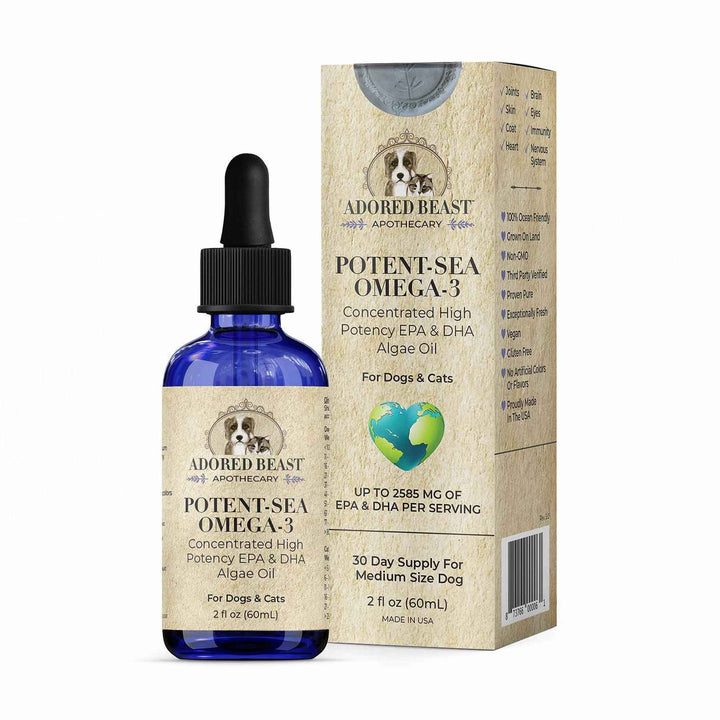
The one I feed Milka
Potent-Sea Omega-3 Oil | EPA & DHA
Most algae oils make you guess. This one is built to be read: a named microalgae, a stated amount per serving, an antioxidant in the formula and a marked dropper, so you can work in millilitres instead of hopeful squirts. Milka is a senior now, and this is one of the few things that never leaves her bowl.
- Marine algae oil from Schizochytrium sp., 962.7 mg per serving
- Grown on land in fermentation rather than harvested from the ocean
- Mixed tocopherols and ascorbyl palmitate in the formula, high-oleic sunflower oil as the carrier
- Dropper marked for measuring, refrigerate after opening
- Fish free, so it suits dogs who react to fish
- Can be set up on Subscribe & Save, since omega-3 works cumulatively
One label note worth knowing before you buy: the rosemary extract used as a preservative can be contraindicated for dogs with epilepsy, so speak to your vet first if that applies to your dog.
Is algae oil for dogs safe, and can you give too much?
Safe at sensible amounts, and yes, there is such a thing as too much. Both halves of that sentence matter.
On the safety side, the beagle study fed algal oil containing EPA and DHA through mating, pregnancy, nursing and puppy growth at dietary levels up to three percent of the diet, which is 30 g per kilogram of food, and reported it well tolerated, with plasma DHA and EPA rising as expected. For context, the National Research Council sets a safe upper limit for adult dogs at 11 g of EPA plus DHA per kilogram of diet on a dry matter basis, and AAFCO sets a dietary minimum of half a gram per kilogram for growing and reproducing dogs.
On the other side, a review in the Journal of Veterinary Internal Medicine on the potential adverse effects of omega-3 in dogs and cats is the honest counterweight. At high intakes the documented concerns include altered platelet function and bleeding time, gastrointestinal upset, increased markers of lipid peroxidation, effects on immune function, and the plain fact that oil is calories. None of that argues against omega-3. It argues against the idea that more is automatically better, which is exactly the assumption a well-meaning pet parent makes.
Practically, that means start low and build. Split the dose across two meals if the stool loosens. Keep the bottle in the fridge and stop using it if it ever smells sharp or paint-like. And tell your vet your dog is on it, particularly before any surgery or alongside a medication that affects clotting.
If you are already giving fish oil, green-lipped mussel, sardines and an algae oil, you are stacking four sources of the same two fatty acids. Add them up before you add anything else. Over-supplementing is the quiet mistake in a careful household.
How long does it take to see a difference?
Weeks to months, and the honest answer is that a healthy dog may show you very little, because you are supporting a system rather than fixing a symptom.
For skin and coat, a randomised, double-blind, placebo-controlled trial in 40 dogs with atopic dermatitis used a diet enriched with omega-3, antioxidants and polyphenols and measured a 25 percent reduction in lesion scores by day 30 and 49 percent by day 60, while the control group did not move. For joints, the multicentre trial published in the Journal of the American Veterinary Medical Association followed 127 client-owned dogs with osteoarthritis across 18 private clinics for six months on a food high in fish-oil omega-3, with both pet parents and vets scoring improvement.
Balance that against the older position. When the ACVD task force reviewed essential fatty acids for canine atopic dermatitis, it concluded the evidence at the time was insufficient to recommend for or against them, and called for longer, better-controlled trials. The evidence has grown since, but omega-3 is a supporting lever, not the whole plan. Anyone promising you a two-week transformation is selling something.
What this really is, is a routine. Thirty seconds at breakfast, given for years, with the effect accumulating quietly in cell membranes where you cannot see it. That is also why the dogs who do best on it are the ones whose pet parents never stopped.
Can my dog get enough omega-3 from food?
Partly, and food should absolutely be doing some of this work. Small oily fish are the classic route, which is why sardine-based recipes earn their place in a rotation, and a fresh diet generally lands better on fatty acid balance than a kibble that has been sitting warm in a bag since spring.
The limit is arithmetic. Unless your food publishes an EPA and DHA figure, you cannot know what your dog is getting, which means you cannot add a supplement to it without guessing. So use food as the base, use a measured oil for the part you want to know, and keep an eye on the total.
If you want the wider picture on sources and how they compare, our guide to choosing the best omega 3 for dogs sits one level up from this article. If your dog is on dry food, the supplements worth adding to a kibble diet covers what else is missing from the bowl, and for an older dog, natural joint support for dogs explains where omega-3 fits alongside everything else.
So which should I actually buy?
Algae oil vs fish oil for dogs comes down to five decision points, and the honest answer changes with the dog in front of you.
Scroll sideways to see the full table.
| Decision point | Algae oil | Fish oil |
|---|---|---|
| Best for | Daily long-term support, fish-sensitive dogs | Higher EPA share at lower cost per mg |
| Key difference | Grown in tanks, skips the marine food chain | Harvested, so purity depends on the supplier |
| Typical profile | DHA dominant, EPA usually the smaller share | More balanced, often EPA leaning |
| Evidence in dogs | Safety and uptake shown, trials still short | Decades of joint and skin trial data |
| Where to start | Potent-Sea Omega-3 Oil | A brand that publishes oxidation testing |
If your dog is well and you are building a routine you intend to keep for a decade, algae oil is the cleaner daily habit, and the freshness question mostly goes away. If your vet has set a specific EPA target for a named joint or skin condition, take the ratio conversation to them before you switch, because the studies behind that target were run on fish.
Either way, read the milligrams. That single habit will do more for your dog than the brand on the bottle.
Much love, Larry
Sources
- Dahms I, Bailey-Hall E, Sylvester E, et al. Safety of a novel feed ingredient, Algal Oil containing EPA and DHA, in a gestation-lactation-growth feeding study in Beagle dogs. PLOS ONE, 2019. Read the study
- Bauer JE. Responses of dogs to dietary omega-3 fatty acids. Journal of the American Veterinary Medical Association, 2007. Read the abstract
- Lenox CE, Bauer JE. Potential adverse effects of omega-3 fatty acids in dogs and cats. Journal of Veterinary Internal Medicine, 2013. Read the review
- Colorado State University Veterinary Teaching Hospital. Canine fish oil dosing chart. View the chart
- Fedorova-Dahms I, Marone PA, Bauter M, Ryan AS. Safety evaluation of Algal Oil from Schizochytrium sp. Food and Chemical Toxicology, 2011. Read the evaluation
- Jackowski SA, Alvi AZ, Mirajkar A, et al. Oxidation levels of North American over-the-counter omega-3 supplements. Journal of Nutritional Science, 2015. Read the study
- Evaluation of the efficacy and safety of omega-3 fatty acid nutritional supplements from Schizochytrium sp. in dog food. Animal Nutrition, 2025. Read the study
- Watson A, Rostaher A, Fischer NM, Favrot C. Randomized, double-blind, placebo-controlled clinical trial measuring the effect of a dietetic food on dermatologic scoring and pruritus in dogs with atopic dermatitis. BMC Veterinary Research, 2021. Read the trial
- Roush JK, Dodd CE, Fritsch DA, et al. Multicenter veterinary practice assessment of the effects of omega-3 fatty acids on osteoarthritis in dogs. Journal of the American Veterinary Medical Association, 2010, 236(1):59-66.
- Olivry T, Marsella R, Hillier A. The ACVD task force on canine atopic dermatitis (XXIII): are essential fatty acids effective? Veterinary Dermatology, 2001.
The content here is for information only. Every animal is different, and none of this replaces veterinary advice for your own dog.