Artist conk for dogs is a woody bracket mushroom, Ganoderma applanatum, used in functional mushroom blends for dogs as an immune-supporting relative of reishi. It is given as a liquid extract, never as raw mushroom, and the evidence behind it comes from laboratory and rodent studies rather than from trials in dogs. That distinction is the whole story here.
Artist conk is a legitimate functional mushroom with real laboratory evidence behind its polysaccharides, but no published clinical trial has tested it in dogs, which is why it belongs inside a blend rather than at the center of your dog's routine.
On this page
- What is artist conk, and why is it in dog supplements?
- What are the benefits of artist conk for dogs?
- Is artist conk safe for dogs?
- Can I give my dog a conk I found on a tree?
- How do you give artist conk to a dog?
- Artist conk or turkey tail: which does your dog need?
- Where artist conk fits in a daily routine
- Sources
Here is the situation I hear about most often. Your dog is somewhere north of eight. Nothing is wrong. He still wants the walk, he still hears the fridge open from two rooms away, and the white on his snout arrived a little faster than you were ready for. So you started reading about functional mushrooms, and somewhere in that reading a name came up that you had never seen before: artist conk.
You are not going to find a straight answer about it easily. Almost every page ranking for this mushroom carries the same three sentences, copied brand to brand, with no source attached to any of them. So let's go through what is actually known, what is not, and how I would decide whether it earns a place in your dog's bowl.
What is artist conk, and why is it in dog supplements?
Artist conk is a perennial shelf fungus that grows on hardwood logs, stumps and injured trees across North America. It is hard, corky and woody, closer to a piece of bark than to anything you would recognise as a mushroom. Mycologists list it as inedible for exactly that reason. Its name comes from the underside: the white pore surface bruises brown the instant it is scratched, and the mark stays, so people have used it as a drawing surface for generations.
The reason it turns up in dog supplements is its family. Artist conk sits in the same genus as reishi, Ganoderma, and shares much of the same chemistry. A 2024 review in the International Journal of Medicinal Mushrooms catalogued 324 compounds isolated from artist conk, mostly triterpenoids, meroterpenoids, steroids and polysaccharides, and noted a long history of medicinal use in China alongside laboratory work on liver protection, blood sugar and antioxidant activity.
So it is not a filler and it is not invented. It is a real medicinal mushroom with a real chemistry behind it. What it does not have is a dog.
What are the benefits of artist conk for dogs?
Here is what most pet parents are never told when they read a benefits list for a functional mushroom: almost none of those bullet points come from an animal that looks anything like your dog. They come from cells in a dish and from laboratory mice. That does not make them worthless. It makes them a starting point rather than a promise.
This is the honest inventory for artist conk.
Scroll sideways to see the full table.
| What was studied | In what | What it showed |
|---|---|---|
| Whole-mushroom chemistry | Laboratory review, 324 compounds | Triterpenoids and polysaccharides dominate |
| Crude polysaccharide extract | Mice, induced early kidney scarring | Less scarring, lower inflammatory markers |
| Polysaccharides and triterpenes | Cell cultures, antioxidant assays | Immune signalling and free-radical activity |
| Any dose, any formula | Dogs | No published clinical trial exists |
That last row is the one nobody writes down, and it is the most useful line on this page. When a supplement brand tells you artist conk supports immune resilience, respiratory function and healthy skin, that sentence is extrapolated from its chemistry and from its better-studied cousin reishi. It is a reasonable extrapolation. It is not a finding in dogs.
If you want the same honest look at the mushroom artist conk is related to, I wrote one on what reishi does for dogs and how to feed it.
Is artist conk safe for dogs?
At the amounts found in a properly extracted tincture, artist conk has no reported toxicity in dogs, and the blends it appears in have been fed daily and long term by a lot of pet parents, including plenty of ours. There is no signal that it causes harm.
What it does have is the caution that comes with the whole Ganoderma family. In human medicine, Memorial Sloan Kettering's herb reference flags reishi as a possible issue alongside blood thinners, because it can increase bleeding risk, and alongside immunosuppressant medication, because it nudges immune activity in the opposite direction to the drug. Those cautions have not been tested in artist conk specifically, which is precisely why I would apply them to artist conk anyway.
So, in plain terms. If your dog is on anticoagulant medication, on an immune-suppressing drug such as a steroid or cyclosporine, has surgery booked in the next two weeks, or is pregnant, ask your vet before you start a Ganoderma mushroom, artist conk included. Not because something bad is expected. Because nobody has checked, and your vet knowing what is in the bowl is worth more than the two weeks you would gain by starting today.
I am not a veterinarian, and this is not medical advice. For anything ongoing or serious, work alongside your vet, ideally a holistic or integrative one.
Can I give my dog a conk I found on a tree?
No. And this is the part I feel strongly about.
Two reasons. The first is that a raw conk does nothing. Mushroom cell walls are built from chitin, the same tough material as a lobster shell, and the beta-glucans everyone is after are locked inside it. The University of Wisconsin's integrative medicine reference explains that hot water extraction is what breaks those cell walls down and releases the polysaccharide intact. Your dog cannot do that with digestion. A woody bracket fungus ground into powder passes straight through him.
The second reason is identification. Veterinary toxicologists writing in dvm360 take the position that every mushroom a pet eats should be handled as toxic until somebody trained in mycology has identified it, because the species that cause liver failure in dogs, Amanita above all, are not reliably told apart by eye. Foraging is a skill. It is not a skill you practise on your dog.
There is a third, quieter problem. Mushrooms are bioaccumulators, so a conk pulls in whatever is in the soil, the wood and the air around it. Where a mushroom grew matters as much as which mushroom it is.
How do you give artist conk to a dog?
As an extract, added to food, once a day. That is the entire method.
Three things worth knowing before you buy anything:
- Extract, not powder. Look for a hot water or dual extraction on the label. Ground dried mushroom is a nutritional food, not a functional dose.
- Fruiting body, not mycelium on grain. If the label says mycelium or mycelial biomass, a share of what you are paying for is the rice or oats it was grown on.
- Start at the low end. Most dog tinctures work out at one dropper daily for a healthy dog and two for a senior. Give it four to six weeks before you form a view, because functional mushrooms move slowly and quietly, which is the point of them.
And the question I get asked most by pet parents building a routine, which is a fair one: am I giving him too much? If your dog is already on three or four supplements, adding a fifth is rarely the move that changes anything. Run one mushroom at a time, finish the bottle, rotate to the next one. Rotation is how you cover more ground without stacking a shelf of half-used bottles.
If what you actually want is the whole picture rather than one ingredient, our free wellness blueprint lays out the standard we apply before anything reaches a bowl. It is the closest thing I have to handing you my own checklist.
Artist conk or turkey tail: which does your dog actually need?
Let's be real for a second. If you came here ready to buy an artist conk product, the most valuable thing I can tell you is that for most dogs, it should not be your first mushroom.
Turkey tail is the one with a dog behind it. In 2012, a team at the University of Pennsylvania's veterinary school ran a small blinded trial of a standardised turkey tail extract in fifteen dogs with splenic hemangiosarcoma. Dogs on the highest daily dose went a median of 112 days before abdominal spread, against 30 days on the lowest dose, and the survival times were the longest reported for that disease at the time. A larger 2022 trial in Veterinary and Comparative Oncology then tested the same extract alongside chemotherapy and found no survival benefit.
Both halves of that are true, and I would rather you had both. One small promising trial plus one larger null result is still an enormous amount more than any other functional mushroom has in dogs, and it is infinitely more than artist conk has.
Scroll sideways to see the full table.
| Artist conk | Turkey tail | |
|---|---|---|
| Best suited to | Immune and airway support inside a blend | Daily immune support on its own |
| Evidence in dogs | None published | One small trial, one larger null result |
| Evidence elsewhere | Cell cultures and rodents | Human oncology, rodents, cell cultures |
| Usually sold as | One mushroom within a multi-blend | A single-mushroom liquid extract |
Read that as a sequence rather than a verdict. A healthy senior dog with no particular complaint starts with turkey tail, either as a single-mushroom turkey tail extract or, if you want the reasoning first, through the honest guide to what turkey tail supports. Artist conk earns its place when the blend it sits in matches something specific you are seeing, and the useful news is that the main artist conk blend carries turkey tail with it, so this is rarely an either or.
Where artist conk fits in a daily routine
Which brings us to what actually goes in the bowl. You will not find artist conk sold on its own for dogs, and that is the right call. It belongs in a blend, and the blend you pick should match what you are seeing at home.
For a dog heading into his senior years with nothing wrong and everything worth protecting, the artist conk bottle I would hand you is the daily immune one.
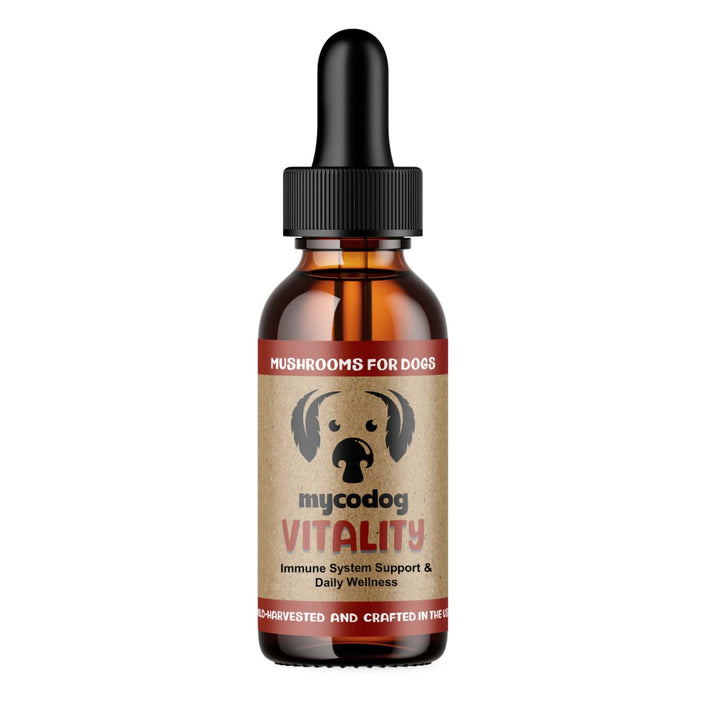
The artist conk bottle I would hand you
Vitality by MycoDog
This is the reason I am relaxed about artist conk having no dog trial of its own. In Vitality it sits with turkey tail and reishi, the two most studied mushrooms in the group, so the evidence in the bottle does not rest on the ingredient you came here to research. Seven mushrooms, two adaptogenic herbs, one dropper a day.
- Artist conk and red belted conk with turkey tail, reishi, shiitake, maitake and chaga
- Astragalus root and ashwagandha alongside the mushrooms
- Fruiting bodies only, no grain and no mycelium
- Triple extracted, with at least 350 mg of mushroom extract per 1 mL
- Label feeding is one to three droppers daily
There is one situation where I would point you somewhere else instead. Every artist conk blend pairs it with mushrooms aimed at breathing, circulation and stamina, and that is not an accident. If the change you have noticed is respiratory, the cough on the cold morning walk, the flat-faced breed who sleeps noisily, the fourteen-year-old who needs a beat longer at the top of the stairs, then a narrower formula does more for him than a broad one.
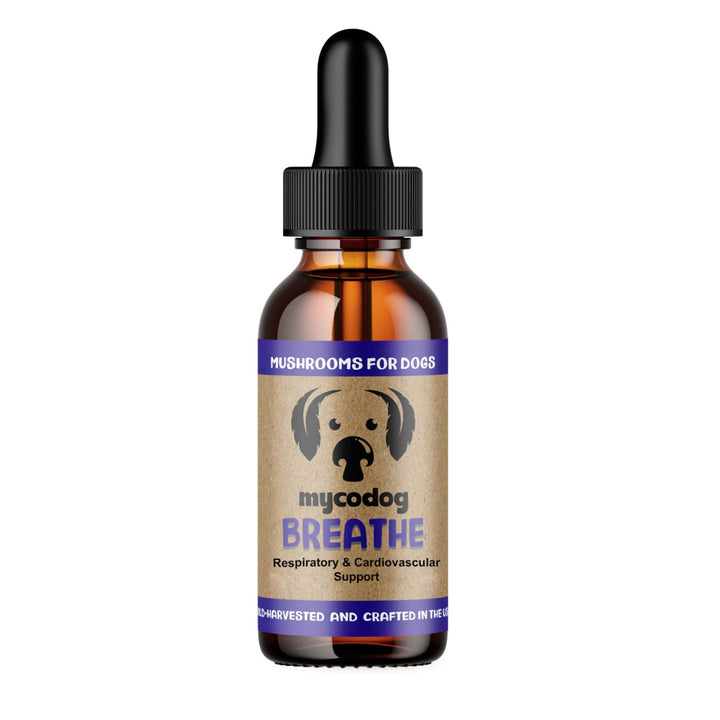
If breathing is the thing you have noticed
BREATHE by MycoDog
Four mushrooms rather than seven, built around airways and heart. Artist conk with cordyceps, reishi and chaga, plus ashwagandha to steady the stress response.
- Same extraction and sourcing standard as Vitality
- Label feeding is one dropper daily, two for senior dogs
Run one of them, not both. And when the bottle is finished, rotate rather than reorder, because variety across the year does more than loyalty to one blend. The rest of the medicinal mushroom extracts we carry is where that rotation goes next.
Ten is not old. We have agreed to call it old. The routine you build while nothing is wrong is the one that means something later, and the pet parents I admire most are the ones who ask what to leave out as carefully as they ask what to add.
Much love, Larry
Sources
- Cheng M, Zhang L, Wang J, Sun X, Qi Y, Chen L, Han C. The Artist's Conk Medicinal Mushroom Ganoderma applanatum (Agaricomycetes): Mycological, Mycochemical, and Pharmacological Properties: A Review. International Journal of Medicinal Mushrooms, 2024, 26(7), 13 to 66. Journal listing
- Effect of crude Ganoderma applanatum polysaccharides as a renoprotective agent against carbon tetrachloride-induced early kidney fibrosis in mice. PubMed Central. Full text
- Brown DC, Reetz JA. Single Agent Polysaccharopeptide Delays Metastases and Improves Survival in Naturally Occurring Hemangiosarcoma. Evidence-Based Complementary and Alternative Medicine, 2012. Full text
- Evaluation of the anti-tumour activity of Coriolus versicolor polysaccharopeptide alone or in combination with doxorubicin for canine splenic hemangiosarcoma. Veterinary and Comparative Oncology, 2022. Abstract
- Practical Application of the About Herbs website: Herbs and Dietary Supplement Interactions, covering reishi and Ganoderma cautions with anticoagulants and immunosuppressants. PubMed Central, 2019. Full text
- Unfriendly fungi: five types of mushrooms toxic to pets. dvm360. Article
- Medicinal mushrooms and extraction methods. University of Wisconsin Osher Center for Integrative Health knowledge base. Reference page
- Ganoderma applanatum species description. MykoWeb, The Fungi of California. Species page