Reishi mushroom for dogs is a functional mushroom used to support immune balance, a calmer nervous system, and healthy aging. The canine research is still early, but one controlled trial in beagles found that a daily dose supported a stronger vaccine response and lower markers of gut inflammation, with no adverse effects. Reishi is not a medicine and it does not replace veterinary care. It is a gentle, slow-working support tool, and it works best as a full-spectrum, dual-extracted, fruiting-body product given consistently over several weeks.
In this article
- What does reishi mushroom for dogs actually do?
- Is reishi safe for dogs?
- Can reishi help an anxious dog?
- Does reishi help dogs with cancer?
- What is the best reishi for dogs?
- How much reishi should I give my dog?
- How do I add reishi to my dog's routine?
- Reishi extract or a mushroom blend: which should you start with?
- Sources
If you have been researching mushrooms for your dog and feeling a little lost in the noise, you are not alone. I felt it too. Half of what you read online sounds like a miracle, and the other half sounds like a warning label. Somewhere in the middle is the honest answer, and that is where I want to sit with you today.
What does reishi mushroom for dogs actually do?
Reishi (its scientific name is Ganoderma lucidum, and it has been used in traditional Chinese medicine for over two thousand years) is what herbalists call an adaptogen. That means it is used to help the body find balance rather than to force one specific effect. For dogs, that shows up in a few main ways.
The most credible evidence is around the immune system. In 2024, a study published in the Journal of Animal Science tested reishi in forty adult beagles. The dogs that received a daily dose of 15 mg per kg of body weight produced higher vaccine-specific antibodies seven days after a rabies vaccination compared to the control group, and they showed a tendency toward lower fecal calprotectin, a marker of gut inflammation. There were no harmful effects on their immune cells. This matters because it is one of the very few reishi studies done in actual dogs, not humans or lab rats.
Beyond immune support, reishi is rich in two families of active compounds: beta-glucans, which are the immune-supporting sugars found in the mushroom's cell walls, and triterpenes (also called ganoderic acids), which are studied for their anti-inflammatory and calming activity. A 2025 systematic review of preclinical research found that reishi triterpenes consistently lowered inflammatory markers like TNF-alpha and IL-6 across cell and animal models. That work is early and not yet confirmed in dogs, so I want to be clear about what it is: promising, not proven.
Here is what the research tells us in plain terms. Reishi mushroom benefits for dogs cluster around immune balance, a healthy inflammatory response, antioxidant support, and a steadier nervous system. It is whole-body support, not a targeted fix for one symptom.
Is reishi safe for dogs?
For most healthy dogs, reishi is well tolerated, and side effects are uncommon and mild. The most likely one is loose stool or mild digestive upset when you introduce it too fast. That usually settles when you slow down and lower the dose.
But safe for most does not mean safe for all, and this is where a lot of blogs go quiet. According to the American Kennel Club, which spoke with integrative veterinarian Dr. Robert Silver, reishi and lion's mane can raise the risk of bleeding when combined with NSAIDs, anticoagulants, or blood-pressure medication.
The immune picture is more nuanced, and it is worth getting right. Reishi is immunomodulatory, not a one-way immune stimulant. Research describes it as bidirectional, which means it may help lift an underactive immune response and calm an overactive, inflammatory one. That regulating quality is a big part of why it is considered an adaptogen. Even so, integrative vets generally advise caution with immune-active mushrooms in two specific situations: dogs on immunosuppressant medication, where reishi's immune-activating side could work against the drug, and dogs with autoimmune conditions, where individual responses vary and adding any immune activity carries a theoretical risk. The canine evidence here is thin, so this is a talk-to-your-vet decision, not a hard rule, and never a do-it-yourself one.
So let's be real for a second. Reishi is gentle, but it is still biologically active. Talk to your veterinarian first if your dog:
- Is on any prescription medication, especially blood thinners, NSAIDs, or blood-pressure drugs
- Has an autoimmune condition or is taking immunosuppressants
- Has a bleeding disorder
- Is pregnant or nursing
- Is scheduled for surgery in the next two weeks
- Is a young puppy
This is not about fear. It is about being your dog's advocate with your eyes open. When in doubt, loop in a holistic or integrative vet who is comfortable with functional mushrooms.
Can reishi help an anxious dog?
This is the reason reishi has a special place in my house.
Reishi has a long traditional reputation as a calming, grounding mushroom, and its triterpenes are the compounds researchers connect to that mellow, settling quality. I want to be honest with you: the calming research in dogs specifically is thin. Most of it is traditional use plus early studies in other species. So I am not going to promise you a calm dog in a bottle.
What I can tell you is what I do with Milka. My Frenchie is a senior now, her snout going white, and supporting her brain and nervous system as she ages is one of my quiet daily rituals. I use reishi as part of her immune and calm foundation, and I pair CLARITY, a functional mushroom blend made to support cognitive function and brain health, with CALM Hemp Oil, a full-spectrum hemp oil that helps ease nervous-system tension. Together they support both the thinking side and the settling side of aging. Reishi sits underneath all of it as steady, everyday support.
If your dog struggles with noise sensitivity, restlessness, or the general edginess that can come with getting older, reishi may be a gentle piece of a bigger picture. It is not a sedative and it does not work overnight. It works slowly, like most things worth doing.
Does reishi help dogs with cancer?
I want to answer this carefully, because it is where the internet gets the most irresponsible.
Reishi has been studied in oncology support settings, mostly in humans and in animal models. Some laboratory and mouse studies have shown that reishi polysaccharides can influence tumor-fighting immune activity. That research is real, and it is genuinely interesting. But there is no evidence that reishi is a cancer therapy for dogs, and reishi should never be used in place of veterinary cancer care.
Where reishi may have a role is as complementary support, alongside a veterinary treatment plan, to help support quality of life and immune function. If your dog has a cancer diagnosis, that is a conversation for you and your oncology vet, not a decision to make from a blog post. I am working on a dedicated post about mushrooms and canine cancer support so I can give that topic the room and the honesty it deserves.
What is the best reishi for dogs?
Here is what most pet parents are never told: the form of reishi you buy matters more than the fact that you bought reishi at all. Two products on the same shelf can be worlds apart.
Two things separate a reishi product that does something from one that does very little: whether it uses the fruiting body or cheap mycelium grown on grain, and whether it is dual-extracted.
Reishi holds its active compounds in two different places that need two different methods to unlock. Beta-glucans are water-soluble and need a hot-water extraction. Triterpenes are alcohol-soluble and need an alcohol extraction. A product made with only one method captures only half the mushroom. A dual extraction, sometimes called a double extraction, pulls both, which is why it is the gold standard for reishi specifically.
The fruiting body versus mycelium question is every bit as important. Independent lab testing, including analyses validated in the Journal of AOAC International, has repeatedly found that mycelium grown on grain often contains only around 5 to 10 percent beta-glucans, sometimes less, with a large share of the product being leftover grain starch. Fruiting-body material tests far higher and actually contains the triterpenes.
| What you are comparing | Fruiting body | Mycelium grown on grain |
|---|---|---|
| What it is | The actual mushroom, grown on wood | Root-like growth cultivated on a grain substrate |
| Beta-glucan content | Tests far higher | Often around 5 to 10 percent, sometimes less |
| Triterpenes (ganoderic acids) | Present | Little to none |
| Leftover grain starch | None | Can be a large share of the finished product |
| What to look for on the label | "Fruiting body" plus "dual extracted" or "double extracted" | "Mycelium" or "grown on grain" are the words to walk away from |
This is exactly why I feed the products I do. Our Reishi Mushrooms Liquid Dual Extract is a full-spectrum, double-extracted reishi made from wood-grown fruiting bodies, with no grain filler or mycelium. It is built to capture both the beta-glucans and the triterpenes, which is the whole point of using reishi in the first place.
The reishi I feed my own dogs
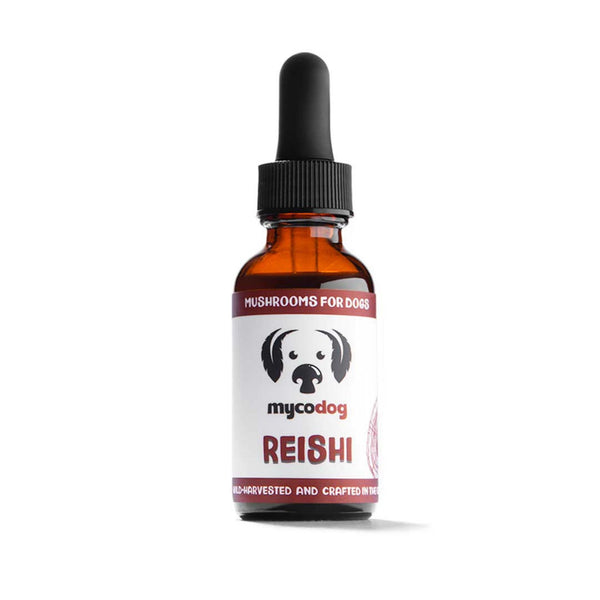 |
Reishi Mushrooms | Liquid Dual ExtractMycoDog · 1 fl oz
How to feed it: 1 dropper daily for proactive care, 2 droppers daily for senior pets. Add it straight to food or give it by mouth. |
How much reishi should I give my dog?
Let me give you the honest version of reishi for dogs dosage, because the numbers online are all over the place.
There is no single, standardized canine reishi dose, and any site that gives you one exact number is glossing over the truth. The reason the figures vary so widely is that product strength varies. Whole dried powder, a hot-water extract, and a dual-extracted tincture are not the same concentration, so one number cannot fit them all.
Here is how I think about it:
- Follow the product label first. A quality product is dosed for its own concentration by weight. That is the most reliable starting point you have.
- Start at half. For the first week, give roughly half the suggested amount so your dog's gut can adjust. This lowers the chance of loose stool.
- Build up slowly. Move to the full label dose over one to two weeks if your dog is tolerating it well.
- Give it with food. Reishi is bitter, and food improves acceptance and digestion.
- Be patient. Reishi is slow. Most benefits are subtle and take two to four weeks at minimum, often one to three months of consistent daily use, to show up. You may notice steadier energy or a calmer baseline before anything dramatic.
For a reference point, the controlled beagle study used 15 mg per kg of body weight per day of a reishi product and saw immune effects at that level. That is a research figure for one specific preparation, not a universal prescription, so please use it as context, not as a formula to copy.
How do I add reishi to my dog's routine?
The easiest reishi mushroom immune support for dogs is a liquid dual extract you can add straight to meals. A dropper into food once a day, given consistently, is all most dogs need. If you want to support the cognitive and nervous-system side too, especially for a senior dog, reishi pairs naturally with a lion's mane and mushroom-blend routine.
If your dog is a senior
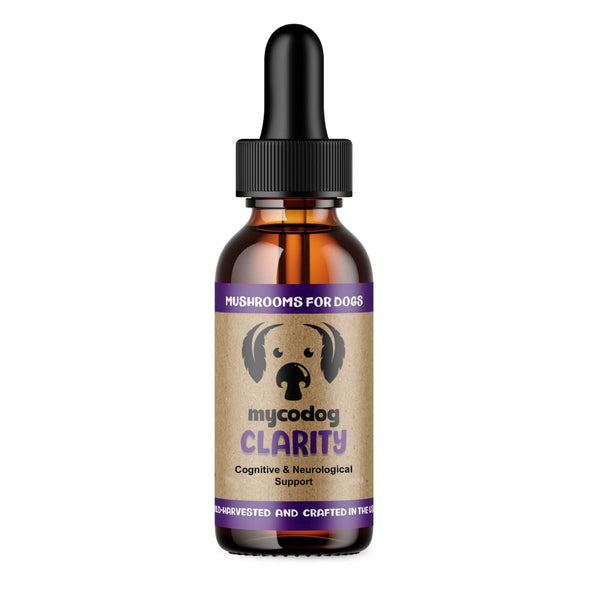 |
CLARITY, Mushrooms for Brain & Nervous System SupportMycoDog · 2 fl oz This is the blend I use for Milka. It is a triple-extracted, fruiting-body tincture of Lion's Mane, Reishi and Cordyceps, with Bacopa Monnieri and Ashwagandha, made to support cognitive function, the nervous system, and healthy aging. Reishi is already in it, so you are supporting the immune and calm side while you support the thinking side. 1 dropper daily for proactive care, 2 droppers daily for senior dogs. At least 350 mg of mushroom extract per 1 mL. No grain, no mycelium, no fillers. Building a senior support routine? Read next: what the brain research actually shows on MCT oil for dogs. |
Reishi extract or a mushroom blend: which should you start with?
Both of the products above are MycoDog tinctures made from fruiting bodies with no grain, no mycelium and no fillers, and both carry at least 350 mg of mushroom extract per 1 mL. The difference is how targeted you want to be. Here they are side by side.
| Reishi | Liquid Dual Extract | CLARITY blend | |
|---|---|---|
| What is in it | Reishi only | Lion's Mane, Reishi, Cordyceps, Bacopa Monnieri, Ashwagandha |
| Extraction | Double extracted | Double extracted |
| Bottle size | 1 fl oz | 2 fl oz |
| Price | $29.99 | $49.99 |
| Best fit | You want reishi specifically, for immune balance and a steadier nervous system | Senior dogs, or when cognitive and nervous-system support is the priority |
| Start here if | This is your first functional mushroom | Aging is the thing you are trying to get ahead of |
You do not need a cabinet full of supplements. You need a few good tools, used consistently, matched to what your dog actually needs. Reishi is one of the most versatile of those tools, and now you know how to choose one that works and how to feed it well.
Your dog's body wants balance. Reishi is one gentle way to support it. You are your pet's biggest advocate, and choosing thoughtfully, the way you already are, is what makes the difference.
Much love, Larry
Sources
- Functional properties of Ganoderma lucidum supplementation in canine nutrition. Journal of Animal Science, 2024. https://pubmed.ncbi.nlm.nih.gov/38417056/
- Anti-Inflammatory Potential of Ganoderma lucidum Triterpenes: A Systematic Review and Meta-Analysis of Preclinical Evidence. 2025. https://www.ncbi.nlm.nih.gov/pmc/articles/PMC12845357/
- Ganoderma lucidum polysaccharide enhances antitumor immune response (mouse model). 2020. https://www.ncbi.nlm.nih.gov/pmc/articles/PMC7313449/
- Medicinal Mushrooms for Dogs (featuring Robert Silver, DVM). American Kennel Club, 2026. https://www.akc.org/expert-advice/health/medicinal-mushrooms-for-dogs/
- McCleary BV, Draga A. Measurement of beta-glucan in mushroom and mycelial products. Journal of AOAC International, 2016.
- Reishi Mushroom: Benefits, Forms, Dosing, and Side Effects. Dr. Brad Stanfield, MD, 2026. https://drstanfield.com/blogs/articles/reishi-mushroom-benefits-forms-dosing-and-side-effects
- Immunomodulatory Effects of Ganoderma lucidum Bioactive Compounds on Gut-Brain and Gut-Liver Axis Disorders. 2025. https://www.ncbi.nlm.nih.gov/pmc/articles/PMC12563824/