Bee pollen for dogs is safe for most healthy dogs in small, food-sized amounts, and it is a genuinely nutrient-dense thing to add to a bowl. What it is not is an allergy solution. The idea that eating local pollen desensitizes an itchy dog is borrowed from a human folk remedy that has never held up in a controlled trial, and the pollen bees collect is mostly not the pollen dogs react to.
Bee pollen is a reasonable food, a poor allergy strategy, and a real allergy risk for a dog who is already pollen sensitive.
What's in this article
If you found this page late at night with a dog licking his paws in the next room, I know exactly where you are. You have already changed the food. You have already done the vet visits. Someone in a group told you bee pollen sorted their dog out, and now you are trying to work out whether that is real or whether it is another jar that ends up in the cupboard with the other seven.
So let's go through it properly. What the research actually supports, what it does not, why the bee question is more complicated than either side of the argument admits, and what I would look at instead if the itching is the reason you are here.
What is bee pollen, and what is actually in it?
Bee pollen is not pollen scraped off a flower. It is flower pollen that a forager bee has gathered, moistened with nectar and her own saliva, and packed into a granule on her back legs to carry home. Beekeepers collect it by fitting a screen at the hive entrance that strips a portion of those granules off as the bee crawls through.
That distinction matters more than it sounds, and we come back to it twice in this article.
Chemically, it is a real whole food. Analysis of pollen samples has confirmed phenolic acids and flavonoids including rutin, quercetin, kaempferol and isorhamnetin, alongside fatty acids, amino acids and B-group vitamins, with measurable antioxidant capacity (1).
Here's the part most pet parents are never told, though. Composition swings enormously with the flowers the bees worked and the region they worked them in. Two bags of bee pollen are not the same product in any meaningful nutritional sense, and neither one comes with an assay telling you what is in it.
What are the benefits of bee pollen for dogs?
Almost every page ranking for bee pollen for dogs lists the same five or six benefits. Very few of them tell you where the evidence for each one comes from, or that most of it was generated in a petri dish or a rodent, and essentially none of it in a dog. So here is that table, honestly.
| The claim | What the evidence actually is | Where that leaves your dog |
|---|---|---|
| Rich in vitamins, minerals, amino acids and antioxidants | Confirmed by direct chemical analysis of pollen samples (1) | Fair. It is a nutrient-dense food. Content varies bag to bag. |
| Antimicrobial and antifungal | Pollen extracts inhibited bacterial strains in laboratory testing (1) | In a dish, not in a dog. No evidence a spoonful reaches those concentrations in the body. |
| Anti-inflammatory | Plausible from the polyphenol content, shown mainly in cell and rodent models | Reasonable to expect a small whole-food contribution. Unreasonable to expect a drug-like effect. |
| Builds tolerance to allergens, like natural immunotherapy | The equivalent human experiment was run with honey and found no benefit over placebo (2) | Fails on the biology. Full explanation below. |
| Contains natural antihistamines | True in principle. Bee pollen contains quercetin, a documented mast cell stabiliser that blocks histamine release from human mast cells in laboratory testing (15) | Real mechanism, wrong dose. The arithmetic is below, and it is the most useful number on this page. |
| Supports the immune system | Immune-modulating activity in laboratory models only | Unmeasured in dogs. Read it as food, not as an immune lever. |
| Safe, because it is natural | Documented anaphylaxis in people after ingestion, including with no prior allergy history (4, 5) | Natural does not mean inert. Start tiny. |
Read down that middle column, and you can see the honest summary: bee pollen is a well-characterized food with almost no canine clinical research behind it. That is not the same as saying it does nothing. It means nobody has measured what it does in a dog, and any page telling you otherwise is filling a gap with confidence.
Is bee pollen safe for dogs?
For most healthy dogs, in small amounts, yes. There are two real risks worth knowing about, and neither gets much airtime.
The first is an allergic reaction. In people, bee pollen ingestion has caused reactions up to and including anaphylaxis, in patients with pollen allergies and in at least one case with no allergy history at all (4). One published case describes a woman who went into anaphylaxis after taking a bee pollen supplement and went on to develop allergic asthma afterward (5). Dog-specific case reports are thin, but the mechanism is not species-specific, and a dog cannot tell you her throat feels tight.
The second is what else is in the bag. Bee pollen is not regulated for pesticide residue the way produce is. A 2024 analysis of 34 commercial bee pollen samples detected 41 different pesticides and one mycotoxin across the set (6), and a review of 61 studies published between 2014 and 2024 identified 358 pesticides in bee products (7). Bees forage over several kilometers, so a pollen granule is a fairly efficient sample of whatever was sprayed nearby.
This is why sourcing is not a marketing detail here. It is the whole safety question. Ask where the hives are, and whether the finished product is residue tested.
How much bee pollen can a dog have?
There is no established canine dose, because there has been no canine dosing study. Anyone giving you a confident milligrams-per-kilogram figure has made it up or copied it from someone who did. What exists is a sensible way to introduce a novel food to an animal who might react to it, which is what I would follow.
This is my own approach rather than a published protocol, so take it loosely:
- Start with a single granule. Not a pinch, not a quarter teaspoon. One granule, on its own, on a day when you will be home.
- Wait a full 24 hours. Watch for facial swelling, hives, vomiting, sudden lethargy or scratching that starts within an hour or two.
- If nothing happens, go to a few granules and hold there for three or four days before increasing again.
- Build slowly toward a food-sized amount, which for most dogs means a fraction of a teaspoon mixed into a meal, not a scoop.
- Stop entirely if anything changes, and call your vet immediately for facial swelling or breathing changes. Do not push through a reaction to see whether it settles.
Honestly, this is the part that made me more comfortable with bee pollen inside a formulated blend than with a jar of loose bee pollen granules. In a blend it arrives at a small, consistent, food-level inclusion alongside ingredients that were chosen to work together, and you are not eyeballing a scoop.
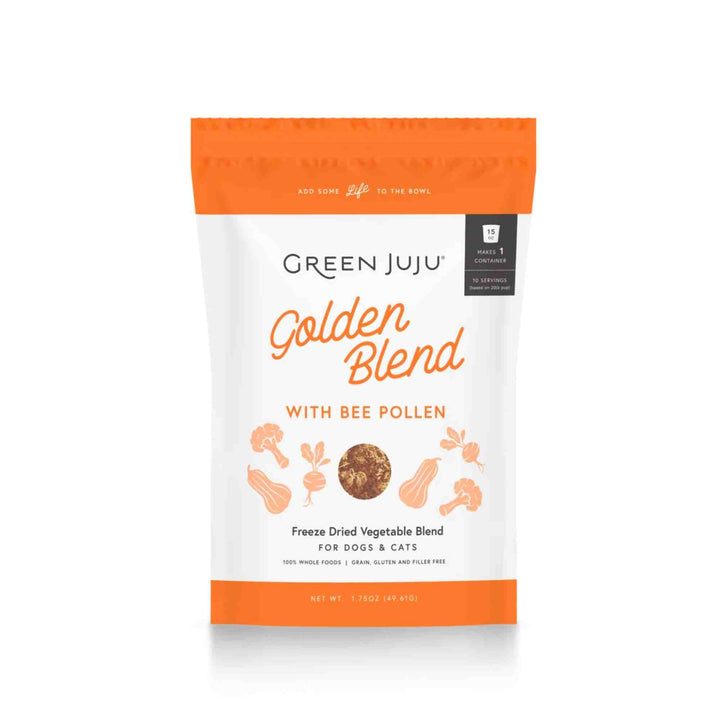
How I'd actually feed it
Golden Blend with Bee Pollen
This is the format I'd pick over loose granules, and it is worth looking at the ingredient panel to see why. Bee pollen sits last on the list, behind organic butternut squash, celery, cauliflower, golden beets, coconut, apple cider vinegar, turmeric, ginger and duck bone broth. It is present at a food-level inclusion, in a blend built around the anti-inflammatory ingredients that carry the real weight, rather than being the whole product.
- Bee pollen as the final ingredient, not the headline
- Certified organic vegetables and roots, freeze-dried rather than heat-processed
- No synthetic vitamins, minerals, grains or fillers
- Rehydrates with water and mixes into kibble, canned or raw
One caveat that applies either way: if your dog has ever reacted to a bee sting, or has a known pollen sensitivity, I would skip bee pollen altogether and talk to your vet first. The next section explains why that is not an overreaction.
Is harvesting bee pollen bad for the bees?
This is the question that stops a lot of thoughtful pet parents, and it deserves a better answer than the two you usually get, which are "it's fine, bees make plenty" and "never buy it".
Here is the actual situation. Pollen is the colony's only real protein source, and brood rearing depends on it. A pollen trap removes a share of what comes home. So the question is not whether pollen matters to the hive, it obviously does. The question is how much you take, and how often.
The research is genuinely mixed, and the pattern in it is frequency:
- A 2018 study using commercial-style traps twice weekly through canola pollination found reduced honey production but no negative effect on sealed brood (8).
- A 2025 study varying trapping frequency found daily trapping cut brood area growth to roughly 19 percent, against about 62 percent in untrapped colonies. Alternate-day, three-day and weekly trapping landed at roughly 46, 61 and 69 percent, so the damage scaled directly with how often the trap was on (9).
- Older work found no significant effect on brood reared at any point, but relatively fewer trapped colonies survived into the following spring (10).
Put together, that says something specific and useful: harvested occasionally, a colony compensates by sending more foragers out for pollen. Harvested daily through a season, it does not. The variable is beekeeping practice, not the existence of bee pollen as a product.
My honest position is that this makes bee pollen a supply-chain question rather than a yes-or-no ethical one, and it is a fair thing to ask a brand about. It is also, I think, another argument for the small-inclusion approach. A blend that uses bee pollen as one supporting ingredient asks far less of a hive than a product that is nothing but pollen.
Does bee pollen help dogs with allergies?
If someone recommended bee pollen for dog allergies and that is what brought you here, this is the section that matters. And it needs more care than a straight yes or no, because two completely different claims get bundled into this question and they fail for different reasons.
The first is that bee pollen desensitizes a dog to allergens, the way an allergy shot would. That one does not survive contact with the biology. The second is that the flavonoids in bee pollen act as natural antihistamines. That one is real pharmacology, and it deserves a proper answer rather than a dismissal. Let's do them separately.
The desensitization claim
The theory sounds elegant. Feed your dog small amounts of local pollen, her immune system gets familiar with it, she reacts less. It is the local honey remedy with a dog attached. There are three separate problems with it.
It is the wrong pollen. Bees work insect-pollinated flowers, whose grains are large and sticky, built to cling to an insect. As allergist and immunologist Dr. Michael Daines of the University of Arizona has put it, large sticky grains do not get into the air we breathe, so they are not what causes allergies in the first place (3). Environmental allergies in dogs are driven by wind-borne tree, grass and weed pollen, which is light enough to travel for miles. Bees have no reason to collect it.
The human version was tested, and it failed. A controlled trial gave people with allergic rhinoconjunctivitis local unpasteurized honey, commercial honey, or a flavored placebo, alongside their usual care. Neither honey group did better than placebo (2). A later trial did find improvement, but only at a very high daily dose taken alongside an antihistamine (11), which is a long way from sprinkling granules on a dinner.
And here is the twist nobody mentions. Bee pollen is not reliably free of allergenic pollen either. Published case work has found bee pollen containing chrysanthemum, dandelion and ragweed, and documented cross-reactivity between wind-pollinated ragweed and insect-pollinated dandelion (12). Clinicians have noted that skin test reactivity to common airborne pollens often tracks with reactivity to bee pollen (4).
So the allergenic material is sometimes in there. In an unknown quantity. With no label telling you which flowers went into the batch. That is the profile of a risk, not a therapy. Real allergen immunotherapy works precisely because the allergen is identified and the dose is measured, which is the one thing a bag of bee pollen can never offer you.
But doesn't bee pollen contain natural antihistamines?
Yes, in a real sense, and I want to give this one its due, because it is a much better argument than the desensitization one and it gets dismissed too quickly by people arguing against bee pollen.
Bee pollen contains quercetin, a flavonoid with genuinely documented anti-allergic activity. Quercetin stabilizes mast cells, the cells that dump histamine when an allergic reaction fires. In laboratory work on cultured human mast cells, quercetin blocked the release of histamine and inflammatory cytokines, and on some measures outperformed cromolyn, a prescription mast cell stabilizer (15). That is not folklore. The mechanism is real.
So the question is not whether the compound works. It is whether a dog eating bee pollen gets enough of it. This is where it comes apart, and the numbers are worth seeing.
Researchers who ran HPLC analysis on Brazilian bee pollen samples measured quercetin at anywhere from under 2 mg to about 68 mg per 100 grams of pollen, a more than thirtyfold swing between samples (16). Take the richest sample in that study. A teaspoon of bee pollen is roughly 5 grams, so a teaspoon of the best of them carries somewhere around 3 mg of quercetin. A teaspoon of the weakest carries around a tenth of a milligram.
Now compare that to the doses quercetin is actually studied at. Human trials in allergic rhinitis use around 200 mg a day of a high-bioavailability formulation, and standard quercetin is typically given at 500 to 1000 mg a day, because absorption of ordinary dietary quercetin runs at roughly 3 to 17 percent (17).
Adjust for bodyweight, since a dog is smaller than a person, and the gap narrows but does not close. Roughly 3 mg in a 20 kg dog works out at about 0.2 mg per kilo. The 200 mg human dose in an average adult is closer to 3 mg per kilo, and the standard dose lands nearer 7. The dog is still somewhere between fifteen and fifty times short of the lowest dose anyone has shown to do anything, before you account for absorption, and that is using the richest pollen sample in the study rather than a typical one.
Here's what that actually means, and it is not "bee pollen does nothing." It means bee pollen is a food that happens to contain a useful compound at food-level concentrations, in an amount that varies more than thirtyfold between bags with nothing on the label to tell you which one you bought. If the quercetin mechanism is what appeals to you, the honest version of that plan is a dose you can count, not a food you hope is the strong batch. That is a conversation worth having with a holistic vet rather than a jar worth buying on the strength of a claim.
If your dog is itching, the next question is not which supplement to add. It is what is actually driving it, and in what order to address it. That is what this free guide walks through.
One more thing worth naming here, because it changes the order of everything else. If your dog has a musty or corn-chip smell, brown-stained paws, gunky ears or dark patches of skin, you may be looking at a yeast pattern rather than a straightforward allergy, and the starting point is different. I have written separately about why yeast keeps coming back in dogs and how to support the gut at the root.
If not bee pollen, what actually helps an itchy dog?
Three things, in this order, and none of them are quick.
The skin barrier, via omega-3. This is the one with real canine evidence behind it. The international consensus guidelines for managing chronic atopic dermatitis in dogs list increasing essential fatty acid intake among the first steps, alongside flare-factor avoidance and skin and coat care (13). It is not dramatic and it is not fast. Veterinary reference sources are explicit that fatty acids are not useful for acute flares and can take up to two months to show an effect (14). I would rather tell you that now than have you give up at week three.
The gut. This is where PAWDEGA's position is holistic rather than proven, and I will label it as such. Large controlled canine trials on gut-first approaches to skin issues do not exist yet. What I can tell you is what I saw with Milka, and what I hear from pet parents every week, which is that skin very rarely settles while digestion is still a mess. If you want the reasoning behind that, I have written about why gut health sits underneath whole-body wellness in dogs.
For a dog with itchy skin and none of the yeast signs above, the Leaky Gut Protocol is where I would start, because it works on the gut lining rather than on the itch. If the yeast picture does sound like your dog, the order flips and the yeast work comes first, otherwise you are repairing a lining while something is still damaging it. That sequence matters more than which jar you open.
The diet itself. Before any supplement, what is in the bowl every day does more work than anything you sprinkle on top of it.
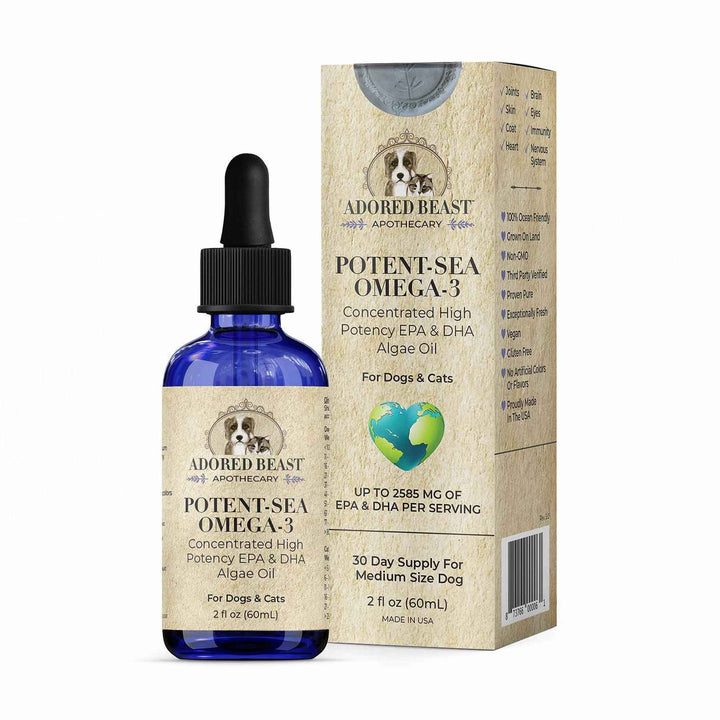
If the itching is why you're here
Potent-Sea Omega-3 Oil
If you take one thing from this article, make it this one rather than the bee pollen. It is algae-sourced rather than fish-sourced, which sidesteps the heavy metal and rancidity problems that come with fish oil, and it is the intervention the veterinary guidelines actually name.
- Concentrated EPA and DHA from marine algae grown on land
- Free from solvents, pesticides and heavy metals
- Give it a full two months before you judge it
- Contains rosemary extract, which the label notes can be contraindicated with epilepsy, so check with your vet first
If you want to go deeper on that choice, I have written about why the source of your omega-3 matters more than the supplement itself.
So, where does that leave bee pollen? Honestly, in a fine place. It is a real food with a decent nutritional profile, it is reasonable to include at a small amount in a blend, and there is no need to feel bad about feeding it if your dog tolerates it and you are happy with the sourcing.
It is only when it gets sold as the answer to your dog's itching that it becomes a problem, because that is time your dog does not have to spare. You are not powerless here, and you are not doing this wrong. You have been aiming at the symptom, because that is what everyone told you to aim at.
I am not a veterinarian and this is not medical advice. Every dog is different, so please work alongside your vet, ideally a holistic or integrative one, for anything ongoing.
Much love, Larry
Sources
- Ilie CI, et al. Bee Pollen Extracts: Chemical Composition, Antioxidant Properties, and Effect on the Growth of Selected Probiotic and Pathogenic Bacteria. Antioxidants, 2022. doi.org/10.3390/antiox11050959
- Rajan TV, Tennen H, Lindquist RL, Cohen L, Clive J. Effect of ingestion of honey on symptoms of rhinoconjunctivitis. Annals of Allergy, Asthma & Immunology, 2002;88:198-203.
- Dr. Michael Daines, allergist and immunologist, University of Arizona College of Medicine, quoted in "9 Allergy Myths Debunked," ABC News.
- Anaphylaxis from bee pollen supplement. CMAJ, 2012;184(10):1167. cmaj.ca/content/184/10/1167
- Eickholt E, Norelli V, Martin K, Diioia M. Supplemental Bee Pollen Ingestion With Resultant Anaphylaxis and Allergic Asthma: Case Report. Case Reports in Immunology, 2026. doi.org/10.1155/crii/9583906
- Carrera MA, Martinez Martinez JA, Hernando MD, Fernández-Alba AR. Simultaneous analysis of pesticides and mycotoxins in primary processed foods: The case of bee pollen. Heliyon, 2024;10(13):e33512. doi.org/10.1016/j.heliyon.2024.e33512
- Carrera MA, Fernández-Alba AR, Hernando MD. Unveiling bee pollen's contamination with pesticides and mycotoxins: Current analytical procedures, results and regulation. TrAC Trends in Analytical Chemistry, 2024;180. doi.org/10.1016/j.trac.2024.117935
- Hoover SE, Ovinge LP. Pollen Collection, Honey Production, and Pollination Services: Managing Honey Bees in an Agricultural Setting. Journal of Economic Entomology, 2018;111(4):1509. academic.oup.com/jee/article/111/4/1509
- Impact of corbicular pollen trapping frequency on pollen yield and colony growth in Apis mellifera L. colonies in Indian mustard. Plant Science Today, 2025. horizonepublishing.com/index.php/PST/article/view/9257
- Some Effects of Pollen Traps on Colonies of Honeybees. Journal of Apicultural Research, 1974;13(2). Older work, included because it is one of the few studies tracking colonies through to the following spring.
- Asha'ari ZA, et al. Ingestion of honey improves the symptoms of allergic rhinitis: evidence from a randomized placebo-controlled trial in the east coast of Peninsular Malaysia. Annals of Saudi Medicine, 2013. doi.org/10.5144/0256-4947.2013.469
- Bee Pollen-Induced Anaphylaxis: A Case Report and Literature Review. Allergy, Asthma & Immunology Research, 2015;7(5):513. e-aair.org
- Olivry T, DeBoer DJ, Favrot C, et al. Treatment of canine atopic dermatitis: 2015 updated guidelines from the International Committee on Allergic Diseases of Animals (ICADA). BMC Veterinary Research, 2015;11:210. doi.org/10.1186/s12917-015-0514-6
- Atopic Dermatitis in Dogs. MSD Veterinary Manual. msdvetmanual.com
- Weng Z, et al. Quercetin Is More Effective than Cromolyn in Blocking Human Mast Cell Cytokine Release and Inhibits Contact Dermatitis and Photosensitivity in Humans. PLoS ONE, 2012. ncbi.nlm.nih.gov/pmc/articles/PMC3314669
- De-Melo AAM, Estevinho LM, Moreira MM, Delerue-Matos C, Almeida-Muradian LB. HPLC-MS flavonoid determination and antioxidant capacity of Brazilian dehydrated bee pollen, 2016. bibliotecadigital.ipb.pt
- Quercetin and Its Lecithin-Based Formulation: Potential Applications for Allergic Diseases Based on a Narrative Review. Nutrients, 2025;17(9):1476. mdpi.com/2072-6643/17/9/1476