The best red light therapy device for your dog is the one that covers the area you are aiming at, delivers a controlled dose, and fits a routine you will actually keep for weeks. It is not the one with the biggest numbers on the box. Here is what nobody selling a device will tell you: the specs those brands ask you to shop by do not agree with each other, and research in living dogs shows that almost none of the light reaches deep tissue anyway.
In living dogs, more than 94 percent of light from a therapeutic device is lost before it reaches deeper tissue, even after the coat is clipped, which is why coverage, skin contact and consistency decide results far more than the wattage printed on the box.
Full disclosure before we go further: we use Photonic Health devices for our own dog, and PAWDEGA earns a commission if you buy one through our link. I have written this post to the same standard I would want if I were the one spending the money, which means the device we use gets held to the same criteria as everyone else's.
What's in this guide
- Why the spec numbers contradict each other
- How deep the light actually goes on a dog
- Is a more powerful device better?
- Are these devices FDA cleared?
- Cheap devices, and how this differs from cold laser
- The seven things that actually matter
- Pad or handheld: what I learned at 35,000 feet
- Does it work, honestly?
- When you should not use it
- What I would tell you if we were talking
If you are reading this, there is a decent chance your vet said a word recently that you have been researching at 4am ever since. IVDD. A CCL tear. Arthritis in a dog who was fine last year. You are following the plan you were given, and you are also trying to work out what else exists that might help, and whether it is worth several hundred dollars of your money.
I have been exactly there with my French Bulldog, Milka. And I have also spent an eleven hour flight from Hamburg to Bangkok with her having an IVDD flare-up in the cabin, reaching for the only tool I could physically get to under the seat in front of me. That flight taught me more about choosing a device than any spec sheet ever did. I will get to it.
Why do the spec numbers on red light devices contradict each other?
Search for the best red light therapy device for dogs and every result on the first page is either a marketplace listing or a buyer's guide written by a company that makes the device it recommends. That would be fine if they agreed with each other. They do not.
Two pet device buyer's guides, both published within the last year, both telling you to shop by penetration depth, give figures for the same wavelengths that differ by more than twentyfold. One says red light reaches 2 to 3 cm into tissue and near-infrared reaches 5 to 7 cm. The other says red reaches 1 to 2 mm and near-infrared reaches 3 to 5 mm. They cannot both be right, and a pet parent comparing them has no way to know which one is closer.
Here is how those claims hold up against work done in actual dogs.
| The spec you are told to shop by | What was measured in living dogs |
|---|---|
| Penetration depth in centimetres. Published pet buyer's guides claim anywhere from 1 mm to 7 cm for the same wavelengths. | An 830 nm study in living dog tissue concluded the settings tested suited targets within roughly 14 mm of depth. Under 1 percent of output was detected through the combined muscle and skin layer. |
| Power density in mW/cm². Different pet device brands publish "correct" ranges of 10 to 50, 20 to 120, and 20 to 200. | There is no published consensus range for dogs. Photobiomodulation follows a curve where low doses stimulate, a middle range works best, and high doses become inhibitory. |
| FDA clearance with a 510(k) number, listed by some guides as a must-have criterion. | The FDA does not require a 510(k) or any premarket approval for devices intended for animal use, so no pet-only device is FDA cleared. |
| Your dog's coat. Rarely mentioned in a spec comparison at all. | Beam attenuation averaged 98.6 percent through unclipped coat and 94.6 percent once clipped, meaning roughly four times more light got through on clipped skin. |
Read that last row again, because it is the one that changes what you should do on a Tuesday evening with your dog on the rug. The variable with the largest measured effect is not the device. It is the coat between the device and the skin.
How deep does red light actually go on a dog?
In 2023, a team publishing in the Journal of the American Veterinary Medical Association put twenty client-owned dogs through a proper measurement of this. They applied a class IV laser at seven sites on each dog and measured how much of the beam was lost, before and after clipping the hair over each site, using a colorimeter to record how dark each dog's skin was.
What they found:
- Through unclipped coat, an average of 98.6 percent of the beam was lost. Roughly one and a half percent made it through.
- Once the hair was clipped, the loss dropped to 94.6 percent. That sounds like a small change until you notice it means about four times more light arriving.
- Every additional millimetre of tissue cost another 11.6 percent.
- Every unit of increase in melanin index cost another 3.3 percent. Darker dogs get less light through than lighter dogs at identical settings.
- At the thickest sites, the caudal vertebrae and the semitendinosus muscles, loss reached 100 percent.
A separate study measuring 830 nm light in living dog tissue found that with the probe held in contact with the skin, roughly 8 to 9 percent of output made it through skin, and under 1 percent made it through the skin and muscle layer together. The authors concluded that the parameters they tested were appropriate for targets within about 14 millimetres. Not centimetres. Millimetres.
Two things follow from this, and both are practical rather than technical. First, contact matters enormously. In that same study, holding the probe away from the skin produced no meaningful difference in what reached deeper tissue across a range of distances, while contact did. Second, parting the coat and pressing the device against skin is a bigger lever than anything you can buy your way to. Nobody selling a device will tell you that your technique outweighs their hardware.
Is a more powerful device better?
This is where I have to be careful, because the popular holistic answer and the popular manufacturer answer are both a bit too simple, and the honest answer sits between them.
You will hear it said that a very powerful device blows straight through the tissue and does nothing. That is not quite what the research shows. A 2020 study in the Canadian Journal of Veterinary Research measured photon transmission in healthy dogs and found transmission was higher at higher power settings, and significantly lower as coat pigment darkened. Coat length, interestingly, was not a significant predictor. So more surface power does push more photons through tissue.
But getting more photons to the cell is not the same as helping the cell. Photobiomodulation follows what researchers call a biphasic dose response, described in a widely cited review by Huang and colleagues. Low doses stimulate. A middle range produces the best effect. High doses tip over into inhibiting the very activity you were aiming to support. The field worked this out within about a decade of starting, and it has been replicated in cell cultures and in animal work since.
So the useful version of the answer is this: raw power is not the spec that decides your outcome. Dose is. And dose is power multiplied by time across a known area, which means a device with a fixed session timer and a defined coverage area gives you something you can actually repeat. A more powerful device with no timer gives you a variable you cannot control.
Are red light therapy devices for dogs FDA cleared?
No, and this one is worth understanding properly, because at least one pet buyer's guide lists FDA clearance with a specific 510(k) number as a criterion you should demand.
The FDA states plainly that it does not require submission of a 510(k), a premarket approval, or any premarket clearance for devices intended for animal use. Manufacturers who exclusively make animal devices are not even required to register their establishments or list their devices with the agency. The FDA does retain oversight and can act if an animal device is misbranded or adulterated, but there is no clearance pathway to pass.
So when a pet device advertises FDA clearance, one of two things is true. Either the clearance belongs to a human device the company also sells, which tells you nothing about how it performs on a dog, or the claim is misleading. Either way, it is not the quality signal it is being sold as, and a brand leaning on it is a small flag rather than a reassurance.
Are cheap devices worth it, and is this the same as cold laser therapy?
Two questions come up more than any others, and they are connected.
On cheap marketplace devices. The price is not the problem. The unverifiability is. Remember there is no clearance pathway standing between a listing and your cart, which means nobody has checked the wavelength or output figures printed on it, and nothing obliges the seller to be able to explain them to you. A low-cost device with named wavelengths, a fixed timer and a real returns process can be a reasonable place to start. A listing with a big wattage number, no timer, no stated wavelengths and nobody behind it gives you nothing you can repeat and no one to ask when it does not seem to be working. The outcome I hear about most often is not that a dog was harmed. It is that someone concluded red light therapy does not work, when what they actually learned was that one unverifiable device did not work.
On cold laser. The laser sessions your vet or canine physiotherapist offers are not a different phenomenon from an LED device. The Merck Veterinary Manual defines photobiomodulation as covering lasers, LEDs and other light sources under the same underlying mechanisms. What differs is intensity, how tightly the light is focused, and the fact that a professional is choosing the dose. That is also why clinic sessions are priced the way they are, and why owning a device changes the arithmetic completely if your dog needs something several times a week for months. Both are considered safe when used correctly, and both carry the same contraindications, which I go through further down.
What should you actually look for in a red light therapy device for dogs?
Strip out everything unmeasurable and this is what is left. This is how to choose a red light therapy device for dogs without a spec sheet, and I would work down the list in order.
- Coverage that matches the area you need. A spine, a hip, and a shoulder are different sizes. If a device forces you to reposition four times per session, you will stop using it by week two, and consistency is the thing the evidence rests on.
- A design that makes skin contact easy. Contact beats distance, and the coat is the biggest single obstacle. A pad that presses against the body, or a handheld you can hold flat while parting the fur, beats a panel your dog stands near.
- A built-in session timer. This is the closest thing you get to dose control at home. Fixed settings mean every session is the same session.
- Both red and near-infrared. Red for surface tissue, near-infrared for anything deeper. This is the one spec where the industry does broadly agree.
- Something you will use daily without dreading it. Judge the device on the routine it creates, not on the numbers it advertises.
- Real support and a real return window. If the device does not suit your dog, you want a human to talk to and a way out. This matters more here than in most categories because there is no clearance process filtering the market.
- Marketing you can check. If a brand claims a penetration depth in centimetres, or FDA clearance for an animal device, they are either not reading their own field or are hoping you will not.
One thing to settle before you spend anything, because it is the question I am asked most by people whose vet has already named something. Red light sits alongside a veterinary plan, never instead of one, and it does not go into your dog's body the way a supplement or a medication does, so there is nothing here to work out against what your vet has already prescribed. There are still places you should not put it, and situations where you should ask your vet first. I have set all of those out in when you should not use it, and I would read that section before your device arrives rather than after.
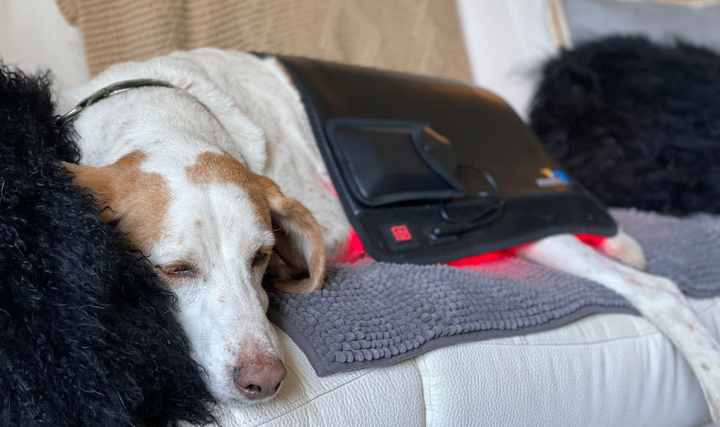
The one that was in our carry-on
Photonic Health Essential Back Pad
This is the device I reach for first, and it wins on the criteria above rather than on a spec sheet. It is large enough to lay over Milka's whole lower back and hips at once, which means no repositioning, which means I actually do it. I lay it over her like a blanket and get on with my evening.
- Roughly 22 by 14 inches of coverage, enough for a spine or both hips in one session
- 270 lights combining red and near-infrared
- Three fixed session lengths, so the dose is the same every time
- Cordless and rechargeable, with straps to hold it in place
- Comes bundled with a step-by-step IVDD course and US-based support
Pad or handheld: what I learned at 35,000 feet
A couple of years ago we flew Hamburg to Bangkok with Milka in the cabin, something we had done many times without incident. This time she started shaking before we even left the house. We gave her everything in our holistic kit and laid the back pad over her, and she settled. Because she settled, and because we were already running late, we got on the plane.
Eleven hours later I understood what an IVDD flare-up on an aircraft is like. Milka was tucked under the seat in front of Larry, in a position where he could not get supplements into her and could barely reach her. The one thing he could reach was the red light device in the carry-on. He laid the back pad over her and she calmed. He took it off twenty minutes later and the shaking came back. He put it on again and she settled again.
Then the pad's battery died mid-flight, somewhere over Asia, and the only thing left was a handheld. He held it against the spot where she had been injured before, and she settled again. I want to be clear that this is my experience and not a study. But it is the reason I no longer think of pad versus handheld as an either-or question.
A pad is a coverage tool. You lay it on, you walk away, and it covers the whole area without you holding anything, which is why it survives contact with real life and a real schedule. A handheld is a precision tool. It goes exactly where the problem is, it fits in a bag, and it works when your dog is wedged into a space the size of a shoebox. Most people who use this seriously end up with both, and if I were starting over I would buy the pad first, because the routine is what produces results and the pad is the one you will keep up.
Does red light therapy actually work for dogs?
Sometimes, for some things, and the honest picture is more mixed than any device brand admits.
The strongest canine evidence is in osteoarthritis. A randomised, double-blinded controlled trial published in the American Journal of Veterinary Research in 2022 followed twenty dogs with bilateral hip osteoarthritis. The photobiomodulation group showed better pain and function scores than the meloxicam control group at multiple checkpoints, and range of motion gains held out to ninety days. A blinded placebo-controlled trial in the Canadian Veterinary Journal in 2018 looked at canine elbow osteoarthritis and found significantly better lameness scores against sham, with improvement in most pain parameters and a reduction in NSAID use.
Now the part that nobody who sells a home device puts in their buyer's guide: both of those trials used clinic-grade class IV lasers, not consumer LED pads. The canine evidence base sits mostly on professional equipment, applied by professionals, at doses they controlled. That does not make a home device useless, and the underlying mechanism is the same one across lasers and LEDs. It does mean the honest framing is that at-home LED devices are supported by an evidence base built on something more powerful than what is in your hand.
The picture is also genuinely mixed elsewhere. Studies in dogs recovering from spinal surgery have found no difference between light therapy and sham. I go through that evidence properly in our post on red light therapy for dogs with IVDD, including the studies that did not find a benefit, because you deserve both halves of it.
When should you not use red light on your dog?
You will read a lot online about this being completely without risk. It is well tolerated, and that is not the same thing. The Merck Veterinary Manual sets out real contraindications for light therapy in animals, and they apply to LED devices as well as lasers, because photobiomodulation covers both under the same mechanisms.
- Never into the eyes. Direct eye exposure is an absolute contraindication, for your dog and for you. Retinal damage is one of the two main risks.
- Not over a known mass or malignancy. Laboratory data goes in both directions, with some malignant cell lines stimulated by light, some inhibited, and some unaffected. Professional guidance is to stay off a known mass. Light therapy is also contraindicated in patients with lymphoma or on immunosuppressant medication.
- Not over a pregnant uterus, an overactive thyroid, or an area of active bleeding.
- Care over long bones in dogs under a year old, where higher powered devices may affect growth plates.
- Lower the intensity if your dog is on photosensitising medication or botanicals.
- Ask your vet before using it over a surgical site. If a procedure deliberately separated a structure, encouraging tissue repair there is not what you want.
That list is the reason I want you using this alongside your vet rather than instead of them. If you do not have someone integrative in your corner yet, we keep a list of holistic and integrative vets offering online consultations.
What I would tell you if we were talking
Stop comparing penetration depths. Nobody can measure that number the way it is being sold to you, and the two brands quoting it at you disagree by a factor of twenty.
Buy for coverage of the area you care about, a timer you can repeat, and a routine you will keep. Then part the coat and press the device against skin, because that single habit does more than any upgrade you could pay for. Give it weeks, not days. And keep your vet in the loop, especially if there is a name attached to what your dog is dealing with.
Milka has been through an IVDD injury, a soft tissue injury, and that flight. Red light has been part of how we have supported her through all three, and you can read the full story of how we managed her IVDD injury naturally alongside our vet. It is not magic. It is one good tool, and knowing what it can and cannot do is what makes it useful.
Please keep in mind that I'm not a veterinarian, and this isn't medical advice. Every pet is unique, so I always recommend working alongside your vet, ideally a holistic or integrative vet, especially for anything ongoing or serious.
Which format, for which dog
| Pad system | Handheld | |
|---|---|---|
| Best for | Spines, hips, and any large area you will be working on daily for weeks | Paws, joints, a specific spot, and anything on the road |
| Key difference | Hands-free. You lay it on and walk away | Targeted. You hold it exactly where the problem is |
| What it asks of you | Almost nothing, which is why the routine survives a busy week | Ten minutes of your hands, and knowing where to place it |
| Evidence status | Same mechanism as the studied devices, larger area, lower intensity per point | Closer in form to the clinic devices used in canine trials, far smaller area |
| If you buy one | Start here. It is the one you will keep using | Add it second, once you know your dog's problem areas |
Sources
- Rosenblum ST, McCarthy DA, Millis DL, Odoi A. Use of a colorimeter is a viable method to measure melanin and erythema content in the context of laser beam attenuation by use of a class IV laser in different tissues in dogs. Journal of the American Veterinary Medical Association, 2023;261(7). pubmed.ncbi.nlm.nih.gov/36884382
- Kampa N, Jitpean S, Seesupa S, Hoisang S. Penetration depth study of 830 nm low-intensity laser therapy on living dog tissue. Veterinary World, 2020;13(7):1417-1422. pubmed.ncbi.nlm.nih.gov/32848319
- Hochman-Elam LN, et al. Effects of laser power, wavelength, coat length, and coat color on tissue penetration using photobiomodulation in healthy dogs. Canadian Journal of Veterinary Research, 2020. pubmed.ncbi.nlm.nih.gov/32255908
- Huang YY, Chen ACH, Carroll JD, Hamblin MR. Biphasic dose response in low level light therapy. Dose-Response, 2009. pubmed.ncbi.nlm.nih.gov/20011653
- Huang YY, Sharma SK, Carroll J, Hamblin MR. Biphasic dose response in low level light therapy, an update. Dose-Response, 2011. pmc.ncbi.nlm.nih.gov/articles/PMC3315174
- Alves JC, Santos A, Jorge P, Carreira LM. A randomized double-blinded controlled trial on the effects of photobiomodulation therapy in dogs with osteoarthritis. American Journal of Veterinary Research, 2022.
- Looney AL, et al. A randomized blind placebo-controlled trial investigating the effects of photobiomodulation therapy (PBMT) on canine elbow osteoarthritis. Canadian Veterinary Journal, 2018;59(9):959-966.
- Merck Veterinary Manual. Photomedicine in Veterinary Patients. merckvetmanual.com
- Veterinary Practice News Canada. Laser therapy and cancer, 2021.
- Today's Veterinary Practice. Laser Therapy: Fact or Fancy?, 2022.
- US Food and Drug Administration. How FDA Regulates Veterinary Devices. fda.gov
DISCLAIMER: Please note that this content is for informational purposes only and is not intended to be a substitute for professional veterinarian advice, diagnosis, or treatment. Our content may include affiliate and/or sponsored links which means your support helps move our mission forward. As content creators, we earn from qualifying purchases.