Yes. Dogs can eat broccoli, and that includes the stalk.
Broccoli is not toxic to dogs. The florets contain compounds called isothiocyanates that can irritate a dog's stomach in larger amounts, which is why portion size matters. The stalk, the part most articles tell you to throw in the bin, carries far less of that compound than the florets do.
And here is what most pet parents are never told: how you prepare broccoli decides how much of it your dog actually absorbs. A whole raw floret mostly passes straight through. The same broccoli chopped small or lightly steamed is a completely different food by the time it reaches the gut.
The short answer: broccoli is safe for dogs in small amounts, the stalk is the gentler part of the plant rather than the dangerous one, and chopping or light steaming is what makes the nutrients available.
On this page
- Is broccoli safe for dogs?
- Can dogs eat broccoli stalks? The data that settles it
- What broccoli actually does inside a dog
- How to prepare broccoli so your dog gets something from it
- How much broccoli can a dog eat?
- The dogs I would leave broccoli off the list for
- Milka and the stalk
- Common questions
Is broccoli safe for dogs?
Broccoli is safe for dogs in small amounts. It is not on any toxic food list. The American Kennel Club describes it as safe raw or cooked, with no seasonings or oils, and notes that the florets contain isothiocyanates, which can cause gastric irritation in dogs when the amount gets high.
That word, isothiocyanate, is doing a lot of heavy lifting in most articles about broccoli and dogs. It sounds alarming. It is worth understanding what it actually is, because it is the same family of compounds responsible for almost every benefit broccoli is famous for.
Broccoli stores compounds called glucosinolates. When the plant tissue is damaged, by chewing, chopping, or blending, an enzyme in the plant called myrosinase converts those glucosinolates into isothiocyanates. The most studied of these is sulforaphane. Too much, and you get gas, loose stool, and an unhappy gut. The right amount, and you get the compound that most of the broccoli research is actually about.
So the question is not really "is broccoli safe." It is "how much, from which part of the plant, and prepared how." Those three answers are where every generic article stops and this one starts.
Can dogs eat broccoli stalks? The data that settles it
If you search this question, you will find flat contradictions on page one. Some well-known holistic sites say dogs should never eat the stalk because it is high in isothiocyanates. Others say the stalk is fine. Both are stated with total confidence and neither shows you a number.
So let's look at the number.
A 2018 analysis in Molecules measured glucosinolate concentration separately in broccoli florets, stems, and leaves. Total glucosinolate concentration in floret tissue was significantly higher than in stem or leaf tissue. Not slightly. By a factor of roughly four and a half against the stem.
| Plant part | Total glucosinolates | What that means in the bowl |
|---|---|---|
| Floret (the green head) | 34.7 | Most concentrated. Smallest portion. This is the part to be careful with. |
| Leaf | 10.1 | Usually discarded by the shop. Perfectly usable, chopped small. |
| Stem and stalk | 7.5 | The gentlest part of the plant on a dog's stomach. |
Source: comparative phytonutrient analysis of broccoli tissues, Molecules, 2018. Figures rounded to one decimal place.
The gap is even wider in the indole group specifically: around 18.8 in florets against 1.4 in stems. Petco's veterinary-reviewed guidance says the same thing in plain language, that stalks are lower in isothiocyanates than the florets.
So the advice to avoid the stalk and feed only florets has it backwards. If you were going to be cautious about one part of broccoli, the floret is the part to be cautious about.
The stalk does carry one real risk, and it has nothing to do with chemistry. It is dense, fibrous, and exactly the wrong shape for a dog who swallows before thinking. A thick chunk of raw stalk is a choking hazard, especially for small dogs, puppies, and flat-faced breeds. That is a knife problem, not a broccoli problem.
What broccoli actually does inside a dog
Most articles list vitamins here and move on. Fair enough, and the numbers are good. Per 100 grams of raw broccoli, USDA data records around 89.2 mg of vitamin C, 101.6 micrograms of vitamin K, 2.6 g of fibre, 2.8 g of protein, 47 mg of calcium, 316 mg of potassium, and a meaningful dose of beta carotene and lutein, all for about 34 calories.
But dogs make their own vitamin C, so that headline number matters less for them than it does for us. The more interesting part is sulforaphane, and here there is something genuinely worth knowing that almost no broccoli article for dogs mentions.
It has been studied in dogs. Actual dogs.
A 2018 study in Veterinary Medicine and Science gave ten healthy dogs a single dose of a broccoli sprout supplement and then tracked their blood and urine for 48 hours. Sulforaphane metabolites showed up in the plasma of nine out of ten dogs, peaking around four hours after the dose. The researchers also saw a drop in histone deacetylase activity, one of the mechanisms sulforaphane is studied for. Their conclusion was that sulforaphane is bioavailable in dogs following broccoli supplement consumption, with limited adverse events.
That is a small study on healthy dogs, and it does not tell us what a spoonful of dinner broccoli does over months. What it does tell us is that the pathway works in a dog. The compound gets absorbed. That is not nothing, and it is more than you can say for a lot of the ingredients being sold to pet parents right now.
Add to that the fibre, which feeds the gut bacteria your dog's whole system depends on, and the fact that broccoli is genuinely low in sugar compared to the carrots and sweet potato most people reach for, and you have a vegetable that earns its place in the bowl.
How to prepare broccoli so your dog gets something from it
This is the part that matters most, and it is the part everyone skips.
Dogs do not have the machinery to break down plant cell walls the way a cow or a rabbit does. Hand your dog a raw floret and most of it will arrive at the other end looking much as it did going in. The nutrients are locked inside cells your dog cannot open.
There is a second layer to it too. Remember myrosinase, the enzyme that turns glucosinolates into sulforaphane? It only meets the glucosinolates when the plant tissue is broken. And it is heat sensitive. Research summarised in Food Science and Nutrition notes that boiling for more than a minute, or steaming for four to five minutes, can inactivate it entirely. Mild heat around 50 to 60 degrees Celsius actually raised sulforaphane levels in that work, while 70 degrees knocked them back down to raw levels.
Why care? Because when active myrosinase is present, sulforaphane has been shown to be three to four times more bioavailable than when it is not. And in a human bioavailability study, steamed broccoli produced more than double the plasma isothiocyanate exposure of boiled broccoli.
| How you serve it | Cell walls | Sulforaphane pathway | Verdict |
|---|---|---|---|
| Whole raw chunk | Mostly intact | Barely triggered | Fun to chew, low nutritional return, choking risk on thick stalk |
| Finely chopped raw | Broken | Enzyme fully active | Strong option. Let it sit a few minutes after chopping |
| Chopped, then lightly steamed | Broken and softened | Preserved if brief and gentle | My default. Easiest on sensitive stomachs |
| Boiled until soft | Broken | Enzyme inactivated, nutrients leach into water | The weakest version. Safe, but you lost most of the point |
| Blended or fermented into a purée | Fully broken | Fully triggered | The most bioavailable form, and the most work |
If you take one thing from this article, take this: a food processor does more for your dog's vegetables than the vegetable you chose. Chop it small, let it sit for a few minutes so the enzyme can work, then either serve it raw or give it a brief, gentle steam. Skip the salt, oil, & onion.
Now, the honest bit. Doing that properly, every single day, alongside everything else you are already doing? Most of us manage it for about two weeks. That is the real reason I keep a prepared blend in the house as well.
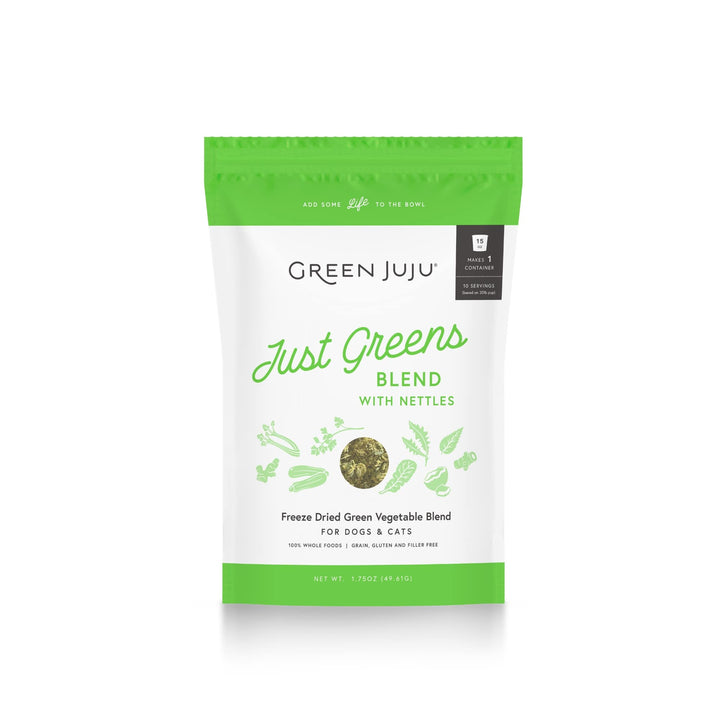
What I keep in the house for the days I do not chop
Green Juju Just Greens with Nettles
Everything above is about one thing: breaking the plant down so the dog can use it. This blend has already done that step. Organic vegetables and herbs, raw and freeze-dried rather than cooked, so nothing was heated past the point where the plant enzymes stop working. It is not broccoli, and I am not going to pretend it is. It is kale, dandelion greens, celery, zucchini, parsley and nettles, prepared the way the research says vegetables need to be prepared before a dog can do anything with them.
- Kale brings the same cruciferous family compounds as broccoli
- Freeze-dried raw, so no cooking step to inactivate the plant enzymes
- Certified organic, no synthetics, no fillers, no grain
- Add water, stir, mix into whatever you already feed
How much broccoli can a dog eat?
The standard veterinary guidance is the ten percent rule: extras of any kind, broccoli included, should stay under ten percent of your dog's daily calories. Purina states it plainly, and it holds up as a sensible ceiling.
The number worth knowing on the other end is where it goes wrong. Guidance drawing on Tufts veterinary nutrition puts serious gastric distress at around twenty five percent or more of the daily diet as broccoli. So there is a wide, forgiving gap between a sensible spoonful and an actual problem. You are not walking a tightrope here.
What I actually do, and this is my own practice rather than a clinical recommendation: start smaller than you think. A teaspoon of finely chopped broccoli for a small dog, a tablespoon for a large one, two or three times a week rather than daily. Then watch the stool for two days. Gas and loose stool mean back off, not stop forever.
And rotate. Broccoli every day for a year is a worse plan than broccoli, then green beans, then a different green the week after. Variety in the bowl is variety in the gut.
The dogs I would leave broccoli off the list for
This is the section most articles do not write, because "yes, feed it" is a cleaner ending. But there are four situations where I would wait.
A dog actively fighting yeast. Our position at PAWDEGA, and the position of the holistic vets we work with, is that vegetables, fruit and grains can feed yeast and inflammation while a dog is in the middle of it. Broccoli is one of the lower-sugar options, which is why it appears on our short list of fresh foods worth adding for kibble-fed dogs. But if your dog has smelly ears, rust-stained paws and that musty corn-chip smell, the bowl is not where I would be experimenting this month. Start here instead.
A dog with thyroid concerns. Cruciferous vegetables are goitrogenic, meaning they can interfere with iodine uptake. This gets stated far more dramatically than the evidence supports. Dr. Jean Dodds, who knows more about canine thyroid than almost anyone, has said the goitrogenic content of green leafy vegetables is minute and should not cause concern when fed in moderation. Integrative vets often suggest steaming them, which reduces the iodine-blocking effect. So this is a conversation with your vet and a steamer, not a ban.
A dog on anticoagulant medication. Broccoli is high in vitamin K, at around 101.6 micrograms per 100 grams. If your dog is on any medication that affects clotting, mention the vegetables you feed at the next appointment. It is a thirty second conversation and worth having.
A dog who inhales food. If your dog does not chew, the stalk goes in the food processor or it does not go in at all.
Milka and the stalk
Milka is a French Bulldog and she is a senior now, with a white snout and strong opinions about vegetables. She has no interest whatsoever in the florets. She will pick them out and leave them in the bowl like a toddler.
The stalk, though. The stalk she loves.
For a long time I assumed I was doing something slightly wrong, because every article I read said to feed the florets and bin the stem. Then I went looking for an actual measurement rather than an opinion, found the tissue-level data, and realised she had been right the whole time. The part she gravitates towards is the part with roughly a fifth of the glucosinolate load. Dogs are often better at this than we give them credit for.
She still does not get it whole. It gets peeled, chopped small, left on the board for a few minutes, and briefly steamed. Then it goes into her meal. That is the whole ritual, and it takes about three minutes.
This is my experience with one dog, not a study. But it is the reason I went digging in the first place, and I am glad I did.
Common questions
Can dogs eat raw broccoli?
Yes, washed and chopped small. Raw keeps the plant enzyme intact, which is an advantage. The catch is that raw is harder on a sensitive stomach and harder to chew, so chop finer than feels necessary.
Can dogs eat broccoli stems and leaves?
Yes to both. Measured glucosinolate concentration is lower in stems and leaves than in the florets, so if anything they are the gentler parts. Chop the stalk small. The leaves are usually trimmed off before the broccoli reaches the shop, but if yours came with them, use them.
Is cooked broccoli better than raw for dogs?
Briefly steamed is easier to digest than raw and, done gently, keeps the enzyme working. Boiled until soft is the weakest version, because the enzyme is inactivated and water-soluble nutrients leach into the water. If you do boil it, use the water too.
Can dogs eat frozen broccoli?
Yes, plain frozen broccoli with nothing added is fine. Thaw and chop it rather than handing over a frozen chunk, which is hard on teeth and on a dog with any dental sensitivity.
Can puppies eat broccoli?
In very small amounts, finely chopped, once their digestion is settled on their regular food. Puppies have less room for error on both choking and stomach upset, so introduce it later rather than earlier and keep portions tiny.
What about broccoli sprouts?
Sprouts carry far higher glucosinolate concentrations than mature broccoli, which is exactly why the canine study used a broccoli sprout supplement rather than dinner leftovers. That concentration cuts both ways. It is a supplement decision rather than a vegetable decision, and one to make with a holistic or integrative vet rather than by eye.
Can cats eat broccoli?
Cats are obligate carnivores, so vegetables matter far less to them than they do to dogs. A small amount of finely chopped, lightly steamed broccoli is not harmful, but it is not something to build a routine around.
Fresh broccoli or a prepared blend?
Both are good answers. They solve different problems, and plenty of us end up doing both.
| Broccoli from your kitchen | A prepared raw vegetable blend | |
|---|---|---|
| Best for | You already cook most nights and the stalk was going in the bin anyway | You want greens in the bowl every day without a chopping board every day |
| Key difference | Free, fresh, and entirely dependent on you preparing it properly | The breaking-down step is already done, and it is the same every single day |
| Evidence status | Nutrient content well documented. Canine sulforaphane absorption shown in one small study | Same plant compounds, different vegetables. No canine trial on this specific blend |
| Where to go next | Our free fermented vegetable recipe | See Just Greens with Nettles |
If your dog is on kibble, broccoli is one of the easiest upgrades there is, and it belongs in a wider picture. We wrote about that here: the best supplements for dogs on kibble. And if you want more on which whole foods actually pull their weight, start here.
So, yes. Feed your dog broccoli. Feed them the stalk. Chop it small, give it a minute, and let their body do the rest.
I am not a veterinarian and this is not medical advice. Every dog is different, so please work alongside your vet, ideally a holistic or integrative vet, for anything ongoing or serious.
Sources
- Comparative Phytonutrient Analysis of Broccoli By-Products: The Potentials for Broccoli By-Product Utilization. Molecules, 2018. PMC6017511
- Curran KM, Bracha S, Wong CP, Beaver LM, Stevens JF, Ho E. Sulforaphane absorption and histone deacetylase activity following single dosing of broccoli sprout supplement in normal dogs. Veterinary Medicine and Science, 2018. doi:10.1002/vms3.118
- USDA FoodData Central. Broccoli, raw; Broccoli, stalks, raw; Broccoli, leaves, raw. Standard Reference Legacy.
- Microwave cooking increases sulforaphane level in broccoli. Food Science and Nutrition, 2020. doi:10.1002/fsn3.1493
- Fahey JW et al. Sulforaphane Bioavailability from Glucoraphanin-Rich Broccoli: Control by Active Endogenous Myrosinase. PMC4629881
- Bioavailability Study of Isothiocyanates and Other Bioactive Compounds of Brassica oleracea L. var. Italica Boiled or Steamed. PMC8868189
- American Kennel Club. Can Dogs Eat Broccoli? akc.org
- Purina. Can Dogs Eat Broccoli? A Guide to Safety. purina.com
- Petco, veterinary-reviewed guidance citing Tufts Petfoodology. Can Dogs Eat Broccoli? petco.com
- Dr. Jean Dodds on goitrogens in green leafy vegetables, quoted in Dogs Naturally, Hypothyroidism In Dogs. dogsnaturallymagazine.com
- Whole Dog Journal. An integrative approach to hypothyroidism in dogs, including steaming cruciferous vegetables. whole-dog-journal.com